Giardia After Hiking, Camping or Travel Abroad: How It Differs From Traveler Diarrhea, Testing, Treatment and Safe Water

🏕️ You come home from a week of hiking, a camping trip by a lake or a holiday abroad, and everything seems fine. Then, ten days later, the stomach starts to rumble, the stools turn loose, greasy and foul, and the bloating does not let up. Diarrhea that begins one to three weeks after a trip is a classic pattern for Giardia, a tiny parasite that lives in untreated water and spreads easily from hands to mouth. 🔍 Many people assume they have ordinary traveler diarrhea and wait it out, or take an antibiotic left over from the trip that does nothing to this parasite. This guide explains how Giardia after outdoor water or travel differs from bacterial traveler diarrhea, which stool test to ask for, how treatment with nitazoxanide, metronidazole or tinidazole works, what helps while you recover, how to avoid passing it to family, and how to make water safe on the next trip.
🏕️ Why the timing after a trip matters
📅 Most bacterial traveler diarrhea starts during the trip itself, often on day two to five, and fades within a few days. Giardia behaves differently. The cysts need about a week, sometimes up to three weeks, to settle in the small intestine and multiply, so symptoms often begin after the person is already home and has forgotten about the glass of tap water, the ice cubes or the mouthful of lake water. 🧠 That delay is why doctors ask “where have you been in the last month?” rather than “what did you eat yesterday?”. A date in the diary can be the most useful clue in the whole diagnosis.
📖 This article looks at Giardia from the angle of hikers, campers and travelers. A detailed comparison of the medicines and the reasons symptoms can linger after a course is covered in giardiasis treatment: nitazoxanide or metronidazole. Here the focus is on recognising the infection after outdoor water or travel, getting the right test and keeping the next trip safe.
🦠 What Giardia is and how little it takes
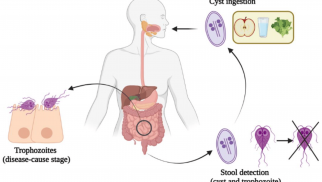
🔬 Giardia duodenalis (also called Giardia lamblia or Giardia intestinalis) is a single-cell parasite with two forms. The active form, the trophozoite, clings to the lining of the small intestine with a sucking disc and interferes with the absorption of fat and sugars. The resting form, the cyst, leaves the body in stool. Cysts are tough: they survive for weeks to months in cold water and resist ordinary levels of chlorine in tap water, which is why outbreaks are linked to streams, lakes, poorly run water systems and swimming areas.
📌 Only a handful of cysts is needed to start an infection, so a single swallow of contaminated water, a drink with ice in a place with unsafe supply, or a snack eaten with unwashed hands after changing a nappy can be enough. Many infected people never feel ill at all but still pass cysts, which explains how the parasite moves silently through households, childcare groups and camping parties.
🗺️ Where travelers and hikers pick it up
🌍 Giardia exists on every continent, including rich countries with clean city water. Travelers to South and Southeast Asia, parts of Africa, Latin America and Eastern Europe are at higher risk, especially on longer stays, trekking routes and trips with young children. In North America and Europe, the classic setting is the backcountry: a clear mountain stream that looks clean but runs through land grazed by cattle or sheep, or past a beaver dam upstream.
⏱️ Onset: the clue most people miss
Food toxins: vomiting soon after a meal
Norovirus, many bacteria
Cryptosporidium, Cyclospora
Giardia, typical peak 7 to 14 days
Amoebic infection, some worms
🤔 The long gap is also why people blame the wrong meal. If the diarrhea began a week or more after coming home, the takeaway from yesterday is an unlikely culprit; the water on the trip is a far better suspect. Writing down the dates of travel, any untreated water, swims and the first loose stool helps the doctor choose the right test the first time.
🔬 Giardia or ordinary traveler diarrhea?
💡 The two can also follow each other: a short bacterial illness in week one, then Giardia in week three. When diarrhea comes back after a quiet spell, or never fully settles after a course of antibiotics, a parasite should be on the list. 📖 For general advice on sudden loose stools at home, see acute diarrhea: when the digestive system needs fast support.
💩 Symptoms that point to Giardia
🥛 Because the parasite damages the surface of the small intestine, many people notice that milk, ice cream and fatty meals make everything worse. This temporary lactose intolerance can last weeks after the parasite has gone. Symptoms can come and go in waves, with a few normal days followed by another week of loose, foul stools, which tempts people to think it has cleared when it has not.
🧭 Other causes of diarrhea after a trip
| 🔎 Cause | 📋 Typical clues | 🧪 How it is found |
|---|---|---|
| Bacterial E. coli | Watery, sudden, during the trip, short | Often no test needed; PCR panel if severe |
| Campylobacter, Shigella, Salmonella | Fever, cramps, blood or mucus | Stool culture or PCR |
| Norovirus | Vomiting first, many people ill at once, 1 to 3 days | Usually clinical; PCR in outbreaks |
| Cryptosporidium | Watery diarrhea after swimming or farms, 1 to 2 weeks | Specific antigen or PCR test |
| Amoebic dysentery | Blood, gradual onset, sometimes liver pain | Stool PCR or antigen, blood tests |
| C. difficile | Diarrhea after an antibiotic taken on the trip | Stool toxin test |
| Post-infection IBS | Loose stools for months after any gut infection, tests negative | Diagnosis after ruling out parasites |
📖 Cryptosporidium is the parasite most often mixed up with Giardia, because both come from water and both start after a delay; see Cryptosporidium diarrhea after swimming. Bloody diarrhea after travel to tropical countries needs a different work-up, described in metronidazole for amoebiasis.
🧪 Which stool test to ask for
| 🧪 Test | ✅ Strengths | ⚠️ Limits |
|---|---|---|
| Giardia antigen test | Sensitive, quick, one sample often enough | Looks only for Giardia (or Giardia plus Cryptosporidium) |
| Multiplex PCR panel | Checks bacteria, viruses and parasites at once | Not offered everywhere; can detect harmless traces |
| Microscopy for ova and parasites | Finds Giardia and many other parasites and worms | Cysts are shed on and off; up to 3 samples on different days |
| Blood tests | Show dehydration, salt loss, anaemia | Do not diagnose Giardia |
💡 The main practical point: a single negative microscopy sample does not rule Giardia out, because cysts appear in the stool on some days and not others. If symptoms fit and the first test is negative, ask whether an antigen or PCR test, or two more samples, can be done. Endoscopy is rarely needed and is kept for long-lasting cases where tests stay negative.
📋 What to tell the doctor
💊 Treatment options for Giardia
🧪 Some healthy adults clear Giardia without medicine, but it may take weeks and they keep passing cysts in the meantime. Most doctors treat a confirmed infection that causes symptoms, because treatment shortens the illness, limits weight loss and protects the household. The main medicines kill the active form of the parasite in the gut.
📌 The choice depends on the person, the other infections that are possible after the trip, and what is available. Nitazoxanide is often chosen when Giardia and Cryptosporidium have not yet been told apart, because it acts on both, while metronidazole does not reliably treat Cryptosporidium.
🟢 Nitazoxanide: how the 3-day course is taken
🍽️ For adults and children aged 12 and over, the usual dose is 500 mg twice a day, about 12 hours apart, with food, for 3 days. Food matters: it improves absorption noticeably. Younger children receive smaller weight- and age-based doses of the liquid, prescribed by a doctor. Diarrhea usually starts to ease within a few days of starting, though bloating and tiredness can take longer to fade.
📋 How it is commonly used
💊 500 mg twice daily with meals
⏱️ 3 days, all six doses
🍷 No known reaction with alcohol, though rest from alcohol helps the gut heal
📊 What to expect
✅ Common: mild belly pain, headache, nausea
✅ Harmless: urine may turn bright yellow or greenish
➖ Less common: diarrhea briefly worse, rash
⚠️ Take care: warfarin users need closer monitoring
💡 Nitazoxanide is generally well tolerated, which is one reason many travelers prefer it. Missing a dose is not a disaster, but finishing the full course matters, since stopping as soon as stools firm up gives surviving parasites a chance to return. People with serious liver or kidney disease should check the dose with a doctor first.
🔵 Metronidazole and tinidazole
💊 Metronidazole has been used for Giardia for decades. A common adult schedule is 250 mg three times a day for 5 to 7 days, and some guidelines use other schedules of similar strength. It often leaves a metallic taste and can cause nausea, so taking it with food helps. Tinidazole, a close relative, is given as a single 2 g dose in adults, which is attractive for people who struggle with a week of tablets.
📖 For metronidazole dosing in other infections and its side effects in more detail, the Flagyl (Metronidazole) page and our article on metronidazole for amoebiasis are useful. The alcohol rule is the one people break most often on holiday, and the result can be flushing, vomiting and a racing heart.
⚖️ Choosing a medicine after travel
| 🧳 Situation | ✅ Often chosen | 📝 Why |
|---|---|---|
| Giardia confirmed, healthy adult | Nitazoxanide, tinidazole or metronidazole | All work; choice by side effects and access |
| Watery diarrhea after swimming, parasite not yet named | Nitazoxanide | Covers Giardia and Cryptosporidium |
| Wants to drink alcohol soon, or had a reaction before | Nitazoxanide | No alcohol reaction |
| Giardia plus worms found on microscopy | Albendazole, sometimes with another drug | Treats both, though less reliable for Giardia alone |
| First course failed | A drug from a different class, or a combination | Resistance and reinfection are both possible |
| Pregnancy | Doctor decides; sometimes waiting or paromomycin | Several drugs are avoided in the first trimester |
💡 When the first course does not work, doctors first check whether the infection came back from the household or a pet, then whether the diagnosis was right, before switching drugs. Treatment failure with metronidazole has been reported more often in travelers returning from Asia.
🚫 Why the traveler diarrhea antibiotic may not help
💊 Many travelers carry a standby antibiotic for sudden diarrhea on the road. These medicines target bacteria. Rifaximin, azithromycin and ciprofloxacin do not reliably kill Giardia, so if the real cause is the parasite, symptoms simply continue after the course. That is one of the most common stories behind a late Giardia diagnosis.
For watery bacterial traveler diarrhea without fever or blood; stays in the gut. Rixmin (Rifaximin)
Often preferred for fever, blood or travel in South and Southeast Asia. Zithromax (Azithromycin)
Used less now because of resistance and tendon and nerve warnings. Cipro (Ciprofloxacin)
📌 Most mild traveler diarrhea does not need an antibiotic at all; fluids and time are enough. Antibiotics are kept for moderate to severe cases, and taking them freely raises the risk of resistant bacteria and of C. difficile. 📖 Rifaximin has other uses in the gut, explained in rifaximin for IBS-D and SIBO.
💧 Rehydration comes first
🥤 Whatever the cause, the real danger of diarrhea is loss of water and salts. Oral rehydration solution, with the right mix of salt and sugar, is absorbed better than plain water, and pharmacy sachets are light enough to carry on any trip. Sip small amounts often, especially if there is nausea. Broth, diluted juice and salty crackers help once the stomach settles.
🛑 Loperamide and anti-sickness tablets: when they are fine
⏸️ Loperamide slows the gut and can make a long bus ride or flight possible. It is reasonable for watery diarrhea without fever or blood, at the dose on the pack, and is often combined with an antibiotic for bacterial traveler diarrhea. It does not treat Giardia; it only reduces the number of trips to the toilet. If loose stools continue for more than two days on loperamide, or fever, blood or severe pain appear, stop it and get checked. Options include Imodium (Loperamide).
🤢 When nausea makes drinking hard, an anti-sickness tablet can help fluids stay down. Ondansetron is widely used for this, usually as short-term treatment, for example Zofran (Ondansetron). It can cause constipation and headache, and people with heart rhythm problems or on several heart medicines should ask a doctor first.
📆 Recovery week by week
📖 If the bowel stays unsettled long after the parasite has gone and tests are clear, the problem may be post-infection IBS, discussed in IBS with diarrhea: what helps and what is often missed. Cutting down on milk products for a few weeks is a simple step that eases many lingering symptoms.
🏠 Not passing it on at home, work and the pool
🧼 Cysts are passed in stool even after the diarrhea stops, and they survive on surfaces. Careful handwashing with soap and water is the single most effective way to protect the household; alcohol gels work poorly against Giardia cysts. Clean the toilet seat, flush handle, taps and door handles often, use separate towels, and wash bedding and towels on a hot cycle.
Many health agencies advise waiting 1 to 2 weeks after diarrhea stops
Usually off work until 48 hours free of diarrhea; local rules may ask for more
Children stay home until 48 hours free of diarrhea
Avoid oral-anal contact for several weeks after recovery
🐶 Dogs and cats can carry Giardia too, though the types found in pets usually differ from the ones that infect people. If a pet has diarrhea at the same time, ask a vet to test it, pick up droppings promptly and wash hands after cleaning litter or walking the dog. Testing family members without symptoms is not usually needed unless the infection keeps coming back.
🚰 Making water safe: the four methods
| 💧 Method | 🦠 Giardia | 🦠 Cryptosporidium | 📝 Notes |
|---|---|---|---|
| Boiling | Very effective | Very effective | Rolling boil 1 minute; 3 minutes above about 2000 m |
| Filter, 1 micron or smaller | Very effective | Very effective | Most filters do not remove viruses |
| Chlorine or iodine tablets | Moderate, needs long contact time | Poor | Weaker in cold or cloudy water |
| Chlorine dioxide | Effective | Effective with long contact, often 4 hours | Follow the pack timing exactly |
| UV light pen | Effective in clear water | Effective in clear water | Needs batteries; filter cloudy water first |
🔥 Boiling remains the gold standard because it kills everything that matters, from parasites to bacteria and viruses. A full rolling boil for one minute is enough at normal altitudes; there is no need to boil for ten or twenty minutes, which only wastes fuel. Let the water cool in a covered pot to keep it clean.
🔍 Filters, tablets and UV in practice
📦 Giardia cysts measure roughly 8 to 12 micrometres, so a filter with an absolute pore size of 1 micron or smaller removes them. Look for words like “absolute 1 micron” or “tested to remove protozoan cysts” on the pack; “nominal” ratings are weaker. Filters that also kill viruses usually add a chemical stage or a much finer membrane, which matters on trips abroad where human sewage, not just animals, may reach the water.
🧪 Chemical tablets are light and cheap, but cold water slows them down and cloudy water uses them up. Let silty water settle or pour it through a clean cloth first, double the waiting time in icy mountain water, and keep the treated water away from the untreated bottle and its lid. UV pens work in seconds but only in clear water and only if the batteries are charged.
🧼 Hands matter as much as water
👟 Studies of backcountry hikers suggest that a lot of trail diarrhea comes from hands, shared snacks and shared cups, not only from the stream. On a long trip, people dig toilets, handle dirty gear and pass bags of trail mix around the group with no soap in sight. A single infected person can then spread it to everyone.
🌍 On trips abroad the same rule applies to street food and buffet meals. “Boil it, cook it, peel it or forget it” is still a useful guide: hot food served steaming, fruit you peel yourself, sealed bottled drinks, and no ice unless you know it was made from safe water. Brushing teeth with bottled or treated water is a small extra step that many people skip.
🎒 What to pack for the next trip
🧭 For remote expeditions far from medical care, some doctors prescribe a standby course for suspected Giardia, such as nitazoxanide or a nitroimidazole, to start only if typical symptoms appear and last several days. This should be a planned decision with clear rules, not a guess on the trail, and a stool test is still worth doing on return if symptoms continue.
🤰 Pregnancy, children and older travelers
👶 Pregnancy changes the medicine choice. Metronidazole and tinidazole are usually avoided in the first trimester, and albendazole is avoided in pregnancy, so doctors may treat with paromomycin, wait for mild cases to clear, or use a drug later in pregnancy when the balance of benefit and risk is clearer. Nitazoxanide has limited pregnancy data and is used only when a doctor decides the benefit is greater. Dehydration is the bigger danger in pregnancy, so fluids come first.
📌 Breastfeeding mothers can usually continue to feed during treatment, but the medicine and its timing should be checked with a doctor or pharmacist, since metronidazole passes into milk in larger amounts than some alternatives.
🗿 Myths about Giardia and outdoor water
🌳 A simple path after you get home
📖 If worms are found on the same stool test, the overview of intestinal parasites and their treatment explains the options. Mixed infections are not rare after long trips, and the treatment plan then has to cover each parasite.
🚨 When to see a doctor
⛔ Get medical help promptly if:
🔹 There is blood in the stool, black stools, or a fever above 38.5 °C.
🔹 You feel dizzy, pass very little urine, or cannot keep fluids down.
🔹 Diarrhea lasts more than 7 days, or keeps coming back in waves after a trip.
🔹 You are pregnant, over 65, have a weak immune system, or a child under 2 has diarrhea.
🔹 There is severe belly pain, yellow skin, or pain under the right ribs after tropical travel.
🔹 You are losing weight without trying weeks after coming home.
💡 Severe dehydration, confusion or fainting need emergency care. For milder symptoms, a stool test before any medicine gives the clearest answer and avoids a wasted course of the wrong drug.
❓ Frequently asked questions
How long after drinking stream water does Giardia start?
Usually 7 to 14 days after exposure, with a range of about 3 days to 3 weeks. Symptoms often begin after the trip is over.
How can I tell Giardia from traveler diarrhea?
Bacterial traveler diarrhea starts during the trip and lasts a few days. Giardia starts later and causes greasy, foul stools, bloating and sulfur burps that can last weeks.
Which test shows Giardia?
A stool antigen test or a PCR panel is the most reliable. Microscopy can miss it, so up to three samples may be needed.
How is nitazoxanide taken for Giardia?
Adults and children over 12 usually take 500 mg twice a day with food for 3 days. Younger children receive a smaller liquid dose prescribed by a doctor.
Will my travel antibiotic treat Giardia?
Usually not. Rifaximin, azithromycin and ciprofloxacin target bacteria and do not reliably kill Giardia.
Can I drink alcohol while treating Giardia?
Not with metronidazole or tinidazole, or for 2 to 3 days after them. Nitazoxanide has no known alcohol reaction, but resting the gut helps recovery.
Does boiling water kill Giardia?
Yes. A rolling boil for 1 minute is enough, or 3 minutes above about 2000 metres.
Do water filters remove Giardia?
Filters with an absolute pore size of 1 micron or smaller remove Giardia cysts. Most do not remove viruses unless they have an extra stage.
How long am I contagious with Giardia?
Cysts can be passed for weeks, even after diarrhea stops. Wash hands with soap, stay off work or childcare until 48 hours free of diarrhea, and avoid swimming for 1 to 2 weeks.
Why do I still feel bloated after Giardia treatment?
The gut lining needs weeks to heal, and temporary lactose intolerance is common. If symptoms last beyond a few weeks, a repeat stool test is advised.
📑 Sources and editorial
- 📘 Public health guidance on giardiasis, recreational water and return to work or childcare
- 🌍 Travel medicine guidelines on traveler diarrhea, standby antibiotics and loperamide
- 💊 Prescribing information for nitazoxanide, metronidazole, tinidazole and albendazole
- 🧪 Laboratory reviews comparing stool microscopy, antigen tests and PCR panels for intestinal parasites
- 🚰 Guidance on household and backcountry drinking water treatment: boiling, filtration, chemical and UV methods
- 🔬 Studies of diarrhea in wilderness hikers and the role of hand hygiene
- 📖 Related reading: giardiasis treatment and lingering symptoms, Cryptosporidium after swimming, acute diarrhea, intestinal parasites, IBS with diarrhea
- 🛒 Related products: Nizonide (Nitazoxanide), Flagyl (Metronidazole), Albenza (Albendazole), Rixmin (Rifaximin), Zithromax (Azithromycin), Imodium (Loperamide)
- 🩺 RXshop Editorial Team — reviewed by Emily Chen, MD — Internal Medicine
Medical Disclaimer: The information in this article is for educational and informational purposes only and is not a substitute for professional medical advice, diagnosis, or treatment. Always seek guidance from a qualified healthcare provider with any questions you may have regarding a medical condition, and before starting, stopping or changing any medication.