Telogen Effluvium: Sudden Hair Shedding After Illness, Childbirth or Diets, the Tests to Ask For and How Long It Lasts

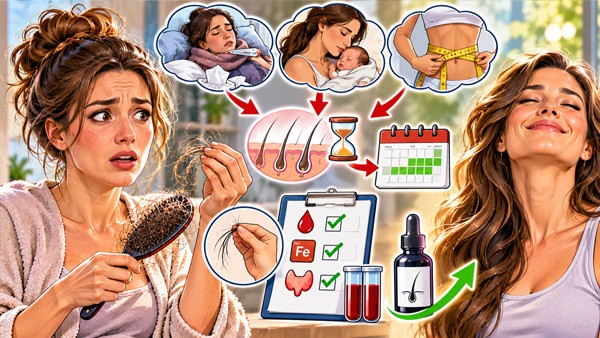

🚿 It usually starts in the shower. The drain fills with hair, the brush looks fuller than the head, and a ponytail feels thinner within weeks. Sudden, even shedding from the whole scalp is most often telogen effluvium, a temporary reaction of the hair cycle to a shock the body went through two or three months earlier. 🔍 Because of that delay, most people blame the wrong thing: a new shampoo, the season, or a recent stress, while the real trigger was a fever, a birth, an operation, a strict diet or a change of tablets weeks before. This guide explains how telogen effluvium works, which triggers matter, how a doctor confirms it with a simple pull test and a few blood tests, how long the shedding lasts, when it turns chronic, and where minoxidil fits in.
🌀 What telogen effluvium is
🔬 Every hair on the scalp lives through its own cycle. The growth phase (anagen) lasts several years, a short transition phase follows, and then the hair rests for about three months (telogen) before it falls out and a new hair starts in the same follicle. On a healthy scalp around 85 to 90 percent of hairs are growing and only about 10 to 15 percent are resting at any moment. In telogen effluvium a stress on the body pushes a large group of growing hairs into the resting phase at the same time. Nothing happens for weeks, and then all of those hairs reach the end of their rest together and fall. The follicle itself is not damaged, which is the single most reassuring fact about this condition: it is a timing problem, not a destruction of hair roots.
⏳ Why the shedding starts months after the cause
📅 The resting phase lasts roughly three months, so hair that was switched off by a fever in January usually falls out in March or April. By then the fever is forgotten, the person feels well, and the sudden fall seems to come from nowhere. This lag is the key to the whole diagnosis. When a doctor asks about the last six months rather than the last two weeks, the trigger is usually found within a few minutes.
🔥 Fever, infections and COVID
🌡️ A high fever is one of the most common triggers. Flu, pneumonia, a kidney infection, dengue, a bad gastric infection or any illness with several days of high temperature can do it. After the COVID pandemic, doctors saw a large wave of people with shedding two to three months after the infection, often after a fairly mild illness. The pattern was classic telogen effluvium and in most cases it settled without treatment within months. The severity of the shedding does not always match the severity of the illness: some people with a short, high fever shed more than people who spent a week in bed with a low temperature.
👶 Shedding after childbirth
🤰 During pregnancy high hormone levels keep more hairs in the growth phase, so many women have unusually thick hair by the third trimester. After the birth those extra hairs enter the resting phase together, and shedding typically begins two to four months later. Postpartum shedding usually eases by the time the baby is six to nine months old, and for most women the hair is back to its usual density around the first birthday. If shedding continues well beyond that, iron levels and the thyroid should be checked, because both are often disturbed after pregnancy.
🩺 Surgery, injuries and emotional shocks
🏥 A major operation combines anaesthesia, blood loss, pain, poor appetite and sometimes infection. Shedding three months after surgery is so common that many surgeons now warn patients about it in advance. The same applies to serious accidents, burns and severe blood loss. Intense emotional stress, such as a bereavement, a divorce or a period of extreme work pressure, can also trigger telogen effluvium, although it is diagnosed more often than it truly happens.
🥗 Crash diets, low protein and fast weight loss
⚖️ Hair is one of the fastest growing tissues in the body, and it is one of the first things the body sacrifices when energy or protein is short. Very low calorie diets, long fasts, eating disorders and rapid weight loss after bariatric surgery are well known causes of shedding. It usually appears two to four months after the weight starts to fall. A steady loss of about half a kilo to one kilo a week, with enough protein at every meal, is much kinder to the hair than a rapid drop.
🩸 Iron deficiency and ferritin
🧪 Low iron stores are the most common treatable finding in women with diffuse shedding. Heavy periods, pregnancy, blood donation, vegetarian diets and stomach or bowel problems all drain iron. Ferritin, the protein that stores iron, can be low long before haemoglobin falls and anaemia appears, so a normal blood count alone does not rule it out. Laboratory reference ranges often call ferritin normal down to about 15 to 30 ng/mL, while many hair specialists prefer to see it above about 40 ng/mL in someone who is shedding. Iron tablets should be taken as advised by a doctor, since too much iron is harmful and a cause for the low level, such as heavy bleeding, needs to be found.
🦋 Thyroid problems
💡 Both an underactive and an overactive thyroid can cause diffuse shedding. Hair usually recovers once thyroid levels have been back in the normal range for a few months, though the delay in the hair cycle means improvement lags behind the blood tests. Hypothyroidism is treated with levothyroxine, available as Synthroid (Levothyroxine), Eltroxin (Levothyroxine) or Thyronorm (Levothyroxine), taken on an empty stomach 30 to 60 minutes before breakfast and at least four hours apart from iron or calcium. In the first months of levothyroxine, or when the dose is too high, shedding can actually increase. A TSH check after six to eight weeks keeps the dose on target. 📖 For the symptoms and treatment of a slow thyroid see understanding hypothyroidism, and for an overactive gland see Graves disease explained.
💊 Medicines that can start or stop a shedding phase
📋 Many medicines can trigger telogen effluvium, usually two to four months after they are started or after the dose changes. The usual sign is a clear link in time: a new tablet, then shedding about three months later. Never stop a prescribed medicine on your own because of hair; for heart, blood pressure, seizure or mood medicines this can be dangerous.
| 💊 Medicine group | 📝 Examples | 📋 Notes |
|---|---|---|
| Retinoids and vitamin A | Isotretinoin, acitretin, high-dose vitamin A supplements | Dose related, settles after the course |
| Beta blockers | Propranolol, metoprolol | Uncommon; an alternative is usually possible |
| Blood thinners | Heparin, warfarin | Shedding often starts some months after starting |
| Seizure and mood medicines | Valproate, lithium | Never stop without medical advice |
| Thyroid medicines | Levothyroxine early on or overdosed, antithyroid tablets | Check TSH and the dose |
| Hormones | Stopping the combined pill, some progestin-only methods, testosterone | See the next section |
| Hair treatments | Starting minoxidil | Brief early shedding, a sign the cycle is restarting |
💊 Starting or stopping the pill and other hormones
🔄 Estrogen keeps hairs in the growth phase, a little like a mini pregnancy. Stopping a combined contraceptive pill can therefore cause shedding two to three months later, much like a small postpartum effluvium. Switching to a pill or implant with a more androgenic progestin can do the same in women who are sensitive. Shedding after stopping the pill usually settles within six months. 📖 Other changes after stopping the pill are covered in what happens if you stop taking birth control pills.
📋 The main triggers at a glance
🔍 How it differs from other types of hair loss
🧭 Telogen effluvium thins the whole scalp evenly, often slightly more at the temples, and the scalp itself looks healthy. Pattern hair loss, by contrast, is slow, follows a set shape and shows hairs of many different thicknesses, while alopecia areata leaves smooth round patches. Telling these apart matters, because the treatments are different.
| 🔎 Feature | 🚿 Telogen effluvium | 🧬 Pattern hair loss | ⚪ Alopecia areata |
|---|---|---|---|
| Onset | Sudden, over weeks | Slow, over years | Sudden patches |
| Where | Whole scalp | Crown, temples or parting | Round smooth areas |
| Hair in the drain | A lot, full length with a white bulb | Little extra, finer hairs | Clumps from one area |
| Pull test | Often positive all over | Usually negative | Positive at the edge of a patch |
| Outlook | Usually recovers alone | Progresses without treatment | Often regrows, may return |
📖 If the picture fits pattern loss rather than shedding, read androgenic alopecia in men, female pattern hair loss or receding hairline: mature hairline or balding.
✋ The pull test and simple checks at home
🧑⚕️ The pull test is the first thing a doctor does. About 50 to 60 hairs are held between thumb and fingers close to the scalp and pulled gently but firmly along their length. Normally only one or two come out. If more than about five or six hairs come away, the test is positive and shows active shedding. It is repeated in several areas: in telogen effluvium it tends to be positive all over the scalp, in pattern loss it is usually negative. Shed hairs can also be looked at closely: a resting hair has a small white bulb at the root and is full length, while a broken hair has no bulb and a ragged end.
🧪 Blood tests to ask for
🩺 There is no single blood test for telogen effluvium. The tests look for causes that keep the shedding going and can be corrected. A sensible first set is short, and further tests are added only when the history points to them.
📈 Reading the results
📑 Results need to be read against your symptoms, not just the printed range. A result inside the laboratory range can still be suboptimal for hair, and a slightly abnormal result is not always the cause.
📅 How long acute shedding lasts
⏱️ Once the trigger has passed, shedding usually continues for about three to six months and then slows down. Meanwhile new hairs are already growing from the same follicles. They appear as short, fine hairs standing up along the hairline and the parting, and are a reliable sign of recovery. Because hair grows only about one centimetre a month, it takes a year or more before the new hair is long enough to restore the old volume, especially in people with long hair.
Fever, birth, surgery or diet
Shedding begins
Peak, then slowing
Short regrowth visible
Volume close to normal
🔁 When shedding becomes chronic
📆 When increased shedding lasts more than six months, doctors call it chronic telogen effluvium. Often the reason is a trigger that never stopped: low iron, an untreated thyroid problem, a medicine, an ongoing diet or a chronic illness. In a separate group, mostly women between about 30 and 60, shedding comes and goes for years without a clear cause. These women typically had thick hair before, notice that their ponytail has become thinner and that the temples look slightly recessed, but the parting stays narrow and the scalp is not visible on top.
🎭 Shedding that unmasks hidden pattern loss
🧩 Sometimes a bout of telogen effluvium reveals a pattern hair loss that was already developing quietly. The shedding settles, but the hair does not fully return, because the follicles on top were already shrinking. A dermatologist can see this with a dermatoscope, which shows variation in hair thickness. This is the situation where treatment matters most, since pattern hair loss progresses without it.
💧 Does minoxidil help telogen effluvium?
🤔 For a single, acute episode with a clear trigger, minoxidil is usually not needed. The hair will come back on its own once the cause is gone, and minoxidil cannot stop hairs that are already in the resting phase from falling. It can make sense in three situations: chronic telogen effluvium that has lasted many months, shedding that has unmasked pattern hair loss, and people who want to speed up regrowth and accept daily use. It also has a well known early shedding phase of its own in the first one to two months, which can be alarming in someone who is already losing hair. 📖 Forms, doses and how to apply it are explained in minoxidil for hair loss: liquid, foam or tablets.
🧴 Minoxidil options for diffuse thinning
💊 Topical minoxidil is applied once or twice daily to a dry scalp and must be used continuously; stopping it returns the hair to where it would have been without treatment within a few months. Low-dose tablets are prescribed off-label by some specialists for chronic shedding when the solution irritates the scalp or is too hard to use every day. Tablets need medical supervision, since minoxidil was first a blood pressure medicine, and they are not suitable in pregnancy, breastfeeding or with some heart conditions.
⚠️ Side effects to know about with minoxidil:
🔹 Scalp itching, dryness or flaking, more often with solutions that contain propylene glycol.
🔹 Unwanted hair on the forehead or face, more common with tablets.
🔹 With tablets: ankle swelling, a fast heartbeat or dizziness, which need a doctor review.
👨 Finasteride: only when pattern loss is part of the picture
🚫 Finasteride blocks the conversion of testosterone to DHT, the hormone behind male pattern baldness. It has no effect on pure telogen effluvium, because the shedding there is not driven by DHT. It becomes relevant only when a man with shedding also has pattern thinning at the crown or temples. Options include Healpecia (Finasteride) and Propecia (Finasteride) at 1 mg a day. It is not for women who are or may become pregnant. 📖 The real rates of side effects are covered in finasteride side effects and what happens if you stop.
🗿 Myths about sudden hair shedding
💆 Caring for your hair during a shedding phase
🧴 The hair that is falling is already loose, so no shampoo or conditioner will keep it on the head. The aim during this period is to protect the hair that stays and to avoid adding breakage on top of shedding. Wash as often as you normally would, use a conditioner so that combing pulls less, and dry the hair gently. Loose styles are better than tight ponytails and braids, which can cause a separate type of loss at the hairline called traction alopecia.
🚨 When to see a doctor
⛔ Get medical advice promptly if:
🔹 Hair falls out in round patches, or eyebrows and eyelashes are also falling.
🔹 The scalp is red, scaly, painful, itchy or has pustules or scarring.
🔹 Shedding comes with weight loss, fever, night sweats, rashes, joint pain or very heavy periods.
🔹 You feel exhausted, short of breath, cold or have a fast pulse and tremor.
🔹 Shedding has lasted more than six months, or you are losing hair after starting a new medicine.
❓ Frequently asked questions
What is telogen effluvium?
It is a temporary, diffuse shedding of scalp hair that starts when a shock to the body pushes many growing hairs into the resting phase at once. The follicles are not damaged.
Why does hair fall out months after an illness?
Hairs pushed into the resting phase stay in place for about three months before they fall, so shedding usually starts two to three months after the trigger.
How long does telogen effluvium last?
Acute shedding usually lasts three to six months after the trigger has passed. Volume returns over 12 to 18 months as the new hair grows longer.
Can COVID cause hair loss?
Yes. Many people noticed shedding two to three months after COVID, usually telogen effluvium that settled without treatment within months.
Which blood tests should I ask for?
A full blood count, ferritin with iron studies, TSH, vitamin D, B12 and folate are a sensible start. Other tests are added depending on symptoms.
What is a positive hair pull test?
When a doctor gently pulls about 50 to 60 hairs, more than five or six coming out suggests active shedding.
Does minoxidil help telogen effluvium?
A single acute episode usually recovers without it. Minoxidil can help chronic shedding or shedding that has revealed pattern hair loss, and may speed regrowth.
Can stopping the pill cause hair shedding?
Yes. Stopping a combined pill can trigger shedding two to three months later, which usually settles within about six months.
When does telogen effluvium become chronic?
When shedding lasts more than six months. Often a trigger such as low iron, thyroid disease or a medicine is still active, but sometimes no cause is found.
Can telogen effluvium make me bald?
No. It thins the hair evenly but does not destroy follicles. If hair does not recover, a doctor should check for pattern hair loss.
📑 Sources and editorial
- 📘 Dermatology textbooks and reviews on the hair cycle, telogen effluvium and chronic telogen effluvium
- 🔬 Clinical studies of hair shedding after fever, COVID infection, childbirth and surgery
- 🩸 Reviews on iron deficiency, ferritin and diffuse hair loss in women
- 🦋 Endocrinology guidance on thyroid disease and levothyroxine treatment
- 💊 Prescribing information for minoxidil, finasteride, levothyroxine and medicines linked to hair shedding
- 📖 Related reading: minoxidil liquid, foam or tablets, female pattern hair loss, androgenic alopecia in men, understanding hypothyroidism
- 🛒 Related products: Morr (Minoxidil), Minoxiboon (Minoxidil), Lonitab (Minoxidil), Synthroid (Levothyroxine), Healpecia (Finasteride)
- 🩺 RXshop Editorial Team — reviewed by Emily Chen, MD — Internal Medicine
Medical Disclaimer: The information in this article is for educational and informational purposes only and is not a substitute for professional medical advice, diagnosis, or treatment. Always seek guidance from a qualified healthcare provider with any questions you may have regarding a medical condition, and before starting, stopping or changing any medication.