When Your Antidepressant Is Not Working: How Long to Wait, When to Switch or Add a Second Medicine, and What Comes Next

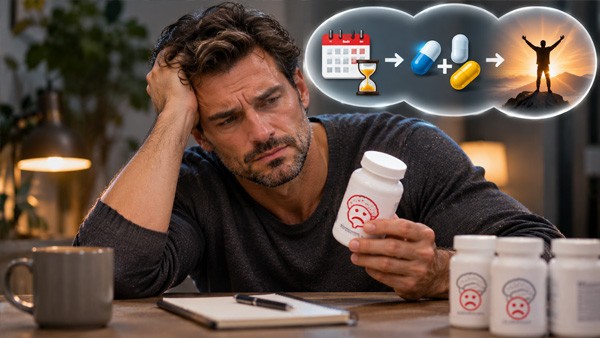

💊 Starting an antidepressant comes with a quiet hope that the first prescription will be the one that works. For roughly a third of people it is, and for many others it is not, at least not fully. 📉 That is not a personal failure and it does not mean depression cannot be treated. It means the plan needs adjusting: a higher dose, more time, a different medicine, a second medicine added, talking therapy alongside, or one of the newer treatments for depression that has resisted several attempts. 🧭 This guide explains how long to wait before judging a medicine, the common reasons an antidepressant seems not to work, how doctors decide between switching and adding, and what the evidence says about each next step.
⏳ How long to give an antidepressant
📅 Antidepressants are slow. Sleep and appetite may shift in the first week or two, but mood usually takes 4 to 6 weeks to lift clearly, and full benefit can take 8 to 12 weeks. 🔍 The early weeks still tell a lot: people who notice no improvement at all by weeks 2 to 4 on a proper dose are less likely to respond later on the same medicine. That is the point at which many doctors raise the dose or start planning a change, rather than waiting months.
🎯 Response, partial response and remission
📏 Doctors use three words that sound alike but lead to different decisions. Response means symptoms have fallen by at least half. Remission means symptoms are minimal and daily life feels close to normal. Partial response sits in between: clearly better, still not well. ⚠️ This matters because people who stop at partial response relapse much more often than those who reach remission, so “a bit better” is a reason to keep adjusting, not to settle.
🔎 Why an antidepressant may seem not to work
🧩 Before calling depression “resistant”, doctors look for reasons the medicine never had a fair chance. This is sometimes called pseudo-resistance, and it is common.
- 💊 Dose and time: many trials end at a starting dose after three or four weeks; a fair trial is usually a full dose for at least 4 to 6 weeks
- 📆 Missed or stopped tablets: a large share of people stop within the first three months, often because of side effects they did not mention
- 🔄 Hidden bipolar disorder: past periods of high energy and little need for sleep change the whole approach; see bipolar 2 or depression
- 🧪 Physical causes: an underactive thyroid, low vitamin B12 or iron, and sleep apnoea all keep mood low
- 🍷 Alcohol and drugs: regular drinking blunts antidepressant response and worsens sleep
- 🏠 An unchanged situation: medicine helps the brain recover, but it cannot remove an abusive relationship, debt or grinding isolation
📉 How often the first antidepressant works
📊 The largest real-world study of stepwise treatment followed several thousand people through up to four steps. About a third reached remission on the first medicine. Each later step helped a further group, though the chance per step fell.
🧱 What counts as treatment-resistant depression
📘 Treatment-resistant depression usually means depression that has not improved enough after at least two different antidepressants, each taken at an adequate dose for an adequate time and taken as prescribed. It affects roughly a quarter to a third of people with major depression. 💡 The label does not mean “untreatable”. It opens the door to treatments that are not usually offered first, such as specialist augmentation, esketamine, magnetic stimulation and electroconvulsive therapy.
🧭 The decision: raise the dose, switch, or add
🤔 When a medicine is not enough, there are three main moves. The choice depends mostly on how much it has helped so far and how well it is tolerated.
↳ Raise the dose if tolerated, check it is taken daily, wait 2 to 4 more weeks
↳ Next question: how much has it helped?
↳ Switch to a different antidepressant
↳ Add a second medicine or talking therapy
📈 Raising the dose first
💊 Many people never get past a starting dose. For Sertafine (Sertraline), that means 50 mg when the range goes up to 200 mg; for Lexapro (Escitalopram), 10 mg when 20 mg is possible. 📊 For SSRIs the extra benefit of higher doses is modest, while side effects can rise. For Effexor (Venlafaxine) and tricyclics, higher doses add a second mechanism and more often bring extra benefit. A dose rise is quick and simple, so it is usually tried before larger changes.
🔄 Switching to a different antidepressant
🔁 Switching makes sense when the first medicine did little or caused side effects that are not fading. Moving to another SSRI and moving to a different class give broadly similar results on average, so the choice is often guided by side effects, other symptoms and past experience.
🔀 How a switch is done safely
⚖️ Most switches use a cross-taper: the old medicine is lowered over one to two weeks while the new one is started at a low dose. Some switches between SSRIs can be direct. ⛔ A few need care: fluoxetine stays in the body for weeks, and MAO inhibitors need a gap of up to five weeks after fluoxetine and two weeks after most others, because combining them can cause serotonin syndrome. Switching from paroxetine or venlafaxine, which leave the body quickly, needs a slower taper to avoid discontinuation symptoms.
➕ Adding a second medicine
🧪 When the first antidepressant has clearly helped but not enough, adding a second medicine, called augmentation or combination, often works faster than starting again. The options differ in strength of evidence and side effects.
⚖️ Switching or adding: the trade-off
💊 Older medicines that still matter
🕰️ Tricyclic antidepressants such as Pamelor (Nortriptyline) and Anafranil (Clomipramine) are rarely first choice because of dry mouth, constipation, dizziness and danger in overdose. In severe or resistant depression, especially with marked physical slowing, they can work when newer drugs have not. Nortriptyline has a known blood level range, which helps get the dose right. An ECG is often checked first in people with heart problems. MAO inhibitors are also effective in resistant depression but need dietary rules and specialist supervision.
🗣️ Talking therapy alongside medicine
🤝 Adding cognitive behavioural therapy for people whose depression had not responded to medicine roughly doubled the chance of meaningful improvement at six months in one large trial, and the benefit held for years. Behavioural activation, which rebuilds routine and rewarding activity step by step, and interpersonal therapy are also effective. 💡 For people with childhood trauma or chronic depression lasting years, the combination of medicine and therapy works noticeably better than either alone.
🔬 Treatments for depression that has resisted several attempts
🏥 When two or more medicines and therapy have not been enough, specialist treatments come in. They are not last resorts in the sense of being desperate; several are among the most effective treatments in psychiatry.
🧬 Does a gene test pick the right antidepressant?
🧪 Pharmacogenetic tests look at liver enzymes, mainly CYP2D6 and CYP2C19, that break down many antidepressants. They can explain why someone has unusual side effects at low doses or no effect at normal doses, and they may help modestly in people who have failed several medicines. ⚠️ They do not predict which drug will lift mood, and most guidelines do not recommend them routinely. A careful history of what has and has not worked remains more useful.
📋 Matching the next medicine to the symptoms
| 🧠 Main remaining problem | 💊 Options often considered |
|---|---|
| 😴 Poor sleep, low appetite | Mirtazapine, or low-dose trazodone at night |
| 🔋 Fatigue, low drive | Bupropion, switch or add |
| 🔥 Chronic pain | Duloxetine, venlafaxine or a tricyclic |
| 😰 Strong anxiety | SSRI or SNRI at full dose; see anxiety medication compared |
| ❤️ Sexual side effects | Bupropion or mirtazapine instead of, or added to, an SSRI |
| 🚨 Suicidal thoughts that persist | Lithium add-on; urgent specialist review |
📝 Keeping track helps the decision
- 📊 A symptom score, such as the PHQ-9, every two to four weeks shows change more reliably than memory
- 📓 A medicine diary: name, dose, dates, how long, what helped, what side effects, why it stopped
- 😴 Sleep, energy and activity recorded briefly each day
- 🍷 Alcohol units per week, honestly
- 🗣️ The view of someone close: others often notice improvement before the person does
📖 More on scoring and on how long treatment should continue once it works: depression recovery: how long treatment should last.
📊 Who is more likely to have resistant depression
🗿 Common beliefs about antidepressants that do not work
| 💭 The belief | ✔️ What is actually the case |
|---|---|
| “If the first one failed, none will work.” | The second step brings remission to about a third of those who try it |
| “Two weeks is enough to know.” | Early signs show at 2 to 4 weeks, but full effect takes 6 to 12 |
| “Feeling a bit better is good enough.” | Partial response carries a much higher relapse risk than remission |
| “Needing two medicines means it is serious.” | Combinations are a routine, well-studied step |
| “ECT is a relic.” | Modern ECT under anaesthetic is the most effective treatment for severe depression |
📋 Levels of care as treatment goes on
🚨 When to get help urgently
⛔ Seek help the same day, or call emergency services.
🔹 Thoughts of suicide with a plan, or feeling unable to stay safe.
🔹 New agitation, restlessness or worsening after starting, raising or switching a medicine, especially under 25.
🔹 Fever, shaking, muscle jerks, confusion or severe diarrhoea during a switch (possible serotonin syndrome).
🔹 Racing thoughts, little need for sleep and unusual energy (possible switch into mania).
❓ Frequently asked questions
How long should I wait before deciding an antidepressant is not working?
Usually 4 to 6 weeks at a full dose. If there is no improvement at all by weeks 2 to 4, the dose is often raised or a change planned.
What is treatment-resistant depression?
Depression that has not improved enough after at least two different antidepressants, each taken at an adequate dose for an adequate time.
Is it better to switch or add a second antidepressant?
Switching suits little benefit or poor tolerance. Adding suits a clear partial benefit with good tolerance.
Can I switch antidepressants on my own?
No. Most switches need a planned cross-taper, and some combinations can cause serotonin syndrome or discontinuation symptoms.
Which medicines are added to an antidepressant?
Low-dose aripiprazole or quetiapine, lithium, bupropion, mirtazapine and, less often, thyroid hormone, chosen by symptoms and side effects.
Why does bupropion get added to SSRIs?
It can help low energy and poor concentration and may ease sexual side effects of SSRIs. It is avoided with seizures or eating disorders.
Does talking therapy help if medicine has not worked?
Yes. Adding CBT roughly doubled meaningful improvement in one large trial of people who had not responded to medicine.
What is esketamine and who gets it?
A nasal spray given in clinic alongside an antidepressant for resistant depression. It can act within hours to days.
Is ECT still used for depression?
Yes. Under brief anaesthetic it is the most effective treatment for severe or resistant depression, with mainly short-term memory effects.
Should I get a gene test to choose an antidepressant?
Not routinely. It can explain unusual side effects or lack of effect, but it does not predict which medicine will lift mood.
📑 Sources and editorial
- 📘 National and international guidelines on the treatment of depression and treatment-resistant depression
- 📊 The large stepwise treatment study of switching and augmentation strategies in major depression
- 💊 Meta-analyses of antidepressant dose response, switching within and between classes, and early improvement as a predictor
- 🧪 Trials and reviews of augmentation with second-generation antipsychotics, lithium, bupropion, mirtazapine and thyroid hormone
- 🗣️ Trials of cognitive behavioural therapy added to medicine in non-responding depression
- 🔬 Reviews of esketamine, repetitive transcranial magnetic stimulation and electroconvulsive therapy
- 🧬 Guidance on pharmacogenetic testing for antidepressants
- 📖 Related reading: antidepressant side effects and the first six weeks, major depressive disorder: diagnosis and treatment, bipolar 2 or depression, trazodone for sleep
- 🛒 Related products: Wellbutrin (Bupropion), Effexor (Venlafaxine), Lexapro (Escitalopram), Cymbalta (Duloxetine), Remeron (Mirtazapine), Lithobid (Lithium), Sertafine (Sertraline), Pamelor (Nortriptyline)
- 🩺 RXshop Editorial Team — reviewed by Thomas Walsh, MD — Psychiatrist
Medical Disclaimer: The information in this article is for educational and informational purposes only and is not a substitute for professional medical advice, diagnosis, or treatment. Always seek guidance from a qualified healthcare provider with any questions you may have regarding a medical condition, and before starting, stopping or changing any medication.