Dog, Cat and Human Bite Infections: Who Needs an Antibiotic, Why Augmentin Comes First and What to Take Instead

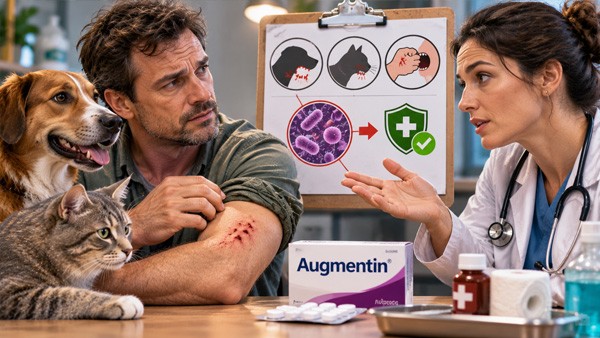

🐾 A bite from a cat, a dog or another person looks like a simple wound, and most people wash it, cover it and forget about it. Bites are different from ordinary cuts because the teeth push mouth bacteria deep under the skin, into a closed space where they multiply quickly. 🔍 A cat puncture on the hand can turn red, hot and painful within a day, and a cut over the knuckles from a punch can infect a joint. This guide explains which bites need an antibiotic and which do not, why amoxicillin with clavulanate (Augmentin) is the usual first choice, what to take if you are allergic to penicillin, which common antibiotics miss bite bacteria, and when tetanus and rabies questions come up.
🐾 Why a bite is not an ordinary cut
🩸 A kitchen knife cut is clean and open, so it drains and heals. A bite is the opposite. Teeth carry saliva full of bacteria and drive it into tissue, then the skin closes over the hole. Crushed tissue around a bite has a poor blood supply, which helps bacteria grow. 📖 For red, spreading skin that did not start with a bite, see cellulitis and skin infections: what needs an antibiotic. This article stays with bites, which follow their own rules.
🦠 What lives in an animal mouth
🔬 Bite infections are almost always mixed. They contain skin bacteria such as staphylococci and streptococci, plus mouth bacteria that rarely cause other skin infections. That second group is the reason bites need a different antibiotic from a boil or an infected scratch.
| 🦠 Bacteria | 🐾 Usual source | 📝 Why it matters |
|---|---|---|
| Pasteurella | Cats, dogs | Infection appears fast, often within a day; missed by several common skin antibiotics |
| Staphylococcus, Streptococcus | Skin of the person, animal mouth | Typical cause of later redness and pus |
| Anaerobes | All mouths | Thrive in deep, crushed, closed wounds; cause foul-smelling pus |
| Eikenella corrodens | Human mouth | Resistant to clindamycin and to first-generation cephalosporins |
| Capnocytophaga | Dogs, cats | Rare, but can cause severe blood infection in people without a spleen |
🐱 Cat bites: small holes, deep trouble
💉 Cat teeth are thin and sharp, like needles. They can reach a tendon sheath, a joint or the bone of the hand through a hole that looks like a pin prick. The surface seals within minutes, so people often do nothing until the finger swells the next day. Hand bites in particular can need surgery to clean a tendon sheath or joint.
🐶 Dog bites: crush more, infect less
🦴 Dog teeth are blunter and the jaw is strong, so dog bites tear and crush tissue more than they puncture it. The wound looks worse but is more open, so it drains better and infects less often than a cat bite. The risk rises when the bite is deep, crushed, on the hand or foot, close to a joint, or when the person waited many hours before cleaning it.
👊 Human bites and the fight bite
🦷 The human mouth carries a dense mix of bacteria, including Eikenella. The most dangerous human bite is not a bite at all: a cut over the knuckles from punching someone in the mouth, called a fight bite or clenched-fist injury. With the fist closed, a tooth can enter the knuckle joint. When the hand opens, the tendon slides back and covers the hole, trapping saliva inside the joint. These cuts look tiny and often return days later as a swollen, stiff hand.
👊 Any cut over a knuckle after a fight should be seen by a doctor the same day, however small it looks. It often needs an X-ray, exploration, washing out by a hand surgeon, and antibiotics that cover Eikenella, such as amoxicillin with clavulanate.
🚿 First aid in the first hour
🧴 Antiseptic such as povidone iodine can be used after washing. A topical antibiotic ointment does not reach bacteria pushed deep by a tooth, so it does not replace tablets in a high-risk bite. Ointments such as Bactroban (Mupirocin) are meant for small surface infections like impetigo, not for punctures.
🩺 What the doctor checks
📋 The doctor also asks about health conditions that raise the risk of a serious infection, current medicines, allergies, and how long ago the bite happened. A bite that is already infected when first seen is treated differently from a fresh, clean one: it may need a swab, drainage and a full treatment course.
🧵 Stitch it or leave it open?
✂️ Closing a wound traps whatever is inside. For this reason most bite wounds on the hands and feet, and most punctures, are left open to drain and heal from the bottom up. Clean, fresh dog bite tears on the face are an exception: the face has an excellent blood supply, scarring matters, and after careful washing they are often closed by a doctor.
Fresh, clean facial dog bites after washing
Large clean gaping tears on arms and legs
Punctures, hand and foot bites, cat and human bites, late or infected wounds
⚖️ Who needs a preventive antibiotic
🤔 Not every bite needs tablets. A shallow graze from a dog on the thigh of a healthy adult usually heals with washing alone. Reviews of the evidence show the clearest benefit of preventive antibiotics for bites on the hand and for human bites, while low-risk dog bites on the arms and legs gain less. Guidelines list situations where a short course is advised.
💊 Why Augmentin is the first choice
🛡️ Amoxicillin alone kills Pasteurella and streptococci, but many staphylococci and anaerobes make an enzyme called beta-lactamase that destroys it. Clavulanate blocks that enzyme, so the combination covers almost all the usual bite bacteria in one tablet: Pasteurella, Eikenella, streptococci, most staphylococci that are not MRSA, anaerobes and Capnocytophaga. That is why guidelines name amoxicillin with clavulanate as the first oral choice for both preventing and treating bite infections.
📋 Dose and length of the course
📆 The dose is set by the prescriber, based on weight, kidney function and how severe the wound is. For adults the common regimens are 875/125 mg twice a day or 500/125 mg three times a day. A preventive course usually lasts 3 to 5 days. An established infection of the skin is often treated for around 5 to 10 days, judged by how fast it settles, while infection of a joint, tendon sheath or bone needs specialist care and a much longer course.
🍽️ Taking it well, day to day
💧 Raise the bitten hand or leg above heart level for the first day or two. Elevation reduces swelling and pain and helps the antibiotic work.
⚠️ Side effects and who should not take it
📋 Most people finish a short course with no trouble. Diarrhoea is the most common side effect, and clavulanate is the part that causes most of it. Nausea, a mild rash and thrush in the mouth or vagina are also seen. Rarely, amoxicillin with clavulanate can inflame the liver and cause jaundice, sometimes weeks after the course, more often in older adults and after longer courses.
| 🚫 Situation | 📝 Why |
|---|---|
| Penicillin allergy | Same allergy group; risk of rash, hives or anaphylaxis |
| Past jaundice or liver problems on this drug | Can happen again and be more severe |
| Severe kidney disease | Dose must be reduced; the 875 mg tablet is not used at low kidney function |
| Glandular fever (infectious mononucleosis) | High chance of a widespread rash |
| Severe or bloody diarrhoea during or after | Possible C. difficile infection; needs a doctor |
🔀 Interactions worth knowing
🚫 Penicillin allergy: the alternatives
🧪 No single tablet replaces amoxicillin with clavulanate perfectly. With a true penicillin allergy, doctors usually combine one drug that covers Pasteurella and Eikenella with a second drug that covers anaerobes, or use one of the few single drugs that cover both.
💊 The anaerobe partner is usually Flagyl (Metronidazole) or Cleocin (Clindamycin). Neither of these two should be used alone for a bite, because both miss Pasteurella or Eikenella. For people with a mild, non-severe penicillin rash in the past, some doctors use a second-generation cephalosporin such as Ceftin (Cefuroxime) plus an anaerobe drug. Fluoroquinolones carry tendon and nerve warnings, so they are kept for cases where simpler options do not fit. 📖 If a past reaction involved swelling of the lips or throat, read allergic angioedema.
❌ Antibiotics that miss bite bacteria
🧫 Several antibiotics that work well for ordinary skin infections are poor choices for bites. Using them alone is one of the most common reasons a bite infection keeps spreading despite treatment.
⏱️ How infection shows up, hour by hour
📈 When the antibiotic does not seem to work
⏳ Redness often looks a little worse in the first 24 hours of treatment as the body reacts. After 48 hours there should be clear improvement in pain, swelling and fever. If not, the reason is usually one of a few: a pocket of pus that needs opening, a joint or tendon infection, a foreign body such as a broken tooth, the wrong antibiotic, or resistant bacteria such as MRSA.
💉 Tetanus after a bite
🧫 Tetanus bacteria live in soil and dirt, and bites count as tetanus-prone wounds. Adults who had a full childhood series need a booster after a dirty wound if the last dose was more than 5 years ago. People who never completed the primary series, or do not know, may also need tetanus immunoglobulin for a high-risk wound.
| 💉 Vaccine history | 🩹 Clean minor wound | 🐾 Bite or dirty wound |
|---|---|---|
| Full series, last dose under 5 years | Nothing needed | Nothing needed |
| Full series, last dose 5 to 10 years | Nothing needed | Booster |
| Full series, last dose over 10 years | Booster | Booster |
| Unknown or incomplete | Start or complete vaccination | Vaccination, and immunoglobulin may be added |
🦇 Rabies: when it is a real question
🌍 Rabies is almost always fatal once symptoms start, and it is completely preventable after exposure if treatment starts in time. The risk depends on the animal and the region: a vaccinated house cat in a country free of land rabies is very different from a stray dog in a region where dog rabies is common, or from any contact with a bat. Washing the wound with soap and water straight away lowers the risk by itself.
Wound care, first vaccine, immunoglobulin if indicated
Second dose
Third dose
Fourth dose; a fifth on day 28 if immunity is weak
🛡️ People at higher risk of a serious infection
🧭 Seek care early after any bite that breaks the skin if you have:
🔹 No spleen or a spleen that does not work: Capnocytophaga from a dog or cat can cause sepsis within a day or two.
🔹 Diabetes, especially with poor circulation or numb feet. See type 2 diabetes: when control starts to slip and diabetic neuropathy.
🔹 Liver cirrhosis or heavy alcohol use, which weakens defences against bite bacteria.
🔹 Medicines that suppress immunity, such as steroids, chemotherapy or transplant drugs. More in living on immunosuppressants.
🔹 An artificial joint or heart valve, or long-term swelling of the bitten limb.
👶 Children and pregnancy
🧒 Young children are bitten most often by dogs they know, and because of their height, bites to the face, head and neck are more common in children than in adults. Any facial bite in a child should be seen by a doctor. Amoxicillin with clavulanate is the usual choice in children too, given as a liquid with the dose based on body weight. Doxycycline is generally avoided in young children, and fluoroquinolones are kept for special cases.
🤰 In pregnancy, amoxicillin with clavulanate has long been used and is usually the preferred option when an antibiotic is needed. Doxycycline and fluoroquinolones are generally avoided in pregnancy, which makes the choice harder for a pregnant woman with a penicillin allergy; that is a decision for a doctor, not for self-treatment. Rabies vaccine and tetanus boosters are given in pregnancy when needed.
🐈 Cat scratch disease: a different problem
🐾 A scratch or bite from a young cat can transmit Bartonella henselae. Cat scratch disease does not look like a wound infection: a small bump appears at the scratch, then one to three weeks later a lymph node in the armpit, neck or groin swells and becomes tender, sometimes with fever and tiredness. Doctors may prescribe azithromycin, such as Zithromax (Azithromycin), for larger or painful nodes, and people with weak immunity need treatment because the infection can spread.
Hours to days; red, swollen, painful wound
1 to 3 weeks later; swollen lymph node, wound healed
🗿 Myths about bite wounds
🚨 When to see a doctor
⛔ Go to emergency care now if:
🔹 Redness is spreading fast, there are red streaks up the limb, or you have fever, chills or feel faint.
🔹 A finger or hand is swollen, painful to move, or held bent, or there is a cut over a knuckle after a fight.
🔹 The bite is deep, bleeding heavily, on the face or genitals, or you cannot feel or move part of the hand.
🔹 You have no spleen, liver disease or weak immunity and the bite broke the skin.
🔹 The bite came from a bat, a wild animal, or a stray or unknown animal where rabies is possible.
🔹 You get swelling of the lips, face or throat, or a widespread rash, after starting an antibiotic.
📖 Mouth bacteria also cause dental abscesses, which have their own rules on antibiotics and drainage: see tooth infection: what antibiotics can and cannot do.
❓ Frequently asked questions
Do I need antibiotics after a dog bite?
Not always. A shallow bite on an arm or leg in a healthy adult often heals with washing alone. Deep, crushed, hand, foot or face bites, and bites in people with weak immunity, usually get a 3 to 5 day course.
Why are cat bites more dangerous than dog bites?
Cat teeth make thin, deep punctures that seal over and trap bacteria near tendons and joints. Up to about half of untreated cat bites become infected.
Which antibiotic is best for an animal bite?
Amoxicillin with clavulanate, such as Augmentin, is the usual first choice because it covers Pasteurella, staphylococci, streptococci and anaerobes in one tablet.
How long should Augmentin be taken for a bite?
Usually 3 to 5 days to prevent infection after a high-risk bite, and around 5 to 10 days for an established skin infection, as decided by the doctor.
What can I take for a bite if I am allergic to penicillin?
Common options are doxycycline, or co-trimoxazole or a fluoroquinolone combined with metronidazole or clindamycin, or moxifloxacin alone in adults. A doctor chooses based on age, pregnancy and allergy type.
Is cephalexin good for a dog or cat bite?
Not on its own. Cephalexin misses Pasteurella and Eikenella, two typical bite bacteria, so it is not a good single choice for bites.
How do I know if a bite is infected?
Pain that gets worse instead of better, spreading redness, swelling, warmth, pus, red streaks or fever, usually 12 to 72 hours after the bite.
Should a bite wound be stitched?
Most punctures and hand or foot bites are left open to drain. Clean, fresh facial dog bites are often closed by a doctor after careful washing.
Do I need a tetanus shot after a bite?
Bites count as tetanus-prone wounds. A booster is usually advised if your last dose was more than 5 years ago or your vaccination history is unknown.
Why is a cut on the knuckle from a punch so serious?
A tooth can enter the knuckle joint when the fist is clenched, and the tendon seals the hole when the hand opens. It needs same-day assessment and often surgical washing.
📑 Sources and editorial
- 📘 Clinical practice guidelines on the diagnosis and management of skin and soft tissue infections, including animal and human bites
- 🔬 Systematic reviews of preventive antibiotics after mammalian bites
- 🦠 Microbiology studies of infected dog, cat and human bite wounds
- 💊 Prescribing information for amoxicillin with clavulanate, doxycycline, fluoroquinolones, metronidazole and clindamycin
- 💉 National guidance on tetanus-prone wounds and rabies post-exposure prophylaxis
- ✋ Hand surgery guidance on clenched-fist injuries and flexor tendon sheath infection
- 📖 Related reading: cellulitis and skin infections, tooth infection and antibiotics, living on immunosuppressants, diabetic neuropathy
- 🛒 Related products: Augmentin (Amoxicillin Clavulanate), Amoxyheal CV (Amoxicillin Clavulanate), Clavam (Amoxicillin Clavulanate), Vibramycin (Doxycycline), Avelox (Moxifloxacin), Flagyl (Metronidazole)
- 🩺 RXshop Editorial Team — reviewed by Emily Chen, MD — Internal Medicine Specialist
Medical Disclaimer: The information in this article is for educational and informational purposes only and is not a substitute for professional medical advice, diagnosis, or treatment. Always seek guidance from a qualified healthcare provider with any questions you may have regarding a medical condition, and before starting, stopping or changing any medication.