Amoxicillin for Strep Throat: Dose, How Fast It Works, Throat Side Effects and What to Take if Allergic to Penicillin

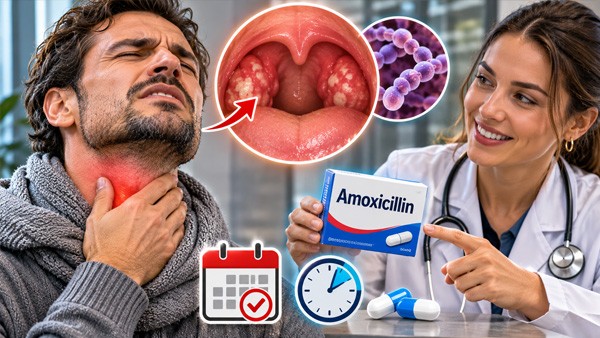

💊 Amoxicillin is the antibiotic most often prescribed for strep throat, the bacterial sore throat caused by group A streptococcus. 🧪 It works well when the cause really is strep, it is cheap, and the bacterium has never become resistant to it. But most sore throats are viral, and amoxicillin does nothing for them. 📋 This guide covers how strep is confirmed before treatment, the usual amoxicillin doses for adults and children, why the course lasts 10 days, how fast you should feel better and when you stop being contagious. It also explains which side effects are normal and which are not, including the ones felt in the throat and mouth, the well-known amoxicillin rash, and what doctors prescribe instead when someone is allergic to penicillin.
💊 Why amoxicillin is the usual choice for strep throat
🧬 Amoxicillin belongs to the penicillin family. It stops bacteria from building their cell walls, so they burst and die. Group A streptococcus remains fully sensitive to penicillins after decades of use, which is unusual among common bacteria. Guidelines name penicillin V or amoxicillin as first-line treatment, and many doctors choose amoxicillin because it is absorbed well, can be given once or twice a day, and the liquid tastes better for children. 🛒 It is sold as Amoxil (Amoxicillin) and as generic versions such as Labmox (Amoxicillin).
🤔 Is it really strep? Check before the first dose
🦠 Only about 1 in 10 sore throats in adults, and up to 1 in 3 in children aged 5 to 15, are caused by strep. The rest are viral and get better on their own. Doctors use a short score to decide who needs a test. The best known is the Centor score, with a point added or taken away for age in the modified (McIsaac) version.
📖 For the wider picture of sore throat causes and why most need no antibiotic, see pharyngitis: why most sore throats need no antibiotic.
🔬 Testing: rapid strep test and throat culture
📋 Amoxicillin dose for strep throat
⚖️ Doses below follow common US and international guidance for streptococcal pharyngitis. Your prescriber may adjust them for weight, kidney function or local practice.
| 👤 Who | 💊 Usual dose | 📅 Length |
|---|---|---|
| Adults | 500 mg twice daily, or 1000 mg once daily | 10 days |
| Adults, alternative | 500 mg three times daily (common in some countries) | 10 days |
| Children | 50 mg/kg once daily, maximum 1000 mg | 10 days |
| Children, alternative | 25 mg/kg twice daily, maximum 500 mg per dose | 10 days |
| Severe kidney disease | Dose interval lengthened; 875 mg tablets avoided | As advised |
💡 Once-daily dosing is as effective as twice-daily dosing in trials, and many families find it easier to complete the full course.
⚖️ Penicillin V or amoxicillin?
🚫 Augmentin (Amoxicillin + Clavulanate) is not needed for a first episode, because strep does not produce the enzyme that clavulanate blocks. It is kept for repeated episodes and treatment failure, explained further down.
📅 Why the course lasts 10 days
🔎 Strep throat feels better within 2 days, so stopping early is tempting. The 10-day course exists to clear the bacteria completely from the throat, which lowers the chance of relapse, of passing strep on, and of rheumatic fever. Shorter courses of penicillins leave more people with strep still in the throat. UK guidance allows 5 to 10 days of penicillin V for adults, and some antibiotics (azithromycin, certain cephalosporins) are licensed for 5 days, but for amoxicillin the standard remains 10 days.
⏱️ How fast amoxicillin works, hour by hour
Bacteria start dying; little change felt
No longer contagious for most people
Fever settles, swallowing gets easier
No better by now: see the doctor
Last dose, even if well for a week
🏫 When you stop being contagious
🦠 Untreated, strep can spread for 2 to 3 weeks. After at least 12 hours of an effective antibiotic, and once the fever has gone, a person is generally no longer contagious, which is the standard used by US public health guidance for return to school or work. Many schools and employers ask for a full 24 hours. 🍽️ Until then, avoid sharing cups, cutlery and towels, and cover coughs and sneezes. Household members only need testing if they develop symptoms.
📝 How to take it: practical rules
- 📆 Finish all 10 days, even when the throat feels normal on day 3
- 🍺 Alcohol does not block amoxicillin, but it can add to stomach upset and slows recovery
- 🚫 Do not share leftover antibiotics or save them for the next sore throat
- 🧴 Probiotics or yoghurt may reduce antibiotic diarrhoea for some people; take them a few hours apart from the dose
📊 Amoxicillin side effects: what is common
🟢 Most people take a 10-day course without problems. Stomach upset is the most frequent complaint, and it usually settles once the course ends.
👄 Side effects felt in the throat and mouth
🔍 People often search for amoxicillin side effects in the throat because it is hard to tell whether a new symptom comes from the infection or the medicine. The traffic light below sorts the usual possibilities.
🟥 The amoxicillin rash: allergy or not?
🤔 Two very different rashes can appear on amoxicillin. Telling them apart matters, because a true allergy label rules out the whole penicillin family for life, while the other rash does not.
| 🔎 Feature | 🟣 Non-allergic rash | 🔴 Allergic (hives) |
|---|---|---|
| Look | Flat or slightly raised pink spots, often blotchy | Raised, itchy welts that move around |
| Timing | Usually day 5 to 10 of the course | Minutes to hours after a dose |
| Itch | Mild or none | Intense |
| Other signs | None, child otherwise well | May come with swelling or breathing trouble |
| Common cause | Viral infection, especially glandular fever (mono) | Immune reaction to penicillin |
🧬 When amoxicillin is given to someone who actually has glandular fever (Epstein-Barr virus), a widespread rash develops in a large share of cases: around a third in recent studies, and more in older reports. This is not a penicillin allergy. 📋 Any rash should still be shown to a doctor, who decides whether to stop the drug and whether allergy testing is worthwhile later.
🚫 Penicillin allergy: what to take instead
📊 About 1 in 10 people say they are allergic to penicillin, yet more than 9 in 10 of them turn out not to be allergic when tested. Allergy testing is worth asking about, because penicillins are the best option for strep. If the allergy is real, the choice depends on what kind of reaction it was.
↓
A first-generation cephalosporin: Keflex (Cephalexin) or Duricef (Cefadroxil), 10 days
↓
Cleocin (Clindamycin) for 10 days, or a macrolide: Zithromax (Azithromycin) for 5 days or Biaxin (Clarithromycin) for 10 days
📊 Alternatives compared
| 💊 Antibiotic | 📋 Usual adult dose for strep | 📅 Length | 📝 Note |
|---|---|---|---|
| Cephalexin | 500 mg twice daily | 10 days | Mild penicillin allergy |
| Cefadroxil | 1 g once daily | 10 days | Once-daily option |
| Clindamycin | 300 mg three times daily | 10 days | Severe allergy; diarrhoea more common |
| Azithromycin | 500 mg once daily | 5 days | Resistance in some regions |
| Clarithromycin | 250 mg twice daily | 10 days | Many drug interactions |
📖 More about azithromycin and where it fits: what azithromycin is used for.
❓ When amoxicillin seems not to work
🔍 Strep itself practically never resists amoxicillin, so failure usually has another explanation.
⚠️ Interactions worth knowing
| 💊 Medicine | 📝 What happens |
|---|---|
| Warfarin | INR can rise; extra blood test often advised during the course |
| Methotrexate | Amoxicillin can raise methotrexate levels; doctor must know |
| Allopurinol | Skin rash more likely when taken together |
| Probenecid | Raises amoxicillin levels (sometimes used on purpose) |
| Oral typhoid vaccine | Antibiotic can make the live vaccine less effective |
| Birth control pill | Current evidence shows no meaningful effect; severe vomiting or diarrhoea can still reduce absorption |
🛡️ Special situations
🤰 Pregnancy and breastfeeding
✅ Amoxicillin is among the antibiotics most widely used in pregnancy
💡 Small amounts pass into milk; watch the baby for loose stools or thrush
🫀 Kidney disease
✅ Doses spaced further apart when kidney function is low
💡 Tell the prescriber your latest kidney results
🧒 Young children
✅ Strep is rare under age 3; testing is usually not done
💡 Use the syringe that comes with the liquid, not a kitchen spoon
👴 Older adults
✅ Strep is less common after 45; other causes are checked first
💡 Diarrhoea causes dehydration faster, so drink more
🚩 Complications treatment helps prevent
📖 Related infections that sometimes follow a throat infection: ear pain in adults and bacterial sinusitis.
🍵 Symptom relief alongside the antibiotic
💊 Amoxicillin works on the cause, but it does little for pain during the first day or two. Paracetamol or ibuprofen at regular doses is the most effective relief, and it lowers the fever too.
📖 If the sore throat came with a runny nose and body aches, compare the signs in flu or a cold: how to tell.
🔁 Strep throat that keeps coming back
🔄 Several confirmed episodes a year raise different questions: whether someone in the household carries strep, whether the person is a carrier with repeated viral infections, and whether a different antibiotic or tonsil removal should be considered. Doctors often switch to amoxicillin with clavulanate, a cephalosporin or clindamycin after repeated failures. Tonsillectomy is discussed when episodes are frequent and well documented, for example 7 in one year or 5 a year for two years. The full picture is in tonsillitis: why it returns and when tonsils come out.
🗣️ Questions to ask your doctor or pharmacist
- ❓ Was a strep test done, and was it positive?
- ❓ Should I take amoxicillin once or twice a day, and for how many days?
- ❓ When can I or my child go back to work or school?
- ❓ Do any of my other medicines interact with it?
- ❓ I was told I am allergic to penicillin as a child: is allergy testing worth doing?
- ❓ What should I do if I am not better in 3 days?
🗿 Myths about amoxicillin and sore throats
🚨 When to get urgent help
⛔ Seek emergency care if:
🔹 There is difficulty breathing, drooling or inability to swallow saliva.
🔹 The voice is muffled, the mouth will not open fully, or pain is much worse on one side.
🔹 Swelling of the lips, tongue or throat, or spreading hives, after a dose.
🔹 A stiff neck, confusion, or a high fever that does not fall after 48 hours of treatment.
📅 Book a routine appointment if the sore throat lasts more than a week, keeps returning, or comes with weeks of tiredness and swollen glands, which can point to glandular fever.
❓ Frequently asked questions
What is the usual amoxicillin dose for strep throat?
For adults, 500 mg twice daily or 1000 mg once daily for 10 days. For children, 50 mg/kg once daily up to 1000 mg, for 10 days.
How fast does amoxicillin work for strep throat?
Fever and pain usually ease within 24 to 48 hours. If there is no improvement after 72 hours, contact your doctor.
When am I no longer contagious on amoxicillin?
After at least 12 hours of treatment and once the fever is gone. Many schools and workplaces ask for 24 hours.
Can I stop amoxicillin when I feel better?
No. Finish the full 10 days. Stopping early raises the chance of relapse and leaves strep in the throat.
Can amoxicillin cause throat swelling?
Rarely, as part of a serious allergic reaction. Throat tightness, swollen lips or tongue, or trouble breathing need emergency care.
Why did I get white patches in my mouth on amoxicillin?
This is often oral thrush, a yeast overgrowth after antibiotics. A doctor or pharmacist can recommend an antifungal treatment.
Is a rash on amoxicillin always an allergy?
No. A flat, blotchy rash after several days is often caused by a virus, especially glandular fever. Hives soon after a dose suggest true allergy.
What is used for strep throat if I am allergic to penicillin?
Cephalexin or cefadroxil after a mild reaction; clindamycin, azithromycin or clarithromycin after a severe one.
Is Augmentin better than amoxicillin for strep throat?
Not for a first episode. Plain amoxicillin works. Amoxicillin with clavulanate is kept for repeated episodes or treatment failure.
Does amoxicillin help a viral sore throat?
No. Antibiotics do not act on viruses and only add side effects. Most sore throats are viral and clear within a week.
📑 Sources and editorial
- 📘 Clinical practice guidelines for the diagnosis and management of group A streptococcal pharyngitis (infectious diseases societies)
- 📗 National guidance on sore throat and antimicrobial prescribing
- 🏫 Public health guidance on strep throat and return to school
- 💊 Amoxicillin prescribing information: dosing, adverse reactions, interactions
- 🔬 Studies of once-daily amoxicillin for streptococcal pharyngitis
- 🧬 Studies of amoxicillin rash in Epstein-Barr virus infection
- 🚫 Reviews of penicillin allergy labels and allergy testing
- 📖 Related reading: pharyngitis, tonsillitis, azithromycin, flu or a cold
- 🛒 Related products: Amoxil (Amoxicillin), Augmentin (Amoxicillin + Clavulanate), Keflex (Cephalexin), Duricef (Cefadroxil), Zithromax (Azithromycin), Cleocin (Clindamycin)
- 🩺 RXshop Editorial Team — reviewed by Sarah Mitchell, PharmD — Clinical Pharmacist
Medical Disclaimer: The information in this article is for educational and informational purposes only and is not a substitute for professional medical advice, diagnosis, or treatment. Always seek guidance from a qualified healthcare provider with any questions you may have regarding a medical condition, and before starting, stopping or changing any medication.