Dexmethylphenidate: The Half of Ritalin That Does the Work

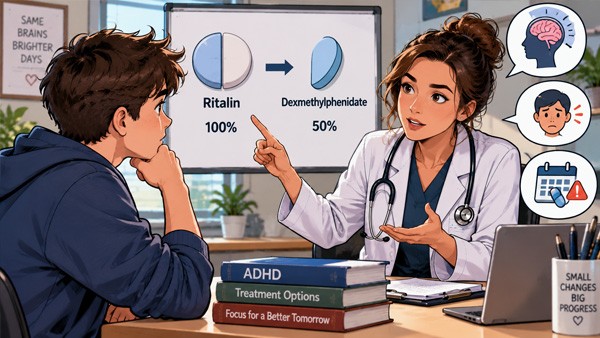

Methylphenidate, the drug sold for decades as Ritalin, is actually two molecules mixed together in equal amounts. They are mirror images of each other — the same atoms, arranged as a left hand and a right hand. One of them does almost all of the work on attention. The other does very little.
Dexmethylphenidate is simply the active hand on its own. That single fact explains its dosing, the most common mistake made when switching to it, and why it behaves so similarly to the drug it was separated from.
📏 The conversion that catches people out. Because the inactive half has been removed, dexmethylphenidate is taken at roughly half the dose of methylphenidate for the same effect. Five milligrams of dexmethylphenidate corresponds to about ten of methylphenidate.
Switching milligram for milligram doubles the effective dose. The result is exactly what a doubled stimulant dose produces: racing heart, jitteriness, anxiety, no appetite and no sleep — frequently read as intolerance to the new drug rather than as a conversion error. Anyone changing between the two needs the numbers recalculated, not copied across.
⚙️ What it does and how long it lasts
It increases the availability of dopamine and noradrenaline in the parts of the brain that regulate attention, impulse control and the ability to stay with a task. In people with ADHD that produces the familiar effect: the noise drops, starting things gets easier, and tasks that used to slide away can be held.
| Form | Onset | Duration | Where it fits |
|---|---|---|---|
| Immediate release | 30 to 60 minutes | About 4 to 6 hours | Flexible timing, usually taken twice a day, with a dip between doses |
| Extended release | 30 to 60 minutes | About 10 to 12 hours | One morning dose. Half the beads release immediately and half several hours later, imitating two doses |
The limitation shared by every stimulant is that the effect ends when the drug wears off. Evenings, early mornings and the hour before a dose takes effect are uncovered, and the wearing-off itself can bring a period of irritability, low mood or tiredness — the so-called rebound — that families often notice more than the person taking it.
📋 The side effects, and which ones matter
| Effect | What to know |
|---|---|
| Reduced appetite | The most common. A substantial breakfast before the dose and a proper meal in the evening, once it has worn off, work better than trying to eat at lunchtime |
| Difficulty sleeping | Usually a timing problem. Moving the last dose earlier often fixes it before anything else is needed |
| Headache and stomach ache | Common in the first weeks, generally settling |
| Raised heart rate and blood pressure | Usually modest. Both should be measured before starting and periodically afterwards |
| Anxiety and irritability | Can emerge or worsen, and is one of the commonest reasons for switching to a non-stimulant |
| Slowed growth in children | A small reduction in growth rate, typically a centimetre or two over years. Height and weight should be tracked |
| Rebound | Irritability or low mood as a dose wears off. Often improved by the extended-release form or a small late-afternoon dose |
🔴 Less common effects that need prompt attention.
- Chest pain, fainting, or palpitations during exertion — stop and seek assessment. Anyone with structural heart disease, a personal history of fainting with exercise, or a family history of sudden cardiac death under fifty should have their heart assessed before starting any stimulant
- An erection lasting more than four hours — an emergency, and a recognised if rare effect of this drug family, including in adolescents
- Fingers or toes turning white, blue or painful in the cold — a circulation effect that should be reported
- New suspiciousness, hearing voices, or unusually elevated mood — uncommon, and a reason to stop and seek advice the same day
🔐 Why it is so tightly controlled
This drug is a controlled substance in almost every country, and the reasons are practical rather than bureaucratic. It is misused — crushed and snorted, or taken by people without ADHD as a study aid — and prescriptions are diverted, particularly among students and teenagers.
For someone prescribed it, three things follow. Store it securely, including away from other members of the household. Never share it, however reasonable the request seems. And be aware that where anyone in the household has a history of substance misuse, a non-stimulant may be the safer choice for the whole family, not only for the person taking it.
⚠️ What must not be combined
- Older monoamine oxidase inhibitor antidepressants — a dangerous combination, requiring at least two weeks between them
- Blood pressure medication — its effect can be reduced, so readings should be checked after starting
- Warfarin, some anticonvulsants and some antidepressants — levels can rise, so monitoring may need adjusting
- Decongestants in cold remedies — add to the effect on heart rate and blood pressure
- Alcohol — worsens side effects, blunts judgement about how the medicine is working, and should be avoided with extended-release forms in particular
- Caffeine in large amounts — adds to jitteriness, palpitations and insomnia
📦 When the pharmacy has none
Stimulant shortages have been a recurring problem in recent years, and many families have faced a month where the prescribed medicine simply cannot be found. The instinct is to switch to whatever stimulant is available at whatever dose, which is exactly where the conversion error described at the top of this page happens most often.
Practical steps: ask the prescriber rather than improvising, since doses do not convert one-to-one between stimulants. Ask whether a different release form of the same drug is available, which is often simpler than changing drug. And for anyone repeatedly caught out, a shortage is a reasonable moment to consider whether a non-stimulant might suit them better — not as an emergency substitute, because non-stimulants take weeks to work, but as a longer-term option that is not subject to the same supply controls.
🔄 The non-stimulant option, honestly
It would be easy to present non-stimulants as a simple alternative. They are not a straight swap, and saying so matters.
On average, stimulants produce a larger effect on ADHD symptoms than atomoxetine does. For many people a stimulant is the right first choice, and nothing on this page argues otherwise.
But for a substantial group of people, a non-stimulant is not the second-best option — it is the better one.
| Situation | Why a non-stimulant may suit better |
|---|---|
| Significant anxiety | Stimulants can worsen it; atomoxetine often does not, and in some people eases it |
| Substance misuse history, personal or in the household | Atomoxetine is not a controlled drug and has no misuse potential |
| Sleep problems | No evening stimulation to work around |
| Need for coverage from waking to bedtime | Works continuously, with no wearing-off and no rebound |
| Tics | Some non-stimulant options are specifically useful here |
| Stimulants not tolerated | Appetite, sleep, mood or heart rate effects that could not be managed |
| Repeated shortages | Not subject to the same supply controls |
The trade-off is time. Atomoxetine takes four to eight weeks to reach its full effect, and judging it at two weeks is judging it too early — a pattern that recurs with every medicine that builds gradually. It also has its own considerations: nausea and reduced appetite at the start, a modest rise in heart rate, a warning about monitoring mood in children and adolescents in the early weeks, and very rarely liver effects, where yellowing skin or dark urine should be reported.
When switching, the non-stimulant is usually started while the stimulant continues, and the stimulant is reduced only once the new medicine has had time to work — so there is no uncovered gap. The detailed comparisons are set out in Strattera vs Ritalin and Strattera vs Concerta, both of which apply closely here since dexmethylphenidate is the active part of the same molecule. Other non-stimulants are compared in Strattera vs Intuniv and Strattera vs Qelbree.
🩺 When to seek help
- Chest pain, fainting or palpitations, particularly during exercise — stop and seek assessment
- An erection lasting over four hours — emergency
- Hearing voices, new suspiciousness, or unusually elevated mood — same day
- Thoughts of self-harm, on either a stimulant or a non-stimulant — same day
- Marked weight loss or a child dropping across growth centiles
- Anxiety that has worsened since starting — worth reconsidering the choice of drug
- Switching between stimulants, including during a shortage — have the dose recalculated
- Yellowing skin, dark urine or pain under the right ribs on atomoxetine
- Before starting, if there is any personal or family history of heart problems or sudden death at a young age
This pharmacy does not supply stimulants. Non-stimulant ADHD treatment is stocked in the ADHD category as Strattera (atomoxetine) and Atomoxet (atomoxetine), which contain the same active ingredient at the same strength. Atomoxetine is not a controlled drug, provides continuous coverage through the day and evening, and needs four to eight weeks before it can be fairly judged.
❓ Frequently asked questions
What is the difference between dexmethylphenidate and Ritalin?
Ritalin contains methylphenidate, which is two mirror-image molecules in equal amounts. One does almost all of the work on attention and the other does very little. Dexmethylphenidate is the active one on its own. It behaves very similarly, lasts about as long in the same release form, and is taken at roughly half the dose.
How do I convert a Ritalin dose?
Roughly half. Five milligrams of dexmethylphenidate corresponds to about ten of methylphenidate. Switching milligram for milligram doubles the effective dose and produces racing heart, jitteriness, anxiety and insomnia — often mistaken for intolerance of the new drug. Any change between stimulants should be recalculated by the prescriber rather than copied across.
How can I manage the loss of appetite?
Work around the timing rather than fighting it. A substantial breakfast before the morning dose, snacks that are easy to eat during the day, and a proper meal in the evening once the effect has worn off tend to work far better than trying to eat a normal lunch. In children, height and weight should be tracked, and a persistent drop across growth centiles needs discussing.
What is the evening crash?
A period of irritability, low mood, tiredness or tearfulness as a dose wears off, often called rebound. Families frequently notice it more than the person taking the drug. It is often improved by an extended-release form, a small late-afternoon dose, or — where it is persistent — a non-stimulant that works continuously and has no wearing-off point.
Is it safe for the heart?
In people without heart disease it usually raises heart rate and blood pressure modestly, and both should be measured before starting and periodically after. Anyone with structural heart disease, fainting during exercise, or a family history of sudden cardiac death under fifty needs their heart assessed first. Chest pain, fainting or palpitations on exertion mean stopping and seeking assessment.
What should I do during a shortage?
Contact the prescriber rather than improvising, because doses do not convert one-to-one between stimulants. Ask whether another release form of the same drug is available, which is often simpler than switching. For people repeatedly affected, it is a reasonable moment to consider a non-stimulant for the longer term — though not as an emergency substitute, since non-stimulants take weeks to work.
Do non-stimulants work as well?
On average stimulants produce the larger effect, and for many people they are the right first choice. But for people with significant anxiety, a substance misuse history in the household, sleep problems, a need for coverage from waking to bedtime, tics, or stimulants they could not tolerate, a non-stimulant is often the better option rather than a lesser one.
How long does atomoxetine take to work?
Four to eight weeks for the full effect, which is the main trade-off against the same-day effect of a stimulant. Judging it at two weeks is too early. When switching, it is usually started while the stimulant continues, with the stimulant reduced only once the new medicine has had time to work, so that there is no gap without treatment.
Why is this drug so tightly controlled?
Because it is misused — crushed and snorted, or taken as a study aid by people without ADHD — and prescriptions are diverted, particularly among students and teenagers. Store it securely, including away from others in the household, and never share it. Where anyone at home has a history of substance misuse, a non-stimulant may be the safer choice for everyone.
It made my anxiety worse. What now?
That is one of the commonest reasons to reconsider the choice of drug. Sometimes a lower dose or a different release form helps. Often the more effective answer is a non-stimulant: atomoxetine frequently does not worsen anxiety and in some people eases it, which makes it a genuinely better fit rather than a compromise for people whose ADHD comes with significant anxiety.
📑 Sources and editorial
- Pharmacology of methylphenidate enantiomers and the activity of the d-threo isomer
- Prescribing information for immediate and extended-release dexmethylphenidate, including dose equivalence with racemic methylphenidate
- Literature on appetite suppression, sleep effects and growth in children treated with stimulants
- Guidance on cardiovascular screening before stimulant treatment
- Regulatory safety communications on priapism and peripheral vasculopathy with methylphenidate products
- Literature on stimulant misuse and diversion in adolescent and student populations
- Interaction data for monoamine oxidase inhibitors, antihypertensives and sympathomimetic decongestants
- Reports on stimulant supply shortages and their clinical consequences
- Meta-analytic comparisons of stimulant and non-stimulant effect sizes in ADHD
- Prescribing information and trial evidence for atomoxetine, including onset of effect and safety monitoring
- Related reading: Strattera vs Ritalin, Strattera vs Concerta, Modafinil vs Ritalin, untreated ADHD
- Related products: ADHD category
- RXshop Editorial Team — reviewed by Thomas Walsh, MD, Psychiatry
Medical Disclaimer: The information in this article is for educational and informational purposes only and is not a substitute for professional medical advice, diagnosis, or treatment. Always seek guidance from a qualified healthcare provider with any questions you may have regarding a medical condition, and before starting, stopping or changing any medication.