Strattera and Liver Health: Hepatotoxicity Risk Profile and Monitoring


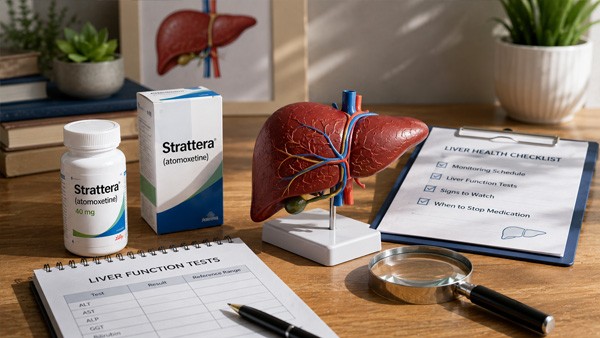
Strattera (atomoxetine) carries an FDA boxed warning for rare but potentially severe hepatotoxicity that emerged from post-marketing reports shortly after 2002 approval. Published case reports include patients who developed severe acute liver injury, some progressing to fulminant liver failure requiring transplantation or causing death. The incidence is genuinely rare — approximately 1 in 50,000 to 1 in 100,000 patients develops clinically significant liver injury — but the severity when it occurs is sufficient to justify boxed warning status, specific symptom monitoring, and patient education across all Strattera prescriptions. Most cases develop within the first 4 months of treatment, though delayed-onset cases have been reported. The pattern is hepatocellular injury (hepatocyte death) rather than cholestatic (bile flow obstruction), with elevated transaminases (ALT, AST) reflecting cellular damage. Early recognition with prompt medication discontinuation typically allows full liver recovery; delayed recognition risks progressive liver failure.
This guide provides comprehensive patient education for Strattera-related liver safety. We address why the FDA boxed warning matters even though incidence is rare, the real frequency of liver injury across millions of patient-years of exposure, warning signs that require immediate action versus those warranting routine attention, the recommended monitoring schedule that varies by patient risk profile, specific risk factors that increase hepatotoxicity concern, the structured action plan if liver enzymes rise on treatment, the typical recovery trajectory after Strattera discontinuation, four risk stratum classifications matching monitoring intensity to patient risk, the liver enzyme interpretation guide that translates lab values into clinical meaning, the post-discontinuation recovery monitoring protocol, and the bottom-line framework for Strattera liver safety management. The topic is serious but the practical message is straightforward: most patients tolerate Strattera without liver issues; symptom awareness catches the rare problems; prompt discontinuation when issues arise typically leads to full recovery.
⛔ STOP STRATTERA IMMEDIATELY if any of these symptoms occur:
• Yellowing of skin or eyes (jaundice)
• Dark urine (tea or cola colored)
• Right upper abdominal pain
• Persistent unexplained fatigue
• Loss of appetite with nausea
• Pale or clay-colored stools
• Severe itching without rash
• Unexplained bruising or bleeding
📞 Within 24 hours of stopping:
• Same-day physician contact (urgent care or telehealth)
• Liver function tests (LFTs) — ALT, AST, alkaline phosphatase, bilirubin
• Prothrombin time/INR if symptoms severe
• Complete blood count
🏥 Emergency department if:
• Severe jaundice with confusion
• Severe right upper abdominal pain
• Vomiting blood or coffee-ground material
• Severe weakness or fainting
• Bruising or bleeding suggesting coagulopathy
• Worsening symptoms despite stopping medication
💊 What to tell the ER:
"I've been taking Strattera (atomoxetine) [X mg] for [Y months]. I developed [specific symptoms] [Z days] ago. Strattera has an FDA boxed warning for hepatotoxicity. I stopped the medication as of [date/time]."
📦 Bring with you: Strattera packaging, dose schedule, list of all medications and supplements, any photos of jaundiced skin/eyes as symptoms evolved.
📋 FDA Warning: Why Liver Matters
The FDA boxed warning for Strattera hepatotoxicity has specific history:
- 2002 FDA approval of Strattera for ADHD.
- 2004 boxed warning addition. Following post-marketing reports of severe liver injury, FDA added boxed warning specifically labeling hepatotoxicity risk.
- Initial cases: Pediatric patient with acute liver injury requiring transplantation triggered initial regulatory attention.
- Subsequent reports: Multiple additional cases documented in adults and children.
- Mechanism uncertainty: Specific mechanism of atomoxetine hepatotoxicity not fully characterized — likely involves immune-mediated or metabolic idiosyncratic reaction.
- Comparison context: Strattera hepatotoxicity risk is real but rare; many medications carry similar warnings.
What the FDA warning means practically:
- Patients should be educated about hepatotoxicity symptoms.
- Healthcare providers should ask about symptoms at routine appointments.
- Routine surveillance LFTs are not required per labeling — symptom-based monitoring is acceptable.
- Higher-risk patients warrant baseline LFTs and possibly periodic monitoring.
- Prompt action if symptoms develop — don't wait to see if symptoms resolve on their own.
- Strattera carries the warning, not all ADHD medications. Stimulants don't have similar specific hepatotoxicity warnings.
📊 Real Frequency of Liver Injury
The actual incidence based on accumulated evidence:
- Clinically significant liver injury: Approximately 1 in 50,000 to 1 in 100,000 patients.
- Asymptomatic liver enzyme elevations: Approximately 1-3% of patients show mild elevations (1-3× upper limit of normal).
- Moderate elevations (3-5× ULN): Approximately 0.2-0.5% of patients.
- Severe elevations (>5× ULN): Approximately 0.05-0.1% of patients.
- Clinical hepatitis: Less than 0.01% of patients.
- Acute liver failure: Approximately 1-2 cases per 100,000 patient-years.
Timing patterns from accumulated cases:
- Approximately 70-80% of cases occur within first 4 months of treatment.
- Approximately 10-15% of cases occur in months 5-12.
- Delayed-onset cases beyond 1 year are rare but reported.
- Some cases follow dose increases rather than initial treatment.
- No specific dose-response pattern — cases reported across dose range.
Demographic patterns:
- Pediatric and adult cases both reported — no strong age predilection.
- Female predilection in some case series (similar to many drug-induced liver injuries).
- No specific ethnic clustering identified.
- Pre-existing liver disease increases risk.
⚠️ Warning Signs to Watch
Specific symptoms that warrant immediate response:
Hepatocellular injury signs:
- Jaundice: Yellow discoloration of skin (especially palms, soles) or whites of eyes. Most easily detected in natural light. May progress over days.
- Dark urine: Tea-colored or cola-colored urine indicates conjugated bilirubin in urine — sensitive sign appearing before clinical jaundice.
- Pale stools: Clay-colored or light-colored stools indicate impaired bile flow.
- Pruritis (itching): Generalized itching without rash, especially severe and persistent.
Systemic illness signs:
- Persistent fatigue: Unusual fatigue out of proportion to activity or sleep.
- Right upper abdominal pain: Discomfort or pain in right upper quadrant; may radiate to right shoulder.
- Loss of appetite: Anorexia, particularly with associated nausea.
- Nausea and vomiting: Often persistent rather than transient.
- Low-grade fever: May accompany hepatitis.
- Generalized malaise: Vague feeling of being unwell.
Severe symptoms (emergency evaluation):
- Confusion or mental status changes: May indicate hepatic encephalopathy.
- Severe jaundice: Marked yellowing requiring immediate attention.
- Bruising or bleeding: May indicate coagulopathy from liver failure.
- Vomiting blood: Hematemesis or coffee-ground emesis suggests upper GI bleeding.
- Severe abdominal pain: Persistent severe RUQ pain.
- Significant ascites: Abdominal swelling from fluid accumulation.
📅 Recommended Monitoring Schedule
Strattera monitoring schedule varies by patient risk profile:
Standard monitoring (most patients):
- Baseline LFTs before starting Strattera — reasonable for all patients; required for higher-risk patients.
- Patient education about hepatotoxicity symptoms.
- Symptom-based monitoring — patients should report concerning symptoms immediately.
- Routine appointments: Inquire about hepatotoxicity symptoms at each visit.
- LFTs if symptoms develop.
- Annual LFTs reasonable for long-term users.
Enhanced monitoring (higher-risk patients):
- Baseline LFTs before starting.
- 3-month LFTs during initial highest-risk window.
- 6-month LFTs for continued monitoring.
- Annual LFTs thereafter.
- More frequent monitoring if specific risk factors present.
- Lower threshold for symptom-triggered LFT checks.
Patient self-monitoring:
- Visual self-check for jaundice (skin and eye color in natural light).
- Urine color awareness — sudden dark urine merits attention.
- Stool color awareness — persistently pale stools merit attention.
- Energy level monitoring — persistent unexplained fatigue.
- Appetite tracking — sustained loss of appetite.
- Symptom diary for any concerning patterns.
🎯 Risk Factors That Increase Concern
Specific factors increase Strattera hepatotoxicity risk:
- Pre-existing liver disease: Chronic hepatitis B or C, fatty liver disease, autoimmune hepatitis, cirrhosis. Strattera may be appropriate with caution but enhanced monitoring essential.
- Concomitant hepatotoxic medications: Acetaminophen (especially >3g/day), methotrexate, statins, certain antibiotics (some), some seizure medications. Compounding risk.
- Alcohol use: Heavy alcohol consumption significantly increases liver injury risk; moderate alcohol may also contribute.
- Recent viral hepatitis or active viral hepatitis.
- Recent acute liver injury from any cause.
- Pregnancy: Liver function changes in pregnancy may complicate monitoring; specific Strattera considerations in pregnancy.
- Female sex: Slightly elevated risk in case series.
- Concurrent CYP2D6 inhibitors: May affect atomoxetine metabolism.
- Slow CYP2D6 metabolizers: Higher plasma atomoxetine levels.
- Family history of drug-induced liver injury.
Risk factor assessment before starting Strattera:
- Detailed medical history including liver disease history.
- Alcohol use assessment.
- Medication and supplement review for hepatotoxic concomitant agents.
- Baseline labs: ALT, AST, alkaline phosphatase, bilirubin, possibly hepatitis screening.
- Risk stratification to determine monitoring intensity.
📈 If Liver Enzymes Rise: Action Plan
Structured response to elevated liver enzymes during Strattera treatment:
Mild elevation (1-3× upper limit of normal):
- Continue Strattera with monitoring in most cases — mild elevations often transient and don't predict severe injury.
- Repeat LFTs in 1-2 weeks to determine trajectory.
- Patient symptom check — any clinical symptoms?
- Review other contributing factors (alcohol, other medications, recent illness).
- If trending upward or symptoms develop, escalate to next level.
Moderate elevation (3-5× ULN):
- Hold Strattera pending evaluation in most cases.
- Comprehensive workup — assess for other liver disease causes (hepatitis screening, imaging if indicated).
- Repeat LFTs in 1 week off medication.
- If LFTs trending down off medication, likely Strattera-related; discuss whether to rechallenge or switch.
- If LFTs persist elevated off medication, investigate other causes.
Severe elevation (>5× ULN) or any clinical symptoms:
- Stop Strattera immediately.
- Urgent evaluation — same-day physician contact, hepatology consultation.
- Comprehensive workup — full hepatitis panel, autoimmune workup, imaging.
- Assessment for liver failure signs — coagulopathy, encephalopathy, ascites.
- Hospitalization if severe or rapidly progressive.
- Do NOT rechallenge with Strattera in severe cases.
Clinical hepatitis (jaundice plus elevated enzymes):
- Emergency evaluation immediately.
- Hospitalization typically required.
- Hepatology consultation.
- Strattera permanently contraindicated.
- Document as drug allergy in medical record.
🌱 Recovery After Stopping
Typical recovery trajectory after Strattera discontinuation for liver injury:
Mild elevation recovery:
- LFTs typically normalize within 2-6 weeks of discontinuation.
- No specific liver treatment required beyond Strattera cessation.
- Most patients have no lasting effects.
Moderate elevation recovery:
- LFTs typically normalize within 4-8 weeks of discontinuation.
- Periodic monitoring until full normalization.
- No specific treatment needed in most cases.
- Generally no lasting liver effects.
Severe injury recovery:
- Recovery typically 1-3 months but variable.
- May require supportive care during acute phase.
- Most patients have complete recovery if Strattera was stopped promptly.
- Some patients have prolonged recovery or residual mild abnormalities.
- Rare cases progress despite discontinuation — requires intensive management including possible transplantation.
Acute liver failure recovery:
- Variable outcomes ranging from full recovery to death.
- Survival without transplantation possible for some cases.
- Transplantation required for some patients.
- Long-term follow-up essential.
🎚️ Risk Stratum Classification
Four risk strata for Strattera hepatotoxicity monitoring:
Stratum 1 — "Low Risk." Healthy adult or pediatric patient without liver disease, alcohol use, hepatotoxic concomitant medications, or other risk factors. Standard symptom-based monitoring with annual LFTs reasonable.
Stratum 2 — "Moderate Risk." Patient with mild risk factors: moderate alcohol use, single hepatotoxic concomitant medication, family history of liver disease. Baseline LFTs; 3-6 month LFT checks; annual surveillance.
Stratum 3 — "Elevated Risk." Patient with significant risk factors: heavy alcohol use, multiple hepatotoxic concomitant medications, pre-existing mild liver disease (fatty liver), prior history of drug-induced liver injury. More intensive monitoring; baseline plus 1-month, 3-month, 6-month LFTs; consider alternative medication.
Stratum 4 — "Contraindicated." Patient with significant pre-existing liver disease (chronic hepatitis B/C with active disease, cirrhosis, autoimmune hepatitis), prior severe drug-induced liver injury, or other contraindications. Strattera not appropriate; alternative ADHD medication should be selected.
| Stratum | Risk profile | Monitoring intensity | Strattera appropriateness |
|---|---|---|---|
| Stratum 1 (Low risk) | No risk factors | Annual LFTs, symptom-based | Standard approach |
| Stratum 2 (Moderate) | Mild risk factors | Baseline, 3-6 month LFTs, annual | Acceptable with monitoring |
| Stratum 3 (Elevated) | Significant risk factors | Baseline, 1-3-6 month LFTs | Consider alternatives |
| Stratum 4 (Contraindicated) | Active liver disease or prior DILI | n/a | Select alternative medication |
📋 Liver Enzyme Interpretation Guide
Translating LFT values into clinical meaning:
| Lab value | Normal range | Mild elevation | Moderate elevation | Severe elevation |
|---|---|---|---|---|
| ALT (alanine aminotransferase) | 7-56 U/L | 56-168 U/L (1-3× ULN) | 168-280 U/L (3-5× ULN) | >280 U/L (>5× ULN) |
| AST (aspartate aminotransferase) | 10-40 U/L | 40-120 U/L (1-3× ULN) | 120-200 U/L (3-5× ULN) | >200 U/L (>5× ULN) |
| Alkaline phosphatase | 44-147 U/L | 147-441 U/L | 441-735 U/L | >735 U/L |
| Total bilirubin | 0.1-1.2 mg/dL | 1.2-3.0 mg/dL | 3.0-10 mg/dL | >10 mg/dL |
| Direct bilirubin | 0.0-0.3 mg/dL | 0.3-1.0 mg/dL | 1.0-3.0 mg/dL | >3.0 mg/dL |
| Pattern interpretation | Normal liver function | Mild injury; monitor | Significant injury; hold medication | Severe injury; stop and evaluate urgently |
Pattern interpretation:
- Hepatocellular pattern: ALT/AST elevations > alkaline phosphatase elevation. Typical Strattera pattern.
- Cholestatic pattern: Alkaline phosphatase elevation > ALT/AST. Less typical for Strattera.
- Mixed pattern: Both elevated.
- Bilirubin elevation: Suggests significant liver dysfunction; concerning combined with enzyme elevations.
- Hy's Law: ALT >3× ULN + bilirubin >2× ULN + no alternative explanation = severe drug-induced liver injury concern.
🔬 Post-Discontinuation Recovery Monitoring
Structured monitoring after stopping Strattera for liver injury:
Week 1-2 after stopping:
- Initial LFT check to document baseline status off medication.
- Symptom monitoring for resolution or progression.
- Comprehensive workup to rule out alternative causes if not already done.
Week 2-4 after stopping:
- Follow-up LFT — expecting improvement.
- Continued symptom monitoring.
- Assessment for any progressive features.
Month 1-3 after stopping:
- LFT monitoring every 2-4 weeks until normalization.
- Document recovery trajectory.
- Consider hepatology follow-up for non-resolving cases.
Long-term follow-up:
- LFT verification of normalization.
- Documentation of Strattera as drug allergy in medical record.
- Avoidance of future Strattera exposure.
- Consideration of alternative ADHD treatment options.
✨ Bottom Line
Strattera hepatotoxicity is rare but serious — FDA boxed warning reflects post-marketing experience showing approximately 1 in 50,000 to 1 in 100,000 patients develops clinically significant liver injury, occasionally progressing to acute liver failure. The boxed warning, symptom education, and prompt action when symptoms develop are designed to catch the rare cases before they progress.
The Liver Safety Action Card provides the practical framework: specific symptoms (jaundice, dark urine, fatigue, RUQ pain, appetite loss, pale stools, severe itching, unexplained bruising) warrant immediate Strattera discontinuation followed by same-day medical evaluation. Severe symptoms warrant emergency department visit. Communication script for ER includes specific medication, duration, symptoms, and FDA hepatotoxicity warning context.
Real frequency is genuinely rare: ~1-3% asymptomatic mild enzyme elevations; ~0.2-0.5% moderate elevations; ~0.05-0.1% severe elevations; less than 0.01% clinical hepatitis; 1-2 per 100,000 patient-years acute liver failure. Most cases occur within first 4 months but delayed-onset cases exist.
Risk stratum classification matches monitoring intensity to patient risk: Stratum 1 (low risk) gets symptom-based monitoring with annual LFTs; Stratum 2 (moderate) gets baseline plus periodic LFTs; Stratum 3 (elevated) gets intensive monitoring or alternative medication consideration; Stratum 4 (contraindicated) gets alternative medication.
Risk factors increasing concern: pre-existing liver disease, concomitant hepatotoxic medications, alcohol use, recent viral hepatitis, female sex, slow CYP2D6 metabolism. Assessment before starting Strattera helps determine appropriate stratum.
If liver enzymes rise: mild elevations (1-3× ULN) usually allow continued treatment with monitoring; moderate elevations (3-5× ULN) warrant holding medication pending workup; severe elevations (>5× ULN) or clinical symptoms require immediate Strattera discontinuation and urgent evaluation. Clinical hepatitis means permanent Strattera contraindication.
Recovery after stopping is generally favorable: mild elevations normalize within 2-6 weeks; moderate elevations within 4-8 weeks; severe injury typically resolves 1-3 months but variable; acute liver failure has variable outcomes including possible transplantation need.
The Liver Enzyme Interpretation Guide translates lab values into clinical meaning. Patterns matter: hepatocellular (ALT/AST predominant) is typical Strattera pattern; Hy's Law combination (ALT >3× ULN + bilirubin >2× ULN) signals severe DILI concern.
For broader Strattera side-effect context, see Strattera Long-Term Side Effects, Strattera and Weight Loss, and Strattera Sexual Side Effects. For modafinil parallel rare-but-serious safety topic, see Modafinil Stevens-Johnson Syndrome.
For Strattera comparison cluster covering alternatives if Strattera contraindicated: vs Adderall, vs Vyvanse, vs Concerta, vs Ritalin, vs Modafinil, vs Wellbutrin, vs Intuniv, vs Qelbree.
For modafinil as off-label alternative for patients with Strattera hepatotoxicity history, Modalert 200 mg from Sun Pharma provides Schedule IV option without hepatotoxicity warning.
❓ Frequently Asked Questions
How rare is Strattera liver damage?
Clinically significant liver injury occurs in approximately 1 in 50,000 to 1 in 100,000 patients. Asymptomatic mild enzyme elevations are more common (1-3%) but typically don't progress to clinical injury. Severe liver injury including acute liver failure is rare — approximately 1-2 per 100,000 patient-years. Despite the rarity, the FDA boxed warning exists because severity when it occurs is sufficient to warrant patient education and prompt action capability.
What are the first signs of Strattera liver injury?
Common early signs: jaundice (yellowing of skin/eyes), dark urine (tea or cola colored), unexplained persistent fatigue, right upper abdominal pain, loss of appetite with nausea, pale or clay-colored stools. Any of these symptoms during Strattera treatment warrants immediate discontinuation and same-day medical evaluation. Don't wait to see if symptoms resolve — early action with mild symptoms produces best outcomes.
Should I have routine blood tests on Strattera?
FDA labeling doesn't require routine surveillance LFTs for low-risk patients — symptom-based monitoring is acceptable. Higher-risk patients warrant baseline plus periodic LFTs (3-6 months, annually). Symptom-triggered LFT checks are essential. Patients with significant risk factors (pre-existing liver disease, heavy alcohol use, concomitant hepatotoxic medications) should have more intensive monitoring. Discuss appropriate schedule with prescriber based on your risk profile.
When does Strattera liver damage usually occur?
Approximately 70-80% of cases occur within the first 4 months of treatment, making this the highest-risk window. About 10-15% occur in months 5-12. Delayed-onset cases beyond 1 year are rare but reported. Some cases follow dose increases rather than initial treatment. Monitoring intensity should be highest during initial treatment period.
What if my liver enzymes are slightly elevated?
Depends on degree of elevation and patient circumstances. Mild elevation (1-3× ULN) often allows continued treatment with monitoring — repeat LFTs in 1-2 weeks to determine trajectory. Moderate elevation (3-5× ULN) typically warrants holding Strattera pending workup. Severe elevation (>5× ULN) requires immediate Strattera discontinuation. Symptoms trump lab numbers — any clinical symptoms with any enzyme elevation warrants stopping medication regardless of degree.
Will my liver recover after stopping Strattera?
Generally yes — most patients have favorable recovery. Mild elevations normalize within 2-6 weeks. Moderate elevations within 4-8 weeks. Severe injury typically resolves 1-3 months but variable. Most patients have complete recovery if Strattera was stopped promptly when symptoms or significant enzyme elevations appeared. Rare cases progress despite discontinuation requiring intensive management including possible transplantation — emphasizing importance of early recognition.
Can I take Strattera if I drink alcohol?
Discuss with prescriber. Light to moderate alcohol use is generally acceptable but increases hepatotoxicity concern. Heavy alcohol use is contraindicated — significantly elevates liver injury risk. Patients drinking alcohol should have baseline LFTs and enhanced monitoring. Alcohol moderation during Strattera treatment reduces risk. Acute heavy alcohol consumption (binge drinking) should be avoided.
What if I have hepatitis B or C?
Active hepatitis B or C is a contraindication for Strattera. Chronic hepatitis B/C with active disease places patient in Stratum 4 — alternative ADHD medication should be selected. Patients with resolved or well-controlled hepatitis on antiviral therapy may be candidates for Strattera with enhanced monitoring (baseline, 1-3-6 month LFTs, hepatology coordination). Discuss specific situation with prescriber and hepatologist.
Can my child take Strattera if there's family history of liver disease?
Possibly with enhanced monitoring. Family history of liver disease is a risk factor but not absolute contraindication. Pediatric monitoring should include baseline LFTs, 3-month LFT check, 6-month, and annual surveillance. Symptom education essential. Family history of drug-induced liver injury specifically should prompt cautious approach. Discuss with pediatrician and possibly pediatric hepatologist.
Should I take herbs or supplements with Strattera?
Cautiously, with awareness. Some herbal supplements have hepatotoxicity potential and may compound Strattera risk: kava, comfrey, chaparral, germander, mistletoe, and some weight loss supplements. Even commonly used supplements can rarely cause liver injury. Discuss all supplements and herbs with prescriber. Avoid hepatotoxic substances during Strattera treatment. Acetaminophen specifically should be limited to standard adult doses (max 3-4g daily) and avoided in higher doses.
📚 References & Further Reading
- FDA prescribing information for Strattera (atomoxetine) — Boxed Warning section on hepatotoxicity.
- FDA MedWatch Safety Alert (2004) — original Strattera hepatotoxicity warning.
- Lim et al. — published case series of atomoxetine-induced liver injury.
- Bangs et al., Journal of Child and Adolescent Psychopharmacology — atomoxetine hepatic safety.
- FDA Adverse Event Reporting System (FAERS) — post-marketing hepatotoxicity reports.
- European Medicines Agency — atomoxetine post-marketing safety.
- American Association for the Study of Liver Diseases — drug-induced liver injury guidelines.
- FDA Drug-Induced Liver Injury Network (DILIN) — atomoxetine cases.
- Chalasani et al. — comprehensive review of drug-induced liver injury.
- Hy's Law — clinical concept for severe DILI assessment.
- Strattera Long-Term Side Effects — comprehensive long-term safety article.
- Strattera and Weight Loss — companion side-effect article.
- Strattera Sexual Side Effects — companion side-effect article.
- Strattera comparison cluster: vs Adderall, vs Vyvanse, vs Concerta, vs Ritalin, vs Modafinil, vs Wellbutrin, vs Intuniv, vs Qelbree
- Modafinil Stevens-Johnson Syndrome — parallel rare-but-serious modafinil safety topic.
- Modalert 200 mg, Modvigil 200 mg, Waklert 150 mg — primary product pages.
- RXshop Editorial Team — content reviewed by licensed pharmacist; for adult patient education, not a substitute for individual medical consultation.
Medical Disclaimer: The information in this article is for educational and informational purposes only and is not a substitute for professional medical advice, diagnosis, or treatment. Always seek guidance from a qualified healthcare provider with any questions you may have regarding a medical condition, and before starting, stopping or changing any medication.