Strattera vs Ritalin: Onset, Duration, and Daily Use Compared


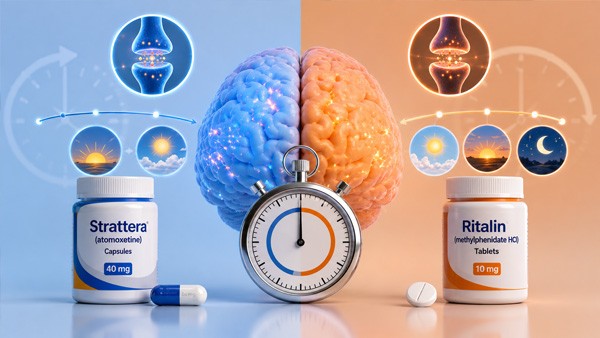
Ritalin and Strattera represent two distinct eras and philosophies of ADHD treatment. Ritalin (methylphenidate immediate-release) is the original ADHD medication — synthesized in 1944, marketed by Ciba-Geigy starting 1955, and the foundation on which the entire field of pharmacological ADHD treatment was built. After 60+ years of clinical use, Ritalin has accumulated the deepest evidence base in pediatric and adult psychiatry, while remaining the medication that defines what "stimulant ADHD treatment" means subjectively for most patients and prescribers. Strattera (atomoxetine), approved in 2002, represented the first FDA-approved non-stimulant alternative — a deliberately engineered modern response to limitations of the classical stimulant paradigm. The two medications use fundamentally different pharmacology, follow fundamentally different daily-life patterns, and suit fundamentally different patient profiles.
This guide compares Strattera and Ritalin on every dimension that matters for the daily-management decision. We cover the classic vs modern positioning of the two medications, the receptor-level mechanism contrast (dopamine boost via reuptake inhibition + vesicular interaction vs pure norepinephrine reuptake inhibition with indirect prefrontal effects), the dramatic onset and duration differences (30 minutes to 4-hour effect vs 4-6 weeks to 24-hour continuous coverage), the 60+ year pediatric evidence base for Ritalin vs newer Strattera data, the historical shift in adult ADHD prescribing away from immediate-release methylphenidate, side effect comparison with frequency data, the structured protocol for switching from Ritalin to Strattera when stimulants fail, four daily-life scenario classifications mapping life contexts to medication choice, the historical timeline of Ritalin from 1955 to present, the Ritalin IR vs ER formulation comparison that often confuses patients, and the bottom-line "sprint vs marathon" framework for the decision.
| Dimension | Ritalin = SPRINT | Strattera = MARATHON |
|---|---|---|
| Pacing | Acute burst per dose | Continuous steady pace |
| Effect window per dose | 3-5 hours | 24 hours (steady state) |
| Doses per day | 2-3× daily (IR) | 1× daily |
| Time to peak | 1-2 hours per dose | No clear peak — flat plateau |
| Onset of clinical benefit | 30-60 min (first dose) | 4-6 weeks (steady state) |
| Subjective experience | "Switched on" then "wore off" | "Function better, no drug sensation" |
| Day structure | Multiple "on/off" cycles | Single continuous baseline |
| Crash / rebound | Common between doses | None |
| Flexibility | High — skip days possible | Low — daily adherence required |
| Schedule | Schedule II | Schedule IV / non-scheduled |
| Effect size (ADHD-RS) | Cohen's d ~0.9-1.1 | Cohen's d ~0.6-0.7 |
| Years of clinical experience | 60+ years (since 1955) | 23+ years (since 2002) |
| Best metaphor | 100m sprint — explosive, brief | Marathon — steady, sustained |
The metaphor captures the core difference: Ritalin produces acute high-intensity effect for short windows requiring repeated dosing throughout the day; Strattera produces moderate steady effect throughout the day from single dose. Different medications for different patient lifestyles and preferences.
🏛️ The Classic vs the Modern Alternative
Ritalin's 60+ year clinical legacy and Strattera's modern positioning shape how each medication is perceived and used:
Ritalin (methylphenidate IR) — The Classic:
- Synthesized 1944 by Leandro Panizzon at Ciba-Geigy. Named after his wife "Rita" who first benefited from it.
- Marketed 1955 for various indications including narcolepsy, depression, fatigue.
- Pediatric ADHD use established 1960s-1970s as the seminal ADHD medication.
- Foundation of modern ADHD pharmacology. Decades of clinical research on Ritalin underpins much of current ADHD treatment understanding.
- Generic available since 1971. Low cost; minimal pricing controversy.
- Multi-dose daily regimen. Original IR formulation requires 2-3 doses daily for full-day coverage; extended-release variants developed later (Ritalin SR, Ritalin LA, Concerta) to address multi-dose burden.
- Schedule II classification reflecting documented abuse potential. Stricter prescription rules.
- FDA approval: 1955 various indications; well-established for ADHD.
Strattera (atomoxetine) — The Modern Alternative:
- Developed by Eli Lilly as first specifically-designed non-stimulant ADHD medication.
- FDA approval 2002 for pediatric and adult ADHD.
- Engineered to address stimulant limitations: abuse liability, cardiovascular impact, side effect burden, controlled substance prescribing complexity.
- First-in-class atomoxetine — selective norepinephrine reuptake inhibitor without dopamine reward system activation.
- Schedule IV (or non-scheduled in some classifications) reflecting genuinely low abuse risk.
- 24-hour continuous coverage from once-daily dosing — designed to address Ritalin's multi-dose burden.
- Pediatric SI black box warning added based on early trial signal — unique safety consideration not present with Ritalin.
- Generic available 2017. Affordable atomoxetine widely accessible.
The "classic vs modern" positioning has clinical implications:
- Ritalin benefits from accumulated experience. Most pediatricians have prescribed it for decades; long-term safety data is robust; prescribing comfort is high.
- Strattera offers modern engineering benefits. Single-dose, no abuse liability, continuous coverage, lower side effect burden in many dimensions.
- Ritalin's multi-dose burden was historically managed by school nurses dispensing midday doses. This infrastructure has weakened in many districts, making Ritalin IR less practical for school-age patients.
- Strattera fits modern lifestyle expectations of single-pill, continuous-coverage medications.
- The "classic" vs "modern" framing is partly historical accident — neither medication is inherently better; they suit different priorities.
🧬 Mechanism: Dopamine Boost vs Norepinephrine Reuptake
Mechanism comparison reveals why subjective experiences differ:
Ritalin (methylphenidate) mechanism:
- Powerful dopamine and norepinephrine reuptake inhibition. Methylphenidate binds DAT and NET with high affinity, blocking reuptake of these neurotransmitters.
- Limited vesicular interaction. Unlike amphetamines, methylphenidate doesn't trigger active vesicular dopamine release. Its effect comes from pure reuptake inhibition.
- Strong nucleus accumbens dopamine elevation. Reward-system activation produces subjective rewarding effect and creates abuse liability.
- Acute pharmacokinetics: Tmax 1-2 hours; half-life 2-4 hours; complete clearance ~6-12 hours after dose.
- Net effect: Substantial elevation of synaptic dopamine and norepinephrine during the acute drug window; clear "on" and "off" experience for patients.
- Subjective signature: "Switched on" feeling within 30-60 minutes, focus and motivation enhancement, energy increase, possible euphoria at higher doses.
Strattera (atomoxetine) mechanism:
- Selective norepinephrine reuptake inhibition. Atomoxetine binds NET with high selectivity (~10× more NET than DAT affinity).
- Indirect prefrontal dopamine effect. In prefrontal cortex, NET also handles dopamine reuptake (DAT density is lower there). So atomoxetine indirectly increases prefrontal dopamine through NET blockade.
- No nucleus accumbens dopamine elevation. Crucial difference from Ritalin — atomoxetine doesn't engage the brain's reward pathway meaningfully. This is why it lacks subjective rewarding effect and has minimal abuse liability.
- Half-life ~5 hours but steady-state coverage with daily dosing produces continuous norepinephrine modulation.
- Net effect: Enhanced norepinephrine signaling throughout brain; enhanced prefrontal dopamine specifically; no nucleus accumbens dopamine surge.
- Subjective signature: Subtle, gradual. "ADHD symptoms get easier without feeling like I'm on anything." No recognizable "switched on" experience.
⏰ Onset and Duration: 4 vs 24 Hours
The pharmacokinetic temporal profiles produce fundamentally different daily-life patterns:
Ritalin IR temporal profile:
- Onset: Detectable effect within 30-60 minutes of dose.
- Peak: 1-2 hours after dose.
- Duration: 3-5 hours per dose.
- Daily doses required: 2-3 doses per day for full-day coverage (typically morning, noon, afternoon).
- Inter-dose wear-off: Common rebound between doses — fatigue, mood drop, ADHD symptom return.
- End-of-day clearance: Last dose clears 6-12 hours after intake; usually doesn't disrupt sleep if dosed by mid-afternoon.
- Practical implication: Multi-dose regimen requires scheduling discipline; school-age children may need nurse-administered midday dose.
Strattera temporal profile:
- Onset: No acute subjective effect on first dose.
- Initial benefit: 1-2 weeks of consistent daily dosing.
- Full effect: 4-6 weeks of consistent daily dosing.
- Steady-state coverage: Continuous 24-hour effect once steady state established.
- No wear-off, no crash: Function remains consistent throughout day and into evening.
- Sleep impact: Minimal — doesn't typically affect sleep onset even with morning dosing because effect is continuous rather than peak-and-trough.
- Practical implication: Once-daily dosing simple but requires consistent daily adherence; missing doses disrupts steady state.
The temporal difference shapes daily life in concrete ways:
- School day: Ritalin IR requires school-administered midday dose (or extended-release like Concerta to avoid this). Strattera covers entire school day from morning home dose.
- Work day: Ritalin IR adult must carry afternoon dose to work, remember to take at scheduled time. Strattera adult takes morning dose at home; no work-day medication management.
- Evening activities: Ritalin IR usually worn off by evening unless very late dose taken. Strattera covers evening activities and homework time.
- Weekend / drug holidays: Ritalin IR can be skipped on weekends or vacations without disrupting future effect. Strattera requires consistent daily dosing.
- Travel: Ritalin IR multiple doses must be packed and scheduled. Strattera single morning dose simplifies travel.
- Missed dose: Ritalin IR missed dose means several hours of ADHD symptoms; next scheduled dose proceeds normally. Strattera missed dose less acutely problematic but multiple missed doses disrupt steady state.
📊 Effectiveness in Children: 60+ Years of Data
The pediatric evidence base for both medications:
Ritalin pediatric evidence:
- 60+ years of clinical use since 1955.
- Largest evidence base of any ADHD medication. Thousands of studies, hundreds of thousands of pediatric patients across decades.
- Effect sizes: Cohen's d 0.9-1.2 on standardized ADHD rating scales.
- Response rates: ~70-80% of pediatric ADHD patients respond to methylphenidate.
- Long-term outcome data (MTA Study and others): Multi-year follow-up shows sustained efficacy and acceptable safety in pediatric populations.
- Comparative effectiveness: Methylphenidate-class shows similar efficacy to amphetamine-class in head-to-head pediatric studies; some patients respond better to one or the other.
- Multiple formulations available: Ritalin IR (3-5 hours), Ritalin SR (6-8 hours), Ritalin LA (8-10 hours), Methylin (chewable, liquid), Concerta (OROS 10-12 hours), Daytrana (patch), etc.
Strattera pediatric evidence:
- 23+ years of clinical use since 2002.
- Substantial evidence base from FDA pivotal trials and post-marketing studies.
- Effect sizes: Cohen's d 0.6-0.7 on ADHD rating scales.
- Response rates: ~60-70% of pediatric ADHD patients respond.
- Long-term outcome data: 5+ year follow-up available; sustained efficacy and acceptable safety profile in most patients.
- Head-to-head with methylphenidate: Methylphenidate produces larger effect sizes; Strattera works for substantial subset including methylphenidate non-responders.
- Specific safety considerations: Pediatric SI black box warning; less growth suppression than stimulants; less cardiovascular impact.
The 60-year evidence gap matters: Ritalin's accumulated experience gives prescribers and families more confidence about long-term outcomes than Strattera's 23-year track record. Both medications have robust pediatric safety data, but the depth of Ritalin's experience base is unmatched.
👨💼 Adult Use: Why Ritalin Has Become Off-Label
Ritalin's prescribing pattern in adult ADHD has shifted substantially:
- Adult ADHD recognition expanded 1990s-2000s. Initially adults with persistent childhood ADHD; later expanded to adults newly diagnosed.
- Ritalin IR was original adult ADHD medication. Same multi-dose schedule used in adults as in pediatric patients.
- Multi-dose IR became impractical for adult work life. Carrying medication, remembering midday dose during meetings, dealing with inter-dose wear-off — all friction.
- Extended-release alternatives became preferred. Concerta (OROS methylphenidate ER) approved 2000; provides once-daily methylphenidate dosing.
- Adderall XR approved 2001; Vyvanse 2007. These long-acting amphetamine options compete for the once-daily prescribing.
- Strattera approved 2002 as non-stimulant once-daily option.
- Ritalin IR adult prescribing declined as long-acting alternatives became available. Still used for specific situations (initial titration to assess response, supplemental "top-up" with extended-release base, low-dose acute use for specific high-demand events).
- Current adult Ritalin IR niche: Patients who specifically benefit from multi-dose flexibility, patients titrating to find optimal dose before switching to ER, patients combining ER base with IR top-up (uncommon).
The "off-label" framing for Ritalin in adults is somewhat imprecise — Ritalin IR is FDA-approved for adult ADHD, but it has been largely superseded by extended-release alternatives in current adult prescribing patterns. Most adult ADHD treatment now uses Concerta, Adderall XR, Vyvanse, or Strattera as primary choice.
⚠️ Side Effects Profile
Side effect comparison:
| Side effect | Strattera | Ritalin IR |
|---|---|---|
| Headache | ~15-20% | ~15-20% |
| Insomnia | ~15-20% | ~20-30% (more with late dosing) |
| Appetite suppression | ~15-20% | ~25-35% |
| Nausea | ~25-30% | ~10-15% |
| Heart rate increase | +2-5 bpm | +5-15 bpm |
| BP increase | +1-3 mmHg | +3-10 mmHg |
| Anxiety | ~5-10% | ~10-15% |
| Irritability | ~5-10% | ~10-20% (especially between doses) |
| Tics exacerbation | Less risk | Possible |
| Sexual dysfunction | ~10-15% | ~5% |
| Dry mouth | ~15-20% | ~15-25% |
| Sweating | ~10-15% | ~5-10% |
| Stomach upset | ~25-30% | ~10-15% |
| Wear-off rebound | None | Common between doses |
| Pediatric SI black box | YES | No |
| Cardiovascular boxed warning | No | YES (sudden cardiac events) |
| Abuse liability | Minimal | Schedule II — substantial |
| Hepatotoxicity | Rare but labeled | Not associated |
| Tachyphylaxis (within-day) | None | Yes — effect attenuates across day |
Pattern summary:
- Strattera wins on: insomnia, appetite, cardiovascular, anxiety, irritability, tic risk, no rebound/wear-off, abuse liability.
- Ritalin wins on: nausea, sexual dysfunction, sweating, stomach upset, hepatotoxicity, no pediatric SI black box.
- Ritalin IR specific: Multi-dose schedule creates between-dose rebound effects that aren't problems with continuous-coverage medications.
🔁 When Ritalin Fails: Strattera as Next Step
Patients sometimes need to switch from Ritalin to Strattera. The structured protocol:
Reasons for switching from Ritalin to Strattera:
- Multi-dose burden unmanageable.
- Between-dose wear-off and rebound affecting function.
- Substance use concerns emerging or recognized.
- Cardiovascular issues developing.
- Severe sleep or appetite side effects.
- Anxiety worsening.
- Schedule II prescription friction unsustainable.
- Tic disorder development or exacerbation.
- Family preference for non-controlled medication.
Switching protocol:
- Day 0: Last Ritalin IR doses at normal times.
- Day 1: Start Strattera 40 mg morning. No acute effect; mild Ritalin withdrawal possible (fatigue, mood drop, possible rebound hyperactivity) for 2-3 days.
- Week 2: Titrate Strattera to 60-80 mg morning.
- Weeks 3-6: Strattera effect gradually emerging. ADHD symptoms typically uncontrolled or partially controlled during this transition.
- Week 6+: Steady-state Strattera response. Assess whether switch successful.
- Caution: Plan reduced demanding cognitive commitments during weeks 1-4 of transition.
- Alternative bridging approach: Some prescribers maintain low-dose Ritalin IR (just morning dose) during initial Strattera ramp-up to provide some ADHD coverage; then taper Ritalin as Strattera effect emerges.
The switch from Ritalin to Strattera often "works" in the sense of providing continuous coverage and eliminating multi-dose burden, but the patient should accept that Strattera's effect size is smaller — ADHD symptom control may be less robust on Strattera than it was on Ritalin at optimal dose. The switch is appropriate when the trade-off (smaller effect + better practical profile) matches patient priorities.
🎯 Daily-Life Scenario Classification
Four daily-life scenarios that influence medication choice:
Scenario 1 — "School-Age Child." Pediatric ADHD patient navigating school day with parents/teachers managing medication. Recommendation: Concerta or Ritalin IR (with school nurse for midday dose) typically first-line. Strattera reasonable for specific situations (no nurse available for IR midday, family preference for non-stimulant, tic disorder, comorbid anxiety). For families navigating between Ritalin formulations, extended-release options (Concerta) avoid the school nurse logistics burden.
Scenario 2 — "College Student." Young adult managing own medication during academic year. Recommendation: Concerta or Vyvanse typically preferred over Ritalin IR due to single-dose convenience. Strattera reasonable for students with substance use concerns or who want non-controlled medication. Ritalin IR's multi-dose schedule difficult in college life with variable schedules.
Scenario 3 — "Working Professional." Adult with structured work schedule. Recommendation: Concerta, Vyvanse, or Strattera depending on priorities. Ritalin IR rarely appropriate first choice for adult work life — multi-dose schedule too cumbersome. Strattera fits when continuous coverage without controlled-substance prescribing matters.
Scenario 4 — "Older Adult." Adult 50+ with newer ADHD diagnosis or long-term treatment. Recommendation: Strattera often preferred due to gentler cardiovascular profile, no Schedule II logistics, and continuous coverage. Older adults more likely to have cardiovascular issues making stimulants problematic. Ritalin or other stimulants may still be appropriate depending on overall health profile.
| Daily-life scenario | Profile | Recommended | Rationale |
|---|---|---|---|
| School-Age Child | Pediatric with parent management | Concerta or Ritalin IR | Established pediatric efficacy |
| College Student | Young adult managing own meds | Concerta or Vyvanse | Single-dose convenience |
| Working Professional | Adult with work schedule | Concerta, Vyvanse, or Strattera | Single-dose; priorities-dependent |
| Older Adult | 50+ with cardiovascular considerations | Strattera often preferred | Gentler CV profile |
📜 Ritalin Historical Timeline
The 60+ year clinical history of Ritalin contextualizes its current position:
| Year | Event |
|---|---|
| 1944 | Methylphenidate synthesized by Leandro Panizzon at Ciba-Geigy. Named "Ritalin" after his wife Rita. |
| 1955 | FDA approval for Ritalin in US for various indications. |
| Late 1950s | Marketed for narcolepsy, depression, mild psychiatric conditions. |
| 1960s | Use begins for childhood hyperactivity ("hyperkinetic reaction of childhood"). |
| 1970s | DSM-II ADHD predecessor diagnoses formalized; Ritalin becomes primary treatment. |
| 1971 | Generic methylphenidate available. |
| 1980s | ADHD diagnosis (DSM-III) formally defined; Ritalin prescribing expands substantially. |
| 1980s-1990s | Growing pediatric Ritalin prescribing; cultural debates about "drugging children." |
| 1990s | Multimodal Treatment of ADHD (MTA) Study begins, providing landmark long-term outcome data. |
| 1996 | Adderall (mixed amphetamine salts) introduced; first major competition to Ritalin. |
| 1999 | MTA Study results published — long-term Ritalin/methylphenidate outcome data. |
| 2000 | Concerta (methylphenidate OROS ER) approved — long-acting methylphenidate addresses multi-dose burden. |
| 2001 | Adderall XR approved; long-acting amphetamine option. |
| 2002 | Strattera (atomoxetine) approved — first non-stimulant ADHD medication. |
| 2007 | Vyvanse (lisdexamfetamine) approved — prodrug amphetamine with abuse-resistant design. |
| 2010s | Telehealth ADHD prescribing expands; Schedule II prescribing logistics increasingly recognized as burden. |
| 2017 | Generic Strattera available. |
| 2020-2022 | COVID pandemic enables widespread telehealth ADHD prescribing; Schedule II controversies emerge. |
| 2022-2024 | Adderall shortages; telehealth Schedule II prescribing restricted post-pandemic. |
| 2026 | Ritalin IR remains available but less commonly prescribed for new adult patients; pediatric use continues; ER methylphenidate (Concerta) and non-stimulants (Strattera) often preferred over IR for new starts. |
💊 Ritalin IR vs ER Formulation Comparison
"Ritalin" often refers specifically to the immediate-release tablet, but multiple methylphenidate formulations exist that can confuse patients:
- Ritalin IR (immediate-release tablets): 3-5 hour duration; 2-3× daily dosing. Original Ritalin formulation. Still available and used.
- Ritalin SR (sustained-release): 6-8 hour duration; 1-2× daily dosing. Less common; largely superseded by other ER options.
- Ritalin LA (long-acting): 8-10 hour duration; once-daily morning dosing. Bimodal release similar to Concerta but different technology.
- Methylin (different brand of methylphenidate): Available as tablets, chewable tablets, liquid suspension. Useful for children who can't swallow standard tablets.
- Concerta (methylphenidate OROS ER): 10-12 hour duration; once-daily morning dosing. Uses Alza OROS osmotic-controlled release technology. Often preferred over Ritalin LA for predictable long-acting coverage. See our companion Strattera vs Concerta article for detailed Concerta information.
- Daytrana (methylphenidate transdermal patch): 9-hour wear time; useful for children who can't swallow medication. Skin irritation common; less commonly used.
- Aptensio XR, Metadate CD, Quillivant XR, Cotempla XR-ODT: Various other methylphenidate ER formulations with slightly different release patterns and dosing schedules.
The "Ritalin" vs "methylphenidate ER" distinction matters because patients comparing to Strattera may be comparing different formulations of methylphenidate without realizing it. If your prescriber suggests "switching from Ritalin to a long-acting methylphenidate" — that's switching from IR to ER (Concerta typically) rather than switching to a different drug class.
When this article compares Strattera to Ritalin, it specifically references Ritalin IR (the original 3-5 hour formulation). Comparison to methylphenidate ER formulations (Concerta) is covered in the companion article.
✨ Bottom Line: Sprint vs Marathon
The Strattera vs Ritalin decision is fundamentally between sprint pharmacology (Ritalin's acute high-intensity 3-5 hour bursts requiring multi-dose daily scheduling) and marathon pharmacology (Strattera's moderate continuous 24-hour coverage from single daily dose). Both medications are FDA-approved, both have substantial evidence base, both work for many ADHD patients. The choice depends on which pharmacological approach matches patient lifestyle and priorities.
For raw ADHD efficacy: Ritalin (and other methylphenidate formulations) wins on average. Effect sizes Cohen's d 0.9-1.1 vs Strattera's 0.6-0.7. Larger response rates. More dramatic improvement in inattention, hyperactivity, and executive function. The 60+ year clinical experience base reflects this established efficacy.
For continuous coverage, prescription convenience, abuse-free profile, and gentler side effects: Strattera wins. Schedule IV vs Schedule II classification meaningfully simplifies prescribing logistics. Gentler cardiovascular profile, less sleep disruption, less appetite suppression, no between-dose rebound. 24-hour continuous coverage from one daily dose vs Ritalin IR's multi-dose schedule.
The four daily-life scenarios (School-Age Child / College Student / Working Professional / Older Adult) suggest different recommendations. School-age children with parent management may use either; college students benefit from single-dose options; working professionals usually need extended-release or non-stimulant for practical reasons; older adults often prefer Strattera for cardiovascular gentleness.
Ritalin's historical position as the original ADHD medication gives it deepest evidence base and prescribing comfort. Strattera represents modern engineering response to Ritalin's limitations — particularly the multi-dose burden and abuse liability. Neither approach is universally better; they suit different priorities and patient profiles.
For modern adult ADHD treatment, Ritalin IR is rarely first choice. Most adult prescribing uses extended-release methylphenidate (Concerta), long-acting amphetamine (Adderall XR, Vyvanse), or non-stimulant (Strattera, atomoxetine). Ritalin IR has narrow current niches: initial titration to assess methylphenidate response, supplemental "top-up" doses with extended-release base (uncommon), patients with specific multi-dose preferences.
The Ritalin IR vs ER distinction often confuses patients comparing medications. "Switching from Ritalin to long-acting medication" usually means switching to Concerta (methylphenidate OROS ER) — same drug class, better daily-life profile. Switching to Strattera means switching drug class entirely (non-stimulant SNRI vs stimulant).
For pediatric patients specifically, methylphenidate has the most established evidence base, and Concerta (OROS methylphenidate ER) is often the practical choice that combines methylphenidate efficacy with single-dose convenience. Strattera is reasonable first-line for pediatric patients with specific factors favoring non-stimulant (substance abuse family history, comorbid anxiety, tic disorder, growth concerns, family preference). See Strattera vs Concerta for the more relevant pediatric ADHD comparison.
For broader ADHD treatment context including off-label alternatives, see Modafinil for ADHD. For other Strattera comparisons, see Strattera vs Adderall, Strattera vs Vyvanse, and Strattera vs Concerta. For modafinil vs methylphenidate comparison, see Modafinil vs Ritalin.
For modafinil as third-line alternative when both Ritalin/methylphenidate and Strattera prove inadequate, Modalert 200 mg from Sun Pharma provides Schedule IV off-label option for cognitive enhancement.
❓ Frequently Asked Questions
Is Ritalin more effective than Strattera?
Yes, on average. Methylphenidate (Ritalin's active ingredient) produces larger effect sizes on ADHD rating scales (Cohen's d 0.9-1.1) than Strattera (Cohen's d 0.6-0.7) across pediatric and adult populations. Approximately 70-80% of ADHD patients respond to methylphenidate vs 60-70% to Strattera. The effect size gap is real and clinically meaningful. However, Strattera works for substantial subset including patients with substance abuse concerns, cardiovascular issues, comorbid anxiety, tic disorders, or specific preference for non-controlled medication.
How many times a day do I take Ritalin vs Strattera?
Ritalin IR (immediate-release): 2-3 times daily, typically morning, noon, and afternoon. The 3-5 hour duration per dose requires multi-dose schedule for full-day coverage. Strattera: once daily, typically morning. Continuous 24-hour coverage from single dose. The dosing schedule difference is one of the largest practical differences between the medications. Extended-release methylphenidate (Concerta, Ritalin LA) is once daily like Strattera but with methylphenidate efficacy.
Why does Ritalin work faster than Strattera?
Different pharmacology. Ritalin is a classical stimulant with direct dopamine and norepinephrine reuptake inhibition — produces detectable effect within 30-60 minutes of first dose. Strattera is a selective norepinephrine reuptake inhibitor that requires 4-6 weeks of consistent daily dosing for full therapeutic effect. The Ritalin patient knows within hours whether the medication will work; the Strattera patient must commit to 6-week trial before knowing. This onset speed difference fundamentally affects how families and prescribers approach medication trials.
Is Ritalin safer than Strattera for children?
Both have established pediatric safety with different specific considerations. Ritalin has 60+ years of pediatric experience and no pediatric SI black box warning. Strattera has 23-year pediatric experience and does have a pediatric SI black box warning (real but rare phenomenon). Ritalin has documented small growth suppression over years (~1-2 cm); Strattera has smaller growth effect. Both medications are FDA-approved for pediatric ADHD. Family discussion with pediatrician about specific child's situation determines best choice.
What's the difference between Ritalin and Concerta?
Same drug (methylphenidate), different release patterns. Ritalin IR is immediate-release with 3-5 hour duration requiring multi-dose daily schedule. Concerta is methylphenidate in OROS osmotic-controlled release technology providing 10-12 hour duration from once-daily dose. Concerta has largely replaced Ritalin IR for school-age children and adult ADHD because the once-daily convenience is substantial. See Strattera vs Concerta for detailed Concerta information.
Can I switch from Ritalin to Strattera?
Yes, with structured protocol. Stop Ritalin IR at scheduled time; start Strattera 40 mg morning the same day or next day. Titrate Strattera to 60-80 mg morning over 2 weeks. Expect 4-6 weeks for Strattera to reach full effect. ADHD symptoms typically uncontrolled or partially controlled during weeks 1-4 transition period. Plan reduced demanding cognitive commitments during this window. Some prescribers maintain low-dose morning Ritalin as bridge during Strattera ramp-up.
Why don't doctors prescribe Ritalin IR for adults anymore?
Multi-dose schedule is impractical for adult work life. Adults working in offices, attending meetings, traveling — all face friction managing 2-3 daily medication doses with set timing requirements. Extended-release alternatives (Concerta, Adderall XR, Vyvanse) provide same or better efficacy with once-daily dosing. Strattera adds non-stimulant once-daily option. Ritalin IR niche has narrowed to specific situations: initial titration to assess methylphenidate response, supplemental top-up doses (uncommon), patients with specific multi-dose preferences. The drug remains FDA-approved and effective; it's just been largely superseded by more convenient alternatives.
What is Ritalin's biggest disadvantage vs Strattera?
Multi-dose schedule and Schedule II prescription friction. The multi-dose daily schedule creates ongoing logistical burden — remembering doses, carrying medication, school nurse coordination for children, between-dose wear-off. Schedule II classification adds monthly pharmacy visits (no refills), no telephone prescribing, PDMP tracking, supply shortage risk. Strattera's once-daily Schedule IV/non-scheduled profile addresses both burdens. The trade-off is Strattera's smaller effect size and 4-6 week onset.
What is Strattera's biggest disadvantage vs Ritalin?
Smaller effect size and slow onset. Strattera's effect size (Cohen's d 0.6-0.7) is meaningfully smaller than Ritalin's (0.9-1.1) — patients often experience less robust ADHD symptom control. The 4-6 week onset means patients can't quickly know if medication will work for them. Some patients abandon Strattera in first 2 weeks before reaching therapeutic effect. For patients with severe ADHD symptoms or who need rapid intervention, Ritalin's acute response is sometimes essential.
If Ritalin works for me, why would I switch to Strattera?
Several reasons might justify switching even from working Ritalin: substance use concerns emerging (Schedule II abuse risk), cardiovascular issues developing (Ritalin's stronger CV impact), pregnancy planning (different profiles), Schedule II prescription logistics becoming unmanageable, career considerations about controlled substance use, multi-dose burden affecting quality of life, or family preference. If Ritalin is working well and none of these factors apply, continuing Ritalin is generally appropriate. Don't switch from working medication without good reason — Strattera's smaller effect size may mean worse ADHD control after switching.
📚 References & Further Reading
- FDA prescribing information for Ritalin (methylphenidate) — official drug profile.
- FDA prescribing information for Strattera (atomoxetine) — official drug profile and warnings.
- FDA prescribing information for Concerta (methylphenidate ER OROS) — extended-release methylphenidate.
- Multimodal Treatment of ADHD (MTA) Study — landmark long-term methylphenidate outcome data.
- Michelson et al., Pediatrics — atomoxetine pediatric pivotal trials.
- Spencer et al., Biological Psychiatry — methylphenidate adult ADHD trials.
- Faraone et al., European Neuropsychopharmacology — meta-analyses of ADHD medication effect sizes.
- Bushe et al., Journal of Psychopharmacology — comparative effectiveness of atomoxetine and stimulants.
- American Academy of Pediatrics — ADHD clinical practice guidelines.
- American Psychiatric Association — practice guidelines for ADHD treatment.
- CADDRA (Canadian ADHD Resource Alliance) — ADHD treatment algorithm.
- NICE clinical guideline NG87 — ADHD UK guidelines.
- European ADHD Guidelines Group — treatment recommendations.
- World Federation of Societies of Biological Psychiatry — ADHD guidelines.
- Panizzon biographical sources — methylphenidate synthesis history.
- DEA scheduling rationale documentation for methylphenidate and atomoxetine.
- Strattera vs Adderall 2026 — companion non-stimulant vs amphetamine comparison.
- Strattera vs Vyvanse 2026 — companion non-stimulant vs prodrug comparison.
- Strattera vs Concerta 2026 — companion non-stimulant vs methylphenidate ER comparison.
- Modafinil vs Ritalin — modafinil vs methylphenidate comparison.
- Modafinil for ADHD — off-label third-line option.
- Modafinil vs Vyvanse, Modafinil vs Armodafinil, Modafinil vs Caffeine — broader comparison articles.
- Modafinil for Students, Modafinil for Programmers, Modafinil for Entrepreneurs, Modafinil for Depression — companion use-case articles.
- Modalert 200 mg, Modvigil 200 mg, Waklert 150 mg — primary product pages on the RXshop antinarcoleptic catalogue.
- RXshop Editorial Team — content reviewed by licensed pharmacist; for adult patient education, not a substitute for individual medical consultation.
Medical Disclaimer: The information in this article is for educational and informational purposes only and is not a substitute for professional medical advice, diagnosis, or treatment. Always seek guidance from a qualified healthcare provider with any questions you may have regarding a medical condition, and before starting, stopping or changing any medication.