Strattera vs Concerta: Daily ADHD Management Compared


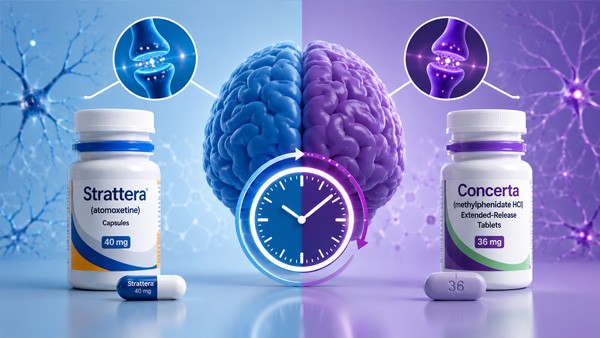
Concerta and Strattera are two of the most prescribed daily ADHD medications globally — Concerta as the most successful long-acting methylphenidate formulation through the OROS osmotic-controlled release technology, Strattera as the first FDA-approved non-stimulant alternative. Both provide once-daily morning dosing, both have FDA approval for pediatric and adult ADHD, both have been on the market long enough (Concerta since 2000, Strattera since 2002) for extensive real-world experience to inform prescribing decisions. The choice between them often comes down to whether predictability (Strattera's smooth continuous coverage with minimal abuse liability) or punch (Concerta's recognizable methylphenidate efficacy with clear effect window) matches the specific patient situation. Pediatric vs adult considerations differ meaningfully, family preferences about controlled substances drive many decisions, and tolerance development patterns over years matter for long-term management.
This guide compares Strattera and Concerta on every dimension that matters for the ADHD treatment decision. We cover the fundamental class difference between non-stimulant SNRI and extended-release methylphenidate, the OROS technology that makes Concerta different from other methylphenidate formulations, why Concerta produces clinical effect within hours while Strattera takes weeks, head-to-head effectiveness data with separate pediatric and adult analyses, side effect comparison focused on the dimensions parents and patients most ask about (cardiovascular, sleep, appetite), tolerance development patterns over years of treatment, the structured switching protocol for transitioning between them, pediatric-specific considerations that affect first-line choice in children, four family-priority classifications that map treatment priorities to medication choice, the Concerta OROS technology explained in technical detail, the school-day hour-by-hour profile comparison for parents evaluating pediatric treatment, and the bottom-line "predictability vs punch" framework for making the decision.
| Dimension | Strattera (atomoxetine) | Concerta (methylphenidate ER) |
|---|---|---|
| Predictability | ▰▰▰▰▰ (max) | ▰▰▰▱▱ |
| Punch (effect intensity) | ▰▰▱▱▱ | ▰▰▰▰▱ |
| Onset speed | ▰▱▱▱▱ (4-6 weeks) | ▰▰▰▰▰ (60 min) |
| Duration | ▰▰▰▰▰ (24 hr) | ▰▰▰▰▱ (10-12 hr) |
| Subjective subtlety | ▰▰▰▰▰ (very subtle) | ▰▰▱▱▱ (recognizable) |
| Abuse liability | ▰▱▱▱▱ (minimal) | ▰▰▰▰▱ (Schedule II) |
| Cardiovascular gentleness | ▰▰▰▰▰ | ▰▰▱▱▱ |
| Sleep friendliness | ▰▰▰▰▰ | ▰▰▰▱▱ |
| Appetite preservation | ▰▰▰▰▱ | ▰▰▱▱▱ |
| Effect size (ADHD-RS) | d ~0.6-0.7 | d ~0.9-1.1 |
| Tolerance over years | Slow / minimal | Gradual / manageable |
| Crash / wear-off | None | Mild late afternoon |
| Pediatric long-term safety | ▰▰▰▰▱ (SI black box) | ▰▰▰▰▱ (growth effect) |
| Prescription convenience | ▰▰▰▰▰ (no Sch II hassle) | ▰▰▱▱▱ (monthly visits) |
| Generic available | Yes (atomoxetine) | Yes (methylphenidate ER OROS) |
Strattera maxes out on predictability, gentleness, and convenience; Concerta wins on raw efficacy and speed of effect. The two medications represent the two ends of the ADHD treatment spectrum — "smooth and subtle" vs "clear and punchy." Neither is universally better; patient priorities determine which trade-off fits.
🧬 Class Difference: NRI vs Methylphenidate ER
The fundamental class distinction shapes everything else in the comparison:
Strattera (atomoxetine) — Non-Stimulant SNRI:
- Selective norepinephrine reuptake inhibitor. Atomoxetine binds the norepinephrine transporter (NET) with high selectivity, preventing reuptake and increasing NE signaling throughout the brain.
- Indirect prefrontal dopamine effect. NET handles dopamine reuptake in prefrontal cortex (DAT density is lower there), so atomoxetine indirectly increases prefrontal dopamine — but only in PFC, not in nucleus accumbens.
- No reward-system activation. No nucleus accumbens dopamine elevation, no subjective rewarding effect, no abuse liability. Schedule IV/non-scheduled status reflects genuinely low abuse risk.
- Continuous 24-hour coverage. Half-life ~5 hours but steady-state coverage with daily dosing produces continuous norepinephrine modulation.
- FDA approval: 2002 (Eli Lilly); pediatric and adult ADHD indications.
Concerta (methylphenidate ER) — Long-Acting Stimulant:
- Methylphenidate via OROS osmotic-controlled release. Methylphenidate itself is a classical stimulant — dopamine and norepinephrine reuptake inhibitor (similar to but distinct from amphetamines). Concerta uses Alza Corporation's OROS technology to deliver methylphenidate gradually over 10-12 hours.
- Direct dopamine and norepinephrine reuptake inhibition. Methylphenidate blocks DAT and NET, increasing both dopamine and norepinephrine in synaptic clefts throughout the brain.
- Reward-system activation. Methylphenidate elevates dopamine in nucleus accumbens, producing rewarding subjective effect and creating abuse liability. Schedule II reflects this real risk.
- 10-12 hour bell-curve coverage. OROS technology releases methylphenidate in a ramped pattern: initial 22% immediate release, then gradual release over remaining 10-12 hours. Single morning dose covers school/work day.
- FDA approval: 2000 (Alza/J&J then Janssen); pediatric (6+) and adult ADHD.
The mechanism comparison summary:
- Both medications improve ADHD symptoms through enhanced norepinephrine and dopamine signaling.
- Only Concerta engages the reward system via nucleus accumbens dopamine elevation, which is why Concerta is Schedule II while Strattera isn't.
- Methylphenidate is mechanistically different from amphetamine — pure reuptake inhibition without vesicular release. This is why methylphenidate is generally considered slightly "cleaner" than amphetamine even though both produce similar clinical effects.
- Long-term tolerance differs. Methylphenidate tolerance development real but gradual; atomoxetine tolerance less notable.
- Subjective experience differs. Concerta produces recognizable methylphenidate effect (focus enhancement, alertness boost); Strattera produces subtle "ADHD symptoms get easier without feeling like I'm on anything."
⚡ Why Concerta Hits Faster
The dramatic onset speed difference between Concerta and Strattera reflects their fundamentally different pharmacology:
Concerta onset:
- 22% immediate-release coating begins absorption within minutes of swallowing.
- Detectable effect within 30-60 minutes. Patient feels improvement on first dose.
- Peak effect 1-3 hours after dose (initial peak).
- Second peak around 6-9 hours as OROS technology releases remaining methylphenidate gradually.
- Wear-off 10-12 hours after dose.
- Same-day clinical response — patients and parents notice improvement on day 1.
- Dose titration possible week-by-week based on observed response.
Strattera onset:
- No acute subjective effect on first dose. Patient doesn't feel anything.
- Plasma steady-state reached 1-2 weeks of consistent daily dosing.
- Initial benefit detectable 1-2 weeks — modest improvement in attention.
- Significant clinical effect 2-4 weeks.
- Full therapeutic effect 4-6 weeks of consistent dosing.
- No same-day response. Patients must commit to consistent daily dosing for weeks before judging effectiveness.
- Dose titration over 2-4 weeks with delayed assessment of response at each dose level.
The onset speed difference has significant practical implications:
- Concerta produces measurable response in trial period that families can assess. Pediatrician can prescribe, family observes for 1-2 weeks, makes decision about continuation.
- Strattera requires extended trial commitment. Families must commit to 6-week trial before knowing if medication works. Many patients abandon Strattera before reaching therapeutic effect.
- Concerta dose titration is observable. Increase dose, observe response within days.
- Strattera dose titration is gradual. Increase dose, wait 2-4 weeks for new steady state and response assessment.
- Concerta allows weekend off-days. Each dose works on its own; skipping doesn't disrupt long-term effect.
- Strattera requires daily adherence. Missing doses disrupts steady state; weekend off-days don't work the same way.
- Concerta produces visible "on/off" experience for families to observe behavioral differences.
- Strattera produces gradual functional improvement that parents may notice indirectly through school feedback, behavior reports, etc.
📊 Effectiveness Data: Children vs Adults
Head-to-head and indirect comparison evidence:
Pediatric ADHD evidence:
- Concerta pediatric pivotal trials: Effect sizes Cohen's d 0.9-1.2 on ADHD-RS. Multiple RCTs since approval. Robust evidence base.
- Strattera pediatric pivotal trials: Effect sizes Cohen's d 0.6-0.7 on ADHD-RS. FDA-approved from age 6.
- Head-to-head pediatric comparison studies (Newcorn et al., others): Concerta produced larger response rates and larger symptom reduction than Strattera. Approximately 75% of patients preferred to continue Concerta over Strattera after sequential trials.
- Real-world pediatric data: Approximately 70-80% of pediatric ADHD patients respond to methylphenidate-class stimulants (Concerta, Ritalin, etc.); 60-70% respond to Strattera.
Adult ADHD evidence:
- Concerta adult trials: Effect sizes Cohen's d 0.8-1.0 on AISRS. FDA-approved for adult ADHD.
- Strattera adult trials: Effect sizes Cohen's d 0.4-0.6 on adult ADHD scales.
- Effect size gap larger in adults than pediatrics. Stimulants' advantage over non-stimulants more pronounced in adult population.
- Adult response patterns: Adults often show more robust response to stimulants than non-stimulants partly due to greater executive function impairment that stimulants address more directly.
Effect dimension differences:
- Inattention: Concerta produces larger improvement; Strattera produces meaningful but smaller improvement.
- Hyperactivity / impulsivity: Concerta produces clear improvement; Strattera less pronounced effect.
- Executive function: Concerta produces larger improvement in task initiation, planning, working memory.
- Emotional dysregulation: Strattera produces relatively larger improvement on emotional regulation compared to its inattention effect. Children with prominent emotional symptoms may benefit relatively more from Strattera.
- Tic exacerbation: Strattera lower risk; Concerta possible.
- Comorbid anxiety: Strattera may improve; Concerta can worsen.
⚠️ Side Effects: Heart, Sleep, Appetite
The three side-effect dimensions parents and patients most ask about:
Cardiovascular:
- Strattera: +2-5 bpm heart rate, +1-3 mmHg blood pressure. Mild and clinically modest in most patients.
- Concerta: +5-15 bpm heart rate, +3-10 mmHg blood pressure. Greater than Strattera, less than Adderall.
- Pediatric cardiac considerations: Both medications require baseline cardiac assessment in children with relevant history. Concerta has FDA boxed warning for sudden cardiac events in pediatric patients with structural cardiac abnormalities; Strattera has more general cardiovascular caution.
- Long-term cardiovascular effects: Both medications have established long-term cardiovascular safety in patients without pre-existing cardiac disease.
Sleep:
- Strattera: Insomnia ~15-20%. Generally well-tolerated for sleep. Some patients sleep better on Strattera due to reduced ADHD-related racing thoughts.
- Concerta: Insomnia ~25-30%. Worse than Strattera for sleep. Critical: morning dosing only — typically by 07:00-08:00 for school-age children with normal bedtimes.
- Concerta sleep impact often improves over 4-8 weeks as tolerance develops.
- Strattera doesn't typically require sleep-time-based dosing decisions.
Appetite:
- Strattera: Appetite suppression ~15-20%. Modest weight effects.
- Concerta: Appetite suppression ~25-35%. Often clinically significant. Weight loss common in first 6 months.
- Pediatric growth considerations: Concerta produces small but real growth velocity reduction over years (~1-2 cm height reduction long-term). Strattera produces smaller effect on growth.
- Practical management: Both medications benefit from structured eating schedule, especially Concerta. Pre-medication breakfast, scheduled lunch even without hunger, evening "catch-up" meal when medication wears off.
| Side effect | Strattera | Concerta |
|---|---|---|
| Headache | ~15-20% | ~15-20% |
| Insomnia | ~15-20% | ~25-30% |
| Appetite suppression | ~15-20% | ~25-35% |
| Nausea | ~25-30% | ~10-15% |
| Heart rate increase | +2-5 bpm | +5-15 bpm |
| BP increase | +1-3 mmHg | +3-10 mmHg |
| Anxiety | ~5-10% | ~10-15% |
| Tic exacerbation | Less risk | Possible |
| Pediatric growth effect | Smaller | ~1-2 cm long-term |
| Sexual dysfunction | ~10-15% | ~5% |
| Pediatric SI black box | YES | No |
| Cardiovascular boxed warning | No | YES (sudden cardiac events) |
| Abuse liability | Minimal | Schedule II |
| Crash / wear-off | None | Mild late afternoon |
📈 Tolerance and Tachyphylaxis
Tolerance development over years of treatment differs between the medications:
Concerta tolerance pattern:
- Initial response often robust. Most pediatric patients show clear improvement at therapeutic dose.
- Tolerance develops gradually over months to years. Patients may need dose increases to maintain response.
- Plateau at higher doses. Above 72 mg/day (max approved adult dose), additional dose increases produce diminishing returns.
- Tachyphylaxis (acute tolerance) within day. Methylphenidate effect can attenuate slightly across the day even with sustained-release formulation.
- Drug holidays may help reset. Weekend breaks or summer breaks (for school-age) may preserve sensitivity. Less applicable for adults with continuous work demands.
- Long-term effect maintenance: ~60-70% of patients maintain meaningful response over 3-5 years.
Strattera tolerance pattern:
- Gradual onset over 4-6 weeks as steady-state plasma levels build.
- Tolerance development less notable than with stimulants. Most patients maintain response without dose escalation.
- No tachyphylaxis within day due to steady-state coverage.
- Drug holidays don't help and disrupt treatment.
- Long-term effect maintenance: ~70-80% of responders maintain response over 3-5 years (among those who reach therapeutic effect).
Tolerance management strategies:
- For Concerta tolerance: Dose increase within FDA-approved range, brief drug holidays (with physician input), switching to different stimulant formulation, adding behavioral intervention to reduce medication dependence.
- For Strattera tolerance: Less common need. Dose increase to maximum tolerated dose; if response lost, reassess for other factors (poor adherence, dose timing, comorbidities).
- Switching between Concerta and Strattera can reset response for tolerance-affected patients.
🔁 Switching Between Them
Patients sometimes need to switch between Concerta and Strattera. Protocols for each direction:
Switching from Concerta to Strattera:
- Day 0: Last Concerta dose at normal morning time.
- Day 1: Start Strattera 40 mg morning. Expect mild Concerta withdrawal — slight fatigue, mood drop, possible rebound hyperactivity for 2-3 days.
- Week 2: Titrate Strattera to 60-80 mg morning.
- Weeks 3-6: Strattera effect gradually emerging. ADHD symptoms typically uncontrolled or partially controlled during this transition.
- Week 6+: Steady-state Strattera response. Assess whether switch successful.
- Caution: Plan reduced demanding cognitive commitments during weeks 1-4 of transition.
Switching from Strattera to Concerta:
- Day 0: Last Strattera dose at normal morning time.
- Days 1-7: Strattera effect gradually diminishes over 1-2 weeks; no acute withdrawal.
- Day 1 or Day 8: Start Concerta — physician decides timing. Some prefer immediate switch; others prefer 1-week washout.
- Starting Concerta dose: Typically 18 mg morning (pediatric) or 36 mg morning (adult). Acute effect on first dose.
- Week 2-4: Stable Concerta regimen established with possible dose adjustments.
- Considerations: Schedule II prescribing logistics begin (monthly visits, no refills, PDMP tracking).
👶 Pediatric Use: Which to Pick
Pediatric considerations often differ from adult considerations and warrant specific attention:
Factors favoring Concerta for pediatric ADHD:
- Largest effect size for pediatric ADHD among non-amphetamine options.
- Same-day response allows family to assess medication trial within 1-2 weeks rather than committing to 6-week Strattera trial.
- Decades of pediatric experience — extensive long-term safety and effectiveness data.
- Established prescribing comfort among pediatricians.
- Coverage from school day morning into homework time evening.
- Tablet form factor swallowable for most children age 6+ (cannot be split or crushed without losing OROS function).
- No pediatric SI black box warning (Strattera has one).
Factors favoring Strattera for pediatric ADHD:
- No abuse liability concerns. Particularly relevant for families with substance abuse history.
- Continuous 24-hour coverage — covers early morning routines and evening activities.
- Gentler cardiovascular profile — relevant for children with mild cardiovascular concerns.
- Less appetite suppression — relevant for children with eating concerns or low growth velocity.
- Less tic exacerbation risk — appropriate for children with comorbid tic disorder.
- Less anxiety amplification — relevant for children with comorbid anxiety.
- No Schedule II prescribing complications — easier prescription management for families.
- Capsule can be opened — easier for children who can't swallow tablets.
Special pediatric scenarios:
- Child with comorbid anxiety: Strattera often preferred. Concerta can worsen anxiety.
- Child with tic disorder: Strattera preferred. Concerta can exacerbate tics.
- Child with significant growth concerns: Strattera preferred due to lesser growth effects.
- Child from family with substance abuse history: Strattera often preferred for lower abuse liability.
- Child who needs evening coverage (homework, sports): Strattera covers; Concerta wears off in evening.
- Child where family wants quick assessment of medication effectiveness: Concerta allows same-day response assessment.
- Adolescent at higher risk for substance experimentation: Strattera may be preferred to reduce home access to stimulant.
👨👩👧 Family Priority Profile Classification
Four family priority profiles that drive different medication choices:
Profile 1 — "Effectiveness-First Family." Family's primary priority is maximum ADHD symptom control. Accepts higher side effects, Schedule II logistics, and abuse considerations in exchange for stronger clinical response. Recommendation: Concerta first-line. Discuss Strattera as fallback if Concerta doesn't work or causes problems.
Profile 2 — "Safety-First Family." Family's primary concern is gentleness — minimizing cardiovascular impact, abuse risk, weight loss, growth effects, and side effect burden. Accepts smaller effect size in exchange for safer profile. Recommendation: Strattera first-line. Plan adequate trial (6-8 weeks) before considering Concerta if Strattera response inadequate.
Profile 3 — "Convenience-First Family." Family prioritizes ease of medication management — no monthly pharmacy visits, telehealth prescribing, no controlled-substance restrictions, no weekend dosing decisions. Recommendation: Strattera first-line. The Schedule II prescription friction of Concerta affects family quality of life significantly.
Profile 4 — "Cost-First Family." Family with limited insurance or out-of-pocket payment situation. Generic atomoxetine generally cheaper than generic methylphenidate ER. Recommendation: Generic atomoxetine. Clinical effectiveness should still drive primary decision, but cost matters for sustained treatment.
| Family priority | Profile | Recommended | Rationale |
|---|---|---|---|
| Profile 1 (Effectiveness) | Max symptom control | Concerta first-line | Larger effect size |
| Profile 2 (Safety) | Gentle profile priority | Strattera first-line | Safer overall |
| Profile 3 (Convenience) | Easy management priority | Strattera first-line | No Schedule II friction |
| Profile 4 (Cost) | Budget concerns | Generic atomoxetine | Cheaper generic |
🔬 Concerta OROS Osmotic Release Technology Explained
Concerta's unique OROS (Osmotic Release Oral System) technology distinguishes it from other methylphenidate ER formulations:
- Tablet structure: Outer coating contains 22% of total methylphenidate dose for immediate release. Inner core is bilayer osmotic pump containing remaining 78% of dose plus osmotically active agents.
- Release mechanism: Outer coating dissolves rapidly in stomach acid, providing immediate 22% dose. Inner osmotic pump activates as water enters through laser-drilled hole; methylphenidate is pushed out through second laser-drilled hole at controlled rate over 10-12 hours.
- Bimodal plasma curve: Initial peak from immediate-release coating (1-2 hours post-dose), then sustained ascending levels from osmotic pump (peak 6-9 hours post-dose).
- Cannot be split, crushed, or chewed. Doing so destroys OROS technology and produces immediate-release methylphenidate from entire dose — defeats long-acting design and creates abuse potential.
- Ghost tablet excreted: The OROS shell is excreted intact in stool after drug release. This is normal and expected.
- Food effect minimal: Can be taken with or without food without significantly affecting absorption.
- Generic OROS available 2013+: Generic methylphenidate ER OROS formulations available, though some pharmaceutical experts argue minor differences exist between brand and generic OROS performance.
Why OROS matters clinically:
- Smoother plasma curve than other ER methylphenidate formulations (Ritalin LA, Metadate CD).
- Bimodal effect with morning peak (good for school start) and afternoon peak (good for late school/homework hours).
- Once-daily dosing covers school day reliably.
- Tamper-resistant design reduces some abuse routes.
- Predictable behavior across patients due to controlled-release engineering.
🎒 School-Day Hour-by-Hour Profile
For pediatric ADHD treatment, the school-day timing matters. Both medications side-by-side from morning through bedtime:
| Time (07:00 dose) | Strattera school-day effect | Concerta school-day effect |
|---|---|---|
| 07:00 (medication, breakfast) | Take morning dose; no acute effect | Take morning dose with breakfast; 22% IR begins |
| 07:30 (getting ready) | Continuous coverage active | IR coating dissolving |
| 08:00 (commute to school) | Continuous coverage active | Onset detectable |
| 08:30 (school start) | Continuous coverage active | Clear effect; focus emerging |
| 09:00-11:00 (morning classes) | Steady continuous function | Approaching first peak |
| 11:00 (mid-morning) | Steady function | First peak; strong focus |
| 12:00 (lunch) | Steady; usually adequate appetite | Lunch difficult — appetite suppressed |
| 13:00-15:00 (afternoon classes) | Steady continuous function | OROS releasing; sustained effect |
| 15:00 (school end) | Steady function continues | Approaching second peak (~6-9 hr) |
| 15:00-17:00 (after-school activities, homework) | Continuous coverage supports activities | Strong sustained effect; good for homework |
| 17:00-19:00 (early evening, dinner) | Continuous coverage; normal appetite | Effect tapering; appetite returning; eat well |
| 19:00-21:00 (evening activities) | Continuous coverage active | Mostly worn off; possible mild rebound |
| 21:00 (bedtime preparation) | Active; doesn't typically affect sleep | Cleared; sleep usually unaffected |
| 22:00 (sleep) | Continuous coverage | Drug cleared |
| Next morning | Take next dose; continuous | Take next dose; previous dose gone |
School-day takeaways:
- Strattera covers morning routines and evening activities beyond Concerta's window.
- Concerta's bimodal peaks align well with school day — first peak in morning classes, second peak in afternoon classes/homework.
- Lunch is harder on Concerta due to appetite suppression during peak hours. Many Concerta children eat poorly at school lunch and "catch up" at evening meal when medication clears.
- Homework time: Concerta still active for after-school homework (3-5 PM). Strattera covers same window with continuous effect.
- Bedtime: Both typically don't disrupt sleep with morning dosing.
- Sports/activities late afternoon: Concerta typically still active; Strattera continuously covers.
✨ Bottom Line: Predictability vs Punch
The Strattera vs Concerta choice is fundamentally about choosing your trade-off position on the ADHD treatment spectrum. Strattera = predictability + gentleness + convenience + smaller effect size + 4-6 week onset. Concerta = punch + recognizable effect + larger effect size + Schedule II logistics + appetite/sleep impact. Both are FDA-approved, both have extensive evidence base, both are widely prescribed. Neither is universally better; patient and family priorities drive the appropriate choice.
For raw ADHD efficacy: Concerta wins. Effect sizes Cohen's d 0.9-1.1 vs Strattera's 0.6-0.7. Larger response rates (~75% vs ~65%). Larger improvement in inattention, hyperactivity, and executive function. For pediatric patients without specific risk factors, Concerta is generally first-line by clinical guidelines.
For gentleness, abuse-free profile, continuous coverage, and prescription convenience: Strattera wins. Minimal abuse liability vs Concerta's Schedule II controlled substance status. Gentler cardiovascular profile, less sleep disruption, less appetite suppression, smaller pediatric growth effect. 24-hour continuous coverage vs Concerta's 10-12 hour window. Standard prescribing convenience without Schedule II monthly visit/no-refill restrictions.
The four family priority profiles map common decision contexts: Effectiveness-First → Concerta. Safety-First → Strattera. Convenience-First → Strattera. Cost-First → Generic atomoxetine. These priorities matter as much as clinical effectiveness data for the final family decision.
For pediatric ADHD specifically: Concerta is more commonly first-line due to larger effect size, decades of pediatric experience, and same-day response that allows family assessment of medication trial. Strattera is reasonable first-line for specific scenarios: comorbid anxiety, tic disorders, growth concerns, family substance abuse history, or family preference for non-controlled substance. The decision benefits from informed family discussion with pediatrician evaluating individual child's situation.
For adult ADHD: Concerta is typically first-line with somewhat larger effect size advantage than in pediatric population. Strattera reasonable for adults with specific risk factors making stimulants problematic. Most adults experience clearer subjective benefit from Concerta's recognizable methylphenidate effect; some adults prefer Strattera's subtle continuous function.
Concerta's OROS osmotic release technology provides smoother plasma curve than other ER methylphenidate formulations, with bimodal peaks aligning well with school day demands. The technology is sophisticated pharmaceutical engineering that has held up well across two decades of clinical use.
For broader ADHD treatment context including alternative options when neither Concerta nor Strattera provides adequate response, see our comprehensive Modafinil for ADHD article (third-line off-label option). For other Strattera comparisons, see Strattera vs Adderall and Strattera vs Vyvanse. For methylphenidate vs other classes, see Modafinil vs Ritalin.
For modafinil as third-line alternative when both Concerta and Strattera prove inadequate, Modalert 200 mg from Sun Pharma provides Schedule IV off-label option that some ADHD patients use successfully despite smaller effect size than either Concerta or Strattera.
❓ Frequently Asked Questions
Is Concerta more effective than Strattera?
Yes, on average. Concerta produces larger effect sizes on ADHD rating scales (Cohen's d 0.9-1.1) than Strattera (Cohen's d 0.6-0.7) across both pediatric and adult populations. Approximately 75% of patients respond to Concerta vs 65% to Strattera. The effect size gap is real and clinically meaningful. However, Strattera works well for substantial subset including patients with substance abuse concerns, cardiovascular issues, comorbid anxiety, tic disorders, or specific preference for non-controlled medication.
How long does it take to see if Concerta works?
Same day for initial response. Concerta produces detectable effect within 30-60 minutes of first dose and clear clinical effect within 1-7 days. Dose titration can be assessed week-by-week. This is fundamentally different from Strattera, which requires 4-6 weeks of consistent daily dosing for full therapeutic effect. The same-day response pattern allows families to assess pediatric medication trials much faster with Concerta than Strattera.
Will my child grow normally on Concerta?
Mostly yes, with small reduction. Concerta produces approximately 1-2 cm reduction in adult height over many years of pediatric treatment compared to expected growth trajectory. This effect is real but small in magnitude. Strattera produces smaller growth effects. For children with significant growth concerns or low growth velocity, Strattera may be preferred. Most children on Concerta achieve growth within normal range despite the modest medication effect. Regular growth monitoring during pediatric ADHD treatment is standard practice.
Can Concerta be split or crushed?
No. Concerta uses OROS osmotic release technology that requires intact tablet structure. Splitting, crushing, or chewing the tablet destroys the controlled release mechanism and produces immediate release of the full methylphenidate dose — defeating the long-acting design and creating both abuse potential and excessive acute effect. The OROS shell is excreted intact in stool after drug release (this is normal). Children who can't swallow tablets should use alternative formulations (Ritalin LA capsules can be opened; Methylin chewable; liquid methylphenidate) rather than Concerta.
Does Strattera work for hyperactive children?
Yes, but less robustly than Concerta. Strattera produces meaningful but smaller improvement in hyperactivity and impulsivity dimensions compared to Concerta. For children with prominent hyperactive/impulsive ADHD presentation, Concerta typically produces more dramatic improvement. For children with predominantly inattentive ADHD or with comorbid conditions favoring non-stimulants (anxiety, tics), Strattera is reasonable choice. Many pediatric ADHD patients respond well to either medication, but the response pattern differs.
Why does Concerta require monthly pharmacy visits?
Federal Schedule II controlled substance regulations prohibit refills on Schedule II prescriptions. Each Concerta prescription requires a new written prescription, can be maximum 90-day supply (varies by state), cannot be telephoned in for new scripts, and is tracked in state Prescription Drug Monitoring Programs. These regulations exist due to methylphenidate's abuse potential. Strattera (Schedule IV or non-scheduled) doesn't have these restrictions — standard refills allowed, telehealth prescribing widely available, no PDMP friction.
Can I take Strattera and Concerta together?
Generally not standard practice. Direct combination is uncommon — the medications would be used alone or sequentially. Some specialists prescribe combination therapy for selected treatment-resistant ADHD cases (typically morning stimulant + non-stimulant for continuous coverage), but this is specialist territory. The mechanism overlap means combination produces additive effects on cardiovascular, anxiety, and sleep dimensions. Patients shouldn't combine these medications without explicit physician direction.
Does Concerta work for adult ADHD?
Yes — Concerta is FDA-approved for adult ADHD and produces effect sizes Cohen's d 0.8-1.0 in adult populations. Many adults find Concerta's bimodal coverage (morning peak through afternoon peak) fits their work schedule well. Adult Concerta dosing typically 36-72 mg morning. Some adults find the late-afternoon wear-off problematic for evening activities; others appreciate the clear "off" experience that allows non-medicated evening time with family. Adult ADHD treatment increasingly recognizes long-acting stimulants like Concerta as appropriate first-line options.
What if my child can't tolerate Concerta side effects?
Several options: (1) dose reduction may resolve side effects while maintaining adequate ADHD response; (2) switching to different stimulant class (Adderall/Vyvanse amphetamines vs methylphenidate-based) — some children tolerate one class better than other; (3) switching to non-stimulant (Strattera, guanfacine, clonidine, viloxazine) — appropriate for children whose stimulant side effects are intolerable; (4) addressing specific side effects with targeted interventions (eating schedule for appetite, sleep hygiene for insomnia, etc.). Discuss with pediatrician — abandoning ADHD treatment entirely is rarely the best response.
Which is cheaper — Strattera or Concerta?
Generic atomoxetine is generally cheaper than generic methylphenidate ER OROS at US retail. Cash prices approximately $30-80/month atomoxetine vs $60-150/month methylphenidate ER OROS. With insurance coverage, copays often similar at standard generic tier (~$5-30). Brand-name Strattera and brand-name Concerta both run $300-450/month at US retail. For cost-sensitive families, generic atomoxetine offers meaningful savings. Schedule II Concerta prescription friction (monthly pharmacy visits) is also a real time/inconvenience cost beyond medication price.
📚 References & Further Reading
- FDA prescribing information for Strattera (atomoxetine) — official drug profile and warnings.
- FDA prescribing information for Concerta (methylphenidate ER OROS) — official drug profile and OROS technology.
- Michelson et al., Pediatrics — atomoxetine pediatric pivotal trials.
- Wolraich et al. — Concerta pediatric efficacy trials.
- Newcorn et al., Journal of the American Academy of Child & Adolescent Psychiatry — head-to-head pediatric comparison.
- Spencer et al. — methylphenidate adult ADHD trials.
- Adler et al., Biological Psychiatry — adult Strattera trials.
- Faraone et al., European Neuropsychopharmacology — meta-analyses of ADHD medication effect sizes.
- Swanson et al., Journal of Clinical Psychopharmacology — OROS technology and pharmacokinetics.
- American Academy of Pediatrics — ADHD clinical practice guidelines.
- American Psychiatric Association — practice guidelines for ADHD treatment.
- CADDRA (Canadian ADHD Resource Alliance) — ADHD treatment algorithm.
- NICE clinical guideline NG87 — ADHD UK guidelines.
- Alza Corporation OROS technology documentation — controlled release pharmaceutical engineering.
- MTA Study (Multimodal Treatment of ADHD) — long-term pediatric outcomes data.
- Strattera vs Adderall 2026 — companion non-stimulant vs amphetamine comparison.
- Strattera vs Vyvanse 2026 — companion non-stimulant vs prodrug comparison.
- Modafinil for ADHD — off-label third-line option.
- Modafinil vs Ritalin — modafinil vs methylphenidate comparison.
- Modafinil vs Vyvanse, Modafinil vs Armodafinil, Modafinil vs Caffeine — broader comparison articles.
- Modafinil for Students, Modafinil for Programmers, Modafinil for Entrepreneurs, Modafinil for Depression — companion use-case articles.
- Modalert 200 mg, Modvigil 200 mg, Waklert 150 mg — primary product pages on the RXshop antinarcoleptic catalogue.
- RXshop Editorial Team — content reviewed by licensed pharmacist; for adult patient education, not a substitute for individual medical consultation.
Medical Disclaimer: The information in this article is for educational and informational purposes only and is not a substitute for professional medical advice, diagnosis, or treatment. Always seek guidance from a qualified healthcare provider with any questions you may have regarding a medical condition, and before starting, stopping or changing any medication.