Strattera Once Daily vs Twice Daily: Splitting the Dose

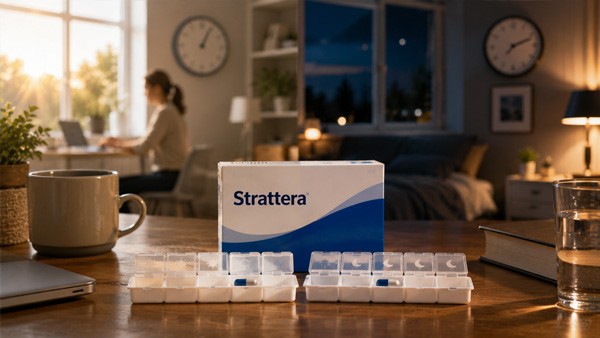

Strattera (atomoxetine) is FDA-approved as a once-daily medication, but clinical experience and prescriber practice patterns have established that splitting the daily dose into morning and afternoon doses can benefit certain patient populations — particularly those experiencing significant peak-dose side effects, those with CYP2D6 slow metabolizer phenotype, those with strong CYP2D6 inhibitor co-medications elevating atomoxetine levels, and those finding once-daily evening dosing disrupts sleep while morning dosing produces unwanted daytime peak effects. The pharmacological basis for splitting: atomoxetine has a relatively short half-life (~5 hours in extensive metabolizers, ~22 hours in poor metabolizers); a once-daily dose produces a peak concentration roughly 1-2 hours after ingestion followed by gradual decline through the day. Splitting the dose (e.g., 40 mg morning + 40 mg afternoon instead of 80 mg morning) produces two smaller peaks rather than one larger peak, smoothing the plasma concentration curve, reducing peak-related side effects, and providing more consistent therapeutic coverage. The trade-off: twice-daily dosing has lower adherence than once-daily, requires more planning, and isn't necessary for most patients who do well with once-daily dosing.
This guide provides comprehensive information about Strattera once-daily vs twice-daily dosing decisions for adult patients and prescribers. We address the FDA-approved once-daily standard and its rationale, why some patients benefit from split dosing despite labeling, specific side effect reduction patterns with splitting, why CYP2D6 slow metabolizers benefit most from splitting (pharmacokinetic explanation), situations where once-daily is clearly better, practical scheduling for twice-daily (8 AM + 4 PM typical), how to switch back to once-daily if twice-daily isn't necessary, four candidate profile archetypes for who should consider splitting, plasma level curve comparison between dosing schedules, adherence strategies for twice-daily dosing (the main practical disadvantage), and the bottom-line framework for this dose schedule decision.
📅 Once-daily 80 mg (FDA-approved standard):
• 8 AM: Take 80 mg with breakfast
• 9-10 AM: Peak plasma concentration
• 11 AM - 2 PM: Plateau therapeutic level
• 3 PM - 8 PM: Gradual decline
• 9 PM - 8 AM next: Trough levels
• Pros: Simple, best adherence, FDA-approved
• Cons: Peak side effects 1-3 hours after dose; less consistent coverage
📅 Twice-daily split 40 mg + 40 mg:
• 8 AM: Take 40 mg with breakfast
• 9-10 AM: First peak (lower than once-daily peak)
• 11 AM - 3 PM: Levels decline as morning dose wanes
• 4 PM: Take second 40 mg with snack
• 5-6 PM: Second peak
• 7 PM - 11 PM: Gradual evening decline
• Pros: Smoother plasma curve, reduced peak side effects, better consistent coverage
• Cons: Two doses to remember; lower adherence; afternoon dose may affect sleep
🎯 Who should consider splitting:
CYP2D6 poor metabolizers / strong CYP2D6 inhibitor co-medications / significant peak-related side effects on once-daily / patients seeking smoother coverage
🚫 Who should stick with once-daily:
Patients doing well on once-daily / patients with adherence concerns / patients with afternoon dosing impractical / those with sleep issues from afternoon Strattera
📋 FDA-Approved Dosing: Once Daily
The standard FDA-approved once-daily protocol:
- FDA approval based on once-daily dosing: Clinical trials used once-daily; labeling reflects this.
- Standard adult dose: 40 mg starting → 80 mg target → up to 100 mg maximum, all taken once daily.
- Standard pediatric dose: Weight-based once daily.
- Morning preferred for most patients — covers school/work day.
- Evening alternative for some patients with morning intolerance.
Why FDA approval is once-daily:
- Long-acting effect: Despite ~5 hour half-life in normal metabolizers, ADHD symptom coverage extends throughout day.
- Therapeutic effect not requiring constant plasma levels: Continuous noradrenergic effect achieved with once-daily dosing.
- Adherence advantage: Single daily dose easier to remember.
- Clinical trial design simplicity.
- Established effectiveness across all studied populations.
Once-daily dosing pharmacokinetics:
- Absorption: Complete from GI tract; peak plasma 1-2 hours.
- Distribution: Wide; crosses blood-brain barrier.
- Metabolism: Primarily CYP2D6 enzyme.
- Half-life extensive metabolizers: ~5 hours (most patients).
- Half-life poor metabolizers: ~22 hours (~7% of Caucasians).
- Steady state: 5-7 days for extensive metabolizers; longer for poor metabolizers.
Therapeutic effect with once-daily:
- Receptor effects sustained beyond plasma concentration time.
- Noradrenergic system effects persist through plasma decline.
- ADHD symptom coverage: Effective throughout day for most patients.
- Subtle peak vs trough variation: Most patients don't notice; some do.
Patient experience on once-daily:
- Take medication morning — typically with breakfast.
- ADHD benefits emerge over 4-6 weeks (not immediate).
- Side effects most prominent 1-3 hours after dose (peak time).
- Evening recovery — side effects diminished by evening.
- Sleep generally unaffected by morning dose for most patients.
🔀 Why Some Patients Split Doses
Reasons patients and prescribers consider split dosing:
- Peak-related side effects: Some patients experience significant nausea, fatigue, dizziness, or anxiety 1-3 hours after once-daily dose.
- CYP2D6 poor metabolizers: Higher peaks at same dose; smoother curve with splitting.
- Strong CYP2D6 inhibitor co-medication: Drug-induced equivalent of poor metabolizer status.
- Inconsistent symptom coverage: Some patients notice afternoon "wear off" effect.
- Sleep interference: Either morning dose with afternoon residual or evening dose with sleep disruption.
- Cardiovascular concerns: Lower peak BP/HR with split dosing.
Clinical scenarios where splitting often helps:
- Patient reports: "I feel awful for a few hours after my morning dose, but better afternoon." Peak side effects suggest splitting may help.
- Patient reports: "ADHD symptoms come back in afternoon despite morning dose." Trough symptoms suggest splitting may improve coverage.
- Patient on fluoxetine or paroxetine: CYP2D6 inhibition makes splitting more beneficial.
- Patient with documented CYP2D6 poor metabolizer status.
- Patient with significant cardiovascular sensitivity: Lower peaks beneficial.
- Patient reports nausea persisting beyond initial week: May reflect peak-related GI effects.
Pharmacological reasoning for splitting:
- Lower Cmax (peak concentration): ~50% reduction with half doses.
- More consistent therapeutic levels: Smoother curve.
- Better symptom coverage: Less afternoon trough.
- Reduced peak-related side effects: Side effect intensity correlates with peak concentration.
- Similar total daily exposure: AUC (area under curve) remains similar.
What splitting doesn't change:
- Total daily atomoxetine exposure: Same total drug delivered.
- 4-6 week therapeutic effect timeline: No faster onset with splitting.
- Maximum recommended dose: Still 100 mg total daily for adults; 1.4 mg/kg or 100 mg for pediatric.
- Drug interactions: Same interaction profile.
- Contraindications: MAOI absolute contraindication unchanged.
Prescribing patterns:
- Off-label twice-daily prescribing — common in clinical practice despite once-daily labeling.
- Insurance may question: Two prescriptions or unusual dosing pattern.
- Pharmacy may comment: Standard counseling on once-daily.
- Document rationale in chart: Off-label use justification.
- Patient education: Aware twice-daily is off-label clinical decision.
📉 Side Effect Reduction with Splitting
Specific side effects that often improve with splitting:
Peak-related side effects (most likely to improve):
- Nausea: Peak GI symptoms often reduced with smaller peaks.
- Dizziness: Particularly orthostatic; reduced with lower peaks.
- Fatigue/sedation peak: Most pronounced at peak; reduced with smaller peaks.
- Headache: Peak-related headaches may diminish.
- Cardiovascular effects: Lower peak BP/HR.
- Anxiety spikes: Peak-related anxiety may reduce.
- Tremor: Peak-related tremor may reduce.
Side effects less likely to improve with splitting:
- Decreased appetite: Total exposure similar; appetite may not improve.
- Constipation: Total exposure effect; may persist.
- Sexual side effects: Total exposure related; may persist.
- Sweating: Total exposure related.
- Sleep disruption: May actually worsen with afternoon dose.
Quantifying side effect changes with splitting:
- Peak side effects: Often 30-50% reduction in subjective intensity.
- Throughout day side effects: Modest changes only.
- Total side effect burden: Variable; some patients clearly better, others similar.
- Quality of life impact: Often improvement in those with significant peak side effects.
Specific patient-reported improvements with splitting:
- "I don't feel as bad in the morning anymore."
- "The nausea is much more manageable."
- "My focus stays more consistent throughout the day."
- "I don't notice the medication as much."
- "I can drive safely without feeling drugged."
Patient-reported issues with splitting:
- "I forget the afternoon dose." — Adherence challenge.
- "The afternoon dose disrupts my sleep." — Timing issue.
- "It's harder to remember two times." — Daily routine issue.
- "I don't see much difference." — Maybe not a splitting candidate.
🧬 CYP2D6 Slow Metabolizers Benefit Most
Why CYP2D6 slow metabolizers benefit most from splitting:
- CYP2D6 enzyme metabolizes atomoxetine — slow metabolizers clear drug slowly.
- Higher peak concentrations: 10-fold higher Cmax in poor metabolizers at same dose.
- Higher overall exposure (AUC): Sustained higher levels.
- Longer half-life: ~22 hours vs ~5 hours in normal metabolizers.
- More pronounced peak side effects: Higher peaks = worse peak side effects.
- Greater benefit from smoothing: Splitting flattens higher peaks more.
CYP2D6 phenotype distribution:
- Poor metabolizers (PM): ~7% Caucasians, ~2% Asians, ~5% Africans, lower in some populations.
- Intermediate metabolizers (IM): ~10-30% depending on ethnicity.
- Extensive metabolizers (EM, normal): Majority of patients.
- Ultra-rapid metabolizers (UM): Small percentage; may need higher doses.
How to identify CYP2D6 poor metabolizers:
- Genetic testing: Pharmacogenomic panels increasingly available.
-
Clinical signs suggestive of poor metabolizer:
- Severe side effects at low doses
- Effective response at lower-than-expected doses
- Family history of medication sensitivity
- Other CYP2D6 substrate sensitivities
- Failed prior atomoxetine trial with significant side effects: Worth checking CYP2D6 status.
- Direct-to-consumer genetic tests: 23andMe with pharmacogenomic add-ons.
Drug-induced CYP2D6 inhibition (clinical equivalent of poor metabolizer):
-
Strong CYP2D6 inhibitors:
- Fluoxetine (Prozac)
- Paroxetine (Paxil)
- Bupropion (Wellbutrin)
- Quinidine
- CBD (cannabidiol) — increasingly relevant
- Cinacalcet
- Effect: Phenotypic conversion to poor metabolizer status.
- Strattera dose typically reduced by ~75% with strong inhibitors.
- Splitting beneficial in these patients similar to genetic poor metabolizers.
Pharmacokinetic comparison — CYP2D6 EM vs PM with twice-daily:
- Extensive metabolizer once-daily 80 mg: Peak ~500 ng/mL; trough ~50 ng/mL.
- Extensive metabolizer twice-daily 40 + 40 mg: Peaks ~300 ng/mL each; smoother curve.
- Poor metabolizer once-daily 80 mg: Peak ~5000 ng/mL; much higher trough.
- Poor metabolizer twice-daily 40 + 40 mg: Peaks ~3000 ng/mL each; still high but smoother.
- Quantitative benefit: Poor metabolizers see larger absolute reduction in peak with splitting.
Practical recommendations for CYP2D6 poor metabolizers:
- Lower target dose: Often 40 mg total daily sufficient.
- Slower titration: Smaller dose increments, longer adaptation.
- Splitting more beneficial: Especially if total dose >40 mg.
- Lower maximum dose: 60 mg often maximum useful; 80-100 mg excessive.
- Pharmacogenomic consultation valuable.
✅ When Once Daily Is Better
Situations where once-daily clearly preferred:
- Patient doing well on once-daily: "If it ain't broke, don't fix it."
- Adherence concerns: Patient unlikely to take second dose reliably.
- Simplicity preference: Patient values single daily dose.
- School-age children: Avoids need for school-administered second dose.
- Travel/irregular schedule: Once-daily easier to maintain.
- Sleep disruption with afternoon dose: Twice-daily worsens insomnia.
- No peak-related side effects: No reason to split.
- Normal CYP2D6 metabolizer with standard dose: Once-daily works well.
Adherence reality with twice-daily dosing:
- Once-daily adherence: Typically 75-85% (already imperfect).
- Twice-daily adherence: Typically 50-65% (significantly lower).
- Second dose most commonly missed: Often forgotten in busy afternoon.
- Total exposure less consistent if doses missed.
- Treatment outcomes worse with significantly missed doses.
Patient factors suggesting once-daily preference:
- Busy professional life: Hard to maintain afternoon dose.
- Memory/organizational issues: ADHD itself often associated with forgetting medication.
- Work travel: Time zone changes complicate.
- Substance use: Adherence often worse.
- Stigma concerns: Reluctance to take medication in afternoon at work.
- Storage concerns: Don't want to carry medication.
Clinical scenarios where once-daily strongly preferred:
- Pediatric school-age children: Avoid school dose if possible.
- Patients with sleep disorders: Avoid afternoon dose contribution.
- Patients with afternoon work shifts: Schedule misalignment.
- Patients in early Strattera treatment: Establish once-daily first; consider splitting later if needed.
- Cost-conscious patients: Two prescriptions may cost more in some insurance plans.
The "establish once-daily first" principle:
- Start with FDA-approved once-daily dosing.
- Complete adequate trial (4-6 weeks at target dose).
- Assess for peak-related side effects.
- If clear peak issues: Consider splitting.
- If once-daily working well: Maintain.
- Don't preemptively split without evidence of need.
⏰ Practical Schedule (8am + 4pm)
Optimal twice-daily scheduling:
8 AM morning dose:
- Take with substantial breakfast to reduce nausea.
- Allows therapeutic level during work/school day.
- Established routine — same time daily.
- Coincides with typical wake-up morning routine.
4 PM afternoon dose:
- Take with snack or light meal if possible.
- Provides afternoon coverage as morning dose wanes.
- Allows several hours before bedtime for plasma decline.
- Set phone alarm — afternoon dose easiest to forget.
Alternative scheduling options:
- 7 AM + 3 PM: If early riser; school-age child.
- 9 AM + 5 PM: If later morning start.
- 6 AM + 2 PM: If very early work schedule.
- 10 AM + 6 PM: Generally too late afternoon — risk sleep disruption.
- Target 8 hours between doses for even coverage.
Dose timing principles:
- Consistent timing daily: Same hour weekly.
- With food: Reduces GI side effects.
- Adequate spacing: 6-10 hours between doses optimal.
- Avoid late afternoon/evening doses: Sleep disruption risk.
- If shift work: Adjust both doses around shift.
What to do with missed doses:
- Missed morning dose: Take as soon as remembered if within 6 hours; if longer, skip and resume schedule.
- Missed afternoon dose: If less than 2 hours overdue, take it; if longer, skip to maintain sleep.
- Don't double dose to make up.
- Frequent misses suggest twice-daily not working — consider returning to once-daily.
Practical implementation strategies:
- Pill organizer with AM/PM slots: Visual reminder for both doses.
- Phone alarms for both doses.
- Link to daily routine: Morning with breakfast, afternoon with coffee break.
- Carry afternoon dose in pill case: If work-based dosing.
- Apps for medication reminders.
- Habit stacking: Pair dose with established daily activity.
↩️ Switching Back to Once Daily
When to return to once-daily dosing:
- Adherence issues with twice-daily: Frequently missing doses.
- Sleep disruption from afternoon dose.
- Schedule changes: New job, travel, life circumstances making twice-daily impractical.
- No clear benefit from splitting: Side effects same on either schedule.
- Patient preference: Reasonable to choose simpler regimen.
- Treatment optimization: CYP2D6 phenotype changed (e.g., CYP2D6 inhibitor discontinued).
How to switch back to once-daily:
- Simply combine doses: 40 mg + 40 mg twice-daily → 80 mg once daily morning.
- No tapering needed.
- Continue same daily total dose.
- Take morning preferred for coverage during waking hours.
- Monitor for peak-related side effects that may return.
What to expect when reverting:
- Peak-related side effects may return — those that improved with splitting.
- Sleep often improves — no afternoon contribution.
- Adherence usually improves — single daily dose easier.
- Therapeutic effect maintained: Same total daily dose, same effectiveness.
- Adjustment period 1-2 weeks for body to adapt to new schedule.
Strategies if peak side effects return when reverting:
- Take with larger meal: Reduces nausea, slows absorption.
- Take medication later in morning: Allows peak during less active time.
- Hydration: Helps with various side effects.
- Consider dose reduction: Lower total dose may be tolerable.
- Consider extended-release alternative: Not available for atomoxetine specifically.
- Consider alternative ADHD medications: If side effects truly intolerable.
Documentation considerations:
- Trial result documented: Whether splitting helped or didn't.
- Reasons for switching back.
- Current effective dose.
- For future reference: If similar issues arise.
👤 Splitting Candidate Profiles
Four candidate profile archetypes:
Profile A — "Significant Peak Side Effects" (most common candidate). Patient experiences pronounced nausea, dizziness, fatigue, or headache 1-3 hours after once-daily dose. ADHD treatment otherwise effective. Splitting often dramatically improves quality of life by reducing peak intensity. Best candidates for trial. Expected outcome: ~70% will continue twice-daily long-term.
Profile B — "CYP2D6 Poor Metabolizer / Drug-Induced Equivalent" (genetic/pharmacological). Documented genetic CYP2D6 poor metabolizer status, OR patient on strong CYP2D6 inhibitor (fluoxetine, paroxetine, bupropion, CBD). Higher peak concentrations make splitting pharmacologically beneficial. Best supported by pharmacokinetic data. Expected outcome: ~75% benefit from splitting.
Profile C — "Inconsistent Symptom Coverage" (afternoon wear-off). Patient notices ADHD symptoms returning in afternoon despite morning dose. Reports "medication wearing off" 6-8 hours after morning dose. Splitting provides afternoon coverage. Expected outcome: ~50% report improved consistent coverage; others find no significant difference.
Profile D — "Cardiovascular Sensitivity" (BP/HR concerns). Patient with mild cardiovascular concerns (slightly elevated BP, palpitations at peak times). Lower peak with splitting reduces acute cardiovascular impact. Expected outcome: ~60% see meaningful cardiovascular improvement; should still monitor.
| Candidate profile | Key indicator | Splitting benefit likelihood | Trial recommendation |
|---|---|---|---|
| A. Significant peak side effects | Severe symptoms 1-3 hours after dose | ~70% benefit | 4-week trial; high success rate |
| B. CYP2D6 poor metabolizer | Genetic testing or inhibitor co-med | ~75% benefit | Strong pharmacokinetic rationale |
| C. Afternoon symptom return | Wear-off effect noted | ~50% benefit | Trial reasonable; variable outcomes |
| D. Cardiovascular sensitivity | Peak BP/HR concerns | ~60% benefit | Trial with cardiovascular monitoring |
📊 Plasma Level Curves Comparison
Conceptual plasma concentration patterns:
Once-daily 80 mg dosing curve (extensive metabolizer):
- Hour 0 (dose): Starting from trough ~50 ng/mL.
- Hour 1-2: Rapid rise to peak ~500 ng/mL.
- Hour 3-6: Plateau then gradual decline.
- Hour 8-12: Decline to ~150 ng/mL.
- Hour 18-24: Trough ~50 ng/mL before next dose.
- Pattern: Single high peak then long decline.
Twice-daily 40 + 40 mg curve (extensive metabolizer):
- Hour 0 (morning dose): Starting from trough.
- Hour 1-2: Rise to first peak ~300 ng/mL.
- Hour 3-7: Gradual decline.
- Hour 8 (afternoon dose): ~150 ng/mL when second dose taken.
- Hour 9-10: Rise to second peak ~350 ng/mL.
- Hour 11-18: Gradual decline.
- Hour 24: Trough ~60 ng/mL.
- Pattern: Two smaller peaks; more consistent levels.
CYP2D6 poor metabolizer comparison:
- Once-daily 80 mg PM: Peak ~5000 ng/mL; sustained high levels.
- Twice-daily 40 + 40 PM: Peaks ~3000 ng/mL each; still elevated but smoother.
- Absolute peak reduction with splitting: ~2000 ng/mL — substantial.
- Clinical implication: Significant peak side effect reduction possible.
Total daily exposure (AUC):
- AUC similar between schedules: Same total drug delivered.
- Therapeutic effect maintained: Total exposure drives ADHD treatment effect.
- Side effects driven by peak (Cmax) for many side effects.
- Trade-off: Same total benefit; redistributed peaks.
Why pharmacokinetic understanding matters:
- Helps explain to patients why splitting may help.
- Justifies off-label use with pharmacological reasoning.
- Predicts which patients benefit: Those with peak-related issues.
- Sets expectations: Total exposure unchanged; peak reduced.
- Informs alternative strategies: If splitting helps, could consider lower total dose.
📅 Adherence Strategies for Twice Daily
Practical strategies to maintain twice-daily adherence:
Reminder systems:
- Phone alarms for both doses: Multiple daily alerts.
- Medication reminder apps: Medisafe, Mango Health, MyTherapy.
- Smart pill bottle: Tracks doses, alerts.
- Smartwatch alerts: Tactile reminder for afternoon dose.
- Calendar alerts: Visual cue throughout day.
- Email reminders: Some apps integrate with email.
Physical organization:
- Pill organizer with AM/PM slots: Weekly fill, visual confirmation.
- Two-compartment pill case for portable afternoon dose.
- Bedside container for morning dose.
- Work/desk container for afternoon dose.
- Backup supply at relevant locations (work, gym).
Habit stacking strategies:
- Morning dose: Stack with breakfast, coffee, brushing teeth.
- Afternoon dose: Stack with afternoon coffee, work break, lunch (if late).
- Daily routines: Build medication into existing patterns.
- Visual cues: Place pill bottle where you'll see at dose time.
- Behavioral chains: "When I do X, I take my medication."
Tracking and accountability:
- Daily dose log: Check off when taken.
- Weekly review: How many doses missed?
- Identify pattern: Which dose more often missed?
- Address barriers: What prevented dose?
- Adjust system: Modify approach based on what works.
- Share with prescriber: Honest adherence reporting helps treatment.
Travel and irregular schedule strategies:
- Pre-trip planning: Pack adequate supply with carry-on.
- Time zone adjustments: Gradually shift dose timing.
- Schedule flexibility: Adjust if schedule unpredictable.
- Backup supply for delayed travel.
- Prescription documentation for international travel.
When adherence consistently fails:
- Reassess fit: Twice-daily may not be right for you.
- Return to once-daily: Better imperfect once-daily than failed twice-daily.
- Address underlying issues: ADHD-related forgetfulness, depression, stress.
- Behavioral interventions: Therapy, coaching for medication management.
- Consider alternative medications with extended-release formulations (not available for Strattera but for other ADHD options).
✨ Bottom Line
Strattera once-daily vs twice-daily dosing decision depends on individual patient factors. FDA-approved standard is once-daily; clinical practice has established twice-daily as off-label option for specific situations. The Daily Schedule Comparison card establishes both approaches: once-daily 80 mg with morning peak vs twice-daily 40 mg + 40 mg producing smoother dual-peak curve with similar total exposure.
FDA-approved once-daily dosing is the standard for adults (40 mg → 80 mg → 100 mg max) and pediatric weight-based dosing. Long-acting effect achieved despite ~5 hour half-life through sustained noradrenergic effects. Adherence advantage and simplicity favor once-daily for most patients.
Why some patients split doses: peak-related side effects (nausea, dizziness, fatigue, headache 1-3 hours after dose), CYP2D6 poor metabolizer status, strong CYP2D6 inhibitor co-medication, inconsistent symptom coverage with afternoon wear-off, cardiovascular sensitivity. Pharmacological basis: lower Cmax with splitting reduces peak-related side effects while maintaining similar AUC.
Side effect reduction with splitting most helpful for: peak-related side effects (often 30-50% subjective reduction). Less helpful for: total-exposure side effects (decreased appetite, constipation, sexual side effects). May worsen: sleep disruption if afternoon dose poorly timed.
CYP2D6 slow metabolizers benefit most. Poor metabolizers (~7% Caucasians) have 10-fold higher peaks at same dose; splitting flattens these higher peaks more substantially. Drug-induced equivalents (patients on fluoxetine, paroxetine, bupropion, quinidine, CBD) benefit similarly. Practical recommendations for CYP2D6 PM: lower target dose, slower titration, splitting more beneficial, lower maximum dose.
The Timing Tip — afternoon dose timing matters: 4 PM (16:00) generally optimal. Too early loses smoothing benefit; too late risks sleep disruption. Set phone alarm — afternoon dose is #1 reason twice-daily fails (forgetting). If regularly missed despite alarms, return to once-daily.
When once-daily is better: patient doing well on once-daily, adherence concerns, simplicity preference, school-age children (avoid school dose), travel/irregular schedule, sleep disruption with afternoon dose, no peak-related side effects, normal CYP2D6 metabolizer with standard dose. Adherence reality: once-daily 75-85% adherence; twice-daily 50-65%.
Practical schedule typically 8 AM + 4 PM with 8-hour spacing. Take morning dose with substantial breakfast, afternoon dose with snack. Alternative timings based on individual schedule (7 AM + 3 PM for early risers; 9 AM + 5 PM for later starters). Avoid late afternoon/evening doses due to sleep risk.
Switching back to once-daily simple: combine doses into morning once-daily. No tapering needed. Same total daily dose maintained. Peak-related side effects may return; sleep often improves; adherence improves. Address returning side effects with food timing, hydration, or dose adjustment consideration.
Four splitting candidate profiles: Profile A Significant Peak Side Effects (~70% benefit, best candidates), Profile B CYP2D6 Poor Metabolizer (~75% benefit, pharmacokinetic rationale strongest), Profile C Afternoon Symptom Return (~50% benefit, variable), Profile D Cardiovascular Sensitivity (~60% benefit with monitoring).
Plasma level curves comparison: once-daily produces single high peak then long decline; twice-daily produces two smaller peaks with more consistent levels. Total AUC similar. CYP2D6 poor metabolizers see most dramatic peak reduction with splitting (~2000 ng/mL absolute reduction in peak).
Adherence strategies for twice-daily essential: reminder systems (phone alarms, medication apps, smart pill bottle, smartwatch), physical organization (pill organizer, two-compartment case, location-based storage), habit stacking (linking to existing routines), tracking and accountability (daily log, weekly review), travel strategies. When adherence consistently fails, return to once-daily — better imperfect once-daily than failed twice-daily.
The fundamental principle: FDA-approved once-daily is appropriate starting point; splitting is reasonable off-label option for specific situations; adherence is the main practical challenge; reverting is valid outcome. Match dosing schedule to individual patient circumstances rather than following one-size-fits-all approach.
For broader Strattera dosing and treatment context, see Strattera Starting Dose for Adults, Strattera 80mg vs 100mg, Strattera Dose for Children and Teens, Strattera and Alcohol, Strattera and Caffeine, Strattera and SSRI/SNRI (CYP2D6 inhibitor context — directly relevant for splitting decisions), Strattera and MAOIs, Strattera and Birth Control, Strattera and Marijuana, Strattera and Antihistamines, Strattera and Albuterol, Cardiovascular Effects, Liver Health, FDA Black Box SI, Sleep Effects (relevant for afternoon dose timing), Long-Term Side Effects, Weight Loss, Sexual Side Effects, and Withdrawal.
For Strattera comparison cluster: vs Adderall, vs Vyvanse, vs Concerta, vs Ritalin, vs Modafinil, vs Wellbutrin, vs Intuniv, vs Qelbree.
For modafinil as off-label ADHD alternative with different dosing flexibility, Modalert 200 mg from Sun Pharma provides Schedule IV option.
❓ Frequently Asked Questions
Can I take Strattera twice a day instead of once?
Off-label but clinically established. FDA-approved as once-daily, but clinical practice allows splitting for specific situations. Typical schedule: 40 mg morning + 40 mg afternoon instead of 80 mg morning. Splitting helpful for: significant peak-related side effects, CYP2D6 poor metabolizers, strong CYP2D6 inhibitor co-medications, inconsistent symptom coverage with afternoon wear-off, cardiovascular sensitivity. Discuss with prescriber for off-label use rationale.
Why would I split my Strattera dose?
Primary reasons: peak-related side effects (nausea, dizziness, fatigue, headache 1-3 hours after dose), CYP2D6 poor metabolizer status, strong CYP2D6 inhibitor co-medication (fluoxetine, paroxetine, bupropion, CBD), inconsistent ADHD symptom coverage with afternoon wear-off, cardiovascular sensitivity. Pharmacological basis: lower Cmax with splitting reduces peak-related side effects while maintaining similar total exposure (AUC).
What's the best schedule for twice-daily Strattera?
8 AM + 4 PM typically optimal — 8-hour spacing provides even coverage. Take morning dose with substantial breakfast; afternoon dose with snack. Alternative timings based on individual schedule: 7 AM + 3 PM for early risers; 9 AM + 5 PM for later starters. Avoid late afternoon/evening doses due to sleep risk. Set phone alarm for afternoon dose — most common reason twice-daily fails is forgetting second dose.
Does splitting Strattera reduce side effects?
Peak-related side effects often reduced 30-50%: nausea, dizziness, fatigue, headache, peak cardiovascular effects, anxiety spikes, tremor. Less likely to improve: total-exposure side effects (decreased appetite, constipation, sexual side effects, sweating). May actually worsen sleep if afternoon dose poorly timed. Most benefit for patients with significant peak symptoms; less benefit for those without peak issues.
Will twice-daily Strattera work better than once-daily?
Same total therapeutic effect — same total drug delivered. Splitting redistributes peaks rather than increasing total exposure. Better symptom coverage possible (less afternoon wear-off) for some patients. Side effects often improved at peaks. Adherence usually lower with twice-daily (50-65% vs 75-85% for once-daily). Whether better depends on individual response — trial needed to know.
Should children take Strattera twice a day?
Generally no. Pediatric dosing typically once-daily morning. Reasons: avoid school-administered dose; children's adherence challenges; sleep effects concerns; behavioral observation simpler with single dose. Exception: pediatric patient with significant peak side effects might benefit from splitting after specialist consultation. Most children do well on once-daily weight-based dosing.
Will splitting Strattera affect my sleep?
Potentially yes — afternoon dose may contribute to insomnia in some patients. Mitigation: keep afternoon dose at 4 PM or earlier; avoid 6-7 PM dosing; allow several hours before bedtime for plasma decline. If sleep significantly disrupted, return to once-daily morning dosing. Some patients find sleep better with splitting (lower peak doesn't disrupt as much) — individual response varies.
How do I switch from once to twice daily?
Simply split current dose: 80 mg once daily → 40 mg morning + 40 mg afternoon. Same total daily dose. No tapering needed. Begin twice-daily schedule immediately on next dose. Set phone alarms for both doses. Track adherence and side effects for 4 weeks to assess whether splitting helps. If clear benefit, continue; if no benefit or adherence issues, return to once-daily.
How do I switch back to once daily?
Simply combine doses: 40 mg + 40 mg twice-daily → 80 mg once daily morning. No tapering needed. Same total daily dose maintained. Take morning preferred for daytime coverage. Peak-related side effects may return; sleep often improves; adherence usually improves. Adjustment period 1-2 weeks for body to adapt. Strategies for returning side effects: food timing, hydration, possible dose adjustment.
Is twice-daily Strattera covered by insurance?
Variable. Many insurance plans cover same total daily dose regardless of schedule. Some may question off-label twice-daily dosing. Prescription may need to specify total daily dose and frequency. Possible solutions: prescriber documentation of medical necessity for split dosing, two prescriptions if necessary, generic atomoxetine cost-effective regardless. Discuss with pharmacist about insurance interpretation.
📚 References & Further Reading
- FDA prescribing information for Strattera (atomoxetine) — once-daily approved dosing.
- Atomoxetine pharmacokinetics literature — Cmax, AUC, half-life data.
- Clinical Pharmacogenetics Implementation Consortium — CYP2D6 atomoxetine guidance.
- American Academy of Family Physicians — adult ADHD dosing flexibility.
- Off-label psychiatric prescribing literature — twice-daily atomoxetine practice patterns.
- Drug interaction databases — CYP2D6 inhibitor interactions with atomoxetine.
- Medication adherence research — once vs twice-daily dosing outcomes.
- Strattera dosing protocol cluster: Adult Starting Dose, 80mg vs 100mg, Pediatric Dose
- Strattera lifestyle/interaction cluster: Alcohol, Caffeine, SSRI/SNRI (CYP2D6 inhibitor context), MAOIs, Birth Control, Marijuana, Antihistamines, Albuterol
- Strattera safety cluster: Long-Term, Cardiovascular, Liver Health, FDA Black Box SI, Sleep, Weight Loss, Sexual Side Effects, Withdrawal
- Strattera comparison cluster: vs Adderall, vs Vyvanse, vs Concerta, vs Ritalin, vs Modafinil, vs Wellbutrin, vs Intuniv, vs Qelbree
- Modalert 200 mg, Modvigil 200 mg, Waklert 150 mg — primary product pages.
- RXshop Editorial Team — content reviewed by licensed pharmacist; for adult patient education, not a substitute for individual medical consultation.
Medical Disclaimer: The information in this article is for educational and informational purposes only and is not a substitute for professional medical advice, diagnosis, or treatment. Always seek guidance from a qualified healthcare provider with any questions you may have regarding a medical condition, and before starting, stopping or changing any medication.