Strattera and Sleep: Insomnia, Drowsiness, and Optimal Dosing Time

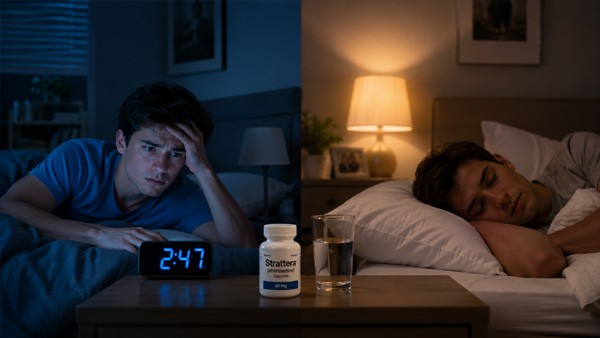
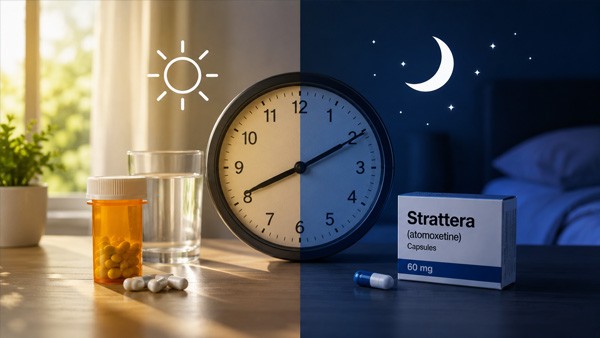
Strattera (atomoxetine) has an unusual relationship with sleep — producing opposite effects in different patients. Approximately 15-20% of patients experience insomnia particularly during initial treatment weeks, while approximately 10-15% experience the opposite pattern of drowsiness, fatigue, or sedation. The same medication that keeps one patient awake at night helps another patient fall asleep. The dual response pattern reflects individual variation in how Strattera's norepinephrine modulation affects sleep architecture and circadian rhythms — and importantly, allows dosing-time optimization to work with the patient's specific response rather than fighting against it. Patients experiencing insomnia generally do better with morning dosing; patients experiencing drowsiness often do better with evening dosing that leverages the sedating effect for sleep onset. Understanding which pattern you have is essential for optimal Strattera management.
This guide covers Strattera sleep effects comprehensively across both directions. We address the bidirectional sleep response phenomenon and what it means clinically, the insomnia pattern affecting some patients with frequency data and characteristics, the drowsiness pattern affecting other patients with management implications, the morning vs evening dosing decision based on individual response, the structured protocol for switching dosing time when the original choice isn't optimal, sleep hygiene strategies specifically relevant for Strattera patients, threshold signals indicating sleep problems warrant medication change rather than continued management, four sleep response phenotype classifications matching patient patterns to approaches, the dosing time decision algorithm, the structured sleep hygiene protocol for Strattera patients, and the bottom-line framework for Strattera sleep management. Most patients can optimize sleep on Strattera with appropriate dosing time and hygiene; a smaller subset has sleep effects severe enough to warrant medication change.
| Response pattern | Frequency | Optimal dosing time | Management approach |
|---|---|---|---|
| Insomnia pattern | ~15-20% | Morning | Sleep hygiene, possible dose reduction |
| Drowsiness pattern | ~10-15% | Evening | Leverage sedation for sleep onset |
| Mixed pattern | ~5-10% | Variable; specialist input | Trial different dosing times |
| Minimal effect | ~55-70% | Morning typically default | Standard care; sleep unaffected |
| Sleep architecture changes | Variable | Depends on response | Difficulty assessing without sleep study |
| Sleep quality vs quantity | Both may be affected | Match dosing to response | Track both subjective and objective |
| Initial weeks vs long-term | Often improves over time | Adjust as tolerance develops | Reassess after 4-8 weeks |
| Reversibility | Resolves with discontinuation | Within 1-2 weeks of stopping | Sleep typically returns to baseline |
The bidirectional response means treatment approach depends on YOUR specific pattern — not a one-size-fits-all rule. Identify your pattern (insomnia, drowsiness, mixed, or minimal effect) and adjust dosing time accordingly. Most patients can optimize sleep with appropriate timing and hygiene; a subset requires medication change.
↕️ Two Opposite Sleep Reactions
The bidirectional sleep response is one of Strattera's distinctive features:
- Insomnia pattern (~15-20%): Difficulty falling asleep, staying asleep, or both. Increased alertness at bedtime. Pattern emerges within first 1-2 weeks of treatment.
- Drowsiness pattern (~10-15%): Daytime sleepiness, fatigue, sedation, reduced energy. May affect work or school function. Pattern often emerges within first weeks.
- Mixed pattern (~5-10%): Some patients experience both — drowsy during day yet difficulty sleeping at night. Disrupted sleep-wake cycle.
- Minimal effect (~55-70%): Most patients don't experience significant sleep effects in either direction. Sleep continues at baseline.
Why opposite reactions occur:
- Individual variation in norepinephrine response. Different patients have different sensitivities to NE-mediated effects on alertness/sleep.
- Baseline sleep state matters. Patients with existing sleep difficulties may experience different responses than well-rested patients.
- Pharmacokinetic variation. Atomoxetine metabolism varies (slow vs fast CYP2D6 metabolizers); plasma curve differences may affect sleep.
- Sleep architecture effects. NE modulation affects REM sleep, deep sleep, and wakefulness in patient-specific ways.
- Circadian rhythm interactions. Individual circadian patterns interact with medication timing.
- Possible paradoxical reactions. Some patients respond to medications opposite to expected direction.
Practical implications of bidirectional response:
- Initial dosing time should be flexible. Morning dosing is conventional but may not suit your specific pattern.
- Trial approach often needed. Try morning first; switch to evening if drowsiness develops.
- Tracking sleep effects matters during initial weeks.
- Don't assume "everyone gets insomnia" — sleep effects vary by patient.
😴 Insomnia: Who Gets It
The Strattera insomnia pattern:
- Frequency: ~15-20% of adult patients; ~10-15% of pediatric patients.
- Subjective experience: Difficulty falling asleep at usual bedtime, staying asleep through night, or both. Mind feels "too alert" at bedtime.
- Time course: Often emerges within first 1-2 weeks of treatment; may improve over 4-8 weeks as tolerance develops; may persist throughout treatment in some patients.
- Severity range: Mild (50-60 minute sleep onset delay) to severe (multi-hour sleep difficulty).
- Sleep architecture: May reduce REM sleep and deep sleep proportions even when total sleep time is preserved.
Patients more likely to experience Strattera insomnia:
- Pre-existing sleep difficulties may worsen.
- Anxiety disorders may amplify Strattera's alertness effect.
- Higher doses tend to produce more insomnia.
- Evening dosing when patient is sensitive to alertness effects.
- Caffeine use compounding alertness effects.
- Slow CYP2D6 metabolizers with higher plasma atomoxetine levels.
Management options for insomnia:
- Morning dosing as primary timing — allows day for drug effects to occur away from sleep.
- Sleep hygiene optimization particularly during early treatment.
- Caffeine elimination particularly after noon.
- Dose reduction if persistent insomnia at standard dose.
- Wait for tolerance — many cases resolve within 4-8 weeks.
- Short-term sleep aid if needed during transition (with prescriber).
😪 Drowsiness: Who Gets It
The Strattera drowsiness pattern:
- Frequency: ~10-15% of adult patients; ~10-20% of pediatric patients.
- Subjective experience: Daytime sleepiness, fatigue, reduced energy, difficulty staying alert. May affect work, school, or driving.
- Time course: Often emerges within first 1-2 weeks; sometimes improves over 4-8 weeks; may persist throughout treatment.
- Severity range: Mild (subtle daytime sluggishness) to severe (impaired functioning during day).
- Patterns: May concentrate at certain times of day; may be more pronounced early in treatment.
Patients more likely to experience Strattera drowsiness:
- Higher initial doses may produce more sedation.
- Female patients show slightly higher drowsiness rates in some studies.
- Pediatric patients often more sensitive to sedating effects.
- Slow CYP2D6 metabolizers with higher atomoxetine levels.
- Concurrent sedating medications compounding effects.
- Pre-existing fatigue from depression, sleep apnea, hypothyroidism.
Management options for drowsiness:
- Evening dosing shifts sedation effect into sleep period.
- Dose reduction may resolve drowsiness while maintaining ADHD efficacy.
- Caffeine use may help (modest amounts; avoid late in day).
- Wait for tolerance — many cases improve over 4-8 weeks.
- Optimize sleep quality at night to reduce daytime sleepiness.
- Rule out other causes of fatigue (anemia, thyroid, sleep apnea).
🕐 Dosing Time: Morning vs Evening
The dosing time decision based on individual sleep response:
Morning dosing (default for most patients):
- Best for: Patients with insomnia response, patients without significant sleep effects, patients with minimal effect pattern.
- Rationale: Drug effects (including any alertness or sleep impact) occur during day rather than at bedtime.
- Practical aspects: Take with breakfast typically; reasonable for most patients as starting point.
- Standard ADHD dosing convention: Most ADHD medications dosed in morning; sleep architecture less affected.
Evening dosing (selected patients):
- Best for: Patients with drowsiness response, patients with significant daytime sleepiness on morning dosing, patients with ADHD-related sleep onset difficulties.
- Rationale: Sedating effect leverages for sleep onset rather than fighting it during day.
- Practical aspects: Take 2-4 hours before bedtime typically; assess effect on sleep quality.
- Non-standard but increasingly recognized: Pediatric and adult patients with appropriate response patterns benefit from evening dosing.
Divided dosing (occasional):
- Sometimes used when neither pure morning nor evening dosing optimal.
- Smaller doses spread may produce different effect profile.
- Specialist territory — discuss with prescriber.
Time course of dosing effect:
- Morning dose: Peak effect 1-2 hours; sustained through afternoon; evening tapering for sleep.
- Evening dose: Peak effect 1-2 hours after dose; coverage continues through night; morning typically clearing.
- Steady-state coverage develops with consistent daily dosing regardless of timing.
🔄 Switching Morning to Evening
Structured protocol for switching dosing time:
When to consider switching:
- Daytime drowsiness affecting function despite 4+ weeks on morning dosing.
- Sleep onset difficulty with morning dosing despite sleep hygiene optimization.
- Pattern more consistent with drowsiness response than insomnia.
- Sleep onset improvement desired (for patients with sleep-related ADHD components).
Switching protocol:
- Discuss with prescriber first. Confirm switch is reasonable for your situation.
- Week 1 transition: Reduce morning dose by half, add half dose in evening.
- Week 2-3: Shift to full evening dose, skip morning dose. Observe sleep and daytime effects.
- Assessment: Sleep quality, daytime function, ADHD symptom control.
- Continue if successful; reverse if sleep worsens or ADHD control inadequate.
- Long-term maintenance: Stable evening dose with periodic reassessment.
Considerations during switch:
- Sleep tracking particularly important during transition.
- ADHD symptom monitoring — coverage shifts may affect symptom timing.
- Possible insomnia during transition as body adjusts.
- Possible drowsiness if drowsiness response stronger than expected with evening dosing.
Pediatric considerations:
- Evening dosing in pediatrics often helps with bedtime resistance.
- Caregiver supervision ensures consistent timing.
- School-age children may benefit from evening dosing covering after-school period through homework.
🌃 Sleep Hygiene While on Strattera
Sleep hygiene strategies particularly relevant for Strattera patients:
Bedroom environment:
- Cool temperature (60-67°F / 16-19°C) optimizes sleep onset.
- Dark room with blackout curtains if needed.
- Quiet environment with white noise if needed.
- Comfortable mattress and pillows.
- Limit bedroom to sleep activities — no screens in bed.
Pre-sleep routine:
- Consistent bedtime within 30-minute window.
- Wind-down routine 30-60 minutes before sleep.
- Avoid screens 60 minutes before sleep.
- Relaxation activities — reading, gentle stretching, meditation.
- Bath or shower can help body temperature transition.
Daytime factors:
- Morning light exposure supports circadian rhythm.
- Regular exercise earlier in day; avoid intense exercise within 4 hours of sleep.
- Caffeine cutoff by noon for sensitive patients; earlier if Strattera amplifies caffeine effects.
- Alcohol avoidance particularly within 4 hours of sleep.
- Avoid daytime napping beyond brief 20-minute periods.
Strattera-specific:
- Consistent dosing time daily.
- Track sleep response to identify your pattern.
- Coordinate caffeine with Strattera timing.
- Sleep environment optimization particularly during initial weeks when effects emerging.
⛔ When Sleep Problems Mean Stopping
Threshold signals indicating sleep problems warrant medication change rather than continued management:
Consider medication change if:
- Persistent severe insomnia beyond 8 weeks despite dose optimization and sleep hygiene.
- Total sleep duration consistently below 6 hours for adults or below age-appropriate minimum for children.
- Daytime impairment from sleep deprivation affecting work, school, safety.
- Persistent severe drowsiness despite evening dosing and dose optimization.
- Sleep deprivation worsening mood with concerning depression or SI symptoms.
- Sleep architecture concerns if sleep study indicates.
- Quality of life significantly affected by sleep problems.
Alternative ADHD medications with different sleep profiles:
- Intuniv (guanfacine ER): Often improves sleep; sedating effect.
- Kapvay (clonidine ER): Sedating; can be dosed at bedtime.
- Wellbutrin: May affect sleep variably.
- Stimulants: Typically cause insomnia if dosed late; morning-only dosing avoids issue.
- Modafinil off-label: Wakefulness-promoting; clearly not for evening dosing; sleep usually fine with proper timing.
For patients whose sleep can't be managed on Strattera, switching to non-stimulant with different sleep profile (Intuniv, Kapvay) or stimulant with proper morning-only dosing often resolves sleep issues. Discuss alternatives with prescriber.
🧭 Sleep Response Phenotype Classification
Four sleep response phenotypes guide management:
Phenotype 1 — "Insomnia Pattern." Difficulty falling asleep or staying asleep on Strattera. Affects 15-20% of patients. Management: morning dosing, sleep hygiene optimization, caffeine elimination, possible dose reduction.
Phenotype 2 — "Drowsiness Pattern." Daytime sleepiness or fatigue on Strattera. Affects 10-15% of patients. Management: evening dosing to leverage sedation, possible dose reduction, optimize sleep quality at night.
Phenotype 3 — "Mixed Pattern." Both insomnia and drowsiness in disrupted pattern. Affects 5-10% of patients. Management: trial different dosing times, specialist consultation, sleep study consideration.
Phenotype 4 — "Minimal Effect." No significant sleep effects from Strattera. Affects 55-70% of patients. Management: standard morning dosing, standard sleep hygiene.
| Phenotype | Frequency | Approach |
|---|---|---|
| Phenotype 1 (Insomnia) | ~15-20% | Morning dosing, hygiene, dose reduction |
| Phenotype 2 (Drowsiness) | ~10-15% | Evening dosing, dose reduction |
| Phenotype 3 (Mixed) | ~5-10% | Trial different times, specialist input |
| Phenotype 4 (Minimal) | ~55-70% | Standard care |
🗺️ Dosing Time Decision Algorithm
Practical algorithm for dosing time decisions:
- Start with morning dosing as conventional default for first 2-4 weeks.
- Track sleep effects during initial period.
- Identify sleep response phenotype based on 2-4 weeks observation.
- If Phenotype 1 (insomnia): Continue morning dosing; optimize sleep hygiene; consider dose reduction if persistent.
- If Phenotype 2 (drowsiness): Discuss switch to evening dosing with prescriber.
- If Phenotype 3 (mixed): Specialist consultation; trial alternative dosing times; sleep evaluation.
- If Phenotype 4 (minimal): Continue morning dosing; standard care.
- Reassess at 6-8 weeks after any change.
- If sleep problems persist despite optimization, discuss medication alternatives.
🛌 Sleep Hygiene Protocol for Strattera Patients
Structured sleep hygiene framework specifically for Strattera patients:
| Time of day | Strattera-specific action |
|---|---|
| Morning (waking) | Bright light exposure; take morning Strattera dose if applicable; consistent wake time |
| Morning (with breakfast) | Take Strattera with food; moderate caffeine acceptable |
| Mid-morning | Strattera effects peaking; productive work period |
| Noon | Caffeine cutoff for sensitive patients; lunch with adequate calories |
| Early afternoon | Continued steady Strattera effect |
| Late afternoon | Exercise window (not within 4 hours of sleep); evening Strattera dose if applicable |
| Evening (dinner) | Lighter dinner; avoid heavy meals close to sleep; alcohol minimization |
| Wind-down (60 min before sleep) | Begin relaxation routine; reduce screens; dim lights |
| Pre-sleep (30 min before) | Bath/shower, reading, meditation, journaling; bedroom cool and dark |
| Sleep | Consistent bedtime; quality sleep environment |
| Overnight | Avoid late-night caffeine; quiet environment |
| Morning (consistent wake) | Same wake time daily; immediate light exposure |
Sleep hygiene principles for Strattera patients:
- Consistent dosing time daily.
- Match dosing time to sleep response (morning for insomnia pattern, evening for drowsiness pattern).
- Track sleep response during initial weeks and after any changes.
- Caffeine awareness — particularly avoid combining with Strattera in late day.
- Sleep environment optimization matters more during initial weeks when Strattera effects emerging.
- Sleep tracking via app or journal provides objective data.
- Communicate with prescriber about sleep changes to inform dosing decisions.
✨ Bottom Line
Strattera's bidirectional sleep response is one of its distinctive features — approximately 15-20% experience insomnia, 10-15% experience drowsiness, 5-10% have mixed patterns, and 55-70% have minimal effect. The same medication produces opposite sleep effects in different patients, requiring individualized management based on your specific pattern.
Dosing time optimization is the primary management tool: morning dosing for insomnia pattern or minimal effect; evening dosing for drowsiness pattern. The conventional default is morning dosing as starting point, with switch to evening if drowsiness response emerges and is sufficient to warrant change. Specialist consultation reasonable for mixed pattern.
The four sleep response phenotype classifications guide management. The dosing time decision algorithm provides systematic approach: start morning, track 2-4 weeks, identify phenotype, adjust accordingly, reassess at 6-8 weeks, consider medication change if problems persist beyond optimization.
The Sleep Hygiene Protocol provides structured framework specifically for Strattera patients. Most patients can optimize sleep on Strattera with appropriate dosing time and hygiene; a smaller subset has sleep effects severe enough to warrant medication change.
Switching dosing time from morning to evening follows structured protocol with prescriber discussion, week-by-week transition, sleep tracking, and assessment of both sleep and ADHD symptom effects. Pediatric considerations include evening dosing benefits for bedtime resistance and after-school coverage.
When sleep problems mean stopping Strattera: persistent severe insomnia or drowsiness beyond 8 weeks despite optimization, sleep deprivation affecting function or safety, sleep deprivation worsening mood with concerning symptoms. Alternative ADHD medications with different sleep profiles include Intuniv (often improves sleep), Kapvay (sedating, bedtime dosing), or stimulants with proper morning-only dosing.
For broader Strattera safety and management context, see Strattera Long-Term Side Effects, Strattera and Suicidal Thoughts (FDA Black Box), Strattera and Liver Health, Strattera Cardiovascular Effects, Strattera and Weight Loss, and Strattera Sexual Side Effects.
For modafinil parallel sleep management article (very different topic since modafinil is wake-promoting), see Modafinil Insomnia.
For Strattera comparison cluster: vs Adderall, vs Vyvanse, vs Concerta, vs Ritalin, vs Modafinil, vs Wellbutrin, vs Intuniv, vs Qelbree.
For modafinil as off-label alternative with different sleep profile, Modalert 200 mg from Sun Pharma provides Schedule IV wakefulness option.
❓ Frequently Asked Questions
Does Strattera cause insomnia or drowsiness?
Both — Strattera has bidirectional sleep effects. Approximately 15-20% of patients experience insomnia; 10-15% experience drowsiness; 5-10% have mixed patterns; 55-70% have minimal sleep effects. Same medication produces opposite responses in different patients. Identifying your specific pattern within first 2-4 weeks guides optimal dosing time and management approach.
When should I take Strattera?
Depends on your sleep response. Morning dosing is conventional default and works for patients with insomnia pattern or minimal sleep effects. Evening dosing better for patients with drowsiness response — uses sedating effect for sleep onset rather than fighting it during day. Start with morning dosing, track sleep effects for 2-4 weeks, switch to evening if drowsiness develops and is sufficient to warrant change.
How do I switch from morning to evening dosing?
Structured protocol with prescriber. Week 1 transition: reduce morning dose by half, add half dose in evening. Week 2-3: shift to full evening dose. Assessment: sleep quality, daytime function, ADHD symptom control. Continue if successful; reverse if sleep worsens. Sleep tracking particularly important during transition. Possible insomnia or drowsiness as body adjusts during transition period.
Will Strattera-related sleep problems go away?
Often partially with tolerance. Many sleep effects improve over 4-8 weeks as body adapts to medication. Insomnia frequently diminishes; drowsiness frequently improves. However, some patients have sleep effects that persist throughout treatment. If sleep issues remain severe after 8 weeks despite optimization, medication change may be appropriate. Reassessment after 6-8 weeks of any change determines whether intervention sufficient.
Can I take Strattera at bedtime to help me sleep?
For patients with drowsiness response, yes — evening dosing leverages sedating effect for sleep onset. Take 2-4 hours before bedtime typically. For patients with insomnia response, evening dosing would worsen sleep. The strategy works only for patients whose response is drowsiness-pattern. Determine your pattern first, then make dosing time decision. Don't use Strattera as primary sleep medication — it's an ADHD medication with sleep-affecting properties.
How long does Strattera affect sleep?
Depends on response pattern. Acute insomnia effect: at bedtime if dosed too late. Acute drowsiness effect: during medication coverage window. Long-term: most sleep effects emerge within first 1-2 weeks; often improve over 4-8 weeks with tolerance; some persist throughout treatment. Reversal upon discontinuation: typically within 1-2 weeks of stopping as drug clears.
What sleep hygiene helps with Strattera?
Cool dark bedroom; consistent bedtime; wind-down routine 30-60 minutes before sleep; avoid screens 60 minutes before sleep; caffeine cutoff by noon (or earlier if Strattera amplifies caffeine effects); morning light exposure; regular exercise (not within 4 hours of sleep); avoid alcohol within 4 hours of sleep; avoid daytime napping beyond brief periods. Sleep tracking via app or journal provides objective data.
Should I take sleeping pills if Strattera is keeping me awake?
Discuss with prescriber. Short-term sleep aid during transition may be appropriate. Long-term sleep medication addition isn't ideal — creates polypharmacy and dependence concerns. Better approach: optimize Strattera dosing time, sleep hygiene, possible Strattera dose reduction, or medication change if problems persist. If sleep medication used, short-term and lowest effective dose preferred.
Is Strattera affecting my child's sleep?
Track patterns. Children may experience similar bidirectional response — insomnia, drowsiness, mixed, or minimal effect. Pediatric monitoring: bedtime difficulty, sleep duration, daytime alertness, school performance. Discuss with pediatrician if concerning patterns. Evening dosing for pediatric drowsiness response can also help with bedtime resistance for children with sleep-related ADHD components. Pediatric-specific patterns may differ from adult patterns.
What if I have both insomnia and daytime drowsiness on Strattera?
Mixed pattern (5-10% of patients) — most challenging response. Trial approaches: morning dosing first; if drowsiness predominates, try evening; if neither works well, specialist consultation. Sleep study may be reasonable to characterize sleep architecture changes. Sometimes Strattera isn't the right medication for patients with mixed sleep response; alternative ADHD medication may resolve both issues.
📚 References & Further Reading
- FDA prescribing information for Strattera (atomoxetine) — sleep-related side effects.
- Sangal et al. — atomoxetine sleep effects studies.
- Bangs et al., Journal of Child and Adolescent Psychopharmacology — pediatric atomoxetine sleep effects.
- American Academy of Sleep Medicine — sleep hygiene guidelines.
- American Academy of Pediatrics — pediatric sleep recommendations.
- National Sleep Foundation — sleep duration recommendations by age.
- Walker — sleep science and pharmacology.
- Strattera safety cluster: Long-Term, FDA Black Box SI, Liver, Cardiovascular, Weight Loss, Sexual Side Effects
- Modafinil Insomnia — parallel modafinil sleep article.
- Strattera comparison cluster: vs Adderall, vs Vyvanse, vs Concerta, vs Ritalin, vs Modafinil, vs Wellbutrin, vs Intuniv, vs Qelbree
- Modalert 200 mg, Modvigil 200 mg, Waklert 150 mg — primary product pages.
- RXshop Editorial Team — content reviewed by licensed pharmacist; for adult patient education, not a substitute for individual medical consultation.
Medical Disclaimer: The information in this article is for educational and informational purposes only and is not a substitute for professional medical advice, diagnosis, or treatment. Always seek guidance from a qualified healthcare provider with any questions you may have regarding a medical condition, and before starting, stopping or changing any medication.