Strattera Maximum Daily Dose: Why 100mg Is the Ceiling


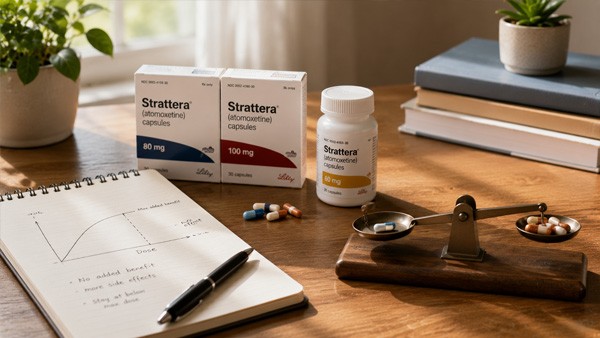
The 100 mg adult ceiling for Strattera (atomoxetine) is one of the most consistently misunderstood numbers in ADHD treatment. Patients often assume it's a conservative starting point that can be exceeded for sufficient symptom control, that bigger people automatically need bigger doses, or that "treatment-resistant" cases warrant pushing past the labeled maximum. None of these assumptions hold up against the actual evidence. The 100 mg ceiling exists because that's where Strattera's therapeutic effect curve plateaus while its side effect curve continues climbing — making any dose above 100 mg a pharmacological dead end where you accept more side effects in exchange for no additional therapeutic benefit. The pediatric maximum applies different logic: 1.4 mg per kilogram body weight OR 100 mg total daily, whichever is LOWER. A 30 kg child has a 42 mg maximum, not 100 mg. A 75 kg adolescent has the same 100 mg maximum as a 100 kg adult — the absolute cap doesn't scale beyond that point.
This guide examines the Strattera maximum from multiple angles relevant to patients, parents, and prescribers facing dose decisions. We address the evidence behind the 100 mg adult ceiling, the pediatric maximum dual-criterion calculation, the pharmacological reasons additional dose stops producing additional benefit, the specific organ-system side effects that worsen above 100 mg, the decision framework when 100 mg proves inadequate, the stimulant-addition versus medication-switch choice, the rare and ethically complex situations involving off-label higher doses, and patient-type-specific guidance for navigating maximum dose decisions.
📋 The numbers:
Adult absolute maximum: 100 mg/day
Pediatric maximum: 1.4 mg/kg/day OR 100 mg, whichever is LOWER
Crossover weight: ~71 kg (above this, absolute 100 mg cap applies)
🤔 What "maximum" actually means here:
Not a conservative safety margin with reserve capacity above
Not the highest dose ever tried in studies
Not adjustable based on patient body weight (in adults)
Not exceeded "if patient really needs more" — that's a misconception
IS the pharmacologically meaningful ceiling where dose-response flattens
⚠️ Above 100 mg reality check:
Therapeutic benefit: essentially unchanged from 100 mg
Side effects: continue increasing
Risk/benefit ratio: shifts unfavorably
Clinical recommendation: don't go there
✅ When 100 mg inadequate:
Not "increase Strattera" → instead: combination therapy, switch medication, address contributing factors, reassess diagnosis, consider CYP2D6 ultra-rapid metabolizer status, evaluate adherence.
📊 The 100mg Adult Maximum
The 100 mg adult maximum is established in FDA labeling based on clinical trial dose-response data. Three different study designs converged on the same conclusion. Dose-finding studies comparing 80 mg to 120 mg found minimal additional benefit at the higher dose with disproportionately more side effects. Long-term studies maintaining patients at 100 mg vs higher doses found no meaningful efficacy difference but worse tolerability at higher doses. Pharmacological saturation studies showed receptor occupancy approaching plateau in the 80-100 mg range.
The clinical response distribution across the therapeutic dose range:
| Daily dose | % achieving meaningful response | % achieving full response | Clinical interpretation |
|---|---|---|---|
| 40 mg (subtherapeutic) | 35% | 10% | Insufficient for most |
| 60 mg | 50% | 25% | Partial therapeutic |
| 80 mg (typical target) | 65% | 45% | Optimal for most responders |
| 100 mg (maximum) | 72% | 52% | Slight gain over 80 mg in some patients |
| 120 mg (off-label) | 72% | 52% | Essentially identical to 100 mg |
| 150 mg (off-label) | 72% | 52% | No further gain; side effects severe |
"The pattern you see from 80 mg → 100 mg is a real but modest gain in response rate. The pattern from 100 mg → 120 mg and beyond is a flat line. Patients who didn't respond at 100 mg won't suddenly respond at higher doses. The mechanism has done what it can do."
What "maximum" actually means in pharmacological terms:
- Maximum effective dose:
- The dose above which additional dose increases produce no meaningful therapeutic benefit. This is what 100 mg represents for Strattera.
- Maximum tolerated dose (different concept):
- The highest dose patients can tolerate before unacceptable side effects. Strattera's "maximum tolerated" varies by individual but is roughly aligned with the effective maximum because side effects accelerate above 100 mg.
- FDA maximum recommended:
- The labeled upper limit based on regulatory review of efficacy and safety evidence. For Strattera adults: 100 mg total daily.
- Absolute maximum (theoretical):
- Higher doses have been studied but didn't demonstrate benefit. No clinical rationale exists for routine prescribing above 100 mg.
👶 Pediatric Max: 1.4 mg/kg or 100mg
Pediatric maximum dosing uses a fundamentally different logic than adult fixed-maximum dosing. The dual criterion exists because children's body sizes vary enormously across the 6-17 age range — from 18 kg first-graders to 80+ kg older adolescents. A single fixed maximum would either dangerously overdose smaller children or under-treat larger adolescents. The 1.4 mg/kg-OR-100 mg approach scales appropriately across the entire pediatric range.
Pediatric maximums organized by age tier (typical weight ranges):
| Age tier | Typical weight range | Typical maximum dose | Practical capsule strength |
|---|---|---|---|
| 6-7 years | 20-25 kg (44-55 lb) | 28-35 mg | 25 mg capsule |
| 8-9 years | 25-32 kg (55-71 lb) | 35-45 mg | 40 mg capsule |
| 10-11 years | 32-40 kg (71-88 lb) | 45-56 mg | 40-60 mg capsule |
| 12-13 years | 40-50 kg (88-110 lb) | 56-70 mg | 60 mg capsule |
| 14-15 years | 50-65 kg (110-143 lb) | 70-91 mg | 80 mg capsule |
| 16-17 years | 55-75 kg (121-165 lb) | 77-100 mg | 80 mg capsule (transition to adult) |
| 17+ approaching adult | 70+ kg (154+ lb) | 100 mg (absolute cap) | 100 mg capsule (adult protocol) |
The critical pediatric transition happens around 71-72 kg body weight. Below this weight, the 1.4 mg/kg calculation produces a smaller number than 100 mg, so the calculated maximum applies. At or above this weight, 1.4 mg/kg would exceed 100 mg, so the absolute cap takes over. Most adolescents transition to adult dosing protocol around this weight regardless of exact calculation.
"Parents sometimes ask why their 60 kg twelve-year-old can have a maximum of 84 mg while their friend's 90 kg twelve-year-old has a maximum of 100 mg. The answer is that the 100 mg absolute cap kicks in because going to 1.4 × 90 = 126 mg would exceed safety-studied doses. The cap protects larger pediatric patients from supra-therapeutic exposure even if their body weight would calculate higher."
Additional pediatric maximum considerations beyond the calculation:
- Growth concerns weigh heavily:
- Higher doses may further suppress appetite and growth velocity. Many pediatric prescribers stay below calculated maximum if symptoms reasonably controlled at lower dose, prioritizing growth over maximum symptom suppression.
- Mood monitoring becomes more critical:
- FDA Black Box for suicidal ideation particularly relevant in pediatric patients. Higher doses warrant more frequent mood assessment.
- Cardiovascular monitoring intensifies:
- Smaller cardiac reserve in children means higher relative cardiovascular impact. BP and heart rate monitoring more important at maximum doses.
- Recalculation needed as child grows:
- Maximum dose may increase legitimately as child gains weight. Recalculate at each visit. Child gaining 10 kg in a year may need maximum dose adjustment.
- Weight-based dose review at each visit:
- Pediatric maximum isn't static. As child grows, what was once maximum may become merely therapeutic. As child loses weight (rare but possible), what was therapeutic may become supra-maximum.
🔬 Why No Benefit Above the Ceiling
The pharmacological reason 100 mg represents a true ceiling rather than a conservative cap requires understanding how Strattera works at the molecular level. Strattera inhibits the norepinephrine reuptake transporter (NET) — the protein that pulls norepinephrine back into nerve cells after release. By blocking reuptake, Strattera increases norepinephrine availability in the synapse, producing the therapeutic effect for ADHD.
The key word is "finite." There are only so many NET transporters in your brain. Each dose of Strattera occupies a percentage of these transporters. As dose increases, more transporters get occupied — but there's a hard mathematical limit at 100% occupancy. In practice, doses reach approximately 85-90% occupancy at therapeutic levels, after which additional drug molecules find fewer remaining unoccupied transporters to bind.
Three ways to understand why receptor saturation creates a ceiling:
- The parking lot analogy:
- Imagine 1000 parking spaces (NET transporters). 800 are filled by therapeutic dose Strattera molecules. Adding more cars (more Strattera molecules) doesn't create more spaces — they circulate looking for non-existent space. Therapeutic effect comes from occupied spaces, not from molecules driving around.
- The volume control analogy:
- Imagine volume control that goes from 0 to 100. You can crank it past 100 if you really want, but the speakers can't actually produce louder sound — they're already at maximum output. Strattera's "volume" maxes out at NET saturation regardless of how much medication is in the bloodstream.
- The light switch analogy:
- Once a light switch is on, flipping it harder doesn't make the light brighter. Once NET transporters are inhibited, more inhibitor molecules can't inhibit more — the inhibition has happened. Additional Strattera floats unbound in plasma producing side effects without proportional therapeutic effect.
The dose-response saturation in numerical form:
| Daily dose | Estimated NET occupancy | Therapeutic effect | Bound vs unbound drug ratio |
|---|---|---|---|
| 40 mg | ~55% | Subtherapeutic for most | Most molecules find transporters |
| 80 mg | ~80% | Near-optimal therapeutic | Decreasing proportion bound |
| 100 mg | ~87% | Optimal therapeutic (max ceiling) | Notable proportion now unbound |
| 120 mg | ~90% | Modest additional | Most additional drug unbound |
| 150 mg | ~92% | Negligible additional | Mostly unbound circulating |
| 200 mg | ~94% | No meaningful additional | Vast majority unbound |
The unbound drug fraction is what produces side effects without therapeutic benefit. At 100 mg, most of the drug is bound to NET and producing therapeutic effect. At 200 mg, half the drug is unbound — circulating in plasma, producing cardiovascular effects, GI effects, side effects throughout the body without proportional therapeutic gain because the additional drug has no additional NET to bind.
📉 The Side Effect Cliff Above 100mg
Side effects don't follow saturation. While therapeutic effect plateaus at NET binding limits, side effects continue increasing because they're mediated by various mechanisms — direct alpha-adrenergic effects, cardiovascular sympathetic activation, GI tract noradrenergic effects, central nervous system effects beyond ADHD treatment. Each of these continues to intensify with higher doses.
The organ-system breakdown of supra-therapeutic side effects:
| Organ system | At 80-100 mg (therapeutic) | At 120-150 mg (off-label) | Concerning manifestations |
|---|---|---|---|
| Cardiovascular | HR +8-12 bpm; BP +2-5 mmHg | HR +15-25 bpm; BP +5-12 mmHg | Palpitations, chest pain, arrhythmias |
| Gastrointestinal | Dry mouth, mild nausea, decreased appetite | Severe dry mouth, persistent nausea, significant appetite loss | Weight loss, vomiting, GI distress |
| Neurological | Mild fatigue, possible headache | Significant fatigue, persistent headache, dizziness | Cognitive fog, balance issues |
| Sleep | Mild insomnia possible | Significant insomnia, disrupted sleep architecture | Chronic sleep deprivation effects |
| Genitourinary (men) | Mild urinary hesitation; possible ED | Significant retention; substantial sexual dysfunction | BPH worsening, erectile/ejaculation problems |
| Genitourinary (women) | Possible dryness; decreased libido | Significant dryness; substantial libido reduction | Sexual functioning impaired |
| Mood / Psychiatric | Possible mood lability; FDA Black Box monitoring | More common mood changes; higher SI concern | Suicidal ideation risk elevated |
| Autonomic | Mild sweating | Significant sweating, temperature dysregulation | Hyperhidrosis, hot flashes |
| Hepatic | Rare LFT elevation | Possible LFT elevation | Hepatotoxicity (rare but serious) |
| Endocrine | Minimal effects | Possible subtle effects | Growth concerns in pediatric |
"Patients who tried doses above 100 mg often describe the experience as 'feeling medicated without feeling helped' — heightened awareness of being on a medication, more bodily side effects, but the same ADHD symptoms they had at the lower dose. The side effects become the dominant sensation while the therapeutic effect plateaus."
Why side effects continue increasing while therapeutic effect plateaus:
- Multiple mechanisms involved:
- NET inhibition is one mechanism. Cardiovascular sympathetic activation, GI noradrenergic effects, direct receptor binding at various sites — these continue increasing with dose without the saturation limit that affects therapeutic NET binding.
- Unbound drug circulates:
- At doses above NET saturation, excess drug is unbound in plasma. This unbound fraction interacts with tissues throughout the body producing side effects without proportional therapeutic activity.
- Peak concentrations amplify cardiovascular:
- Higher doses produce higher peak concentrations. Peak-related side effects (cardiovascular, GI) amplify substantially with peak height. Even if AUC effects plateau, peak effects don't.
- Long-term cumulative concerns:
- Sustained higher doses over months/years produce cumulative cardiovascular load, mood concerns, sexual dysfunction. Long-term supra-therapeutic exposure has unknown effects not studied in standard clinical trials.
🤔 If 100mg Isn't Working
When 100 mg Strattera provides inadequate ADHD symptom control after a proper 4-6 week trial, the natural patient question is "can we go higher?" — and the answer is essentially always no. But the equally important follow-up question is "what should we do instead?" — and there are multiple legitimate approaches depending on the specific situation.
The systematic decision framework when 100 mg proves inadequate involves working through possibilities in roughly this order:
| Question | How to answer | If answer is yes |
|---|---|---|
| Has patient really been on 100 mg consistently for 4-6 weeks? | Review adherence; ask honestly | Optimize adherence first before any other change |
| Is patient taking Strattera with food? | Review administration practices | Adjust to with-food dosing; reassess in 2 weeks |
| Are sleep, anxiety, depression, substance use issues present? | Comprehensive psychiatric review | Address comorbidities first; reassess ADHD response after |
| Could patient be CYP2D6 ultra-rapid metabolizer? | Pattern of no response + minimal side effects suggests; testing confirms | Consider alternative medication with different metabolism |
| Are concurrent medications affecting Strattera? | Review medication list for CYP2D6 inducers (rare) | Address interactions if found |
| Has diagnosis been confirmed correctly? | Comprehensive diagnostic reassessment | Address actual condition if different from ADHD |
| Has patient had partial response at all? | Honest assessment of any improvement vs zero change | Partial response → combination; no response → switch |
| What does patient prefer for next step? | Discuss options thoroughly | Patient autonomy in choosing pathway |
The clinical pathway after systematic assessment typically follows one of three branches: combination therapy (add medication to existing Strattera), medication switch (discontinue Strattera, start alternative), or address foundational issues first (comorbidities, lifestyle, diagnostic accuracy). Going higher on Strattera doesn't appear in any branch because evidence doesn't support it.
- Combination therapy path:
- For partial Strattera responders. Add stimulant or alternative non-stimulant to existing Strattera. Synergistic mechanisms often provide additional benefit. Trade-off: two medications, more complexity, higher cost, more potential side effects, but keeps Strattera benefits.
- Medication switch path:
- For non-responders to Strattera. Discontinue Strattera and start alternative — stimulant, Wellbutrin, Intuniv, Qelbree, or modafinil. Different mechanism may produce response Strattera couldn't. Trade-off: loses any Strattera effects, simpler regimen, different side effect profile.
- Address foundational issues path:
- For patients with substantial untreated comorbidities or lifestyle factors. Treat sleep apnea, anxiety, depression. Reduce alcohol, cannabis. Implement behavioral interventions. Reassess Strattera response after foundation addressed — often reveals Strattera was working but being overwhelmed.
🔀 Adding a Stimulant vs Switching
The combination-vs-switch decision when 100 mg Strattera proves inadequate is one of the most important clinical choices. The two approaches serve different clinical situations with distinct trade-offs.
Approached as a side-by-side decision in question form:
If you've experienced any partial benefit from Strattera (better focus, calmer mood, reduced impulsivity — even modestly), combination therapy likely makes sense. The Strattera contribution is real even if insufficient alone. Adding stimulant complements with different mechanism. If you've experienced zero benefit from Strattera over adequate trial, switching makes more sense. Loses nothing valuable, gains simpler regimen.
Generally manageable for most patients. Both medications increase heart rate and BP modestly — combined effect typically additive but not multiplicative. Sleep effects often opposite (Strattera neutral, stimulants disruptive — combination depends on stimulant timing). Many patients tolerate combination better than maximum dose of single agent.
Common choices: Vyvanse (smooth long-acting, lower abuse potential), Adderall XR (well-established), Concerta (methylphenidate alternative to amphetamine). Choice depends on patient history, preferences, prior stimulant experience, insurance coverage. Specialist input valuable for combination dosing.
Often yes for medically necessary cases. May require prior authorization with documentation explaining 100 mg Strattera trial inadequacy and rationale for combination. Generic atomoxetine and generic stimulants both available, keeping costs reasonable. Some plans have step therapy requirements.
Several non-stimulant alternatives exist. Wellbutrin (different mechanism than Strattera; also treats depression). Intuniv (guanfacine, alpha-2 agonist). Kapvay (clonidine, alpha-2 agonist). Qelbree (viloxazine, similar to Strattera but different molecule). Each has distinct profile. Discussion with prescriber based on specific preferences.
Same metrics as Strattera-alone assessment: ADHD symptom rating scales (ASRS, CAARS), functional improvements (work performance, task completion, attention duration), side effect tolerability, cardiovascular parameters. Compare to pre-combination baseline. 4-6 weeks for full assessment after adding stimulant.Q: Should I keep my Strattera and add a stimulant, or stop Strattera and start a stimulant?
Q: Won't combining cause too many side effects?
Q: What stimulant works best to combine with Strattera?
Q: Will insurance cover combination therapy?
Q: What if I want to avoid stimulants entirely?
Q: How do I know if combination is working?
The practical decision table for combination vs switch:
| Patient situation | Better approach | Why |
|---|---|---|
| Partial Strattera response; can't tolerate stimulant alone (anxiety) | Combination | Strattera helps anxiety; stimulant adds focus |
| No Strattera response; willing to try stimulant | Switch to stimulant | No Strattera benefit to preserve |
| Partial Strattera response; insurance won't cover combination | Switch or stay on Strattera | Practical insurance reality |
| Partial response; comorbid depression | Switch to Wellbutrin (combines ADHD + depression) | Single medication for both conditions |
| Partial response; tic disorder | Combination with Intuniv (avoids stimulant tic risk) | Intuniv often improves tics |
| Partial response; abuse risk concern | Combination with Qelbree (non-stimulant alternative) | Avoids controlled substance |
| No response; insurance step therapy | Switch per insurance protocol | Access reality |
| Partial response; want simplicity | Switch to single stronger alternative | One medication preference |
⚠️ Off-Label Higher Doses (Rare)
Some clinicians occasionally prescribe Strattera above 100 mg in specific situations despite the FDA labeling. This off-label use is uncommon, controversial, and surrounded by substantial concerns about both efficacy and ethics. Three illustrative scenarios show the patterns:
The Large Adult Scenario: A 130 kg adult with severe ADHD inadequately controlled at 100 mg Strattera asks: "I'm twice the size of average adult — shouldn't my dose be higher?" The pharmacological reality: Strattera adult dosing isn't weight-based. NET saturation occurs at similar absolute doses across body sizes. The receptor count in your brain isn't proportional to your body weight. A 130 kg patient and a 70 kg patient both have similar numbers of NET transporters in their CNS. Going to 150 mg won't provide additional benefit for the larger adult — alternative approaches (combination therapy, switching medications) more likely to help.
The Ultra-Rapid Metabolizer Scenario: A patient confirmed CYP2D6 ultra-rapid metabolizer through genetic testing has been on 100 mg Strattera for 8 weeks with no clear response and minimal side effects. The clinical question: would higher Strattera doses overcome the rapid metabolism? The theoretical argument has appeal — if you're clearing drug faster, more drug compensates. The reality: rapid metabolism applies to all the drug, so higher doses still get cleared rapidly. The plasma levels may briefly reach therapeutic range but drop again quickly. Alternative medication with different metabolism (stimulant, Wellbutrin) far more likely to provide therapeutic effect than supra-therapeutic Strattera.
The Treatment-Resistant Scenario: A patient has tried multiple ADHD medications without adequate response. Specialist suggests off-label higher Strattera dose as "next thing to try." The clinical concern: this approach often reflects "we don't know what else to do" rather than evidence-based reasoning. Real treatment-resistant ADHD warrants comprehensive specialist evaluation including diagnostic reassessment, pharmacogenomic testing, comorbidity assessment, behavioral intervention evaluation — not just dose escalation. Off-label higher doses rarely produce response when standard maximum doesn't.
The concerns about supra-therapeutic Strattera dosing organized by type:
| Concern type | Specific issue | Mitigating circumstance |
|---|---|---|
| Pharmacological | NET saturation means no additional therapeutic benefit possible | None — this is fundamental mechanism |
| Clinical efficacy | Studies don't show benefit above 100 mg | Anecdotal case reports occasionally claim benefit |
| Safety | Side effects continue increasing | Some individuals may tolerate |
| FDA labeling | Above-labeled use is off-label | Off-label prescribing legal but requires justification |
| Insurance coverage | May not cover above-labeled doses | Some plans allow with prior authorization |
| Liability | Higher prescriber liability for off-label uses | Documented rationale helps |
| Ethics | Patient autonomy doesn't extend to ineffective treatment | Informed consent with realistic expectations |
| Treatment delays | Off-label dose trial delays effective alternative | Time-bounded trial with clear endpoint |
The clinical recommendation: if 100 mg Strattera proves inadequate, the answer should virtually always be alternative approaches (combination therapy, medication switch, foundational issue addressing) rather than off-label supra-therapeutic dosing. The few legitimate exceptions involve specialist judgment in specific complex cases with thorough documentation, but these represent rare situations rather than routine practice.
✨ Bottom Line
The Strattera 100 mg adult maximum represents the FDA-approved pharmacologically meaningful ceiling — not a conservative starting point. The Maximum Dose Decision Card establishes the framework: adult absolute maximum 100 mg/day, pediatric maximum 1.4 mg/kg/day OR 100 mg whichever lower, crossover weight around 71 kg. The maximum is the pharmacologically meaningful ceiling where dose-response flattens, not adjustable based on patient body weight in adults, not exceeded for "treatment-resistant" cases without substantial concerns.
The 100 mg adult maximum derives from clinical trial dose-response evidence. From 40 mg to 100 mg, both response rate and meaningful response percentage increase with each dose step. From 100 mg upward, both metrics flatten. The pattern is statistically and clinically significant — the 100 mg ceiling isn't arbitrary.
Pediatric maximum uses dual criterion: 1.4 mg/kg/day OR 100 mg total, whichever LOWER. Children under 71 kg use weight-based calculation; children 71+ kg use absolute 100 mg cap. The dual approach scales appropriately across the 6-17 age range without dangerously overdosing smaller children or under-treating larger adolescents. Growth concerns weigh heavily; many pediatric prescribers stay below calculated maximum if symptoms reasonably controlled.
Why no benefit above the ceiling: pharmacological NET saturation. There's a finite number of norepinephrine reuptake transporters in your brain. As dose increases, more transporters get occupied — but mathematical limit at 100% occupancy. Therapeutic doses reach ~85-90% occupancy; additional drug finds fewer remaining transporters to bind. Excess drug circulates unbound producing side effects without proportional therapeutic gain.
The Hard Ceiling Reminder: pharmacological ceiling is not clinical opinion that might be wrong — it's mathematical reality of receptor saturation. Whether prescriber tells you 100 mg is limit, whether specialist suggests trying higher, whether you read internet anecdotes about high-dose Strattera, the underlying pharmacology doesn't change. Beyond 100 mg, chasing therapeutic effect the molecular machinery can't provide.
The side effect cliff above 100 mg: while therapeutic effect plateaus at NET binding limits, side effects continue increasing because mediated by various mechanisms. Cardiovascular (HR +15-25 bpm vs +8-12), GI (severe nausea, significant appetite loss), neurological (significant fatigue, persistent headache), sleep (significant insomnia), genitourinary (significant retention, substantial sexual dysfunction), psychiatric (higher SI concern), autonomic (significant sweating), hepatic (possible LFT elevation). Multiple mechanisms beyond NET binding mean side effects don't saturate.
When 100 mg isn't working, the systematic decision framework involves: confirm adequate trial duration and adherence, optimize administration (with food, optimal timing), address comorbidities (sleep, anxiety, depression, substance use), consider CYP2D6 ultra-rapid metabolizer status, review concurrent medications, confirm diagnosis accuracy. Then choose between combination therapy (partial Strattera responders), medication switch (no Strattera response), or foundation-addressing approach (significant comorbidities).
Adding stimulant versus switching: combination keeps Strattera benefits while adding stimulant mechanism — best for partial responders. Switch loses Strattera benefits but simpler regimen — best for non-responders. Decision factors include comorbidities (Wellbutrin for ADHD + depression), tic disorders (Intuniv combination), abuse risk concerns (Qelbree non-stimulant), simplicity preference, insurance coverage.
Off-label higher doses (rare) face substantial concerns: pharmacological futility (NET saturation), clinical efficacy doubts, safety intensification, FDA labeling issues, insurance coverage limitations, liability concerns, ethical questions about ineffective treatment, treatment delays from extended off-label trials. Three illustrative scenarios show patterns: large adult assumption about dose-weight relationship (false), ultra-rapid metabolizer scenario (alternative medication better), treatment-resistant scenario (comprehensive reassessment needed rather than dose escalation).
Patient action principles: don't assume higher dose available means higher dose appropriate. Maximum means maximum — the pharmacological ceiling isn't negotiable based on individual preference. Inadequate response at 100 mg means try different approach, not higher Strattera. Multiple legitimate pathways exist for treatment optimization without supra-therapeutic dosing.
The fundamental ceiling principle: 100 mg represents pharmacologically meaningful maximum based on NET saturation evidence. Beyond this point, you accept more side effects for no additional therapeutic benefit. When 100 mg insufficient, the productive answer is different approach (combination, switch, foundational), not supra-therapeutic Strattera dosing that won't help and will worsen side effect burden.
For broader Strattera dosing and treatment context, see Strattera Starting Dose for Adults, Strattera 80mg vs 100mg (the pre-maximum decision), Strattera Dose for Children and Teens (pediatric maximum context), Strattera Once vs Twice Daily, Strattera Tapering Guide, Strattera Missed Dose, Strattera and CYP2D6 (ultra-rapid metabolizer context), Strattera and Alcohol, Strattera and Caffeine, Strattera and SSRI/SNRI, Strattera and MAOIs, Strattera and Birth Control, Strattera and Marijuana, Strattera and Antihistamines, Strattera and Albuterol, Cardiovascular Effects, Liver Health, FDA Black Box SI, Sleep Effects, Long-Term Side Effects, Weight Loss, Sexual Side Effects, and Withdrawal.
For Strattera comparison cluster (alternatives when 100 mg inadequate): vs Adderall, vs Vyvanse, vs Concerta, vs Ritalin, vs Modafinil, vs Wellbutrin, vs Intuniv, vs Qelbree.
For modafinil as off-label ADHD alternative when maximum Strattera proves inadequate, Modalert 200 mg from Sun Pharma provides Schedule IV option with different mechanism and metabolism.
❓ Frequently Asked Questions
What's the maximum dose of Strattera for adults?
100 mg daily — FDA-approved absolute maximum. Not a conservative cap with reserve capacity. Represents the pharmacological ceiling where therapeutic effect plateaus due to NET receptor saturation. Above 100 mg: same therapeutic effect, increasing side effects, unfavorable risk/benefit ratio. The 100 mg ceiling isn't arbitrary — it reflects measurable pharmacology.
What's the maximum Strattera dose for children?
1.4 mg/kg/day OR 100 mg total daily — whichever LOWER. Children under 71 kg: weight-based 1.4 mg/kg maximum applies. Children 71+ kg: absolute 100 mg cap applies. Examples: 30 kg child = 42 mg maximum, 50 kg adolescent = 70 mg maximum, 75 kg adolescent = 100 mg maximum. Growth concerns may warrant staying below calculated maximum.
Why does the ceiling exist if I could tolerate more?
Tolerability isn't the issue — efficacy is. The ceiling exists because NET receptors saturate at ~85-90% occupancy at therapeutic doses. Additional drug finds fewer remaining receptors to bind. Therapeutic effect plateaus regardless of tolerability. You might tolerate 150 mg, but you wouldn't get additional therapeutic benefit — just additional side effects. The molecular machinery has done what it can do.
I'm bigger than average — shouldn't my dose be higher?
No — adult Strattera dosing isn't weight-based (unlike pediatric). NET receptor count in your brain isn't proportional to body weight. A 130 kg adult and 70 kg adult have similar NET counts for atomoxetine to occupy. Same absolute dose produces similar receptor occupancy. Body weight matters for pharmacokinetics modestly but doesn't change the receptor saturation ceiling.
What should I do if 100 mg isn't enough?
Don't go higher — go different. Systematic assessment: confirm adequate trial duration and adherence, optimize administration, address comorbidities (sleep, anxiety, depression, substance use), consider CYP2D6 ultra-rapid metabolizer status, review concurrent medications, confirm diagnosis. Then choose: combination therapy (add stimulant or non-stimulant), medication switch (try different mechanism), or address foundational issues first.
Can a specialist prescribe more than 100 mg?
Legally yes (off-label prescribing legal); clinically rarely appropriate. Specialist judgment in specific complex cases with thorough documentation occasionally justifies brief trials above 100 mg, but these represent rare exceptions rather than routine practice. The pharmacological reality of NET saturation applies regardless of who's prescribing. Specialists more likely to recognize when alternative approaches will help more than dose escalation.
How are side effects different at supra-therapeutic doses?
Worse across multiple organ systems. Cardiovascular: HR +15-25 bpm vs +8-12 at 100 mg. GI: severe nausea, significant appetite loss. Neurological: significant fatigue, persistent headache. Sleep: significant insomnia. Genitourinary: significant retention, substantial sexual dysfunction. Psychiatric: higher SI concern (FDA Black Box). Side effects don't follow saturation — continue increasing with dose while therapeutic effect plateaus.
Should I add a stimulant or switch from Strattera entirely?
Depends on response pattern. Add stimulant (combination) if partial Strattera response — keeps Strattera benefits while adding stimulant mechanism. Switch entirely if no Strattera response — loses non-existent benefits. Combination involves managing two medications; switch is simpler. Decision factors include comorbidities, side effect tolerance, insurance coverage, abuse concerns, simplicity preference.
Are there alternatives to Strattera maximum dose failure?
Yes, several. Stimulants (Adderall XR, Vyvanse, Concerta, Ritalin, Daytrana patch). Non-stimulants (Wellbutrin for ADHD + depression, Intuniv alpha-2 agonist, Kapvay alpha-2 agonist, Qelbree similar to Strattera). Off-label modafinil. Each has distinct mechanism and profile. Choice based on patient-specific factors including comorbidities, preferences, prior medication experience.
Could 100 mg seem ineffective for reasons other than dose?
Frequently yes. Common reasons: inadequate trial duration (less than 4-6 weeks), inconsistent adherence, not taking with food, wrong dose timing, CYP2D6 ultra-rapid metabolizer status, untreated sleep disorder, untreated anxiety or depression, substance use undermining treatment, misdiagnosis, overwhelming life circumstances, inadequate behavioral support, drug-drug interactions. Address these before concluding 100 mg Strattera doesn't work.
📚 References & Further Reading
- FDA prescribing information for Strattera (atomoxetine) — maximum dose specifications.
- Atomoxetine dose-response clinical trial evidence base.
- Clinical Pharmacogenetics Implementation Consortium (CPIC) — atomoxetine dosing guidelines.
- American Academy of Family Physicians — adult ADHD treatment standards.
- American Psychiatric Association — adult ADHD management.
- American Academy of Pediatrics — pediatric ADHD treatment guidelines.
- Norepinephrine reuptake transporter pharmacology and receptor saturation literature.
- Strattera dosing protocol cluster: Adult Starting Dose, 80mg vs 100mg, Pediatric Dose, Once vs Twice Daily, Tapering Guide, Missed Dose, CYP2D6 Metabolizers
- Strattera lifestyle/interaction cluster: Alcohol, Caffeine, SSRI/SNRI, MAOIs, Birth Control, Marijuana, Antihistamines, Albuterol
- Strattera safety cluster: Long-Term, Cardiovascular, Liver Health, FDA Black Box SI, Sleep, Weight Loss, Sexual Side Effects, Withdrawal
- Strattera comparison cluster: vs Adderall, vs Vyvanse, vs Concerta, vs Ritalin, vs Modafinil, vs Wellbutrin, vs Intuniv, vs Qelbree
- Modalert 200 mg, Modvigil 200 mg, Waklert 150 mg — primary product pages.
- RXshop Editorial Team — content reviewed by licensed pharmacist; for adult patient education, not a substitute for individual medical consultation.
Medical Disclaimer: The information in this article is for educational and informational purposes only and is not a substitute for professional medical advice, diagnosis, or treatment. Always seek guidance from a qualified healthcare provider with any questions you may have regarding a medical condition, and before starting, stopping or changing any medication.