Strattera and Antihistamines: Sedation, Anxiety, and Smart Use

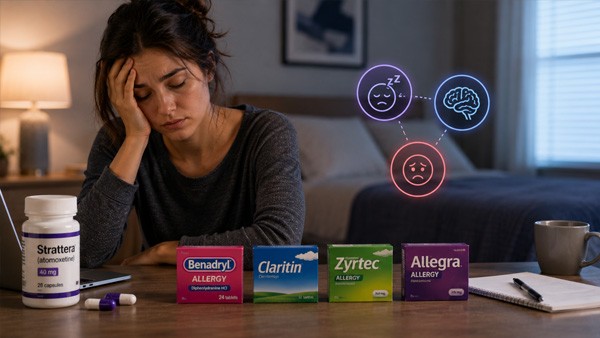
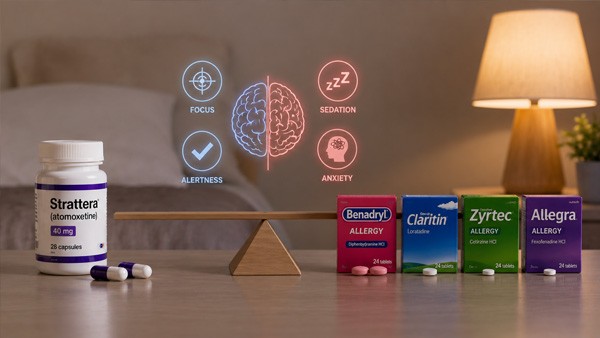
Strattera (atomoxetine) and antihistamines interact differently depending on which antihistamine is involved — and the differences matter substantially for safety, sleep quality, ADHD treatment effectiveness, and daily functioning. First-generation antihistamines (Benadryl/diphenhydramine, doxylamine, chlorpheniramine) cross the blood-brain barrier extensively, producing significant sedation that can stack with any drowsy/calming effects, impair cognition, and create anticholinergic burden that interacts with Strattera's noradrenergic effects in complex ways. Second-generation antihistamines (Claritin/loratadine, Zyrtec/cetirizine, Allegra/fexofenadine, Xyzal/levocetirizine) cross the blood-brain barrier minimally and generally cause less sedation, though some (notably cetirizine) cause more drowsiness than others. The Strattera-antihistamine interaction matrix isn't a simple "yes/no" — it's a graduated set of considerations across multiple antihistamine generations and specific products.
This guide provides comprehensive information about Strattera-antihistamine combinations for patients managing seasonal allergies, year-round allergies, occasional allergy symptoms, sleep difficulties, motion sickness, or other antihistamine-treated conditions while taking Strattera. We address the sedating vs non-sedating distinction that's the most important framework, why Benadryl + Strattera is the worst combination (heavy sedation, cognitive impairment, anticholinergic burden), the generally safer second-generation options (Claritin, Zyrtec, Allegra), heart rate considerations that span both medication classes, sleep-aid antihistamines (doxylamine in ZzzQuil, Unisom — significant concerns), daytime allergy management approaches, when pharmacist consultation is particularly valuable, brand-name lookup for the dozens of antihistamine products, nighttime allergy protocol approaches, pediatric considerations, and the bottom-line framework for navigating allergy season on Strattera.
🏆 S-tier (best with Strattera):
• Allegra (fexofenadine) — least sedating second-gen, minimal interactions, daytime safe
• Xyzal (levocetirizine) — refined cetirizine, less sedating, effective
🥇 A-tier (very good):
• Claritin (loratadine) — non-sedating for most, classic choice
• Astepro (azelastine nasal) — topical nasal, minimal systemic
• Pataday (olopatadine eye drops) — local action only
🥈 B-tier (acceptable with awareness):
• Zyrtec (cetirizine) — more sedating than other 2nd-gen; some patients fine, others drowsy
• Singulair (montelukast) — not antihistamine but allergy treatment; FDA black box for mood
🥉 C-tier (caution, situational):
• Chlor-Trimeton (chlorpheniramine) — 1st gen but less sedating than diphenhydramine
• Hydroxyzine (Atarax, Vistaril) — prescription 1st gen; significant sedation
⛔ F-tier (avoid if possible):
• Benadryl (diphenhydramine) — heavy sedation, anticholinergic burden, cognitive impairment
• Unisom/ZzzQuil (doxylamine) — sleep aid; same concerns as Benadryl
• Tylenol PM, Advil PM, Nyquil — contain diphenhydramine/doxylamine — same concerns
💡 General principle: Choose S/A-tier for daytime allergy control on Strattera. Avoid F-tier when possible. If F-tier needed occasionally (single dose), use lowest dose and avoid driving/operating machinery.
🌡️ Sedating vs Non-Sedating Antihistamines
The fundamental antihistamine distinction:
First-generation (sedating) antihistamines:
- Cross blood-brain barrier extensively — significant central nervous system effects.
- Significant sedation — primary side effect, often desired for sleep aid use.
- Anticholinergic effects — dry mouth, dry eyes, constipation, urinary retention.
- Cognitive impairment — slowed thinking, memory issues.
- Examples: Diphenhydramine (Benadryl), doxylamine (Unisom, ZzzQuil), chlorpheniramine (Chlor-Trimeton), hydroxyzine (Atarax, Vistaril), promethazine (Phenergan).
- Duration of effect: 4-6 hours typically; doxylamine longer.
Second-generation (non-sedating) antihistamines:
- Minimal blood-brain barrier crossing — designed to act peripherally.
- Minimal sedation for most patients.
- Less anticholinergic effects.
- Minimal cognitive impairment.
- Examples: Loratadine (Claritin), cetirizine (Zyrtec — moderate sedation in some), fexofenadine (Allegra), levocetirizine (Xyzal), desloratadine (Clarinex).
- Duration of effect: 24 hours typically — once-daily dosing.
Why this matters with Strattera:
- Strattera doesn't typically cause sedation at therapeutic doses (some patients experience drowsiness, particularly initially).
- Sedating antihistamines add drowsiness on top of any Strattera-related sleepiness.
- Anticholinergic burden: Can affect Strattera's noradrenergic effects in complex ways.
- Cognitive impairment counter to ADHD treatment goal.
- Driving safety concerns with sedating combination.
Decision framework:
- Daytime allergy use: Choose non-sedating (second-generation).
- Nighttime sleep aid use: Avoid if possible; if used, awareness of Strattera interaction.
- Acute severe allergy: May need sedating antihistamine temporarily; plan around driving and activities.
- Pediatric considerations: Specific options for children on Strattera.
⛔ Benadryl + Strattera: Worst Combo
Why diphenhydramine (Benadryl) is particularly concerning with Strattera:
- Heavy sedation: Diphenhydramine produces significant drowsiness, particularly in younger patients.
- Anticholinergic burden: Significant effects on dry mouth, eyes, constipation, urinary retention.
- Cognitive impairment: Slowed thinking, memory problems documented.
- Cardiovascular effects: Can affect heart rhythm in some patients.
- Driving impairment: Similar to alcohol intoxication levels at therapeutic doses.
- Strattera counterproductive: Strattera's focus/attention enhancement undermined by diphenhydramine's cognitive impairment.
Common scenarios where this combination occurs:
- Allergy management: Patient takes Benadryl for seasonal allergies.
- Sleep aid: Patient uses Benadryl to help with Strattera-related insomnia.
- Cold/flu treatment: Many OTC cold medications contain diphenhydramine.
- Motion sickness: Dramamine-style products use diphenhydramine.
- Acute allergic reaction: Single-dose use for hives, mild allergic reaction.
Specific scenarios warranting concern:
- Regular daily use of diphenhydramine: significantly impacts cognition and ADHD treatment.
- Driving while on combination: Significant impairment risk.
- Older adults: Diphenhydramine particularly problematic; Beers Criteria identifies it as inappropriate for elderly.
- Children: Paradoxical reactions possible (excitation rather than sedation).
- BPH patients: Anticholinergic effects worsen urinary retention.
- Glaucoma patients: Anticholinergic effects worsen narrow-angle glaucoma.
If diphenhydramine is needed despite Strattera:
- Single dose for acute situation: Generally manageable.
- Use lowest effective dose: 12.5 mg may be sufficient for some patients.
- Avoid driving for at least 6-8 hours after dose.
- Plan around timing: Evening doses better than daytime.
- Discuss with pharmacist or prescriber for regular use.
- Consider non-sedating alternative when possible.
✅ Claritin, Zyrtec, Allegra: Generally Safe
Second-generation antihistamine analysis:
Loratadine (Claritin):
- Minimal sedation for most patients.
- Once-daily dosing (10 mg).
- Few drug interactions.
- Strattera compatibility: Excellent.
- OTC availability.
- Generic widely available — cheap.
- Good for daytime use on Strattera.
Cetirizine (Zyrtec):
- More sedation than other second-generation — some patients drowsy.
- Once-daily dosing (10 mg).
- Slightly more potent than loratadine for symptom control.
- Strattera compatibility: Generally good but individual sedation response matters.
- OTC availability.
- Try at night first if uncertain about sedation effect.
Fexofenadine (Allegra):
- Least sedating second-generation typically.
- Once or twice daily dosing (180 mg once or 60 mg twice).
- Avoid taking with fruit juice (reduces absorption).
- Strattera compatibility: Excellent.
- OTC availability.
- Best choice for daytime use if cognitive clarity essential.
Levocetirizine (Xyzal):
- Refined cetirizine — less sedating than parent compound.
- Once-daily dosing (5 mg).
- Effective symptom control.
- Strattera compatibility: Excellent.
- OTC availability.
Desloratadine (Clarinex):
- Refined loratadine.
- Once-daily dosing (5 mg).
- Prescription typically.
- Strattera compatibility: Excellent.
Choosing between second-generation antihistamines:
- Allegra: Best if cognitive clarity essential (work, school, driving).
- Claritin: Classic, cheap, well-tolerated for most.
- Zyrtec: Slightly more potent symptom control; some sedation possible.
- Xyzal: Good balance of potency and tolerability.
- Try one for 2-3 weeks before switching if not effective.
- Switch if first choice not working well.
❤️ Heart Rate Considerations
Cardiovascular interaction considerations:
- Strattera increases heart rate — typically 5-10 bpm at therapeutic doses.
- Most antihistamines have minimal cardiovascular effect.
- Some antihistamines have specific cardiac concerns: Older nonsedating antihistamines (terfenadine, astemizole) caused QT prolongation; withdrawn from market.
- Current second-generation antihistamines generally cardiovascular-safe.
- Decongestant combinations raise different cardiovascular concerns.
Specific cardiovascular concerns by product:
- Pseudoephedrine-containing products (Claritin-D, Zyrtec-D, Allegra-D, Sudafed): Pseudoephedrine raises BP and heart rate; combined with Strattera produces significant cardiovascular stacking. Generally avoid these on Strattera.
- Phenylephrine-containing products (newer Sudafed PE formulations): Less effective than pseudoephedrine but also affects cardiovascular system; caution.
- Plain antihistamines without decongestants: Cardiovascular-neutral generally.
- Topical decongestants (Afrin, oxymetazoline nasal): Less systemic effect than oral decongestants.
Allergy products to be aware of:
- "D" suffix products (Claritin-D, Zyrtec-D, Allegra-D, Mucinex-D): Contain pseudoephedrine decongestant — avoid on Strattera.
- Cold/flu combinations: Often contain decongestants — read labels.
- "Sinus" formulations: Often contain decongestants — check ingredients.
- Plain antihistamine without "D" or decongestant: Cardiovascular-safe on Strattera.
Alternative decongestion options on Strattera:
- Saline nasal sprays: No medication interaction; symptomatic relief.
- Nasal corticosteroids (Flonase, Nasacort): No systemic cardiovascular effects; effective for chronic allergies.
- Topical nasal antihistamines (Astepro/azelastine): Minimal systemic effects.
- Topical decongestants (limited use 3 days max): Less systemic but rebound congestion risk.
- Antihistamine + saline + nasal steroid: Often effective combination without decongestant.
🌙 Sleep Aid Antihistamines (Doxylamine)
Sleep-aid antihistamines and Strattera concerns:
- Doxylamine (Unisom, ZzzQuil): First-generation antihistamine; significant sedation; primary sleep aid in OTC products.
- Diphenhydramine (Benadryl, Tylenol PM, Advil PM): Same concerns as doxylamine.
- Both produce significant anticholinergic burden.
- Strattera-related insomnia common — patients often seek sleep aids.
- Antihistamine sleep aids problematic with Strattera for multiple reasons.
Why Strattera patients use sleep aids:
- Insomnia from Strattera — particularly initially or with evening dosing.
- Difficulty falling asleep due to noradrenergic effects.
- Sleep latency issues.
- Self-medication common.
Why antihistamine sleep aids are problematic:
- Anticholinergic burden: Compounds with Strattera's autonomic effects.
- Morning hangover: Cognitive impairment lasting into next day.
- Tolerance develops quickly: Less effective over time.
- Disrupts sleep architecture: Less restorative sleep quality.
- Falls risk in older adults.
- Counterproductive next-day: ADHD treatment undermined by next-day cognitive fog.
Better sleep approaches for Strattera-related insomnia:
- Move Strattera to morning if evening dosing causing insomnia.
- Sleep hygiene optimization: Consistent schedule, dark room, no screens before bed.
- Melatonin: Generally compatible with Strattera; lower interaction risk.
- Magnesium supplementation: May help with sleep quality.
- L-theanine or chamomile: Mild relaxation aids without anticholinergic burden.
- CBT-I (cognitive behavioral therapy for insomnia): Most effective long-term insomnia treatment.
- Prescription sleep medications: Discuss with prescriber for severe persistent insomnia (ramelteon, low-dose trazodone, etc.).
☀️ Daytime Allergy Management on Strattera
Practical daytime allergy management strategies:
Mild allergy symptoms:
- Loratadine 10 mg once daily.
- Fexofenadine 180 mg once daily.
- Saline nasal spray as needed.
- Eye drops for itchy eyes (Pataday, Zaditor).
- Trigger avoidance where possible.
Moderate allergy symptoms:
- Daily second-generation antihistamine + nasal corticosteroid (Flonase, Nasacort).
- Allow 2-3 weeks for full effect.
- Eye drops for ocular symptoms.
- Consider allergy testing if persistent.
Severe or persistent allergy:
- Combination therapy: Second-generation antihistamine + nasal steroid + nasal antihistamine + saline.
- Allergist referral for evaluation.
- Immunotherapy (allergy shots or sublingual) for chronic severe allergies.
- Avoid decongestants due to Strattera cardiovascular concerns.
Acute allergic reaction (hives, mild reaction):
- Single-dose diphenhydramine may be necessary despite Strattera concerns.
- Plan around timing — avoid driving, demanding cognitive tasks.
- Severe allergic reaction: Epinephrine first, then antihistamines; emergency care.
Seasonal allergy preparation:
- Start medication 1-2 weeks before season starts for best effect.
- Use throughout season for continuous control.
- Choose second-generation for daytime use.
- Monitor Strattera effectiveness during allergy season for any changes.
Activities to plan around:
- Driving: Use non-sedating antihistamines.
- School/work performance: Cognitive clarity from non-sedating choices.
- Exercise: Some patients find allergy meds affect exercise tolerance.
- Outdoor activities: Pre-medication before high-allergen exposure.
- Sleep: Most second-generation antihistamines don't disrupt sleep.
💊 When to Talk to Pharmacist
Situations warranting pharmacist consultation:
- Starting new antihistamine on Strattera — verify compatibility.
- OTC product selection — pharmacist can identify problematic combinations.
- Multiple OTC products — pharmacist can check for ingredient duplications.
- Decongestant questions — pharmacist can recommend Strattera-compatible options.
- Symptom not controlled — pharmacist can suggest alternative approaches.
- Side effects from antihistamine — pharmacist can troubleshoot.
- Children's antihistamine selection — pediatric considerations.
- Pregnancy or breastfeeding — additional considerations.
- Other prescription medications — broader interaction picture.
What to ask the pharmacist:
- "I'm on Strattera — is this antihistamine okay?"
- "Does this product contain decongestant?"
- "Will this make me drowsy with my other medications?"
- "Is this safe for daytime use?"
- "What's the best option for [specific symptom] on Strattera?"
- "How long should I try this before switching?"
Information to provide pharmacist:
- All current medications including Strattera dose.
- All other OTC products you're using.
- Symptoms you're trying to treat.
- Any specific concerns about driving, work, school.
- Any medication allergies.
- Other medical conditions.
Pharmacist consultation is free and valuable:
- No appointment usually needed.
- Pharmacists trained specifically in drug interactions.
- Can save you from problematic combinations.
- Insurance not needed for consultation.
- Available 7 days at most pharmacies.
🏪 Brand Name Lookup Table
Common antihistamine and allergy product brand names with active ingredients and Strattera compatibility:
| Brand name | Active ingredient(s) | Generation | Strattera compatibility |
|---|---|---|---|
| Benadryl | Diphenhydramine 25-50 mg | 1st gen | ⛔ Avoid daily; OK single dose |
| Claritin | Loratadine 10 mg | 2nd gen | ✅ Excellent |
| Zyrtec | Cetirizine 10 mg | 2nd gen | ✅ Good (mild sedation possible) |
| Allegra | Fexofenadine 180 mg | 2nd gen | ✅ Excellent |
| Xyzal | Levocetirizine 5 mg | 2nd gen | ✅ Excellent |
| Clarinex | Desloratadine 5 mg | 2nd gen | ✅ Excellent |
| Chlor-Trimeton | Chlorpheniramine 4 mg | 1st gen | ⚠️ Caution (less sedating than Benadryl) |
| Atarax / Vistaril | Hydroxyzine 10-50 mg | 1st gen (Rx) | ⚠️ Caution (prescription; significant sedation) |
| Phenergan | Promethazine | 1st gen (Rx) | ⚠️ Caution (prescription; significant sedation) |
| Claritin-D / Zyrtec-D / Allegra-D | Above + pseudoephedrine | 2nd gen + decongestant | ⛔ Avoid (pseudoephedrine cardiovascular) |
| Unisom SleepTabs | Doxylamine 25 mg | 1st gen sleep aid | ⛔ Avoid (anticholinergic, cognitive impact) |
| ZzzQuil | Diphenhydramine 50 mg | 1st gen sleep aid | ⛔ Avoid (anticholinergic, cognitive impact) |
| Tylenol PM / Advil PM | Acetaminophen/Ibuprofen + diphenhydramine | 1st gen sleep aid | ⛔ Avoid (contains Benadryl) |
| Nyquil | Multiple including doxylamine | 1st gen sleep aid | ⛔ Avoid for daily use |
| Dayquil | Multiple — check label | Often contains decongestant | ⚠️ Avoid if contains pseudoephedrine |
| Mucinex (plain) | Guaifenesin (expectorant) | Not antihistamine | ✅ Compatible (no decongestant) |
| Mucinex-D | Guaifenesin + pseudoephedrine | Decongestant | ⛔ Avoid (decongestant) |
| Sudafed (red box) | Pseudoephedrine | Decongestant | ⛔ Avoid |
| Sudafed PE | Phenylephrine | Decongestant | ⚠️ Caution |
| Afrin (nasal) | Oxymetazoline nasal | Topical decongestant | ⚠️ 3-day limit (rebound risk) |
| Flonase / Nasacort | Fluticasone / Triamcinolone (nasal steroid) | Steroid (not antihistamine) | ✅ Compatible |
| Astepro | Azelastine nasal antihistamine | Topical antihistamine | ✅ Excellent |
| Pataday / Zaditor | Eye drop antihistamines | Topical | ✅ Excellent |
🌃 Nighttime Allergy Protocol
Specific approach for nighttime allergy symptoms on Strattera:
Goals for nighttime:
- Symptom control sufficient for sleep.
- Avoid morning cognitive hangover.
- Maintain ADHD treatment effectiveness next day.
- Avoid problematic antihistamine sleep aids.
Approach 1 — Once-daily evening second-generation antihistamine:
- Zyrtec or Allegra taken evening for overnight symptom control.
- If Zyrtec causes morning drowsiness in you, switch to Allegra or Claritin.
- Some patients prefer evening dosing regardless of second-generation choice.
- 24-hour duration covers nighttime + next day.
Approach 2 — Nasal corticosteroid + saline before bed:
- Flonase or Nasacort 1-2 sprays each nostril before bed.
- Saline rinse if congested.
- No systemic effects, no Strattera interaction concerns.
- Effective for chronic allergic rhinitis.
Approach 3 — Topical nasal antihistamine before bed:
- Astepro (azelastine) 1-2 sprays each nostril before bed.
- Local action, minimal systemic effects.
- Effective for nasal symptoms specifically.
Approach 4 — Combination for severe nighttime symptoms:
- Second-generation oral antihistamine + nasal steroid + nasal antihistamine.
- All evening-administered for overnight coverage.
- No anticholinergic burden, no sedating components.
- Effective for severe combined allergy.
What to avoid for nighttime allergies on Strattera:
- Benadryl/diphenhydramine — even though it makes you sleepy.
- Unisom/doxylamine — same concerns.
- Tylenol PM, Advil PM, Nyquil — contain sedating antihistamines.
- Pseudoephedrine-containing products — cardiovascular concerns.
- Multiple sedating substances — compounds problems.
👶 Pediatric Antihistamine Considerations
Children's antihistamine selection on Strattera:
For children with allergies on Strattera:
- Second-generation antihistamines preferred: Children's Claritin, Children's Zyrtec, Children's Allegra all available.
- Diphenhydramine particularly problematic in children: Paradoxical excitation possible (hyperactivity instead of sedation).
- Doxylamine not for children under 12 typically.
- Liquid formulations for younger children.
- Chewable or melt tablets for older children.
Pediatric dosing:
- Children's Claritin: Age 2+: 5 mg daily; age 6+: 10 mg daily.
- Children's Zyrtec: Age 2+: 2.5-5 mg daily; age 6+: 5-10 mg daily.
- Children's Allegra: Age 2+: 30 mg twice daily; age 12+: adult dosing.
- Follow label directions or pediatrician guidance.
Specific pediatric concerns:
- Paradoxical excitation with diphenhydramine — particularly in younger children; can mimic or worsen ADHD symptoms.
- Combined cognitive impact from sedating antihistamine + ADHD symptoms problematic for school.
- Anticholinergic effects may be more pronounced in children.
- OTC product label reading important — many cold/flu products contain diphenhydramine.
What to avoid for children on Strattera:
- Benadryl daily use.
- Combination cold products with sedating antihistamines.
- Pseudoephedrine products (also have age restrictions).
- Multi-ingredient products without careful label reading.
Parent guidance:
- Read all OTC labels carefully for combination products.
- Stick with single-ingredient antihistamines when possible.
- Consult pediatrician for chronic allergy management.
- Consider allergist referral for severe allergies in child on Strattera.
- Inform school of medications if school dispensing required.
✨ Bottom Line
Strattera and antihistamines interaction varies dramatically by which antihistamine — making the Antihistamine Tier List essential framework. S-tier (Allegra, Xyzal) and A-tier (Claritin, Astepro, Pataday) options provide excellent compatibility for daytime allergy management. B-tier (Zyrtec, montelukast) acceptable with awareness. F-tier (Benadryl, Unisom, ZzzQuil, Tylenol PM, Advil PM, Nyquil) should be avoided when possible due to sedation, anticholinergic burden, cognitive impairment, and counter-productivity to ADHD treatment.
The sedating vs non-sedating distinction is the most important framework. First-generation antihistamines (Benadryl, doxylamine, chlorpheniramine, hydroxyzine, promethazine) cross blood-brain barrier extensively producing significant sedation, anticholinergic effects, and cognitive impairment. Second-generation antihistamines (Claritin, Zyrtec, Allegra, Xyzal, Clarinex) cross minimally and cause far less sedation.
Benadryl + Strattera is the worst combination — heavy sedation, significant anticholinergic burden, cognitive impairment, driving impairment, and direct counter to Strattera's focus/attention enhancement. Single-dose use for acute allergic reactions generally manageable; regular use significantly problematic.
Heart rate considerations span both medication classes. Strattera alone increases heart rate 5-10 bpm. Pseudoephedrine-containing combination products (Claritin-D, Zyrtec-D, Allegra-D, Sudafed) raise BP and heart rate; combined with Strattera produces significant cardiovascular stacking — generally avoid these. Plain antihistamines without decongestants generally cardiovascular-neutral.
Sleep aid antihistamines (doxylamine in Unisom/ZzzQuil, diphenhydramine in Tylenol PM/Advil PM) are particularly problematic — combined anticholinergic burden, morning cognitive hangover undermining next-day ADHD treatment, sleep architecture disruption, tolerance development. Better sleep approaches: move Strattera to morning, optimize sleep hygiene, melatonin, magnesium, CBT-I, or prescription sleep options.
Daytime allergy management strategies use second-generation antihistamines, nasal corticosteroids, saline rinses, eye drops, and avoid decongestants and sedating antihistamines. Severe persistent allergies benefit from allergist evaluation and possible immunotherapy.
Pharmacist consultation valuable for: starting new antihistamines, OTC product selection, multiple OTC products, decongestant questions, symptom control issues, side effects, children's antihistamine selection, pregnancy/breastfeeding, complex medication situations. Free, no appointment needed, available at all pharmacies.
Brand Name Lookup Table provides comprehensive reference for 25+ common antihistamine and allergy products with active ingredients and Strattera compatibility rating — essential for navigating OTC aisle effectively.
Nighttime allergy protocols on Strattera should avoid antihistamine sleep aids and use approaches like once-daily evening second-generation antihistamine, nasal corticosteroid + saline before bed, topical nasal antihistamine, or combination for severe symptoms — all without anticholinergic burden.
Pediatric considerations include avoiding diphenhydramine (paradoxical excitation possible), preferring second-generation children's formulations, careful label reading for combination products, and pediatrician/allergist consultation for chronic conditions.
For broader Strattera safety and lifestyle context, see Strattera and Alcohol, Strattera and Caffeine, Strattera and SSRI/SNRI, Strattera and MAOIs (absolute contraindication), Strattera and Birth Control, Strattera and Marijuana, Cardiovascular Effects, Liver Health, FDA Black Box SI, Sleep Effects, Long-Term Side Effects, Weight Loss, Sexual Side Effects, and Withdrawal.
For Strattera comparison cluster: vs Adderall, vs Vyvanse, vs Concerta, vs Ritalin, vs Modafinil, vs Wellbutrin, vs Intuniv, vs Qelbree.
For modafinil as off-label ADHD alternative, Modalert 200 mg from Sun Pharma provides Schedule IV option.
❓ Frequently Asked Questions
Can I take Benadryl with Strattera?
Single-dose for acute allergic reaction generally manageable but suboptimal. Regular use significantly problematic: heavy sedation, anticholinergic burden, cognitive impairment that counters Strattera's focus/attention enhancement. If needed despite Strattera, use lowest effective dose (12.5 mg may suffice), avoid driving 6-8 hours after, take in evening. Better options for daily use: Claritin, Zyrtec, Allegra, or Xyzal — second-generation antihistamines without these concerns.
Is Claritin safe with Strattera?
Yes — excellent compatibility. Loratadine 10 mg once daily, minimal sedation for most patients, few drug interactions, generic widely available and cheap. Good daytime option. Doesn't significantly interfere with Strattera effectiveness. Try for 2-3 weeks before deciding if effective enough; switch to Zyrtec, Allegra, or Xyzal if needed.
Does Zyrtec make you sleepy on Strattera?
Possibly for some patients. Cetirizine (Zyrtec) more sedating than other second-generation antihistamines — about 15% of patients experience drowsiness. Try evening dose first if uncertain about sedation effect. If significant daytime drowsiness, switch to Claritin or Allegra. Combined with Strattera, sedation effect varies — some patients fine, others affected. Individual response matters.
What about Allegra-D and similar "D" products?
Avoid on Strattera. "D" suffix means decongestant (typically pseudoephedrine) is added. Pseudoephedrine raises BP and heart rate; combined with Strattera produces significant cardiovascular stacking. Use plain Allegra (or Claritin, Zyrtec) instead. For decongestion, consider saline rinses, nasal corticosteroids (Flonase, Nasacort), topical nasal antihistamine (Astepro), or topical decongestant for ≤3 days (Afrin).
Can I use OTC sleep aids on Strattera?
Generally avoid antihistamine sleep aids (Unisom, ZzzQuil, Tylenol PM, Advil PM, Sominex, Nytol). All contain diphenhydramine or doxylamine — first-generation antihistamines with anticholinergic burden and morning cognitive impairment that undermines ADHD treatment. Better sleep approaches: move Strattera to morning, sleep hygiene optimization, melatonin, magnesium, CBT-I, or discuss prescription options with prescriber if persistent severe insomnia.
What's the best antihistamine for daytime use on Strattera?
Fexofenadine (Allegra) — least sedating second-generation antihistamine. 180 mg once daily, 24-hour coverage. Maintains cognitive clarity essential for work, school, driving. Avoid taking with fruit juice (reduces absorption). Alternatives: Claritin (loratadine) — classic, well-tolerated; Xyzal (levocetirizine) — refined cetirizine with less sedation than parent. Zyrtec acceptable if not sedating for you individually.
Is nasal Flonase safe with Strattera?
Yes — excellent compatibility. Flonase (fluticasone) and similar nasal corticosteroids (Nasacort/triamcinolone, Rhinocort/budesonide) act locally with minimal systemic absorption. No significant Strattera interaction. Allow 2-3 weeks for full effect. Effective for chronic allergic rhinitis. Can be combined with second-generation oral antihistamine + nasal antihistamine + saline for severe allergies without compromising Strattera.
What about cold and flu medications on Strattera?
Read labels carefully — many contain problematic ingredients. Avoid: pseudoephedrine (cardiovascular concerns); diphenhydramine/doxylamine in PM formulations (sedation, anticholinergic burden); multi-symptom combinations often have multiple problematic ingredients. Safer choices: plain acetaminophen or ibuprofen for fever/pain; plain guaifenesin (Mucinex) for cough; saline nasal sprays for congestion; honey or warm liquids for cough; rest.
Are antihistamines safe for children on Strattera?
Second-generation children's antihistamines (Children's Claritin, Children's Zyrtec, Children's Allegra) preferred. Diphenhydramine particularly problematic in children — paradoxical excitation possible (hyperactivity instead of sedation), can mimic or worsen ADHD symptoms. Combined cognitive impact problematic for school. Read all OTC labels carefully — many cold/flu products contain diphenhydramine. Consult pediatrician for chronic allergy management.
When should I talk to a pharmacist about antihistamines on Strattera?
Starting new antihistamine on Strattera; OTC product selection; multiple OTC products at once; decongestant questions; symptom not controlled; side effects from antihistamine; children's antihistamine selection; pregnancy or breastfeeding; other prescription medications. Pharmacist consultation is free, no appointment usually needed, available 7 days at most pharmacies. Trained specifically in drug interactions — can save you from problematic combinations.
📚 References & Further Reading
- FDA prescribing information for Strattera (atomoxetine).
- American Academy of Allergy, Asthma & Immunology — antihistamine guidelines.
- American College of Allergy, Asthma & Immunology — allergy treatment recommendations.
- American Geriatrics Society Beers Criteria — antihistamines in older adults.
- Clinical pharmacology databases — antihistamine interaction profiles.
- American Academy of Pediatrics — pediatric antihistamine use.
- FDA OTC drug guidance — antihistamine product information.
- Strattera lifestyle/interaction cluster: Alcohol, Caffeine, SSRI/SNRI, MAOIs, Birth Control, Marijuana
- Strattera safety cluster: Long-Term, Cardiovascular, Liver Health, FDA Black Box SI, Sleep, Weight Loss, Sexual Side Effects, Withdrawal
- Strattera comparison cluster: vs Adderall, vs Vyvanse, vs Concerta, vs Ritalin, vs Modafinil, vs Wellbutrin, vs Intuniv, vs Qelbree
- Modalert 200 mg, Modvigil 200 mg, Waklert 150 mg — primary product pages.
- RXshop Editorial Team — content reviewed by licensed pharmacist; for adult patient education, not a substitute for individual medical consultation.
Medical Disclaimer: The information in this article is for educational and informational purposes only and is not a substitute for professional medical advice, diagnosis, or treatment. Always seek guidance from a qualified healthcare provider with any questions you may have regarding a medical condition, and before starting, stopping or changing any medication.