Modafinil vs Ritalin: Two Approaches to Focus


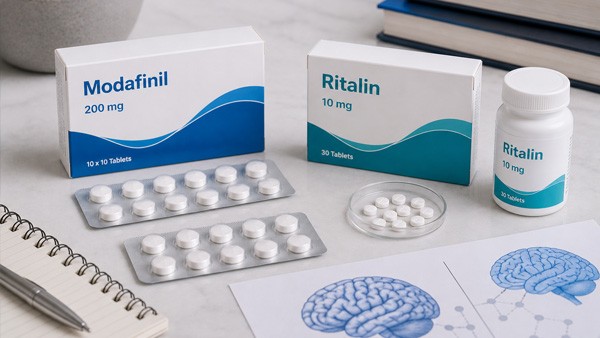
Modafinil and Ritalin are not competing versions of the same drug class — they are two fundamentally different pharmacological strategies that happen to produce overlapping outcomes for certain patient groups. Ritalin (methylphenidate) is a Schedule II central nervous system stimulant that acts as a dopamine and norepinephrine reuptake inhibitor in much the same way amphetamines do, just with a different binding profile. Modafinil is a Schedule IV wake-promoting agent that engages a broader set of arousal pathways (dopamine, histamine, orexin, norepinephrine) with much weaker affinity than classical stimulants. The two drugs feel different, last different lengths of time, carry different abuse and dependence risks, and earn their place in different patient populations.
This guide walks through the comparison on every axis a patient or physician would actually weigh: the underlying neurochemistry that makes Ritalin a stimulant and modafinil a "eugeroic", the dramatically different onset and duration curves, the clinical scenarios where each clearly outperforms the other, the FDA-approved indications that legally separate them, and the head-to-head side-effect and dependence profiles that often decide the final choice. We close with switching considerations, drug interactions, the legal/scheduling differences that affect availability, an honest "who should avoid each" list, and a ten-question FAQ.
Do you have an ADHD diagnosis? → Yes: Ritalin is FDA-approved and first-line. → No: Continue below.
Do you need 4-6 hour acute focus blocks (e.g., exam, deep work session)? → Yes: Ritalin (immediate-release).
Do you need 10-14 hour all-day alertness (e.g., long shift, narcolepsy)? → Yes: Modafinil.
Do you have cardiovascular concerns or arrhythmia history? → Yes: Modafinil has the gentler cardiovascular profile.
Do you have a history of stimulant abuse or dependence? → Yes: Modafinil (Schedule IV, lower abuse liability).
Is appetite suppression a deal-breaker? → Yes: Modafinil (less pronounced appetite effect).
🧪 Methylphenidate Mechanism
Ritalin is methylphenidate — a phenethylamine-class compound chemically related to amphetamine but with a distinct receptor profile. The primary mechanism is blockade of the dopamine transporter (DAT) and norepinephrine transporter (NET) in the presynaptic neuron. By inhibiting reuptake, methylphenidate elevates synaptic concentrations of dopamine and norepinephrine, prolonging their effect on postsynaptic receptors. The net result is increased catecholamine signaling in the prefrontal cortex, striatum, and several other key arousal regions.
This mechanism is similar in direction to amphetamine (both elevate dopamine/norepinephrine) but different in method. Amphetamines additionally release dopamine from presynaptic storage vesicles via the vesicular monoamine transporter (VMAT2), creating a more aggressive surge effect. Methylphenidate works only on the reuptake side without the vesicle-release component. This is why methylphenidate is generally considered a "cleaner" stimulant than amphetamine — fewer non-dopaminergic effects, somewhat shorter duration, and a less intense subjective rush.
Modafinil's mechanism is fundamentally different. Although modafinil does inhibit dopamine reuptake (the same target as methylphenidate), it does so with much lower binding affinity — roughly 50-100× weaker than methylphenidate at the dopamine transporter. The clinical wake-promoting effect of modafinil arises not primarily from this weak DAT inhibition but from engagement of the histaminergic and orexinergic arousal systems — pathways that govern natural wakefulness rather than reward and motivation. This is why modafinil is classified as a "eugeroic" (wake-promoting agent) rather than a stimulant in the classical sense.
The practical consequence of these mechanism differences shows up everywhere: in subjective feel, in abuse liability, in cardiovascular effects, in appetite suppression, and in how each drug interacts with sleep architecture. Ritalin behaves like a stimulant because it is one; modafinil behaves like a wakefulness restorer because that is what it does.
| Property | Ritalin (methylphenidate) | Modafinil |
|---|---|---|
| Drug class | CNS stimulant (phenethylamine) | Eugeroic (wake-promoting agent) |
| Primary mechanism | Strong DAT + NET reuptake inhibition | Weak DAT inhibition + histamine/orexin engagement |
| Receptor affinity at DAT | Strong (Ki ~100 nM) | Weak (Ki ~5,000-8,000 nM) |
| Vesicular release component | None (reuptake only) | None |
| FDA approval year | 1955 (original) | 1998 (Provigil) |
| US Schedule | Schedule II (high abuse potential) | Schedule IV (low abuse potential) |
| FDA-approved primary indication | ADHD, narcolepsy | Narcolepsy, OSA, SWSD |
| Subjective character | Distinct "stimulated" feeling | "Alert" without classical stimulant feel |
⏱️ Onset and Duration Differences
Ritalin and modafinil sit at opposite ends of the onset-and-duration spectrum. Immediate-release Ritalin reaches peak plasma concentration in about 1-2 hours and clears with a 2-4 hour half-life. The subjective effect window is approximately 3-5 hours per immediate-release dose, which is why dosing schedules typically involve 2-3 administrations spread across the day. Extended-release formulations (Ritalin LA, Ritalin SR, Concerta) stretch this window to 6-12 hours through delayed-release matrix designs, but the underlying drug is still methylphenidate with the same short native half-life.
Modafinil reaches peak plasma in 2-4 hours and clears with a 12-15 hour half-life. A single morning dose produces a subjective effect window of approximately 8-12 hours. There is no extended-release formulation because the native half-life is already long — modafinil is, in a sense, a built-in extended-release drug compared to methylphenidate.
This pharmacokinetic difference is the single biggest practical separator between the two drugs. A student facing a 4-hour exam window benefits more from Ritalin's clean acute-focus profile; a narcoleptic facing a 14-hour wake day benefits more from modafinil's all-day coverage; a shift worker needing 8-hour coverage can use either depending on tolerance for the multi-dose Ritalin schedule.
| Formulation | Onset | Peak | Duration | Dosing schedule |
|---|---|---|---|---|
| Ritalin IR 10 mg | 20-30 min | 1-2 hours | 3-5 hours | 2-3× daily |
| Ritalin SR 20 mg | 30-60 min | 2-3 hours | 6-8 hours | 1-2× daily |
| Ritalin LA 20 mg | 30-60 min | Bimodal (1h + 6h) | 8-10 hours | Once daily morning |
| Concerta 18-54 mg | 60 min | Continuous release | 10-12 hours | Once daily morning |
| Modalert 200 mg (modafinil) | 30-60 min | 2-4 hours | 10-14 hours | Once daily morning |
| Time of day (07:00 morning dose) | Ritalin IR 10 mg (no top-up) | Modafinil 200 mg |
|---|---|---|
| 07:00 — dose taken | Onset within 20-30 min | Onset within 30-60 min |
| 08:30 — early morning | Approaching peak | Climbing toward peak |
| 10:00 — mid-morning | Strong effect, near peak | Approaching peak plateau |
| 12:00 — noon | Tapering noticeably | Solid plateau |
| 14:00 — early afternoon | Largely worn off — need top-up | Still solid plateau |
| 17:00 — late afternoon | Gone unless second dose taken | Tapering gently |
| 21:00 — evening | Long gone | Subtle residual presence |
| 23:00 — bedtime | No interference with sleep | Mostly cleared — minimal issue |
🎯 Best Use Cases
The clearest way to think about when each drug wins is through specific scenarios. Each of the four scenarios below maps cleanly to one product over the other.
Scenario A — "It's 08:00 Saturday morning. You have a 4-hour licensing exam at 09:30 that demands intense focus during a narrow window." Ritalin wins. The fast onset, predictable 3-5 hour effect window, and clean wear-off align perfectly with the exam structure. You do not need 14-hour coverage; you need maximum cognitive throughput during a specific window followed by clean recovery. Take 10-20 mg about 45 minutes before the exam.
Scenario B — "It's 06:30 Tuesday morning. You have a 12-hour ER shift starting at 07:00 followed by a 90-minute drive home." Modafinil wins. The full-day coverage with single morning dose removes the logistical burden of mid-shift re-dosing, the lower cardiovascular stress is preferable in a high-stress environment, and the smooth wear-off into evening makes the drive home safer than the abrupt drop-off of multi-dose Ritalin.
Scenario C — "You are a 32-year-old with diagnosed adult ADHD struggling with task initiation, attention switching, and working memory." Ritalin wins (or other methylphenidate formulations). ADHD is the indication methylphenidate was specifically developed for; decades of evidence and treatment guidelines support its first-line role. Modafinil has shown some off-label efficacy in adult ADHD but the evidence base is much smaller and the indication is not FDA-approved.
Scenario D — "You are a 28-year-old shift worker with confirmed shift work sleep disorder, struggling to stay alert through 21:00-07:00 night shifts." Modafinil wins. Shift work sleep disorder is an FDA-approved modafinil indication; methylphenidate is not approved for this use. The 12-15 hour half-life matches a typical shift window cleanly, and the lower abuse liability matters for a population that may need long-term use across multiple shifts per week.
Beyond these primary scenarios, several practical decision factors apply:
- Single-dose convenience: Modafinil is one morning tablet; Ritalin IR requires 2-3 doses across the day or an extended-release formulation. Patients who hate scheduled dosing prefer modafinil.
- Acute peak intensity: Ritalin produces a more distinct subjective "on" feeling. Some patients want this for psychological reassurance; others find it intrusive. Modafinil's effect feels more like restored baseline.
- Sleep architecture preservation: Modafinil's longer half-life means residual evening presence; Ritalin clears fully by bedtime if dosed before noon. Sleep-sensitive patients may prefer Ritalin's clean washout.
- Tolerance development: Methylphenidate tolerance develops faster and more aggressively than modafinil tolerance. Long-term daily users often gravitate to modafinil for this reason.
- Cost availability: Generic modafinil from licensed Indian manufacturers (Modalert, Modvigil) is dramatically cheaper than US-brand Ritalin or Concerta. Cost-sensitive patients without insurance often default to modafinil.
🧠 ADHD Treatment Comparison
ADHD is where the two drugs most directly compete clinically — and where the answer most clearly favors methylphenidate. Ritalin has been FDA-approved for ADHD since the 1960s and is supported by the largest evidence base of any ADHD treatment, with hundreds of randomized controlled trials and decades of pediatric and adult outcome data. Treatment guidelines from the American Academy of Pediatrics, American Psychiatric Association, NICE (UK), and CADDRA (Canada) all list methylphenidate as a first-line ADHD treatment for both pediatric and adult populations.
Modafinil's relationship to ADHD is more complicated. Cephalon attempted to gain FDA approval for pediatric ADHD in 2006 but the application was rejected — primarily due to a single case of Stevens-Johnson syndrome in a pediatric trial, though efficacy data were also borderline compared to methylphenidate. Modafinil is therefore used off-label in adult ADHD by some practitioners, typically as a second-line option for patients who cannot tolerate or do not respond to methylphenidate or amphetamine. The off-label efficacy is real but modest — generally inferior to stimulants in head-to-head trials.
| ADHD treatment dimension | Ritalin / methylphenidate | Modafinil |
|---|---|---|
| FDA approval for ADHD | Yes — pediatric (6+) and adult | No — off-label use only |
| Guideline position | First-line (all major guidelines) | Not in primary guidelines |
| Effect size in RCTs (adult ADHD) | Large (Cohen's d ~0.9-1.1) | Modest (Cohen's d ~0.4-0.6) |
| Symptom dimensions improved | Inattention + hyperactivity + impulsivity | Mostly inattention; less effect on hyperactivity |
| Onset of clinical effect | Same day (within hours of first dose) | Same day, but milder improvement |
| Pediatric use | Well-established from age 6+ | Not approved; SJS concern |
| Long-term outcome data | Decades of follow-up data | Limited long-term ADHD-specific data |
⚠️ Side Effect Comparison
The side-effect profiles overlap meaningfully but diverge in clinically important ways. Most patients tolerate both drugs reasonably well at therapeutic doses, but the character and severity of side effects differ in ways that often drive treatment selection.
Ritalin's side-effect profile is dominated by classical stimulant effects: cardiovascular activation (heart rate, blood pressure), appetite suppression (often pronounced), insomnia if dosed too late, irritability, and a "wear-off" rebound effect as the dose clears. The cardiovascular effects are clinically meaningful — methylphenidate raises heart rate by 5-15 bpm and systolic blood pressure by 3-10 mmHg in typical adult patients. Long-term cardiovascular safety in healthy patients is generally established but the drug is contraindicated in patients with structural heart disease or arrhythmia history.
Modafinil's side-effect profile is gentler in most dimensions but carries one rare-but-serious risk: Stevens-Johnson syndrome and toxic epidermal necrolysis. The incidence is very low (estimated 1-5 cases per million patient-years) but consequences are severe. The cardiovascular impact of modafinil is meaningfully smaller than methylphenidate's — typically 1-3 bpm heart rate increase and 1-3 mmHg blood pressure increase. Appetite suppression occurs but is much less pronounced than with stimulants.
| Side effect | Ritalin frequency / severity | Modafinil frequency / severity |
|---|---|---|
| Headache | ~15-25% mild to moderate | ~25-35% mild to moderate (most common modafinil SE) |
| Insomnia | ~10-20% if late dosing | ~5-15% |
| Appetite suppression | ~25-40% often pronounced | ~5-15% mild |
| Heart rate increase | +5-15 bpm typical | +1-3 bpm typical |
| Blood pressure increase | +3-10 mmHg systolic | +1-3 mmHg systolic |
| Anxiety / nervousness | ~10-15% | ~5-10% |
| Irritability | ~10-20% | ~5% |
| Wear-off rebound | Common with IR formulations | Rare due to long half-life |
| Stevens-Johnson syndrome | Very rare (general SJS risk) | Very rare but specifically labeled (~1-5/million) |
| Tic exacerbation | Possible in tic-prone patients | Not reported |
| Growth suppression (pediatric) | Mild but documented over years | Not applicable (not pediatric-approved) |
| Abuse / dependence liability | Schedule II — meaningful | Schedule IV — low |
💊 Drug Interactions
Both drugs have meaningful interaction profiles but the specific interactions differ because the metabolic pathways differ:
- MAO inhibitors (both drugs): Contraindicated. Concurrent MAOI use with either methylphenidate or modafinil can trigger hypertensive crisis or serotonin syndrome. Minimum 14-day washout in either direction.
- Hormonal contraceptives (modafinil only): Modafinil induces CYP3A4 and reduces oral contraceptive efficacy by 20-40%. Add barrier method or switch to non-hormonal contraception during use and for 1 month after. Methylphenidate does not have this interaction.
- SSRIs and SNRIs (both drugs): Combination is generally safe but increases serotonergic and adrenergic tone. Monitor for serotonin syndrome symptoms (rare) and for amplified anxiety or insomnia.
- Antihypertensives (Ritalin): Methylphenidate's pressor effect can reduce the efficacy of blood pressure medications. Dose adjustments of antihypertensives may be needed.
- Warfarin (both drugs): Both drugs can affect INR — modafinil through CYP-mediated metabolism changes, methylphenidate through less well-defined mechanisms. Monitor INR more frequently after starting either.
- Caffeine (both drugs): No formal interaction but additive stimulant/arousal effect. Most patients reduce coffee intake on either drug to avoid jitters and tachycardia.
- Alcohol (both drugs): No direct dangerous interaction but combination masks alcohol intoxication signs (alertness overrides drunkenness), increasing risk of alcohol overdose. Both drugs should be avoided with heavy drinking.
- Tricyclic antidepressants (Ritalin): Methylphenidate inhibits TCA metabolism, raising TCA plasma levels. Dose adjustments needed.
- Clonidine (Ritalin pediatric): Combined use in children has been associated with sudden cardiac events in rare cases — combination requires cardiology consultation.
🔁 Switching Considerations
Patients sometimes transition between Ritalin and modafinil — typically because Ritalin tolerance has developed, because cardiovascular effects became uncomfortable, or because the multi-dose schedule was unsustainable. The two directions of switch follow different protocols:
Switching from Ritalin to modafinil:
- Day 1: Take last Ritalin dose normally on Day 0; do not take Ritalin on Day 1. Take 100 mg modafinil (half-tablet) at the morning time you previously took your first Ritalin dose.
- Days 1-3: Use 100 mg modafinil only. Track for adequate alertness, side effects, and bedtime ease. Do not add Ritalin top-ups during this assessment.
- Day 4-7: If 100 mg modafinil is adequate, hold the dose. If alertness is insufficient, increase to 200 mg starting Day 4.
- Week 2: Establish stable dose. Most patients land on 200 mg morning. Some former Ritalin users notice modafinil feels "less obvious" — that is the expected subjective shift, not inadequate dosing.
- Week 3+: Switch complete. Do not return to Ritalin episodically — the contrast in subjective feel can make patients chase the more obvious stimulant effect inappropriately.
Switching from modafinil to Ritalin:
- Day 1: Last modafinil dose Day 0; skip Day 1 entirely. Start Ritalin 5 mg IR (low starting dose) at morning on Day 2.
- Days 2-7: Titrate methylphenidate upward as needed — typical increments 5 mg every 3-5 days under physician guidance. Most adult patients land at 10-20 mg per dose, 2-3× daily.
- Week 2-3: Establish dosing schedule. Decide between IR multi-dose (3× daily) vs extended-release single-dose (Concerta, Ritalin LA).
- Week 4+: Final regimen settled. Be alert to cardiovascular effects — heart rate and BP should be checked at week 2 and week 6.
⚖️ Legal Status & Scheduling
The legal classification difference between the two drugs is large and affects availability, prescribing patterns, and patient experience:
- Ritalin (methylphenidate): Schedule II in the US (and equivalent restrictive classifications in most countries). Schedule II places methylphenidate alongside cocaine, amphetamines, oxycodone, and morphine — drugs with high abuse potential. Practical consequences: prescription cannot be refilled (each fill requires a new prescription), prescriptions cannot be telephoned in to pharmacies, transmission rules are stricter, and federal record-keeping is required.
- Modafinil: Schedule IV in the US (with corresponding lower-tier classifications in most countries). Schedule IV places modafinil alongside benzodiazepines like diazepam and lorazepam — drugs with recognized but low abuse potential. Practical consequences: prescriptions can be refilled up to 5 times within 6 months, telephone prescriptions are allowed, and federal restrictions are much lighter.
- International variation: In the UK, methylphenidate is Class B / Schedule 2 (similar to US Schedule II); modafinil is prescription-only but not formally controlled. In Australia, both are Schedule 4 prescription medicines. In Japan, methylphenidate is heavily restricted (essentially only narcolepsy-prescribed); modafinil is prescription medicine without controlled-substance status.
- Travel implications: Carrying Ritalin across borders requires documentation in many countries and is outright prohibited in some (e.g., Japan, UAE). Modafinil travels more easily — most countries allow it with a standard prescription, though customs may inspect.
- Generic availability: Both drugs are widely available as generics in legal channels. The licensed Indian generic modafinil market (Modalert, Modvigil, Vilafinil) is well-developed and exported globally. Generic methylphenidate is also widely available but US prescription requirements are stricter due to Schedule II status.
🚫 Who Should Avoid Each
Each drug has distinct absolute and relative contraindications. The patient who must avoid one is not necessarily the patient who must avoid the other:
Patients who should avoid Ritalin specifically:
- Structural cardiac disease, severe arrhythmia, or recent myocardial infarction (FDA black box for sudden cardiac events).
- Untreated severe hypertension (cardiovascular activation is significant).
- Personal or family history of stimulant abuse or dependence (Schedule II abuse liability).
- Severe anxiety disorders where stimulants worsen symptoms.
- Active or recent tic disorders (methylphenidate can exacerbate tics).
- Pheochromocytoma (absolute contraindication — catecholamine surge risk).
- Patients within 14 days of stopping any MAOI.
Patients who should avoid modafinil specifically:
- Prior Stevens-Johnson syndrome or serious skin reaction to any drug (modafinil carries specific SJS labeling).
- Left ventricular hypertrophy or recent MI (FDA caution though risk lower than Ritalin).
- Severe hepatic impairment (dose reduction needed; many physicians simply avoid).
- Combined hormonal contraceptive users without backup method (efficacy reduction).
- Patients within 14 days of stopping any MAOI.
- Pregnancy (Category C; documented developmental toxicity in animal studies).
✨ Bottom Line
Modafinil and Ritalin are two different solutions to overlapping problems. Modalert 200 mg (modafinil) from Sun Pharma is the right choice for narcolepsy, shift work sleep disorder, all-day alertness needs, patients with cardiovascular sensitivity, patients with abuse-liability concerns, and patients who prefer once-daily dosing with subtle subjective effect. Ritalin (methylphenidate) is the right choice for FDA-approved ADHD treatment, acute focus windows of 3-5 hours, patients who need a clean fast onset and clean fast wear-off, and patients whose physicians have determined that stimulant therapy is appropriate for their condition.
Neither drug is "better" in absolute terms — they answer different clinical questions. Patients with ADHD should generally start with methylphenidate; patients with narcolepsy or shift work disorder should generally start with modafinil; patients with off-label cognitive enhancement goals should weigh single-dose convenience and lower abuse liability (modafinil) against acute peak intensity and FDA-supported indication base (methylphenidate).
For RXshop's catalogue, modafinil is available as Modalert 200 mg (Sun Pharma), Modvigil 200 mg (HAB budget tier), and several armodafinil R-enantiomer variants. For the broader modafinil comparison context, see our companion article Modafinil vs Armodafinil.
❓ Frequently Asked Questions
Is Ritalin stronger than modafinil?
Yes, in the pharmacological sense — methylphenidate binds the dopamine transporter roughly 50-100× more tightly than modafinil and produces a more intense subjective stimulant effect at therapeutic doses. But "stronger" is the wrong frame for choosing between them. Ritalin produces stronger acute peak focus over 3-5 hours; modafinil produces gentler effect spread over 10-14 hours. For an acute exam window, Ritalin's stronger short-term effect is preferable. For all-day alertness, modafinil's longer-duration coverage is preferable despite the gentler peak.
Can modafinil replace Ritalin for ADHD?
Modafinil is not FDA-approved for ADHD and is generally inferior to methylphenidate in head-to-head ADHD trials (effect size roughly half that of stimulants). For most ADHD patients, methylphenidate remains the better choice. Modafinil is used off-label in adult ADHD specifically for patients who cannot tolerate or do not respond to stimulants — typically as a second-line option, not a first-line replacement. If you have ADHD and stimulants work for you, switching to modafinil is usually a downgrade.
Which is safer for the heart?
Modafinil is meaningfully easier on the cardiovascular system. Methylphenidate typically raises heart rate by 5-15 bpm and systolic blood pressure by 3-10 mmHg at therapeutic doses; modafinil raises these by roughly 1-3 bpm and 1-3 mmHg. Both drugs are contraindicated in structural heart disease, but the gentler pressor effect of modafinil makes it the safer choice for patients with borderline hypertension, mild arrhythmias, or general cardiovascular caution.
Why is Ritalin Schedule II and modafinil Schedule IV?
Methylphenidate has measurable abuse potential — it produces a stimulant subjective effect similar enough to amphetamine and cocaine that some users misuse it recreationally, and chronic high-dose use can produce dependence. The DEA classifies methylphenidate Schedule II alongside other high-abuse-potential drugs. Modafinil's abuse potential is much lower because its subjective effect is less rewarding — the wakefulness it produces does not feel like stimulant intoxication. Schedule IV reflects this real difference, though modafinil is not entirely abuse-free (low rates of misuse exist, particularly in academic and shift-work populations).
Can I take Ritalin and modafinil together?
Generally no. Combined dopaminergic tone from both drugs exceeds either alone and creates real risk of hypertension, tachycardia, arrhythmia, severe insomnia, and amplified anxiety. There is no clinical scenario where combination is preferable to optimizing one drug alone. Physicians occasionally prescribe both for highly selected ADHD patients with narcolepsy comorbidity, but this is rare specialist territory and not something patients should attempt independently. If switching between the two, allow at least 24 hours between last dose of one and first dose of the other.
Which causes more appetite suppression?
Ritalin, by a large margin. Methylphenidate produces meaningful appetite suppression in roughly 25-40% of users, often pronounced enough to require active meal scheduling around drug timing. Modafinil produces mild appetite suppression in roughly 5-15% of users, typically manageable. Patients struggling with low body weight, eating disorders, or pediatric growth concerns generally do better on modafinil from an appetite standpoint. Patients deliberately seeking appetite suppression for weight management should not use either drug for that purpose — both have other indications and the appetite effect is not a primary mechanism.
Will Ritalin show up on a drug test?
Methylphenidate is not on standard 5-panel or 10-panel employment drug screens; standard amphetamine panels do not cross-react with methylphenidate. Specialized testing can detect methylphenidate specifically if requested. Modafinil similarly does not appear on standard panels and requires specialized testing. For most employment drug screens, neither drug is detectable; for sport drug testing (WADA), both are prohibited in-competition and would be detected by sport-specific panels.
How long after Ritalin can I sleep?
Ritalin IR clears within 5-7 hours; sleep onset is typically unaffected if your last dose is 6+ hours before bedtime. For a 23:00 bedtime, your last IR dose should be by 17:00. Extended-release formulations (Concerta, Ritalin LA) clear later — typically need 8-10 hours, so last dose by 13:00-15:00 for a 23:00 bedtime. Modafinil's 12-15 hour half-life means residual presence at bedtime if dosed late morning, but the residual is usually mild enough that most patients sleep normally with single morning dosing.
Which has worse withdrawal?
Methylphenidate withdrawal is more clinically apparent — discontinuation after chronic high-dose use produces fatigue, low mood, irritability, increased appetite, and "crash" feelings for 3-7 days. Tapering is generally recommended for long-term high-dose users. Modafinil discontinuation typically produces no meaningful withdrawal — most users stop without notable symptoms beyond return of baseline sleepiness. This withdrawal asymmetry is one of the practical advantages of modafinil for patients who anticipate long-term intermittent use.
Is one better for studying / cognitive enhancement?
For a discrete study session of 3-5 hours, Ritalin's clean fast onset and clean wear-off are well-suited — take 10 mg about 30-45 minutes before the session, get focused study, then clean recovery for normal evening activities. For all-day study or multiple sessions across a long day (e.g., 9 AM through 8 PM), modafinil's single-dose coverage is more practical. For off-label cognitive enhancement long-term, modafinil's lower abuse liability, gentler cardiovascular profile, and once-daily dosing make it the more sustainable choice. Neither drug is "magic" for studying — they restore alertness and focus baseline but cannot manufacture knowledge or motivation.
📚 References & Further Reading
- FDA prescribing information for Ritalin (methylphenidate) — official mechanism, dosing, and safety profile.
- FDA prescribing information for Provigil (modafinil) — official wake-promoting agent profile.
- American Academy of Pediatrics — ADHD clinical practice guidelines (2019) covering methylphenidate first-line role.
- CADDRA (Canadian ADHD Resource Alliance) — adult ADHD treatment algorithm with methylphenidate as first-line.
- NICE clinical guideline NG87 — ADHD diagnosis and management, UK.
- Volkow et al., Journal of Neuroscience — comparative dopamine transporter binding studies for methylphenidate and modafinil.
- Turner et al., Psychopharmacology — cognitive enhancement effects of modafinil in non-ADHD adults (off-label evidence base).
- FDA briefing documents (2006) — pediatric modafinil ADHD application rejection rationale.
- DEA scheduling rationale — Schedule II for methylphenidate vs Schedule IV for modafinil.
- Modafinil vs Armodafinil — companion comparison covering the R-enantiomer differences.
- Modafinil vs Adderall — comparison with amphetamine-class stimulants.
- Best Time to Take Modafinil — timing rules relevant to switching considerations.
- Modafinil Tolerance and Dose Escalation — long-term use considerations.
- Modafinil and Birth Control — CYP3A4 interaction details (not applicable to Ritalin).
- Modalert 200 mg, Modvigil 200 mg, Waklert 150 mg — primary product pages on the RXshop antinarcoleptic catalogue.
- RXshop Editorial Team — content reviewed by licensed pharmacist; for adult patient education, not a substitute for individual medical consultation.
Medical Disclaimer: The information in this article is for educational and informational purposes only and is not a substitute for professional medical advice, diagnosis, or treatment. Always seek guidance from a qualified healthcare provider with any questions you may have regarding a medical condition, and before starting, stopping or changing any medication.