Strattera vs Adderall: Stimulant vs Non-Stimulant ADHD Treatment Compared


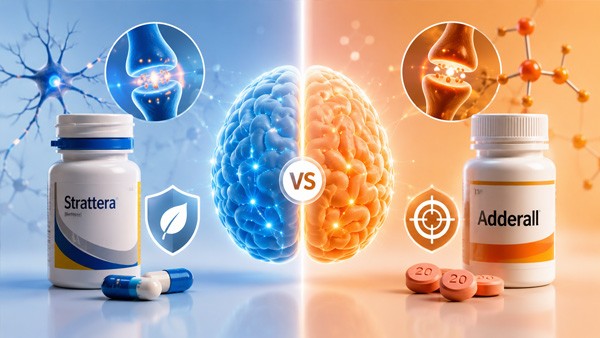
Adderall and Strattera represent two fundamentally different pharmacological approaches to the same condition. Adderall is a Schedule II amphetamine — a classical stimulant that has dominated ADHD treatment since the 1990s and remains first-line therapy by most clinical guidelines. Strattera (atomoxetine) is a Schedule IV non-stimulant — the first FDA-approved non-stimulant for ADHD (approved 2002), developed specifically to provide an alternative for patients who cannot tolerate stimulants, have abuse-liability concerns, or experience worse mood/anxiety with stimulant treatment. The choice between them is rarely about "which is better" in absolute terms — it's about which fits the specific patient profile, which side effects are acceptable, and which approach matches treatment goals beyond pure symptom reduction.
This guide compares Strattera and Adderall on every dimension that matters for ADHD treatment decisions: receptor-level mechanism differences that explain why the experiences differ, head-to-head effectiveness data with honest acknowledgment that stimulants typically win on raw efficacy metrics, the dramatically different onset and duration profiles, side-effect comparison with frequency rates, abuse potential and scheduling implications that affect both prescribing and patient experience, the four major patient profiles where Strattera is clinically preferred over Adderall, the switching protocol for patients transitioning between them, real-world cost and insurance considerations, and the structured bottom-line framework for making the decision. We close with cross-references to broader ADHD treatment context including off-label options like modafinil that occupy a third position in the treatment algorithm.
| Dimension | Strattera (atomoxetine) | Adderall (mixed amphetamine salts) |
|---|---|---|
| Drug class | Non-stimulant SNRI | CNS stimulant (amphetamine) |
| DEA schedule | Schedule IV (low abuse) | Schedule II (high abuse) |
| FDA approval year | 2002 | 1996 (Adderall); 1937 (amphetamine class) |
| Effect size (ADHD-RS) | Cohen's d ~0.6-0.7 | Cohen's d ~0.9-1.1 |
| Onset of full effect | 4-6 weeks | 30-60 minutes (per dose) |
| Duration per dose | 24 hours (continuous) | 4-6 hours IR / 10-12 hours XR |
| Daily dosing | Once daily; continuous coverage | 1-3× daily IR or 1× daily XR |
| Subjective character | Subtle; "normal but better" | Distinct; "switched on" |
| Crash / wear-off | None | Common, especially IR |
| Abuse liability | Minimal | Significant |
| Cardiovascular impact | Mild (+1-3 mmHg, +2-5 bpm) | Moderate (+3-10 mmHg, +5-15 bpm) |
| Insomnia risk | ~15-20% | ~25-35% |
| Appetite suppression | ~15-20% | ~30-40% |
| Standard adult dose | 40-100 mg daily | 20-60 mg daily |
| Generic available | Yes (atomoxetine) | Yes (mixed amphetamine salts) |
The versus card frames the article: stimulant wins raw efficacy and acute onset; non-stimulant wins on abuse liability, cardiovascular gentleness, and continuous-coverage dosing. Neither is universally "better" — they fit different patient profiles.
🧬 Core Difference: Non-Stimulant vs Stimulant
The most important conceptual difference between Strattera and Adderall: they belong to different drug classes with fundamentally different mechanisms, regulatory status, and patient experience profiles.
Adderall is a classical CNS stimulant. Mixed amphetamine salts produce alertness, focus, and motivation enhancement through powerful dopaminergic and noradrenergic stimulation. The mechanism is essentially the same as amphetamines have been used since the 1930s (with modern mixed-salt formulations optimizing duration and acceptability). Schedule II controlled substance with significant abuse and dependence potential. Effective rapidly — same-day response on first dose. Effect comes from boost to wakefulness and motivation pathways that produce subjective "switched on" experience for many patients.
Strattera is a selective norepinephrine reuptake inhibitor (SNRI), specifically targeting the norepinephrine transporter without affecting dopamine reuptake significantly. Despite producing improvement in ADHD symptoms, atomoxetine does not produce stimulant subjective effects, has minimal abuse liability (Schedule IV reflects the genuinely low abuse risk), and requires 4-6 weeks of consistent use before full therapeutic effect develops. Patients on Strattera typically describe it as "ADHD symptoms get easier without feeling like I'm on anything" — distinct from Adderall's recognizable activation.
The clinical implications of this core difference:
- Speed of effect: Adderall produces noticeable improvement within 30-60 minutes of first dose. Strattera takes 4-6 weeks to reach full effect. For acute symptom relief (high-stakes exam, urgent work project), Adderall is fundamentally different.
- Consistency of coverage: Strattera provides continuous 24-hour coverage from once-daily dosing. Adderall provides 4-6 hours (IR) or 10-12 hours (XR) of coverage per dose. Strattera doesn't have "wearing off" periods; Adderall does.
- Abuse and dependence: Strattera has minimal abuse liability and isn't a Schedule II controlled substance. Adderall is widely misused, has dependence potential, and faces increasing prescribing scrutiny.
- Patient experience: Strattera's effect is subtle and gradual; Adderall's is acute and obvious. Some patients prefer the subtler experience; others prefer the obvious productivity boost.
- Side effect profile: Strattera has gentler cardiovascular, appetite, and sleep effects but produces nausea and sexual dysfunction that Adderall doesn't. Different trade-off pattern.
- Discontinuation: Strattera can be tapered without significant withdrawal; Adderall discontinuation can produce notable rebound fatigue, depression, and sleep disturbance.
🧠 How Each Works in the Brain
Receptor-level mechanism differences explain why the experiences differ:
Adderall mechanism:
- Powerful dopamine and norepinephrine reuptake inhibition. Adderall blocks the dopamine transporter (DAT) and norepinephrine transporter (NET), preventing reuptake of these neurotransmitters from the synapse.
- Vesicular release of dopamine. Amphetamines additionally trigger release of dopamine from presynaptic storage vesicles via the vesicular monoamine transporter (VMAT2). This active release mechanism distinguishes amphetamines from pure reuptake inhibitors and produces the more intense subjective effect.
- MAO inhibition contribution. Mild inhibition of monoamine oxidase further increases monoamine availability.
- Net effect: Substantial elevation of synaptic dopamine and norepinephrine in prefrontal cortex, striatum, and other arousal-relevant regions.
- Subjective signature: Acute "switched on" feeling, motivation enhancement, focus on detail, energy increase. Many patients describe this as transformative for ADHD symptoms.
Strattera mechanism:
- Selective norepinephrine reuptake inhibition. Atomoxetine blocks the norepinephrine transporter (NET) with high affinity, preventing reuptake of norepinephrine.
- Indirect dopamine effect. In prefrontal cortex specifically, NET also handles dopamine reuptake (DAT density is lower there). So atomoxetine indirectly increases prefrontal dopamine through NET blockade — but only in prefrontal cortex, not in nucleus accumbens (the reward center).
- No vesicular release. Atomoxetine does not trigger active neurotransmitter release; it only inhibits reuptake.
- No nucleus accumbens dopamine elevation. Crucially, atomoxetine doesn't substantially affect dopamine in the brain's primary reward pathway, which is why it lacks abuse liability — there's no subjective "high" or reward signal.
- Net effect: Enhanced norepinephrine signaling throughout brain; enhanced prefrontal dopamine specifically; no nucleus accumbens dopamine surge.
- Subjective signature: Gradual, subtle. ADHD symptoms improve without producing recognizable drug experience. Many patients describe Strattera as "I just function better" rather than feeling activated.
The mechanism difference explains the abuse liability difference: amphetamines produce reward-system activation that makes them inherently rewarding and habit-forming; atomoxetine doesn't engage the reward system meaningfully, so the brain doesn't seek repeated dosing for reward purposes. Both medications improve ADHD symptoms through cortical norepinephrine and dopamine enhancement, but only amphetamines have the additional reward-circuit activation that drives abuse potential.
📊 Effectiveness Head-to-Head
The honest evidence on relative effectiveness:
- Adderall produces larger effect sizes on ADHD rating scales. Multiple meta-analyses consistently show stimulants achieve Cohen's d 0.9-1.1 on ADHD-RS while non-stimulants achieve Cohen's d 0.6-0.7. This is a meaningful effect size gap — clinically translates to noticeably better symptom reduction with Adderall than Strattera for the average patient.
- Response rates differ. Approximately 70-80% of ADHD patients respond to stimulants (defined as ≥30% symptom reduction); response to atomoxetine is approximately 60-70%. Both produce meaningful improvement in most responders.
- Head-to-head trials favor Adderall. Multiple direct comparison studies show Adderall outperforming atomoxetine on symptom measures, executive function tests, and patient-reported outcomes. The advantage is real and consistent.
- Strattera works for patients Adderall doesn't. A subset of patients respond poorly to stimulants or cannot tolerate stimulant side effects. For these patients, atomoxetine often produces meaningful benefit despite lower average effect size. The relevant question for individual patients is not "which is more effective on average" but "which works for me specifically."
- Different symptom dimensions respond differently. Adderall produces larger improvement in inattention and impulsivity; atomoxetine produces relatively more improvement in emotional regulation and persistence. Some patients with specific symptom profiles find atomoxetine matches their needs better despite lower aggregate effect size.
- Long-term effectiveness is similar. Over multi-year treatment, both medications maintain efficacy reasonably well. Stimulant advantage in initial trials may narrow over years as tolerance and contextual factors equilibrate.
- Combination therapy uncommon. Direct combination of stimulant + atomoxetine is not standard practice; either approach is used alone or sequentially.
⏰ Onset and Duration
The temporal profile of each medication shapes daily life with treatment:
Adderall temporal profile:
- Acute onset 30-60 minutes after dose. Patients can feel effect on first dose.
- Peak 1-3 hours. Maximum acute effect.
- Duration IR: 4-6 hours. Wears off; requires redosing for full-day coverage.
- Duration XR: 10-12 hours. Single morning dose covers most workday.
- Wear-off pattern: Common rebound including fatigue, low mood, irritability, sometimes brief anxiety as drug clears.
- End-of-day cliff: Particularly with IR formulations, end of effect can feel abrupt.
- Practical implication: Acute use possible — take when needed for specific task. Drug holidays viable.
Strattera temporal profile:
- No acute onset. First dose doesn't produce noticeable subjective effect.
- Initial benefit 1-2 weeks of consistent use. Mild improvement detectable.
- Full effect 4-6 weeks of consistent use. Maximum benefit emerges gradually.
- Continuous 24-hour coverage. Once-daily dosing maintains consistent plasma levels.
- No wear-off, no crash. Stable functional level throughout day and into evening.
- Discontinuation: Effects gradually diminish over 1-2 weeks if stopped; no acute withdrawal.
- Practical implication: Must be taken consistently daily for treatment effect. Drug holidays don't work the same way; you can't take only on demanding days.
The temporal difference has lifestyle implications:
- Adderall fits demand-driven use. Take it on high-demand days, skip on relaxed days. Drug holidays during vacation possible.
- Strattera requires committed daily adherence. Inconsistent taking undermines effect; missing doses for several days requires gradual rebuilding of plasma levels.
- Adderall has identifiable "on" and "off" periods. Some patients like the structure; others find the cyclic experience disruptive.
- Strattera produces consistent function. No clear "on" or "off" experience; treatment is continuous.
- Sleep impact differs. Adderall taken too late disrupts sleep; Strattera generally doesn't affect sleep (some patients actually sleep better on Strattera because of its norepinephrine modulation).
⚠️ Side Effects Compared
The frequency and character of side effects differ substantially between the medications:
| Side effect | Strattera frequency | Adderall frequency | Winner |
|---|---|---|---|
| Headache | ~15-20% | ~15-25% | Comparable |
| Insomnia | ~15-20% | ~25-35% | Strattera (gentler) |
| Appetite suppression | ~15-20% | ~30-40% | Strattera (gentler) |
| Nausea | ~25-30% (most common Strattera SE) | ~5-10% | Adderall (gentler) |
| Heart rate increase | +2-5 bpm | +5-15 bpm | Strattera (gentler) |
| Blood pressure increase | +1-3 mmHg | +3-10 mmHg | Strattera (gentler) |
| Anxiety | ~5-10% | ~10-20% | Strattera (gentler) |
| Irritability | ~5-10% | ~10-15% | Strattera (gentler) |
| Sexual dysfunction | ~5-10% (decreased libido, erectile dysfunction) | <5% | Adderall (gentler) |
| Dry mouth | ~15-20% | ~15-25% | Comparable |
| Sweating | ~10-15% | ~5-10% | Adderall (gentler) |
| Urinary hesitancy | ~5-10% | Rare | Adderall (gentler) |
| Suicidal ideation (pediatric black box) | Boxed warning | No specific warning | Adderall (no pediatric SI signal) |
| Hepatotoxicity | Rare but specifically labeled | Not associated | Adderall (no liver signal) |
| Cardiovascular events | Rare | Boxed warning for cardiac events | Strattera (lower cardiac risk) |
| Crash / rebound | None | Common, especially IR | Strattera (smoother) |
| Abuse / dependence | Minimal | Substantial | Strattera (much lower) |
| Tic exacerbation | Less risk | Possible | Strattera (better for tic-prone) |
| Growth suppression (pediatric) | Smaller effect | Documented over years | Strattera (less effect) |
Side-effect profile summary:
- Strattera wins on: cardiovascular gentleness, appetite preservation, sleep impact, anxiety, irritability, crash/rebound (none), abuse liability (minimal), tic exacerbation risk, growth effects.
- Adderall wins on: nausea (much lower), sexual dysfunction (much lower), urinary symptoms (rare), no hepatotoxicity warning, no pediatric SI black box.
- Comparable: headache, dry mouth.
- Pattern: Strattera produces gentler "everyday" side effects but has specific concerning warnings (hepatotoxicity, pediatric suicidal ideation). Adderall produces stronger everyday side effects but lacks these specific serious warnings.
📋 Abuse Potential and Scheduling
The Schedule II vs Schedule IV difference is one of the most important practical distinctions:
Adderall — Schedule II Controlled Substance:
- High abuse potential officially recognized. Significant misuse exists in academic, professional, and recreational contexts.
- No refills allowed by federal law. Each prescription requires new written prescription. Maximum 90-day supply per script in most states.
- No telephone or fax prescriptions for new scripts. Some allowances for electronic prescribing in specific contexts.
- Pharmacy receipt requires ID and signature. Tracking and documentation requirements.
- State PDMP (Prescription Drug Monitoring Program) reporting. Your Schedule II prescription history is in a state database.
- Travel implications: Carrying internationally requires documentation; prohibited in some countries (Japan particularly strict).
- Insurance prior authorization common. Insurance may require step therapy through non-stimulants first.
- Increasing prescribing scrutiny. Telehealth Adderall prescribing has been heavily restricted post-pandemic; in-person evaluation increasingly required.
- Diversion risk: Family members, friends, roommates may pressure for "borrowing" Adderall. Secure storage required.
Strattera — Schedule IV (in some classifications) or non-scheduled:
- Low abuse potential officially recognized. Genuine lack of meaningful misuse in real-world data.
- Standard prescription rules apply. Refills allowed; no special restrictions.
- Telephone, fax, electronic prescriptions accepted. Same as other prescription medications.
- PDMP reporting may or may not apply depending on state. Less stringent tracking.
- Travel implications: Easier international travel; rarely problematic at customs with prescription.
- Insurance coverage typically straightforward. Most insurance covers without step therapy.
- Less prescribing scrutiny. Telehealth prescribing widely available.
- No diversion concerns. Family members don't have incentive to "borrow" Strattera (no subjective reward).
The scheduling difference creates real-world quality-of-life difference for many patients. Schedule II prescription management — monthly pharmacy visits, no refills, new prescription required, occasional supply issues — adds friction to medication management that Schedule IV/non-scheduled drugs avoid. For patients with executive function challenges from ADHD, this medication management burden can be significant.
🎯 Who Should Choose Strattera
Specific patient populations where Strattera is preferred over Adderall:
- Patients with substance abuse history. Personal history of stimulant abuse, methamphetamine dependence, cocaine use, or alcohol use disorder. Strattera's minimal abuse liability is appropriate; Schedule II amphetamines represent unacceptable risk.
- Family history of substance abuse. Strong genetic component to addiction risk. Many psychiatrists prefer non-stimulant options for patients with family history even without personal use history.
- Cardiovascular contraindications or concerns. Patients with hypertension, arrhythmia history, structural heart disease, or family history of sudden cardiac events. Strattera's milder cardiovascular profile is safer.
- Comorbid anxiety disorders. Adderall can worsen anxiety in vulnerable patients; Strattera typically doesn't and may even help anxiety in some patients.
- Tic disorders. Stimulants can exacerbate tics; Strattera has lower tic-exacerbation risk.
- Patients who experienced significant Adderall side effects. Severe insomnia, dramatic appetite suppression, mood deterioration on stimulant trial.
- Patients who want continuous 24-hour coverage. ADHD symptoms affect early morning routines (before stimulant onset) and evening activities (after stimulant wear-off) for many patients. Strattera's continuous effect covers these periods.
- Career or personal preference for non-controlled substance. Pre-professional students (medical, law, military) sometimes prefer non-Schedule II for licensure considerations. Patients in safety-sensitive jobs or with specific employment concerns.
- Patients with poor medication adherence to multi-dose regimens. Once-daily Strattera is easier than multi-dose Adderall IR for patients with executive function challenges.
- Patients who dislike feeling "on a drug." Some patients find Adderall's acute subjective effect intrusive; Strattera's subtler profile is preferable.
- Pediatric patients with specific risk profiles. Some pediatric psychiatrists prefer Strattera as initial trial for children whose families have substance abuse concerns or specific cardiovascular history.
- Patients with bipolar disorder (carefully). Both medications carry mania-precipitation risk but stimulants more so. Strattera with adequate mood stabilizer coverage may be preferable.
👥 Best-Fit Patient Type Classification
Four major patient profiles and the medication match:
Type 1 — "Standard ADHD, No Complications." Adult or pediatric ADHD without comorbid substance abuse, cardiovascular issues, or other complicating factors. Modafinil approach: Adderall first-line for most patients in this profile. Larger effect size and faster onset make it the default choice. Strattera reserved for patients who fail or can't tolerate stimulants.
Type 2 — "Substance Use History Concerns." Personal history of substance abuse, family history of addiction, or active concerns about controlled substance prescribing. Strattera preferred. Lower abuse liability appropriate; Adderall represents unacceptable risk regardless of effect size advantage.
Type 3 — "Cardiovascular Concerns." Hypertension, arrhythmia, structural heart disease, family history of sudden cardiac events. Strattera preferred with monitoring. Adderall's cardiovascular impact more concerning in this population. If stimulant absolutely needed, low-dose with cardiac monitoring; otherwise prefer Strattera.
Type 4 — "Anxiety or Mood Comorbidity." Significant comorbid anxiety, panic disorder, or mood disorder. Strattera often preferred. Adderall can worsen anxiety in vulnerable patients. Strattera's gentler profile better fit for anxiety comorbidity. Bipolar disorder requires specialist input regardless of medication choice.
| Patient type | Profile | Recommended | Why |
|---|---|---|---|
| Type 1 (Standard ADHD) | No complications | Adderall first-line | Larger effect size; faster onset |
| Type 2 (Substance use history) | Personal or family addiction history | Strattera preferred | Minimal abuse liability |
| Type 3 (Cardiovascular) | HTN, arrhythmia, CV history | Strattera preferred | Gentler cardiovascular profile |
| Type 4 (Anxiety/mood) | Comorbid anxiety or mood disorder | Strattera often preferred | Doesn't typically worsen anxiety |
🔁 Switching Protocol Between Them
Patients sometimes need to switch between Strattera and Adderall. Different protocols for each direction:
Switching from Adderall to Strattera:
- Day 0: Last Adderall dose at normal time.
- Days 1-3: Expect mild withdrawal — fatigue, low mood, possible mild rebound depression as amphetamine clears. Sleep extra; expect performance dip.
- Day 1: Start Strattera 40 mg morning. No immediate effect expected — this is normal.
- Week 2: Titrate Strattera to 60 mg morning if tolerated.
- Week 3-4: Titrate to 80-100 mg morning (standard adult dose).
- Weeks 4-6: Full Strattera effect emerging. ADHD symptoms gradually improve.
- Week 6+: Final response assessment. If inadequate symptom control, dose adjustment or reconsider whether to return to Adderall.
Switching from Strattera to Adderall:
- Day 0: Last Strattera dose at normal time.
- Days 1-7: Strattera effect gradually diminishes over 1-2 weeks; no acute withdrawal.
- Day 1 or Day 8: Start Adderall — physician decides timing. Some prefer immediate switch; others prefer 1-week washout.
- Starting Adderall dose: Typically 10 mg IR morning or 20 mg XR morning. Acute effect on first dose.
- Days 1-7 of Adderall: Titrate based on response. Multiple doses per day for IR or single XR dose.
- Week 2-4: Stable Adderall regimen established.
- Considerations: Schedule II prescribing logistics begin (no refills, monthly visits, PDMP tracking, etc.).
Common reasons for switching directions:
- Adderall → Strattera: Substance use concerns developed, cardiovascular issues emerged, severe side effects, scheduling burden too high.
- Strattera → Adderall: Inadequate symptom control, want faster onset, want acute "on" experience, want demand-driven dosing flexibility.
💰 Cost and Insurance Comparison
Practical cost considerations:
| Cost dimension | Strattera (atomoxetine) | Adderall (mixed amphetamine salts) |
|---|---|---|
| Brand name monthly retail | ~$300-450 | ~$200-400 (IR); ~$300-500 (XR) |
| Generic monthly retail | ~$30-80 | ~$15-60 (IR); ~$30-100 (XR) |
| Insurance copay (with coverage) | ~$5-30 | ~$5-30 |
| Insurance prior authorization | Less common | More common |
| Step therapy requirements | Rare | Some plans require Strattera first |
| Telehealth prescribing | Widely available | Restricted post-pandemic |
| Pharmacy refills | Standard refills | No federal refills; monthly script |
| Supply shortage risk | Less affected | Recurring shortages 2022-2026 |
The cost economics typically favor whichever drug your insurance covers preferentially. Generic atomoxetine and generic mixed amphetamine salts are comparable in cost; brand-name versions vary by manufacturer pricing. Adderall supply shortages have been a recurring issue 2022-2026, occasionally forcing patients to switch to Strattera or another alternative regardless of clinical preference.
For broader ADHD treatment context including off-label alternatives, see our comprehensive Modafinil for ADHD article. Generic modafinil (e.g., Modalert 200 mg) is a third-line off-label option that some patients prefer for Schedule IV status and gentle side effect profile, despite lower effect size than either Adderall or Strattera for ADHD specifically.
✨ Bottom Line
The Strattera vs Adderall decision is not "which is better" — it's "which fits this specific patient." Adderall wins on raw efficacy metrics (Cohen's d 0.9-1.1 vs 0.6-0.7 on ADHD-RS), acute onset (same-day effect vs 4-6 weeks), and patient-reported subjective improvement satisfaction. Strattera wins on abuse liability (minimal vs significant), cardiovascular gentleness (+2-5 bpm vs +5-15 bpm), continuous 24-hour coverage, prescription simplicity (no Schedule II logistics), and freedom from crash/rebound effects.
Adderall is the default first-line ADHD treatment for patients without specific contraindications — its larger effect size and faster onset make it the more effective choice for the average patient. Strattera is preferred for patients with substance use history, cardiovascular concerns, anxiety/mood comorbidity, tic disorders, who experienced significant Adderall side effects, who want continuous coverage, or who have specific career/personal preference for non-Schedule II medication.
The four major patient type classifications (Standard ADHD / Substance Use History / Cardiovascular Concerns / Anxiety-Mood Comorbidity) map to appropriate medication choice. Standard ADHD without complications: Adderall. The three complication categories: Strattera preferred.
The temporal profile difference shapes daily life with treatment substantially. Adderall fits demand-driven use with acute effect and clear "on/off" periods; Strattera requires committed daily adherence and provides continuous 24-hour function without clear drug-experience moments.
The Schedule II vs Schedule IV/non-scheduled difference creates real-world quality-of-life implications beyond pure pharmacology — monthly pharmacy visits, no refills, PDMP tracking, supply shortages, travel complications, telehealth prescribing restrictions all add friction to Schedule II Adderall management that Strattera avoids.
The side-effect profile trade-off: Strattera wins on cardiovascular, appetite, sleep, anxiety, and crash dimensions; Adderall wins on nausea, sexual dysfunction, and urinary symptom dimensions. Both are reasonably well-tolerated at therapeutic doses for most patients.
For patients newly starting ADHD treatment without specific risk factors: stimulants (Adderall, Vyvanse, methylphenidate) are first-line per clinical guidelines. For patients with risk factors making stimulants problematic: Strattera, guanfacine, clonidine, or viloxazine are appropriate FDA-approved non-stimulant first-line options. For patients who fail or can't tolerate FDA-approved options: off-label alternatives including modafinil, armodafinil, or bupropion may be considered with specialist input — see Modafinil for ADHD for full off-label context.
For comprehensive comparison articles on ADHD medication alternatives, see Modafinil vs Ritalin (methylphenidate vs eugeroic comparison), Modafinil vs Vyvanse (different amphetamine prodrug comparison), Modafinil vs Armodafinil, and Modafinil vs Caffeine.
For broader ADHD treatment use-case context, see our companion articles on specific patient populations: Modafinil for Students, Modafinil for Programmers, Modafinil for Entrepreneurs, and Modafinil for Depression.
❓ Frequently Asked Questions
Is Strattera as effective as Adderall?
No, on average. Multiple meta-analyses show Adderall produces larger effect sizes on ADHD rating scales (Cohen's d 0.9-1.1) than Strattera (Cohen's d 0.6-0.7). The clinical translation: Adderall is more effective for most ADHD patients. However, Strattera works well for a subset of patients including those who don't respond to or can't tolerate stimulants. For individual patients, "which works for me" matters more than "which is more effective on average."
Why is Strattera not a controlled substance?
Strattera doesn't activate the brain's reward system meaningfully. Atomoxetine inhibits norepinephrine reuptake but doesn't substantially affect dopamine in the nucleus accumbens (the brain's primary reward region). Without reward-system activation, the drug isn't subjectively rewarding and doesn't drive repeated misuse. Real-world data confirms minimal abuse of Strattera. Adderall, by contrast, produces nucleus accumbens dopamine elevation that drives both its therapeutic effects and its abuse liability.
How long does Strattera take to work?
4-6 weeks for full therapeutic effect. Initial benefit may be noticeable at 1-2 weeks of consistent use; full effect emerges gradually over the following weeks. This is fundamentally different from Adderall's same-day effect. Patients switching from Adderall to Strattera need to understand and accept this delayed onset — there's no acute symptom relief during the titration period. Many patients abandon Strattera in the first 2 weeks because "it's not working" before reaching full therapeutic plasma levels.
Can I take Strattera and Adderall together?
Generally not standard practice. Direct combination of stimulant + atomoxetine is uncommon — the medications would be used alone or sequentially rather than combined. Some specialists prescribe combination therapy for selected treatment-resistant ADHD cases, but this is specialist territory and not routine. Patients shouldn't combine these medications without explicit physician direction.
Does Strattera cause weight loss like Adderall?
Less. Strattera produces appetite suppression in approximately 15-20% of users with modest weight effects. Adderall produces appetite suppression in 30-40% of users with often significant weight loss. For patients with eating concerns, growth concerns (pediatric), or low body weight, Strattera's gentler appetite effect is a meaningful advantage.
Will Strattera help my anxiety?
Possibly. Some patients with comorbid anxiety and ADHD find that Strattera modestly improves both conditions, particularly when anxiety is partially driven by ADHD-related functional difficulties. Adderall can worsen anxiety in vulnerable patients due to stimulant activation. For patients with prominent anxiety comorbidity, Strattera is often preferred. Severe anxiety disorders may require dedicated anxiety treatment regardless of ADHD medication choice.
What's the dose of Strattera for adult ADHD?
Standard adult dose: 40-100 mg daily, typically titrated up from 40 mg to 80-100 mg over 2-4 weeks. Maximum dose 100 mg/day or 1.4 mg/kg whichever is lower. Once-daily morning dosing standard. Can be split to twice daily for patients experiencing side effects, though this is less common with the long half-life. Children: weight-based dosing, typically 0.5-1.4 mg/kg/day.
What's the dose of Adderall for adult ADHD?
Standard adult dose: 20-60 mg daily (IR), often split into 2-3 doses. XR (extended-release) typically 20-60 mg once daily. Starting dose 10 mg IR or 20 mg XR with titration based on response. Maximum approved dose 60 mg/day though some specialists use higher doses for treatment-resistant cases. Pediatric: lower weight-based doses with careful titration.
Why does Strattera have a suicidal ideation warning?
Pediatric studies showed slightly elevated rates of suicidal ideation in children and adolescents treated with atomoxetine compared to placebo. FDA added a boxed warning requiring pediatric monitoring for suicidal thoughts, particularly during initial treatment weeks. This is a real but rare phenomenon — most pediatric patients tolerate Strattera without suicidal ideation. Adult patients have a smaller signal. Monitoring during initial treatment weeks matters. Adderall doesn't have an equivalent pediatric suicidal ideation black box.
Is Strattera or Adderall better for adults with ADHD?
Depends on the adult. Adderall has larger effect size for the average adult ADHD patient. Strattera is preferred for adults with substance abuse history, cardiovascular concerns, comorbid anxiety, or specific preference for non-controlled substance. For adults newly diagnosed without complicating factors: Adderall is first-line by guidelines. For adults with relevant risk factors making stimulants problematic: Strattera is appropriate. The individual patient profile determines the choice; "better" is patient-specific rather than absolute.
📚 References & Further Reading
- FDA prescribing information for Strattera (atomoxetine) — official drug profile and warnings.
- FDA prescribing information for Adderall (mixed amphetamine salts) — official drug profile.
- Faraone et al., European Neuropsychopharmacology — meta-analyses of ADHD medication effect sizes.
- Bushe et al., Journal of Psychopharmacology — comparative effectiveness of atomoxetine and stimulants.
- American Academy of Pediatrics — ADHD clinical practice guidelines.
- American Psychiatric Association — practice guidelines for ADHD treatment.
- CADDRA (Canadian ADHD Resource Alliance) — adult ADHD treatment algorithm.
- NICE clinical guideline NG87 — ADHD diagnosis and management UK.
- European ADHD Guidelines Group — treatment recommendations.
- World Federation of Societies of Biological Psychiatry — ADHD guidelines.
- DEA scheduling rationale documentation for Adderall and atomoxetine.
- NIH National Institute of Mental Health — ADHD patient resources.
- Modafinil for ADHD — off-label modafinil option in broader ADHD treatment context.
- Modafinil vs Ritalin — methylphenidate-class comparison.
- Modafinil vs Vyvanse — lisdexamfetamine comparison.
- Modafinil vs Armodafinil — R-enantiomer comparison.
- Modafinil vs Caffeine — baseline cognitive enhancement comparison.
- Modafinil vs Phenylpiracetam — nootropic comparison.
- Modafinil for Students, Modafinil for Programmers, Modafinil for Entrepreneurs, Modafinil for Depression, Modafinil for Shift Workers — companion use-case articles.
- Modalert 200 mg, Modvigil 200 mg, Waklert 150 mg — primary product pages on the RXshop antinarcoleptic catalogue.
- RXshop Editorial Team — content reviewed by licensed pharmacist; for adult patient education, not a substitute for individual medical consultation.
Medical Disclaimer: The information in this article is for educational and informational purposes only and is not a substitute for professional medical advice, diagnosis, or treatment. Always seek guidance from a qualified healthcare provider with any questions you may have regarding a medical condition, and before starting, stopping or changing any medication.