Modafinil and Stevens-Johnson Syndrome: Rare but Serious


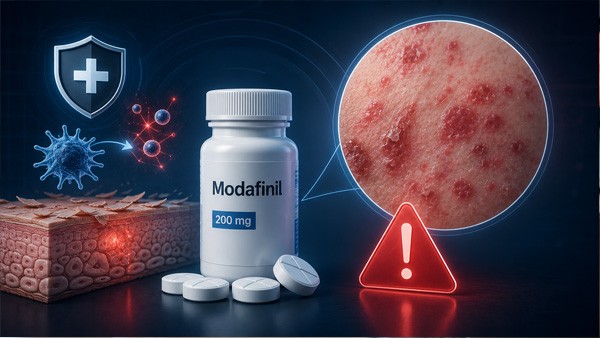
Stevens-Johnson syndrome (SJS) is a rare but life-threatening immunological reaction to certain medications, characterized by widespread skin detachment, mucous membrane involvement, and systemic illness — and modafinil carries a specific FDA-labeled warning for this risk. The incidence is genuinely rare — approximately 1 to 5 cases per million patient-years of modafinil exposure — but the consequences when SJS does occur are severe enough that no amount of incidence rarity makes vigilance optional. This is the side effect of modafinil that overrides everything else in the safety conversation: not the most common, but the most serious by a substantial margin, and the only modafinil adverse event that justifies same-day emergency response to seemingly minor early signs.
This guide addresses SJS with the precise gravity it warrants. Calibrated alarm rather than dismissive reassurance — most modafinil users will never experience SJS, but those who do require immediate recognition and emergency response to maximize outcomes. We cover what SJS actually is medically and how it progresses, the precise incidence rate in modafinil users compared to background population and other drug classes, the early warning signs that distinguish prodrome from common viral illness, the absolute criteria that mandate immediate drug discontinuation and emergency evaluation, the risk factor profile that predicts higher susceptibility, the four-stage clinical deterioration timeline that helps users and clinicians recognize where in the disease process a patient is, the daily skin check protocol for the first weeks of modafinil use when SJS risk is highest, the communication script for explaining your situation to emergency room staff, and the broader context of what happens during hospital evaluation and recovery from SJS.
⛔ If ANY of these occur while taking modafinil — STOP THE DRUG IMMEDIATELY:
• Any new skin rash anywhere on body (even small or mild)
• Painful red or purple skin patches
• Blistering skin or skin peeling
• Sores in mouth, throat, eyes, nose, or genitals
• Burning eyes with redness
• Fever >38°C / 100.4°F with general unwellness
• Sore throat with skin/mouth involvement
• Swelling of face or tongue
📞 Then within 1-4 hours:
• Same-day physician contact (urgent care or telehealth) for mild signs
• Emergency department evaluation for any blistering, mucous membrane involvement, or systemic symptoms
• Call ambulance (911 / 112 / your local emergency) for extensive rash, breathing difficulty, or severe systemic illness
🏥 What to tell the ER on arrival:
"I have been taking modafinil [X mg] for [Y days/weeks]. I am concerned about possible Stevens-Johnson syndrome. The drug has a specific FDA-labeled SJS warning. I have stopped taking it as of [time/date]."
💊 Bring with you: The modafinil packaging (or photograph of it), the dose schedule, any photographs of the rash/sores as they evolved, list of all medications and supplements you currently take.
🩺 What SJS Is
Stevens-Johnson syndrome and its more severe form toxic epidermal necrolysis (TEN) are severe cutaneous adverse reactions (SCARs) — immunologically-mediated reactions to certain medications in which the body's T-cell response targets the patient's own skin and mucous membrane epithelial cells, causing them to die and detach in sheets. The clinical picture is dramatic and unmistakable in advanced stages but subtle in early stages — which is exactly why early recognition is the difference between manageable outcome and catastrophic outcome.
The pathophysiology involves cytotoxic T-cell activation by drug-derived antigens that are mistakenly recognized as foreign. In susceptible individuals, certain HLA genotypes increase the probability that specific drugs will produce this immune cross-reaction. Once activated, the T-cells release granulysin, perforin, and granzyme B that destroy keratinocytes (skin cells), leading to widespread cell death across epidermis and mucous membranes. The skin then separates at the dermoepidermal junction, producing the characteristic blistering and sheet-like detachment.
SJS and TEN are on a clinical continuum distinguished by extent of skin detachment:
- SJS: <10% body surface area (BSA) skin detachment.
- SJS-TEN overlap: 10-30% BSA detachment.
- TEN: >30% BSA detachment.
Mortality rates correlate with extent: SJS ~5-10%, SJS-TEN overlap ~15-25%, TEN ~30-40% even with optimal hospital care. Survival depends heavily on speed of drug discontinuation and quality of supportive care (typically delivered in burn units or intensive care). Patients who survive often have permanent sequelae including eye damage (which can include blindness), skin scarring, lung damage, kidney dysfunction, and lifelong drug allergies requiring strict avoidance of related medications.
The drugs most commonly implicated in SJS/TEN cases include certain antibiotics (sulfonamides, especially sulfamethoxazole-trimethoprim), antiepileptics (carbamazepine, phenytoin, lamotrigine), allopurinol, nevirapine, and a small set of others — modafinil falls into this small set, with the FDA prescribing label specifically calling out SJS risk based on cases observed during clinical trials and post-marketing surveillance.
📊 Incidence Rate in Modafinil Users
The incidence numbers matter for honest risk assessment. Modafinil SJS is genuinely rare in absolute terms — but it is not zero, and the FDA-labeled warning exists because the rate is meaningfully above background population SJS incidence.
- Background population SJS incidence (any cause): Approximately 1-2 cases per million person-years globally.
- Modafinil-associated SJS incidence: Approximately 1-5 cases per million patient-years of modafinil exposure. The wide range reflects estimation difficulty from post-marketing surveillance data.
- Pediatric modafinil SJS incidence: Higher than adult — estimated 2-10× the adult rate. This is why modafinil is not FDA-approved for pediatric ADHD and why pediatric use of any kind requires specialist input.
- Adult patient population modafinil SJS: Approximately 1 case per 200,000-500,000 patients treated. A practicing physician prescribing modafinil regularly may go an entire career without seeing a case.
- Comparison: carbamazepine SJS rate: Approximately 1-10 per 10,000 patients in some populations — orders of magnitude higher than modafinil. This puts modafinil's SJS risk in perspective.
- Comparison: lamotrigine SJS rate: Approximately 1 per 1,000-2,000 patients — also dramatically higher than modafinil.
- Comparison: penicillin allergy rate: Approximately 10% of patients self-report; severe reactions including SJS approximately 1 per 10,000.
The interpretation: modafinil SJS is real but rare. The absolute risk per patient is very small. The reason it nonetheless dominates the safety conversation is because the consequences when it does occur are severe enough to warrant disproportionate vigilance. A 1-in-200,000 risk of a fatal or life-altering event is mathematically small but clinically important.
| Drug | SJS incidence rate | Reference framing |
|---|---|---|
| Background population | 1-2 / million person-years | Spontaneous rate without specific drug |
| Modafinil (adults) | 1-5 / million patient-years | FDA-labeled warning; rare but elevated |
| Modafinil (pediatrics) | 2-10× adult rate | Higher; not approved for pediatric ADHD |
| Lamotrigine (adults) | ~1 / 1,000-2,000 patients | Common SJS-associated drug |
| Carbamazepine (HLA-B*1502+ Asian populations) | ~1 / 100-1,000 patients | Highest known drug-SJS association |
| Sulfamethoxazole-trimethoprim | ~1 / 10,000-100,000 patients | Common antibiotic SJS cause |
| Allopurinol (HLA-B*5801+) | ~1 / 10,000 patients | Gout drug SJS association |
🔍 Early Warning Signs
SJS typically begins with a prodromal phase 1-3 days before the characteristic skin changes appear. The prodrome is what is most often missed — it mimics common viral illness and patients (and sometimes clinicians) attribute it to seasonal flu or a cold rather than to potential SJS. Recognizing the prodrome in the context of recent modafinil initiation is the critical early warning.
Prodromal phase signs (1-3 days before skin involvement):
- Fever: Often >38°C / 100.4°F. Generally not high (rarely >40°C) but persistent.
- Sore throat: Out of proportion to other respiratory symptoms. May be the patient's primary complaint at this stage.
- Malaise and fatigue: "Feeling unwell" without clear focal symptoms.
- Body aches: Diffuse muscle and joint discomfort.
- Burning sensation in eyes: Sometimes mistaken for conjunctivitis. May progress to redness.
- Sensitivity to light (photophobia): Often subtle but present.
- Painful swallowing: Sore throat that worsens with swallowing; sometimes mouth tenderness.
- Cough: Often dry. Easily attributed to viral illness.
- Nausea, vomiting, or loss of appetite: Less specific but commonly present.
Skin and mucous membrane signs (typically appearing 1-3 days after prodrome onset):
- Painful red or purple skin patches: Often beginning on face and upper trunk, then spreading. Painful even before visible. Pain is characteristically out of proportion to visible findings — this is a distinguishing feature from less serious rashes.
- Target or atypical target lesions: Round patches with central darker area, sometimes resembling small bullseyes.
- Blistering: Initially small blisters that may merge into larger ones. Fluid-filled rather than pustular.
- Sheet-like skin detachment: In advanced stages, skin detaches in sheets when gently rubbed (Nikolsky sign — applied by trained clinicians, not self-tested).
- Mucous membrane sores: Painful ulcers in mouth, throat, eyes, nose, genitals, or anus. Often very painful. Sores in two or more mucous membranes is a key SJS criterion.
- Eye involvement: Red, painful, watery eyes with sensitivity to light. May progress to severe conjunctivitis with blistering of conjunctiva.
- Lip swelling and crusting: Hemorrhagic crusts on lips are a classic SJS sign.
🚑 When to Stop and Go to ER
The threshold for stopping modafinil is dramatically lower than the threshold for going to the emergency department — and both should be calibrated to recognize the asymmetric cost of late diagnosis. Use the table below to determine appropriate response level:
| Symptom presentation | Stop modafinil? | Where to go? | Timeline |
|---|---|---|---|
| Any new skin rash, even small | YES | Urgent care or telehealth | Same day |
| Rash + fever | YES | Urgent care or ER | Same day |
| Rash + mouth/eye sores | YES | Emergency department | Same day, urgent |
| Blistering skin anywhere | YES | Emergency department | Immediately |
| Painful red/purple patches with fever | YES | Emergency department | Immediately |
| Skin peeling or sheet-like detachment | YES | Emergency department | Call ambulance |
| Mucous membrane sores in 2+ sites | YES | Emergency department | Immediately |
| Face/tongue swelling | YES | Emergency department | Call ambulance |
| Difficulty breathing or swallowing | YES | Emergency department | Call ambulance |
| Fever + severe sore throat without rash (yet) | YES if recent modafinil start | Urgent care | Same day |
| Flu-like illness 5+ weeks after modafinil start | Optional pause | Routine care if no rash | Within 24-48 hours |
| Flu-like illness 0-5 weeks after modafinil start | YES (precaution) | Telehealth or urgent care | Same day |
The general principle: any rash + modafinil = stop the drug immediately, no exceptions, no "let me see if it gets worse first." The cost of stopping unnecessarily is trivial — you miss a day or two of alertness and can resume after proper evaluation if SJS is ruled out. The cost of continuing during early SJS can be permanent disability or death. The asymmetric cost calculation makes the conservative response always correct.
⚠️ Risk Factors
Several patient characteristics increase the risk of developing SJS on modafinil. Some are modifiable; most are not. Knowing your risk profile helps calibrate vigilance during the high-risk early weeks of modafinil use:
- Prior SJS or TEN history with ANY drug: The single strongest risk factor. Patients with prior SJS/TEN to any medication have substantially higher cross-reactivity risk with modafinil. Many specialists consider prior SJS/TEN an absolute contraindication for modafinil use regardless of which drug caused the original reaction.
- HLA-B*1502 genotype: More common in Asian populations (Han Chinese, Thai, Malaysian). Associated with carbamazepine-SJS most strongly but with theoretical relevance to other drug-induced SJS including modafinil. Pre-treatment HLA testing is FDA-recommended for carbamazepine in at-risk populations; less established for modafinil but worth discussion in high-risk individuals.
- Pediatric age: Children and adolescents have higher SJS rates on modafinil than adults — one of the major reasons modafinil is not FDA-approved for pediatric ADHD.
- Concurrent SCAR-associated medications: Taking modafinil at the same time as carbamazepine, lamotrigine, allopurinol, or sulfonamide antibiotics compounds SJS risk. Any combination of these requires extra vigilance.
- Recent viral illness: Active or recent viral infection (particularly HSV, EBV, Mycoplasma) at the time of modafinil initiation appears to increase risk through immune activation.
- HIV infection: Patients with HIV have substantially elevated SCAR risk to multiple drugs including modafinil. Use should be specialist-supervised.
- Female sex: Slightly elevated risk compared to male, particularly in younger age groups.
- Family history of SCAR: Some genetic clustering exists; family history of severe drug reactions warrants caution.
- Early treatment phase: Approximately 80-90% of modafinil-SJS cases occur within the first 5 weeks of starting the drug. After 8-12 weeks of stable use without rash, ongoing SJS risk drops substantially.
- Higher dose: Higher initial doses appear to slightly increase risk vs lower starting doses, though the effect is modest. Conservative starting dose (100 mg) for the first 2-4 weeks is reasonable for risk-conscious users.
📈 Deterioration Stage Classification
SJS progression follows a recognizable clinical staging from prodrome through acute phase. Understanding the stages helps users (and clinicians evaluating users) identify where in the disease process a patient is and what immediate steps are appropriate:
Stage 1 — Prodromal phase (Day -3 to Day 0): Flu-like illness without skin findings. Fever, sore throat, malaise, body aches, possibly burning eyes or photophobia. Can last 1-3 days before skin signs appear. Critical recognition window — this is when stopping modafinil produces the best outcome. Action at this stage: STOP modafinil immediately if any combination of fever + sore throat + malaise occurs within the first 5 weeks of treatment. Same-day medical evaluation. Mention possible SJS to the evaluating clinician.
Stage 2 — Early skin/mucous involvement (Day 1-3 after prodrome): First skin findings appear. Painful red or purple patches, often beginning on face and upper trunk. Mouth, eye, or other mucous membrane sores may begin. Skin pain is characteristically out of proportion to visible findings. Action at this stage: STOP modafinil immediately if not already done. Emergency department evaluation. Photograph the rash for medical record purposes. Avoid eating or drinking if mouth involvement is severe — wait for clinical evaluation.
Stage 3 — Acute phase (Day 3-10): Skin detachment begins. Blistering coalesces. Mucous membrane involvement progresses. Patient becomes systemically ill — fever persists or worsens, dehydration, electrolyte imbalance, increased risk of secondary infection. Patient typically requires hospital admission, often to burn unit or intensive care for supportive management. This stage involves substantial mortality if not aggressively managed.
Stage 4 — Re-epithelialization (Day 10-30+): If the patient survives the acute phase, skin begins healing through re-epithelialization. Hospital course often lasts 2-4 weeks. Long-term sequelae become apparent — eye damage (sometimes severe), skin scarring, kidney or lung complications, post-traumatic stress. Lifelong avoidance of the offending drug (and related drugs) is established. Genetic testing may be appropriate to identify HLA risk factors and inform future drug avoidance.
| Stage | Timeline | Characteristics | Critical action |
|---|---|---|---|
| 1 (Prodromal) | Day -3 to Day 0 | Flu-like symptoms only | STOP modafinil; same-day evaluation |
| 2 (Early skin) | Day 1-3 | First rash + mucous sores | STOP modafinil; ER evaluation |
| 3 (Acute) | Day 3-10 | Skin detachment, systemic illness | Hospital admission (ICU/burn unit) |
| 4 (Re-epithelialization) | Day 10-30+ | Healing + sequelae management | Multi-specialty follow-up |
🔬 Daily Skin Check Protocol (First 6 Weeks)
Because 80-90% of modafinil-SJS cases occur within the first 5 weeks of treatment, structured daily skin self-examination during this window is the highest-value early-detection intervention. The protocol below takes 2 minutes and should be done every day for the first 6 weeks of modafinil use:
Daily examination routine (perform in morning before dressing):
- Stand in good light — natural daylight or bright bathroom light, in front of full-length mirror.
- Visually scan face: Look for any new red patches, swelling, blisters, or sores around lips, mouth, eyes, nose.
- Open mouth and inspect: Check inside cheeks, gums, tongue, palate for any ulcers or sores. Light touch with clean finger to check for tenderness.
- Check eyes: Look at whites of eyes for redness. Note any burning, sensitivity to light, or excess tearing.
- Visually scan chest, abdomen, back (via mirror) for any new spots or rash: Particularly attention to upper trunk where SJS often begins.
- Check arms, legs: Both sides of arms and legs for any spots, redness, or patches.
- Touch areas of skin lightly: Any unexpected pain or tenderness in normal-looking skin warrants attention.
- Check genitals briefly: Any new sores, ulcers, or unusual redness.
- Document anything new: If you find any new finding, photograph it and note the date. If you took modafinil today, note that. Recheck the next day to see if the finding has changed.
After 6 weeks of modafinil use without skin findings, the daily protocol can be relaxed to weekly self-examination. Any new finding at any time during long-term use still warrants medical evaluation, but the high-vigilance window is the first 5-6 weeks specifically.
What "new finding" warrants concern:
- Any new skin rash, regardless of size or location.
- Any new pain in skin without visible cause.
- Any new mouth ulcer that does not heal within 24-48 hours.
- Any new eye redness or pain.
- Any new burning or stinging in mucous membranes.
- Any swelling of face, lips, or tongue.
- Any new fever or feeling of being unwell during the high-risk window.
🏥 What to Tell the ER
If you are presenting to emergency department with possible SJS while on modafinil, clear communication accelerates appropriate evaluation and treatment. The script below should be adapted to your specific situation but covers the key points:
Opening statement at triage:
"I have been taking modafinil [or your specific brand, e.g., Modalert] [X mg] daily since [start date]. I started developing [list of symptoms: rash, fever, mouth sores, etc.] [X days] ago. Modafinil has a specific FDA-labeled warning for Stevens-Johnson syndrome. I am here for evaluation of possible SJS. I stopped taking the drug as of [date/time]."
Key information to provide:
- Exact dose and start date of modafinil: "I started 200 mg daily on April 1, 2026."
- Symptom timeline: "Fever started Tuesday morning, sore throat began Wednesday, the rash appeared Thursday afternoon on my chest and is now spreading to my arms."
- All current medications and supplements: Bring a written list or a photograph of all medication bottles. SJS evaluation requires complete medication context.
- All recent medication changes: Any new prescription, OTC drug, or supplement started in the past 8 weeks. The relevant window is wider than people expect.
- Personal SJS/TEN history: Any prior severe drug reaction in your life, even decades ago.
- Family history of drug reactions: Important for genetic considerations.
- Recent viral illnesses: Cold, flu, mono, herpes outbreak in the past 4-6 weeks.
- Photographs of the rash as it evolved: If you have any photographs of the rash from prior days, share them. The progression pattern is diagnostically valuable.
What the ER will typically do:
- Complete physical examination including skin, mucous membranes, and assessment for systemic involvement.
- Blood tests: CBC, comprehensive metabolic panel, liver function tests, CRP, possibly procalcitonin.
- Possibly skin biopsy if the diagnosis is uncertain (definitive diagnosis of SJS requires biopsy in many cases).
- Consultation with dermatology if rash is concerning.
- Consultation with ophthalmology if eye involvement.
- Admission to hospital if SJS is suspected — typically to burn unit or specialized dermatology service if available.
- Transfer to higher-level care if local hospital does not have SJS-experienced care.
- IV fluids and pain management as needed.
- Documentation of modafinil as drug allergy with notation across your medical record.
What to advocate for if you feel the ER is not taking it seriously:
- Specifically request dermatology consultation if any skin findings are present.
- Request that "Stevens-Johnson syndrome — modafinil related" be added to your medical record allergy list, even if formal diagnosis is pending.
- If you are sent home with diagnostic uncertainty, request explicit return-to-ED criteria in writing and follow them strictly.
- If your local ED does not have SJS experience, request transfer to a regional center with burn unit or specialized dermatology.
- If you are not satisfied with evaluation, seek second opinion at a different facility. The diagnostic stakes are high enough to warrant assertiveness.
✨ Bottom Line
Stevens-Johnson syndrome on modafinil is genuinely rare (approximately 1-5 cases per million patient-years) but life-threatening when it occurs. The asymmetric cost of late diagnosis — manageable outcome if drug is stopped within 24 hours of first signs, vs catastrophic outcome if continued — justifies disproportionate vigilance compared to incidence rate alone. The standing instruction is absolute: any rash anywhere on the body during modafinil use = stop the drug immediately and seek medical evaluation today. No exceptions, no "let me see if it gets worse." The cost of stopping unnecessarily is trivial; the cost of continuing during early SJS is irreversible.
The 4-stage clinical deterioration timeline (Prodromal → Early skin → Acute → Re-epithelialization) helps patients and clinicians recognize where in the disease process they are. The prodromal stage (flu-like illness without skin findings) is the highest-value early intervention window — stopping modafinil at the first sign of fever + sore throat + malaise within the first 5 weeks of treatment provides the best survival and recovery outcomes. The daily skin check protocol during the first 6 weeks of treatment provides systematic early detection during the highest-risk window.
Risk factors include prior SJS/TEN history (likely contraindication for modafinil use), HLA-B*1502 genotype (more common in Asian populations), pediatric age, concurrent SCAR-associated medications, recent viral illness, HIV infection, and early treatment phase (first 5 weeks). Patients with multiple risk factors should discuss with their physician before starting modafinil and consider whether alternative wakefulness strategies might be safer.
If SJS is suspected, communication with the emergency department is critical — the opening statement template above conveys the essential information quickly: drug name and dose, start date, symptom timeline, FDA-labeled SJS warning, and the action of having stopped the drug. Patient advocacy may be necessary in facilities without SJS experience; assertiveness about diagnostic seriousness, dermatology consultation, allergy documentation, and possibly transfer to specialized care can substantially affect outcomes.
For pharmaceutical-grade modafinil with clear labeling and predictable dose-response (which matters during cautious risk-monitoring use), Modalert 200 mg from Sun Pharma remains the most widely used legitimate generic. Patients who experience SJS on modafinil should NOT subsequently try armodafinil (Waklert) — the cross-reactivity risk is high, since armodafinil is the R-enantiomer of the same molecule. See Modafinil vs Armodafinil for the molecular relationship context.
For broader context on modafinil safety topics, see our companion articles Modafinil Long-Term Side Effects, Modafinil Cardiovascular Effects, Modafinil Headaches, Modafinil Insomnia, and Modafinil and Anxiety. SJS overrides everything else on this safety hierarchy by an order of magnitude in severity.
❓ Frequently Asked Questions
How common is Stevens-Johnson syndrome from modafinil?
Genuinely rare — approximately 1-5 cases per million patient-years of modafinil exposure. For an individual patient on modafinil, the lifetime SJS risk is approximately 1 in 200,000 to 1 in 500,000. A practicing physician prescribing modafinil regularly may go an entire career without seeing a case. The reason SJS dominates the safety conversation despite its rarity is the severity when it does occur — mortality rates of 5-40% across the SJS-TEN spectrum and frequent permanent sequelae in survivors. Rare but life-threatening.
What does Stevens-Johnson syndrome look like in early stages?
Early SJS typically begins with 1-3 days of flu-like illness — fever (often >38°C), sore throat out of proportion to other respiratory symptoms, malaise, body aches, possibly burning eyes. Skin findings appear 1-3 days after prodrome onset: painful red or purple patches often beginning on face and upper trunk, possibly with target-shaped lesions, sometimes with mucous membrane sores (mouth, eyes, genitals). Skin pain characteristically out of proportion to visible findings is a distinguishing feature. The flu-like prodrome is the most often missed warning — recognizing it in the context of recent modafinil initiation is the critical early intervention point.
If I get a rash on modafinil, should I stop immediately?
Yes — any new skin rash anywhere on body while taking modafinil should trigger immediate drug discontinuation and same-day medical evaluation. No exceptions, no "let me see if it gets worse first." The asymmetric cost of this decision strongly favors the conservative response: the cost of stopping unnecessarily is trivial (you miss alertness for a day or two), while the cost of continuing during early SJS can be catastrophic (permanent disability or death). Even a small mild-looking rash warrants stopping. Resume modafinil only after appropriate medical evaluation rules out SJS.
When during modafinil treatment is SJS risk highest?
Approximately 80-90% of modafinil-SJS cases occur within the first 5 weeks of treatment. The first 2-4 weeks are particularly high-risk. After 8-12 weeks of stable use without rash, ongoing SJS risk drops substantially. This is why the daily skin check protocol described above focuses on the first 6 weeks specifically. Long-term users who have stable use over months to years have very low ongoing SJS risk relative to new-start patients. New rash years into use is still reason for evaluation but the probability of SJS specifically is much lower than in the early-use period.
Can I take armodafinil (Waklert) if I had SJS on modafinil?
No. Armodafinil is the R-enantiomer of modafinil — same molecular family, essentially the same drug from an immunological cross-reactivity standpoint. Patients with prior SJS on modafinil should avoid armodafinil entirely; the cross-reactivity risk is high. The lesson generalizes: SJS to any specific drug typically contraindicates that drug class permanently. Find an alternative wakefulness or cognitive enhancement strategy in consultation with your physician. The convenience of an alternative within the same drug family is not worth the risk of triggering another SCAR.
Who is at highest risk for modafinil SJS?
Patients with prior SJS/TEN history with any drug (likely contraindication for modafinil), patients with HLA-B*1502 genotype (more common in Asian populations), pediatric patients (modafinil is not FDA-approved for pediatric ADHD partly because of this), patients concurrently taking other SCAR-associated drugs (carbamazepine, lamotrigine, allopurinol, sulfonamides), patients with active or recent viral illness at modafinil initiation, patients with HIV infection, and patients during the first 5 weeks of treatment. Multiple risk factors warrant additional caution and possible specialist input before starting.
Is the SJS warning the same for Modalert and brand-name Provigil?
Yes — the SJS risk is associated with the modafinil molecule itself, not with the manufacturer or brand. Modalert (Sun Pharma generic), Modvigil (HAB generic), Provigil (Teva brand), and any other modafinil product carry identical SJS risk profiles because they contain the same active drug. Switching between brands does not change SJS risk. See Modalert vs Provigil for the generic-vs-brand context — bioequivalence applies to therapeutic effects and safety profiles alike.
What happens if I'm diagnosed with SJS?
Treatment is supportive care, typically in an intensive care unit or burn unit. Modafinil is stopped permanently (which has already happened by the time of diagnosis). Hospital course typically lasts 2-4 weeks. Treatments may include IV fluids and electrolyte management, pain control, wound care for skin involvement, eye care (often with ophthalmology specialist input), nutritional support if mouth involvement prevents eating, treatment of any secondary infections, and sometimes immunomodulating therapies (IVIG, cyclosporine, or others depending on severity and local protocols). Long-term, you will have a documented severe drug allergy requiring strict avoidance of modafinil, armodafinil, and possibly related drugs for life. Genetic testing may be appropriate to identify HLA risk factors.
Can SJS happen from modafinil after years of safe use?
Possible but very rare. Approximately 80-90% of SJS cases occur within the first 5 weeks of starting; the remaining 10-20% can occur later. New-onset SJS years into stable modafinil use is unusual but not impossible — case reports exist. The relevant practical implication: any new rash on modafinil at any time during use, including in long-term users, warrants stopping the drug and medical evaluation. The probability of SJS specifically is much lower in long-term users than new-start patients, but the diagnostic process is the same. Do not assume "I've been on this for 5 years so this can't be SJS."
Should I get HLA genetic testing before starting modafinil?
Generally not routinely required for adults of European ancestry. HLA-B*1502 genetic testing is FDA-recommended specifically for carbamazepine in patients of Asian ancestry (where the variant is more common). For modafinil, similar testing is not standardly recommended, though some specialists consider it for high-risk patients (prior SJS history with related drugs, Asian ancestry, particularly cautious clinical scenario). Discuss with your physician if you are in a higher-risk category — testing costs $100-300 USD typically and provides individualized risk stratification. For most patients, the rarity of modafinil-SJS does not justify routine genetic screening as a precondition for use.
📚 References & Further Reading
- FDA prescribing information for Provigil (modafinil) — Boxed Warning and Warnings sections detail SJS risk.
- FDA prescribing information for Nuvigil (armodafinil) — comparative SJS warning.
- FDA MedWatch Safety Alert (2007) — original modafinil SJS warning communication.
- Letko et al., Annals of Allergy, Asthma & Immunology — comprehensive SJS/TEN review including drug-specific incidence data.
- Mockenhaupt et al., RegiSCAR consortium publications — European registry of severe cutaneous adverse reactions with drug-specific risk estimates.
- Roujeau et al., New England Journal of Medicine — landmark SJS/TEN pathophysiology and management reviews.
- Schwartz et al., Journal of the American Academy of Dermatology — clinical staging and management protocols for SJS/TEN.
- American Academy of Dermatology — SJS/TEN clinical practice guidelines.
- NIH Genetic and Rare Diseases Information Center — Stevens-Johnson syndrome patient education.
- WHO Adverse Drug Reaction Database — international SJS surveillance including modafinil cases.
- Chung et al., Nature — HLA-B*1502 genetic association with carbamazepine-SJS and broader implications.
- Modafinil vs Armodafinil — molecular relationship explains why SJS cross-reactivity applies between the two drugs.
- Modalert vs Provigil — generic vs brand context; SJS risk applies to the active ingredient regardless of brand.
- Modafinil Long-Term Side Effects — companion long-term safety article.
- Modafinil Cardiovascular Effects — companion cardiac safety article.
- Modafinil Headaches — companion side-effect management article (headache vs SJS prodrome distinction).
- Modafinil and Anxiety — companion anxiety article.
- Modafinil Insomnia — companion sleep article.
- Modalert 200 mg, Modvigil 200 mg, Waklert 150 mg — primary product pages on the RXshop antinarcoleptic catalogue.
- RXshop Editorial Team — content reviewed by licensed pharmacist; for adult patient education, not a substitute for individual medical consultation.
Medical Disclaimer: The information in this article is for educational and informational purposes only and is not a substitute for professional medical advice, diagnosis, or treatment. Always seek guidance from a qualified healthcare provider with any questions you may have regarding a medical condition, and before starting, stopping or changing any medication.