Modafinil Insomnia: How to Sleep After Taking It


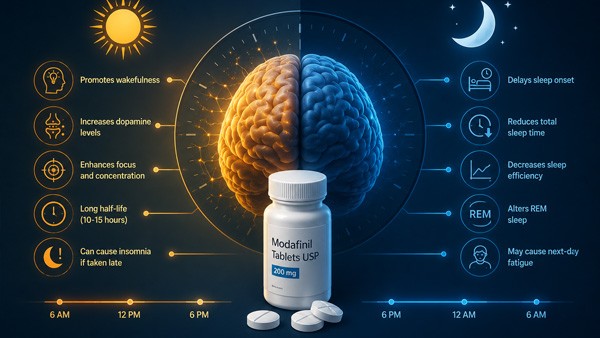
Modafinil's 12-15 hour half-life is the single fact that explains almost every sleep problem on the drug. A 200 mg tablet taken at 07:00 still has roughly half the original drug present at 19:00-22:00 — meaning meaningful pharmacological activity persists straight into the typical evening bedtime window. For users who take their dose early and respect cutoff timing, this rarely produces problems. For users who take their dose at 10:00 or later, the residual evening activity reliably delays sleep onset by 30-90 minutes and degrades sleep quality through the first half of the night. The math is unforgiving and individual — your specific cutoff time depends on your bedtime, your dose, and your personal sensitivity.
This guide is structured as a practical sleep-management manual. The aim is to give you the dose-timing math to prevent insomnia before it happens, the recovery tactics to use when you already cannot sleep, and the chronotype-aware customization to fit your specific sleep schedule rather than a one-size-fits-all rule. We cover the underlying half-life arithmetic, the cutoff time rule that prevents the majority of insomnia cases, the sleep hygiene supplements that help during the modafinil window, the melatonin cautions that matter because modafinil and melatonin interact in non-obvious ways, the dose-to-bedtime calculator that reverse-engineers your safe dosing window from any given bedtime, the "Recovery Night Protocol" for tonight when you have already taken the dose too late and need to salvage sleep anyway, three chronotype-specific profiles (early bird, intermediate, night owl), and the criteria for skipping a day when sleep recovery matters more than continued alertness.
Example 1: 23:00 bedtime → cutoff = 09:00 morning dose
Example 2: 22:00 bedtime → cutoff = 08:00 morning dose
Example 3: 00:00 bedtime → cutoff = 10:00 morning dose
Example 4: 21:00 bedtime → cutoff = 07:00 morning dose
The 14-hour gap protects against the meaningful evening tail. Doses taken later than the cutoff time reliably push sleep onset back 30-90 minutes and reduce sleep efficiency in the first half of the night. The rule is conservative — sensitive users may need 15-16 hours; tolerant users may get away with 12-13. Use this as a starting point and adjust based on your actual experience.
🧮 The Half-Life Math
Modafinil pharmacokinetics are the foundation for everything else in this article, so it is worth being precise about the numbers. The mean elimination half-life is approximately 12-15 hours across most adult patients, with individual variation roughly 10-17 hours depending on metabolism, age, and concurrent medications. After one half-life, plasma concentration is reduced by half; after two half-lives, by three-quarters; after three half-lives, by approximately 87%. This translates to a long tail of drug presence that persists well into evening even from a morning dose.
Let's work through a concrete example. Take 200 mg modafinil at 07:00. The drug reaches peak plasma concentration around 09:00-11:00 (Tmax 2-4 hours). From peak, elimination begins:
- 11:00 — peak plasma: ~100% of post-absorption peak concentration.
- 23:00 (12 hours post-peak): ~50% — one half-life elapsed. This is half the peak still circulating at typical bedtime.
- 11:00 next day (24 hours post-peak): ~25% — two half-lives elapsed. Still meaningful residual.
- 23:00 next day (36 hours post-peak): ~12.5% — three half-lives elapsed. Mostly cleared.
- Full clearance (5+ half-lives): 60-75 hours. Effectively complete clearance is approximately 3 days after the dose.
The practical implication: at typical bedtime (say 23:00) after a 07:00 dose, you still have approximately half the peak drug concentration in your bloodstream. This is not "the drug is out of your system by then" — this is "the drug is still very much active and is the reason your eyes will not close." Understanding this number is what makes the cutoff time rule meaningful rather than arbitrary.
The half-life also explains the next-morning carryover that some users notice. The dose you took at 07:00 yesterday still has approximately 25% peak concentration at 11:00 today — meaningful enough to alter sleep architecture if you took a late dose, but typically not noticeable by the next workday in standard dosing patterns. This carryover becomes clinically relevant when users take modafinil multiple consecutive days — drug accumulation slightly extends the effective half-life and tightens the cutoff window.
| Hours post-peak | % peak concentration | Practical state |
|---|---|---|
| 0 (peak) | 100% | Maximum alertness |
| 6 hours | ~70% | Strong plateau |
| 12 hours (1 half-life) | ~50% | Half-strength — still meaningful |
| 18 hours | ~35% | Diminished but present |
| 24 hours (2 half-lives) | ~25% | Quarter-strength — light residual |
| 36 hours (3 half-lives) | ~12.5% | Mostly cleared |
| 60+ hours (5 half-lives) | ~3% | Effectively cleared |
⏱️ Cutoff Time Rule
The cutoff rule is the single most effective insomnia prevention tactic: take modafinil at least 14 hours before your intended bedtime. The 14-hour gap accounts for one full half-life of decline from the morning peak, leaving roughly 50% peak concentration at bedtime — generally below the threshold that meaningfully interferes with sleep onset for most users.
The 14-hour rule is calibrated for average modafinil sensitivity at the standard 200 mg dose. Adjustments may be needed for specific scenarios:
- 200 mg dose, 23:00 bedtime: Cutoff = 09:00. Dose by 09:00 should produce minimal sleep disruption for most users.
- 200 mg dose, 22:00 bedtime: Cutoff = 08:00. Earlier bedtime requires earlier cutoff.
- 200 mg dose, 00:00 bedtime: Cutoff = 10:00. Late bedtime allows slightly later cutoff.
- 100 mg dose (half-tablet): Cutoff can move 1-2 hours later because lower peak means lower evening residual. 11:00 dose with 23:00 bedtime works for many users at 100 mg.
- Sensitive users: Tighten the cutoff to 15-16 hours before bedtime. Sensitive users include older adults, those who normally sleep 8+ hours, and those who have noticed sleep disruption from modest evening caffeine in the past.
- Tolerant users: Some long-term modafinil users get away with 12-13 hours. This is the minority pattern and should not be assumed for new users.
- Shift workers using SWSD indication: The cutoff rule does not apply in the same way — shift workers take modafinil 1 hour before shift start regardless of clock time, and the "bedtime" is a daytime sleep that may itself be partial. The pharmacokinetics are the same but the timing framework differs.
- Armodafinil users: Armodafinil's pure R-enantiomer has a slightly longer effective half-life (~15 hours vs 12-15 for modafinil). Tighten the cutoff by 60-90 minutes — for 23:00 bedtime, dose by 08:00 rather than 09:00.
🛏️ Sleep Hygiene Boosts
The cutoff rule prevents most modafinil insomnia. The sleep hygiene tactics below help with the residual cases where some evening drug effect persists and you need to actively shift your physiology toward sleep readiness. These work in combination with proper timing, not instead of it.
- Light management from 19:00: Dim your home lighting to warm low intensity by 19:00. Blue-spectrum light exposure suppresses melatonin production through ipRGC pathways — modafinil already disrupts this; bright evening lighting compounds the problem. Switch to warm-temperature bulbs in living areas and avoid screen time without blue-light filtering after 21:00.
- Cool room temperature: Bedroom temperature of 16-19°C (60-67°F) is the sleep-research-optimal range. Cool ambient temperature triggers core body temperature drop, which is one of the strongest natural sleep onset signals. Modafinil slightly elevates body temperature; counter this with cool environment.
- Magnesium glycinate (200-400 mg evening): Magnesium has mild calming effect through GABA-A receptor modulation. Glycinate is the most sleep-friendly form (well-tolerated, no laxative effect). Reasonable evening supplement during modafinil weeks for users with sleep difficulty.
- Glycine (3 g pre-sleep): Amino acid that lowers core body temperature and improves sleep onset. Has small evidence base in sleep research. Safe to combine with modafinil.
- L-theanine (100-200 mg evening): Found naturally in green tea. Mild relaxation effect without sedation. Counters the stimulant character that modafinil residual produces.
- Wind-down routine 60 minutes before bed: Reading, stretching, warm shower (the shower's exit-cooling effect mimics natural body temperature drop), quiet conversation. The signal-to-physiology that "sleep is coming" matters more on modafinil days than on non-modafinil days.
- Avoid alcohol within 4 hours of bed: Alcohol degrades sleep architecture and amplifies the modafinil residual effect on sleep quality. Common pattern is "I drank a glass of wine to wind down and then could not sleep" — alcohol is a sleep-disruptor masquerading as a sleep aid.
- Avoid intense exercise after 18:00: Late evening exercise raises core body temperature for several hours afterward, fighting against the temperature drop that drives sleep onset. Morning or early afternoon exercise is fine and may even improve sleep.
- Watch evening hydration: The earlier hydration emphasis (in the headache article) helps prevent dehydration headaches but late evening fluid intake produces nocturnal urination. Front-load hydration into morning and afternoon; reduce after 18:00.
💊 Melatonin Cautions
Melatonin is the most commonly attempted sleep aid by modafinil users with insomnia — and the relationship between modafinil and melatonin is more complex than the simple "take a sleep supplement when you cannot sleep" framing implies. There are real considerations that warrant careful approach.
Modafinil's effect on natural melatonin production. Modafinil activates the brain's arousal pathways during evening hours when natural melatonin would normally be rising. This effectively delays the body's natural melatonin onset, contributing to the sleep delay pattern. Exogenous melatonin supplementation can partially compensate for this disruption but does not undo the underlying arousal-pathway activation.
Dosing strategy. The intuitive approach is "if 1 mg doesn't work, take more" — but this is exactly wrong with melatonin. Research consistently shows that 0.3-1 mg of melatonin is more effective for sleep onset than higher doses. Doses of 3-5 mg (common in OTC products) actually produce paradoxically worse sleep in many users by overshooting the natural melatonin peak and producing next-day grogginess. The most evidence-supported dosing pattern is 0.3-0.5 mg taken 30-60 minutes before intended sleep time.
Timing matters more than dose. Melatonin works by signaling "biological night" rather than by sedation. Taking it too late (right at bedtime) provides minimal benefit because the natural rise should already be happening. Taking it too early (more than 90 minutes before bed) wastes the effect. The window is roughly 30-60 minutes before intended sleep.
What to avoid combining with modafinil for sleep:
- Benzodiazepines (Xanax, Ativan, Klonopin): Combining for sleep is generally inappropriate — the wake-promoting drug fighting the sleep-promoting drug is poor pharmacological strategy and creates dependence risk on the benzodiazepine side. Discuss with physician if persistently needed.
- Z-drugs (Ambien, Lunesta): Same logic. Occasional use under physician guidance is reasonable for specific transitional situations but not sustainable as a routine modafinil sleep solution.
- Diphenhydramine (Benadryl, PM formulations): Common OTC sleep aid; produces sedation but poor sleep quality and significant next-day grogginess that compounds with any modafinil residual. Not a good choice for routine use.
- Alcohol: Discussed above; degrades sleep architecture and amplifies modafinil residual disruption.
- CBD products: Some users report sleep benefit; evidence is limited. No significant drug-drug interaction documented but quality of CBD products varies widely. Cautious experimentation acceptable; do not rely as primary intervention.
- Cannabis / THC: May aid sleep onset but degrades sleep architecture (suppresses REM). Not a sustainable solution. Drug-drug interaction with modafinil not well-characterized.
🛑 When to Skip a Day
Sometimes the right intervention is not to fix sleep — it is to skip the modafinil dose entirely. Recognizing when to skip prevents days of sleep debt accumulation and the worsening insomnia pattern that comes from chronically inadequate sleep.
Skip-the-day criteria — take a modafinil holiday today if any of these apply:
- You slept less than 4 hours last night. Stacking modafinil on top of severe sleep debt produces poor cognitive outcome (more anxiety, more irritability, more headache) plus reinforces the bad sleep cycle. Take the day off, prioritize sleep tonight, resume modafinil tomorrow.
- You have a high-priority sleep recovery window tonight. If you really need quality sleep tonight (important event tomorrow, accumulated sleep debt, illness recovery), skipping today's modafinil removes one variable from the sleep equation.
- You have noticed cumulative insomnia worsening over the past 3-5 days. A pattern of progressively later sleep onset suggests modafinil-cumulative drug presence is building. A 1-2 day skip allows full clearance and resets the pattern.
- You have an evening obligation that prevents normal wind-down. If you know you will be socially active until 23:00 tonight, skipping today's modafinil removes the residual drug effect from the equation and gives you a fighting chance at decent sleep.
- You are sick or recovering from illness. The body needs sleep for immune recovery; modafinil residual interferes with this. Skip during illness unless your alertness is professionally essential.
- You are crossing time zones. Modafinil's pharmacokinetics do not respect your travel — the dose acts on solar time relative to when you took it. Time zone changes complicate the sleep equation enough without adding drug residual. Skip on travel days when possible.
- It is a weekend day with no alertness requirement. Many users naturally take modafinil 5-on-2-off precisely to maintain sleep quality across the work week.
🧮 Dose-to-Bedtime Calculator
The table below reverse-engineers your safe dosing window for any given bedtime. Use it as a quick reference rather than recalculating the 14-hour rule each time. The recommendations assume standard 200 mg dose; adjust earlier for higher doses or later for lower doses as noted:
| Your bedtime | Latest 200 mg dose | Latest 100 mg dose | Latest armodafinil 150 mg dose |
|---|---|---|---|
| 21:00 (early) | 07:00 | 08:00 | 06:00 |
| 22:00 | 08:00 | 09:00 | 07:00 |
| 22:30 | 08:30 | 09:30 | 07:30 |
| 23:00 (typical) | 09:00 | 10:00 | 08:00 |
| 23:30 | 09:30 | 10:30 | 08:30 |
| 00:00 (late) | 10:00 | 11:00 | 09:00 |
| 01:00 (very late) | 11:00 | 12:00 | 10:00 |
| 02:00 (shift worker) | 12:00 | 13:00 | 11:00 |
The calculator is conservative. If your dosing is at or before the indicated time and you still experience sleep disruption, the issue is likely not timing — work through the sleep hygiene and melatonin sections, or consider dose reduction.
🚑 Recovery Night Protocol — When You Already Can't Sleep
You took modafinil at 11:00 thinking you'd have an early evening. Now it's 23:00, you're wide awake, and you have to be at work at 08:00 tomorrow. What do you do tonight? This protocol is the practical sequence:
- 22:30 — Acceptance phase. Stop trying to force normal-time sleep. The drug is still active and fighting against you. Reframe the goal from "sleep on schedule" to "get 5-6 hours of sleep starting whenever I can."
- 22:30-23:00 — Light reduction. Dim all lights to minimum. Switch off bright screens. If reading, use a low-warm-light source. The goal is to allow natural melatonin to begin even though it is delayed by modafinil.
- 22:45 — Optional supplements. 0.5 mg melatonin AND 200-300 mg magnesium glycinate. Both together if you have them; either alone if not. Do NOT take diphenhydramine, alcohol, or benzodiazepines.
- 23:00-23:30 — Wind-down activity. Quiet reading, light stretching, or a warm shower. The shower's exit-cooling helps trigger body temperature drop. Avoid problem-solving thinking that activates further.
- 23:30 — Bed despite alertness. Get into bed even if you don't feel sleepy. Cool room, dark, quiet. Practice paradoxical intention — explicitly stop trying to sleep and just rest. Trying-to-sleep is itself activating; resting-while-letting-sleep-come is not.
- 00:00-01:00 — Probable sleep onset. Most users with this scenario fall asleep 60-90 minutes later than usual. This is the cost of the late dose — accept it as data for next time rather than fighting it.
- 06:30 next morning — recovery decisions. Sleep was probably 5-6 hours rather than your normal 7-8. Two options: (A) skip modafinil today entirely to allow sleep recovery tonight, or (B) take half-dose (100 mg) early to get through the day without setting up another bad night. Choice depends on your day's demands.
- The following night — recovery sleep. Aim for 1-2 hours longer than your normal sleep window. Sleep debt is real; the body will use the recovery night to consolidate.
👤 Chronotype Profiles — Customized Strategy
The standard advice in this article assumes a "normal" chronotype with bedtime around 23:00. Many users have chronotypes that differ substantially and require customized strategy. Three common profiles cover the majority of users:
Profile A — "Early bird (lark) chronotype." Natural bedtime 21:00-22:00, natural wake time 05:00-06:00. The standard 14-hour rule means your modafinil dose must be by 07:00-08:00 at latest. Many early-bird users dose at 05:30-06:30 immediately after waking, which works well — the drug peaks during their natural high-energy morning hours and tapers cleanly into their natural early evening wind-down. Insomnia is rare in this profile if cutoff is respected. The risk: taking modafinil at 09:00-10:00 "to get the day going" pushes the peak into early afternoon and creates evening residual fighting against natural early-bedtime physiology.
Profile B — "Intermediate chronotype." Natural bedtime 23:00-00:00, natural wake time 07:00-08:00. This is the most common profile and is what the standard 14-hour rule was calibrated for. Morning dose at 08:00-09:00 produces full-day coverage with sleep landing in the natural window. Most insomnia issues in this profile stem from too-late dosing (10:00+ morning), not from the drug itself. Sleep hygiene basics plus correct cutoff time handle the large majority of cases.
Profile C — "Night owl chronotype." Natural bedtime 01:00-02:00, natural wake time 09:00-10:00. The 14-hour rule allows modafinil dose up to 11:00-12:00, which aligns with most night owls' natural morning routine. The risk for this profile is the opposite of early birds: taking modafinil at 07:00 "because I should be up early" produces strong drug effect during natural low-energy hours and full clearance by mid-evening — meaning the morning use does not match the body's natural rhythm. Night owls often do better with later morning dosing aligned to their natural chronotype, or use modafinil only on days when external schedule forces early wakefulness.
Profile D — "Shift worker." Sleep window varies by shift schedule; the body's circadian system may be desynchronized from the standard cycle. The 14-hour rule still applies but is calculated relative to the actual sleep window, not standard nighttime. Night shift worker sleeping 07:00-15:00 should dose by 17:00 the previous evening if working a 21:00-07:00 shift — the cutoff applies to upcoming sleep, not to clock time. Shift workers benefit from particularly careful sleep hygiene and bedroom environment management because their sleep is already disrupted by underlying schedule rotation.
| Chronotype | Bedtime window | Modafinil cutoff | Common insomnia pattern |
|---|---|---|---|
| Early bird (lark) | 21:00-22:00 | 07:00-08:00 max | Late morning dosing causes evening residual |
| Intermediate | 23:00-00:00 | 09:00-10:00 max | Standard 14-hour rule applies |
| Night owl | 01:00-02:00 | 11:00-12:00 max | Early morning dosing wastes effect window |
| Shift worker | Variable | 14 hrs before sleep onset | Circadian desync amplifies sleep difficulty |
✨ Bottom Line
Modafinil insomnia is almost entirely preventable through correct dose timing. The 14-hour cutoff rule — take modafinil at least 14 hours before your intended bedtime — eliminates the large majority of insomnia cases by accounting for the drug's long half-life and ensuring evening plasma concentrations are below the threshold that interferes with sleep onset. The dose-to-bedtime calculator above reverse-engineers your specific cutoff time from any bedtime.
For residual cases where some evening drug effect persists, sleep hygiene tactics (light management, cool room, magnesium, glycine, L-theanine) and careful low-dose melatonin (0.3-0.5 mg, not 3-5 mg) work in combination with proper timing. When you have already taken the dose too late, the Recovery Night Protocol above salvages partial sleep rather than fighting against pharmacokinetics that have already committed.
For users with chronotypes far from the intermediate norm, the 14-hour rule still applies but is calculated relative to your actual sleep window. Early birds dose very early; night owls can dose later; shift workers calculate against the upcoming sleep window rather than clock time. Sometimes the right intervention is skipping the day entirely — when sleep debt has accumulated, when an evening obligation precludes normal wind-down, when illness recovery matters more than alertness, or simply when a weekend day has no alertness requirement.
For pharmaceutical-grade modafinil with split-scored tablets that allow easy dose reduction to 100 mg when sensitivity demands it, Modalert 200 mg from Sun Pharma is the most widely used generic. For users sensitive to standard modafinil's evening tail, Waklert 150 mg (armodafinil) sometimes produces a smoother profile despite the slightly longer half-life — see Modafinil vs Armodafinil for full comparison.
❓ Frequently Asked Questions
What is the latest time I can take modafinil and still sleep?
The 14-hour rule: take modafinil at least 14 hours before your intended bedtime. For a 23:00 bedtime, this means dose by 09:00 at the latest. For a 22:00 bedtime, dose by 08:00. For a 00:00 bedtime, dose by 10:00. The rule is calibrated for standard 200 mg dose; you can move 60-90 minutes later for 100 mg half-dose, or should move 60-90 minutes earlier for armodafinil due to its slightly longer effective half-life. Sensitive users may need 15-16 hours; long-term tolerant users may get away with 12-13.
How long does modafinil stay in your system affecting sleep?
Modafinil's elimination half-life is approximately 12-15 hours, meaning roughly half the peak concentration remains at the 12-hour mark and a quarter remains at the 24-hour mark. Effective clearance to functionally zero takes 60-75 hours (5 half-lives). For sleep-relevant concentration, the practical window where the drug meaningfully affects sleep is approximately 14-16 hours after the dose. Beyond that, residual concentration is usually low enough not to prevent sleep, though sensitive users may notice partial effects for longer.
Can I take melatonin to sleep on modafinil days?
Yes, with the important caveat that dose matters dramatically. Take 0.3-0.5 mg (a small fraction of typical OTC products at 3-5 mg) approximately 45 minutes before your intended bedtime. Higher doses produce paradoxically worse sleep and next-day grogginess. Time it correctly: too early wastes effect, too late provides minimal benefit. Combine with light reduction starting 19:00 and proper wind-down for best results.
Does modafinil tolerance reduce the insomnia effect over time?
Partially. Many users notice that the sleep-disruptive effect diminishes over 2-4 weeks of consistent use as the body adapts. The improvement is usually meaningful but not complete — the 14-hour cutoff rule should still be respected even after months of use. Users who skip days regularly (5-on-2-off pattern, for example) do not develop as much tolerance to sleep effects because the body resets during the off-days.
Will reducing modafinil dose help with insomnia?
Yes — modafinil sleep disruption is moderately dose-dependent. Users who experience persistent insomnia on 200 mg often sleep normally on 100 mg even at the same dose time. The reduction can be done by simply taking half a tablet (Modalert and most other generics are split-scored). Worth trying for one week if cutoff timing alone has not resolved the issue. The functional trade-off is whether 100 mg provides adequate alertness for your needs — for many users it does.
Why does modafinil sometimes affect sleep even when I dose early?
Several possibilities: (1) individual half-life variation — some patients metabolize modafinil more slowly and experience longer effective duration; (2) concurrent caffeine intake — heavy afternoon caffeine compounds the evening alertness load; (3) cumulative dosing — multiple consecutive days produce modest drug accumulation that effectively extends half-life; (4) inadequate sleep hygiene — bedroom temperature, light exposure, and pre-sleep activities matter more on modafinil days; (5) underlying sleep disorder unrelated to modafinil that the drug now reveals. Work through the 7-day journal pattern (similar to the headache article) to identify your specific contributor.
Should I take sleep medication if I cannot sleep on modafinil?
Generally avoid combining prescription sleep medications with modafinil — the wake-promoting drug fighting the sleep-promoting drug is poor pharmacological strategy and creates dependence risk on the sleep medication side. Better approach: fix the modafinil timing first (the 14-hour rule), then sleep hygiene, then low-dose melatonin if needed. If after all these interventions you still cannot sleep on modafinil, the drug may not be the right fit for your physiology — discuss with your physician rather than stacking sleep medications.
Can I drink alcohol to fall asleep after modafinil?
No — alcohol degrades sleep architecture and amplifies the modafinil residual effect on sleep quality, despite the initial sedating feeling. Common pattern is "I drank wine to wind down and then could not sleep" — alcohol is a sleep-disruptor masquerading as a sleep aid. The combination of evening alcohol plus modafinil residual produces worse sleep than either alone. If you are going to drink alcohol, do so at least 4 hours before intended sleep, in moderate quantity, and accept that even moderate alcohol degrades sleep quality regardless of modafinil context.
Should I use armodafinil instead to avoid sleep issues?
Mixed. Armodafinil has a slightly longer effective half-life (~15 hours vs ~12-15 for modafinil), so the bedtime concern is theoretically slightly worse rather than better. However, armodafinil's smoother plasma curve (no S-enantiomer differential elimination) means some users find the evening tail less alerting in practice despite the longer half-life. Worth trying as a switch if standard modafinil sleep management fails, but adjust the cutoff to 15-16 hours before bedtime rather than 14. See Modafinil vs Armodafinil for full comparison.
How do I recover from days of modafinil-induced sleep debt?
Skip modafinil for 2-3 consecutive days. The drug needs ~60-75 hours for complete clearance (5 half-lives). During this washout, prioritize sleep — go to bed earlier than usual, allow waking naturally rather than to alarm, expect 1-2 hours of "catch-up" sleep above your normal duration. By day 3 the drug is fully cleared and the sleep system has had time to consolidate. Resume modafinil with strict adherence to the 14-hour cutoff rule. For users who have built up extended sleep debt over weeks, the recovery period may be longer — a full week off modafinil with deliberate sleep prioritization is reasonable.
📚 References & Further Reading
- FDA prescribing information for Provigil (modafinil) — pharmacokinetic data including half-life and dose-effect curves.
- FDA prescribing information for Nuvigil (armodafinil) — comparative pharmacokinetics for the R-enantiomer.
- American Academy of Sleep Medicine — clinical practice guidelines on sleep hygiene and behavioral sleep interventions.
- National Sleep Foundation — recommendations on bedroom environment and chronotype-specific sleep strategies.
- Brzezinski et al., Sleep Medicine Reviews — meta-analysis of melatonin dose-response in sleep onset.
- Auld et al., Sleep Medicine Reviews — evidence base for melatonin in primary insomnia.
- Cochrane reviews on sleep hygiene and behavioral interventions in adults.
- Roenneberg et al., Chronobiology International — chronotype questionnaire and population-level chronotype distribution.
- Best Time to Take Modafinil — companion article on dose timing.
- Modafinil Tolerance and Dose Escalation — context for sustained-use considerations.
- Modafinil 200 mg Dosage Guide — standard dosing reference.
- Modafinil Headaches — related side-effect management article with parallel journaling approach.
- Modafinil vs Armodafinil — R-enantiomer alternative for users with persistent sleep effects.
- Modafinil vs Caffeine — analysis of caffeine stacking that worsens insomnia.
- Modalert 200 mg, Modvigil 200 mg, Waklert 150 mg — primary product pages on the RXshop antinarcoleptic catalogue.
- RXshop Editorial Team — content reviewed by licensed pharmacist; for adult patient education, not a substitute for individual medical consultation.
Medical Disclaimer: The information in this article is for educational and informational purposes only and is not a substitute for professional medical advice, diagnosis, or treatment. Always seek guidance from a qualified healthcare provider with any questions you may have regarding a medical condition, and before starting, stopping or changing any medication.