Strattera and SSRI/SNRI Antidepressants: Interaction Profile


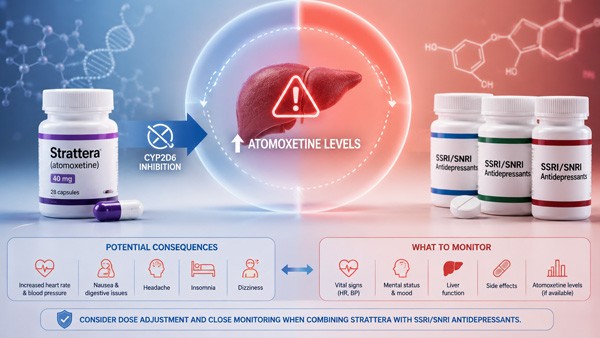
Strattera (atomoxetine) frequently coexists with SSRI or SNRI antidepressants in patients with ADHD plus depression or anxiety comorbidity — but the combination requires specific knowledge of CYP2D6 metabolism that affects atomoxetine plasma levels significantly. Approximately 18-30% of adult ADHD patients have comorbid depression or anxiety requiring antidepressant treatment. Many of these patients take both Strattera and an SSRI/SNRI. The interaction concern: atomoxetine is metabolized primarily by CYP2D6 enzyme, and several common SSRIs (particularly paroxetine and fluoxetine) potently inhibit CYP2D6. This inhibition can elevate atomoxetine plasma levels 5-10× normal, producing increased side effects and theoretical toxicity risk. The interaction is manageable through dose adjustment — typically reducing atomoxetine to 25-50% of standard dose when combined with strong CYP2D6 inhibitors — but requires informed prescribing.
This guide provides comprehensive clinical information about Strattera-SSRI/SNRI interactions. We address the clinical context of why this combination is common, the CYP2D6 metabolic pathway that creates the interaction, specific SSRIs ranked by interaction severity from major (fluoxetine, paroxetine) to minimal (citalopram, escitalopram), SNRI considerations including venlafaxine (Effexor) and duloxetine (Cymbalta), the required dose adjustments when combining medications, side effect risks that may emerge with elevated atomoxetine levels, the monitoring strategy during combined treatment, four CYP2D6 metabolizer type classifications based on genetic variation, the comprehensive antidepressant compatibility matrix covering all major options, the considerations for CYP2D6 genetic testing when relevant, and the bottom-line clinical approach. The combination is generally manageable with proper prescribing knowledge; most patients can safely take Strattera plus an SSRI/SNRI with appropriate dose adjustments.
| Antidepressant | Class | CYP2D6 inhibition | Strattera dose adjustment |
|---|---|---|---|
| Fluoxetine (Prozac) | SSRI | Strong | Reduce to 25% standard dose |
| Paroxetine (Paxil) | SSRI | Strong | Reduce to 25% standard dose |
| Bupropion (Wellbutrin) | NDRI | Moderate | Reduce to 50% standard dose |
| Duloxetine (Cymbalta) | SNRI | Moderate | Reduce by 25-50% |
| Sertraline (Zoloft) | SSRI | Mild | May need slight adjustment |
| Venlafaxine (Effexor) | SNRI | Minimal | Standard dose typically OK |
| Citalopram (Celexa) | SSRI | Minimal | Standard dose OK |
| Escitalopram (Lexapro) | SSRI | Minimal | Standard dose OK |
| Desvenlafaxine (Pristiq) | SNRI | Minimal | Standard dose OK |
| Mirtazapine (Remeron) | NaSSA | Minimal | Standard dose OK |
| Vortioxetine (Trintellix) | Multimodal | Minimal | Standard dose OK |
| Vilazodone (Viibryd) | SSRI/5-HT1A | Minimal | Standard dose OK |
| MAOIs | MAOI | CONTRAINDICATED | Cannot combine — 14-day washout |
| TCAs (amitriptyline, etc.) | TCA | Caution | Specialist evaluation; usually avoid |
The grid frames clinical prescribing: strong CYP2D6 inhibitors (fluoxetine, paroxetine) require Strattera dose reduction to 25%; moderate inhibitors (bupropion, duloxetine) require 50% reduction; mild inhibitors (sertraline) may need slight adjustment; minimal/no inhibitors (escitalopram, citalopram, mirtazapine) generally allow standard Strattera dosing. MAOIs absolutely contraindicated.
👥 Why This Combination Is Common
The clinical context for Strattera-SSRI/SNRI combinations:
- ADHD-depression comorbidity: 18-30% of adult ADHD patients have comorbid depression at some point.
- ADHD-anxiety comorbidity: 25-35% of adult ADHD patients have anxiety disorders.
- Pediatric ADHD with anxiety: Significant overlap requiring management of both conditions.
- Bidirectional treatment: Sometimes depression treated first reveals ADHD; sometimes ADHD treated first reveals depression.
- Strattera as ADHD-only treatment: Treats ADHD but doesn't adequately address depression for most patients.
- SSRIs as depression-only treatment: Treat depression but don't address ADHD.
- Combination needed: Many patients need both medications to address both conditions adequately.
Why combination is preferred over alternatives:
- Distinct mechanisms: Strattera (NE) and SSRIs (5-HT) target different neurotransmitter systems.
- Complementary effects: Strattera improves ADHD; SSRI improves depression — different symptom domains.
- vs Wellbutrin alone for both: Wellbutrin off-label for ADHD has smaller effect than Strattera + SSRI for each condition.
- vs Stimulant + SSRI: Stimulant alternative also reasonable; choice depends on stimulant tolerability.
- vs Single medication for both: No single medication treats both ADHD and depression well; combination often optimal.
🧬 CYP2D6: The Metabolism Bottleneck
The pharmacological basis for the interaction:
- Atomoxetine metabolized primarily by CYP2D6. This enzyme handles ~80% of atomoxetine clearance.
- Genetic variation in CYP2D6 activity: Population variation includes ultra-rapid, normal, intermediate, and poor metabolizers.
- CYP2D6 inhibition by drugs: Some medications block CYP2D6, slowing atomoxetine clearance and raising plasma levels.
- Atomoxetine half-life effect: Normal metabolizers ~5 hours; CYP2D6 inhibition extends to 21+ hours.
- Plasma level effect: Strong CYP2D6 inhibition can raise atomoxetine 5-10× standard levels.
- Clinical implication: Patient on Strattera + paroxetine effectively functioning like Strattera + slow metabolizer status.
Why this matters clinically:
- Increased side effects with elevated atomoxetine levels.
- Potential toxicity risk from very high plasma levels.
- Treatment optimization requires dose adjustment.
- Genetic testing may help identify slow metabolizers.
- Drug selection can avoid problematic combinations.
CYP2D6 inhibitor strength categories:
- Strong inhibitors: Fluoxetine, paroxetine, bupropion (moderate-strong), quinidine.
- Moderate inhibitors: Duloxetine, sertraline (mild-moderate), terbinafine, cimetidine.
- Mild inhibitors: Sertraline, citalopram (very mild).
- Minimal/no effect: Escitalopram, venlafaxine, mirtazapine, most newer antidepressants.
🎯 Specific SSRIs That Raise Strattera Levels
SSRIs by interaction severity:
Strong CYP2D6 inhibitors (require Strattera dose reduction):
- Fluoxetine (Prozac): Strong CYP2D6 inhibitor. Combined with Strattera: reduce atomoxetine to 25% of standard dose. Long half-life (4-6 days) and active metabolite norfluoxetine extend interaction beyond fluoxetine discontinuation.
- Paroxetine (Paxil): Strong CYP2D6 inhibitor. Combined with Strattera: reduce atomoxetine to 25% of standard dose. Shorter half-life than fluoxetine (~21 hours) but still strong effect.
Mild CYP2D6 inhibitors:
- Sertraline (Zoloft): Mild to moderate CYP2D6 inhibition (dose-dependent). Combined with Strattera: may need slight dose adjustment (reduce by 25%); standard dose often acceptable. Monitor for side effects.
Minimal CYP2D6 inhibitors (standard Strattera dose generally OK):
- Citalopram (Celexa): Minimal CYP2D6 effect. Standard Strattera dose usually appropriate.
- Escitalopram (Lexapro): Minimal CYP2D6 effect. Standard Strattera dose appropriate. Preferred SSRI when combining with Strattera in many cases.
- Vilazodone (Viibryd): Minimal CYP2D6 effect. Standard Strattera dose.
- Vortioxetine (Trintellix): Minimal CYP2D6 effect. Standard Strattera dose.
Practical SSRI selection considerations:
- If starting both medications: Choose SSRI with minimal CYP2D6 interaction (escitalopram, citalopram).
- If patient already on fluoxetine/paroxetine: Start Strattera at reduced dose (25%) or consider SSRI switch.
- If patient already on Strattera: Choose SSRI carefully; avoid strong inhibitors if possible.
- Patient-specific factors: Prior antidepressant response history matters; ideal SSRI choice balances ADHD interaction with depression treatment response.
💉 Effexor and Cymbalta (SNRIs) Considerations
SNRI-specific considerations:
Venlafaxine (Effexor):
- Minimal CYP2D6 inhibition — generally compatible with Strattera.
- Standard Strattera dose usually appropriate.
- Cardiovascular consideration: Both medications mildly elevate BP; monitor combined effect.
- Common combination in clinical practice for adult ADHD + depression.
- Withdrawal note: Venlafaxine has notable discontinuation syndrome; plan changes carefully.
Duloxetine (Cymbalta):
- Moderate CYP2D6 inhibition — affects atomoxetine metabolism.
- Dose adjustment recommended: reduce Strattera by 25-50%.
- Monitor for elevated atomoxetine effects.
- Cardiovascular consideration: Combined elevation of HR/BP.
- Hepatic consideration: Both have hepatic considerations; combined liver assessment needed.
Desvenlafaxine (Pristiq):
- Minimal CYP2D6 effect — generally compatible.
- Standard Strattera dose appropriate.
- Less commonly prescribed but acceptable combination.
Levomilnacipran (Fetzima):
- Minimal CYP2D6 effect.
- Standard Strattera dose appropriate.
- Newer SNRI with limited combination experience.
📊 Required Dose Adjustments
Practical dose adjustment guidance:
With strong CYP2D6 inhibitors (fluoxetine, paroxetine):
- Reduce Strattera to 25% of standard target dose.
- Standard adult target 80 mg → reduce to 20 mg.
- Standard adult target 100 mg → reduce to 25 mg.
- Pediatric weight-based dose proportionally reduced.
- Allow steady state to establish at reduced dose (1-2 weeks).
- Reassess clinical response at reduced dose.
With moderate CYP2D6 inhibitors (bupropion, duloxetine):
- Reduce Strattera by 25-50% of standard target.
- Start with 50% reduction and adjust based on response.
- Standard adult 80 mg → reduce to 40-60 mg.
- Monitor for side effects closely.
With mild inhibitors (sertraline):
- Slight reduction may be needed (10-25% reduction).
- Standard dose often acceptable.
- Monitor for side effect emergence.
With minimal/no inhibitors (escitalopram, citalopram, mirtazapine, etc.):
- Standard Strattera dose appropriate.
- No specific adjustment required.
- Standard monitoring for both medications.
Sequence of adjustment:
- Adding antidepressant to existing Strattera: Adjust Strattera dose downward before starting strong inhibitor.
- Adding Strattera to existing antidepressant: Start Strattera at lower dose if antidepressant is strong inhibitor.
- Switching antidepressants: Adjust Strattera dose appropriately for new antidepressant's CYP2D6 profile.
- Discontinuing antidepressant: Allow washout (especially fluoxetine's long half-life) before increasing Strattera back to standard dose.
⚠️ Side Effect Risks
Side effects to monitor with combined treatment:
From elevated atomoxetine levels (with strong inhibitors):
- Increased nausea beyond typical Strattera levels.
- More pronounced appetite suppression.
- Greater fatigue or sedation.
- More noticeable cardiovascular effects (HR, BP elevation).
- Increased sexual dysfunction.
- Sleep changes amplified.
- Mood effects potentially amplified.
From combined Strattera + SSRI/SNRI:
- Cardiovascular additive effects — both mildly elevate HR/BP.
- Serotonin syndrome (rare): Theoretical risk; very rare in practice but warrants awareness.
- Hyponatremia (SSRIs): Strattera doesn't add to this but combined patient management matters.
- QT prolongation (some combinations): Citalopram particularly at higher doses; monitor.
- Bleeding risk (SSRIs): Strattera doesn't add to this but multiple medications affect bleeding considerations.
- Sexual dysfunction: Both contribute; cumulative effect may be significant.
Serotonin syndrome — theoretical but rare:
- Combination of serotonergic drugs theoretically increases serotonin syndrome risk.
- Strattera has minimal serotonergic effect — risk addition is small.
- Symptoms: Confusion, agitation, tremor, hyperreflexia, hyperthermia, autonomic changes.
- Treatment: Discontinue offending agents; supportive care; cyproheptadine.
- Rare in clinical practice for Strattera + SSRI specifically.
📋 Monitoring Strategy
Monitoring approach for combined Strattera-SSRI/SNRI treatment:
Pre-combination assessment:
- Comprehensive medication review including all current medications.
- Identify CYP2D6 interaction potential for specific antidepressant choice.
- Baseline vitals: BP, HR, weight.
- Baseline mood and ADHD symptom assessment.
- Baseline side effect documentation on current medication if applicable.
- Liver function baseline if relevant.
During first 4 weeks of combination:
- Weekly side effect check for first 2 weeks.
- BP/HR monitoring 1-2 weeks after starting combination.
- Mood monitoring particularly for pediatric patients (Strattera SI black box context).
- ADHD symptom response tracking.
- Discuss any new symptoms with prescriber promptly.
Stable combined treatment (after 4 weeks):
- Routine appointments at 4-week, then 3-month, then 6-month intervals.
- Annual labs as appropriate.
- Mood and ADHD symptom assessment at each visit.
- Side effect review with both medications considered.
- Medication reconciliation at each visit.
Special monitoring for specific combinations:
- Strattera + fluoxetine/paroxetine: Enhanced side effect monitoring due to elevated atomoxetine levels.
- Strattera + bupropion: Both seizure risk consideration; cardiovascular monitoring; CYP interaction.
- Strattera + duloxetine: Combined hepatic and cardiovascular monitoring.
- Strattera + venlafaxine: Cardiovascular monitoring particularly important.
- Pediatric combined treatment: Enhanced mood monitoring; pediatric SI black box considerations.
🧬 CYP2D6 Metabolizer Type Classification
Four CYP2D6 metabolizer types based on genetic variation:
Type 1 — "Ultra-rapid metabolizer." Multiple functional CYP2D6 gene copies; very fast atomoxetine metabolism. Affects ~3-5% of population. May need higher Strattera doses for adequate effect; less affected by CYP2D6 inhibitor interactions.
Type 2 — "Normal/extensive metabolizer." Standard CYP2D6 function. Affects ~70-80% of population. Standard Strattera dosing appropriate; standard dose adjustments for inhibitors apply.
Type 3 — "Intermediate metabolizer." Reduced CYP2D6 activity. Affects ~10-15% of population. Higher Strattera plasma levels than normal metabolizers; may need lower doses; more pronounced effect from CYP2D6 inhibitors.
Type 4 — "Poor metabolizer." Little to no CYP2D6 function. Affects ~5-10% of population. Very high Strattera plasma levels; significantly reduced doses needed; major effect from any CYP2D6 inhibitor.
| Metabolizer type | Frequency | Strattera approach | Inhibitor interaction |
|---|---|---|---|
| Type 1 (Ultra-rapid) | ~3-5% | May need higher doses | Less affected by inhibitors |
| Type 2 (Normal) | ~70-80% | Standard dosing | Standard adjustments apply |
| Type 3 (Intermediate) | ~10-15% | Reduced dose may be needed | More pronounced inhibitor effect |
| Type 4 (Poor) | ~5-10% | Significantly reduced doses | Major effect from inhibitors |
📊 Antidepressant Compatibility Matrix
Comprehensive interaction matrix for clinical reference:
| Antidepressant | CYP2D6 effect | Strattera dose adj. | Cardiovascular | Specific considerations |
|---|---|---|---|---|
| Fluoxetine (Prozac) | Strong inhibitor | Reduce to 25% | Minor | Long half-life affects washout |
| Paroxetine (Paxil) | Strong inhibitor | Reduce to 25% | Minor | Worst SSRI for sexual dysfunction |
| Sertraline (Zoloft) | Mild-moderate | Slight reduction | Minor | Often well-tolerated combination |
| Citalopram (Celexa) | Minimal | Standard dose | QT consideration at high doses | Good combination option |
| Escitalopram (Lexapro) | Minimal | Standard dose | Minor | Preferred SSRI option for many |
| Fluvoxamine (Luvox) | Variable | Some adjustment | Minor | Multiple CYP interactions broadly |
| Venlafaxine (Effexor) | Minimal | Standard dose | BP elevation cumulative | SNRI option for depression |
| Duloxetine (Cymbalta) | Moderate | Reduce by 25-50% | BP and cardiovascular effects | Hepatic monitoring combined |
| Desvenlafaxine (Pristiq) | Minimal | Standard dose | BP cumulative | Newer SNRI option |
| Mirtazapine (Remeron) | Minimal | Standard dose | Minor | Often used for sleep/appetite |
| Trazodone | Minimal | Standard dose | Minor | Often added for sleep |
| Vilazodone (Viibryd) | Minimal | Standard dose | Minor | SSRI/5-HT1A partial agonist |
| Vortioxetine (Trintellix) | Minimal | Standard dose | Minor | Multimodal serotonin |
| Bupropion (Wellbutrin) | Moderate | Reduce by 50% | Both BP/HR | Also off-label ADHD; combination considerations |
| MAOIs (phenelzine, etc.) | CONTRAINDICATED | 14-day washout | Hypertensive crisis | Absolutely avoid |
| TCAs (amitriptyline, etc.) | Variable | Specialist evaluation | Cardiovascular concerns | Generally avoid combination |
Decision-making considerations:
- Patient already on antidepressant with strong CYP2D6 inhibition: Reduce Strattera to 25% or consider antidepressant switch.
- Patient already on Strattera, adding antidepressant: Choose minimal-interaction option (escitalopram, citalopram, sertraline often preferred).
- New patient starting both: Choose compatible combination from start.
- Treatment resistance: Sometimes specific antidepressant required for depression; manage Strattera around it.
🧬 CYP2D6 Genetic Testing Considerations
When CYP2D6 testing is helpful:
- Unexplained side effect intensity at standard Strattera doses.
- Treatment failure despite adequate doses.
- Family history of unusual drug responses.
- Multiple medications metabolized by CYP2D6.
- Pre-treatment in specific clinical contexts.
- Patient interest in personalized medicine.
Testing options:
- Standard CYP2D6 genotyping available through clinical laboratories.
- Comprehensive pharmacogenomic panels testing multiple drug-metabolism genes.
- Direct-to-consumer options (some companies offer pharmacogenomic testing).
- Insurance coverage variable depending on clinical indication.
- Results interpretation requires expertise — consult pharmacist or genetic counselor.
Limitations of CYP2D6 testing:
- Doesn't predict all variability. Other factors (drug interactions, age, sex, organ function) affect drug metabolism.
- Cost considerations. Not always covered by insurance.
- Results don't change all decisions. Clinical response often guides treatment more than genotype.
- One-time test sufficient — genotype doesn't change.
Practical recommendation:
- Most patients don't need CYP2D6 testing for Strattera prescribing.
- Testing reasonable for patients with treatment difficulties at standard doses.
- Testing helpful when multiple drug interactions complicate prescribing.
- Discuss with prescriber about whether testing would inform your specific situation.
✨ Bottom Line
Strattera-SSRI/SNRI combination is common and clinically manageable when prescribers understand the CYP2D6 metabolic interaction. The drug interaction severity grid frames specific medication choices: strong CYP2D6 inhibitors (fluoxetine, paroxetine) require Strattera dose reduction to 25%; moderate inhibitors (bupropion, duloxetine) require 50% reduction; minimal/no inhibitors (escitalopram, citalopram, sertraline, mirtazapine) generally allow standard Strattera dosing. MAOIs absolutely contraindicated with 14-day washout required.
The CYP2D6 pathway is the metabolism bottleneck — atomoxetine cleared ~80% by this enzyme. Strong inhibition can raise plasma levels 5-10× normal, producing increased side effects and theoretical toxicity. Genetic variation in CYP2D6 activity (ultra-rapid, normal, intermediate, poor metabolizers) further affects atomoxetine response and inhibitor interactions.
Specific SSRI selection matters: for patients on Strattera adding antidepressant, escitalopram or citalopram often preferred (minimal CYP2D6 effect); sertraline reasonable choice; fluoxetine and paroxetine require significant Strattera dose adjustment. For patients on existing SSRI starting Strattera, choose starting dose appropriate for that SSRI's CYP2D6 profile.
SNRI considerations: venlafaxine generally compatible with standard Strattera dose; duloxetine requires 25-50% reduction; desvenlafaxine and levomilnacipran generally compatible.
The four CYP2D6 metabolizer type classifications (Ultra-rapid / Normal / Intermediate / Poor) affect both baseline Strattera dosing and inhibitor interaction magnitude. Most patients are normal metabolizers; CYP2D6 genetic testing reasonable for patients with treatment difficulties at standard doses.
The comprehensive antidepressant compatibility matrix provides clinical reference for prescribing decisions. The CYP2D6 genetic testing considerations help determine when pharmacogenomic testing would inform care.
Side effect monitoring focuses on amplified atomoxetine effects (with strong inhibitors), combined cardiovascular effects (additive HR/BP), serotonin syndrome (rare theoretical), and specific combination considerations (hepatic, QT, bleeding).
Monitoring strategy includes pre-combination assessment, intensive first 4 weeks (weekly side effect check, BP/HR monitoring, mood monitoring particularly pediatric), and stable combined treatment monitoring (routine appointments, annual labs, medication reconciliation).
For most patients with ADHD-depression comorbidity, Strattera + SSRI/SNRI combination is manageable and effective with appropriate dose adjustments and monitoring. The combination addresses both conditions through complementary mechanisms (NE for ADHD, 5-HT for depression). Combination produces better treatment outcomes than either alone for patients with both conditions.
For broader Strattera safety and lifestyle interaction context, see Strattera Long-Term Side Effects, Strattera and Alcohol, Strattera and Caffeine, Strattera Cardiovascular Effects, Strattera Sleep Effects, Strattera and Liver Health, Strattera Suicidal Ideation Black Box, Strattera Weight Loss, Strattera Sexual Side Effects, and Strattera Withdrawal.
For Strattera vs Wellbutrin direct comparison (relevant for depression-ADHD comorbidity), see Strattera vs Wellbutrin.
For Strattera comparison cluster: vs Adderall, vs Vyvanse, vs Concerta, vs Ritalin, vs Modafinil, vs Intuniv, vs Qelbree.
For modafinil parallel depression adjunct article, see Modafinil for Depression.
For modafinil as off-label alternative for treatment-resistant ADHD with antidepressant comorbidity, Modalert 200 mg from Sun Pharma provides Schedule IV option.
❓ Frequently Asked Questions
Can I take Strattera and Prozac together?
Yes, with dose adjustment. Fluoxetine (Prozac) is strong CYP2D6 inhibitor that raises atomoxetine levels 5-10× normal. Standard approach: reduce Strattera to 25% of standard dose when combined with fluoxetine. Standard adult target 80 mg → reduce to 20 mg. Long fluoxetine half-life (4-6 days) and active metabolite extend interaction. Discuss with prescriber before starting combination.
Which SSRI is best with Strattera?
Escitalopram (Lexapro) or citalopram (Celexa) often preferred. Both have minimal CYP2D6 effect, allowing standard Strattera dosing. Sertraline (Zoloft) is also reasonable with mild interaction. Avoid fluoxetine and paroxetine if possible due to strong CYP2D6 inhibition requiring substantial Strattera dose reduction. The "best" SSRI also depends on patient's depression treatment history.
What's CYP2D6 and why does it matter?
CYP2D6 is liver enzyme that metabolizes ~80% of atomoxetine. Genetic variation determines metabolizer status (ultra-rapid, normal, intermediate, poor). Drugs that inhibit CYP2D6 (especially fluoxetine and paroxetine) slow atomoxetine clearance and raise plasma levels significantly. This is why specific SSRI choice matters for patients on Strattera — strong CYP2D6 inhibitors require Strattera dose reduction.
Can I take Strattera with Effexor?
Yes — Effexor (venlafaxine) has minimal CYP2D6 inhibition. Standard Strattera dose typically appropriate. Combined cardiovascular monitoring matters (both mildly elevate BP). Common combination for adult ADHD + depression. Venlafaxine has notable discontinuation syndrome; plan changes carefully.
Can I take Strattera with Cymbalta?
Yes, with dose adjustment. Duloxetine (Cymbalta) is moderate CYP2D6 inhibitor. Strattera dose reduction of 25-50% recommended. Monitor for elevated atomoxetine side effects. Combined cardiovascular monitoring (both elevate BP). Hepatic monitoring combined consideration.
What if I'm already on an SSRI and starting Strattera?
Inform prescriber of all medications. Strattera starting dose depends on SSRI's CYP2D6 profile. If on fluoxetine or paroxetine: start Strattera at 25% of standard dose. If on bupropion or duloxetine: start at 50% reduced dose. If on escitalopram, citalopram, or other minimal-interaction SSRI: standard Strattera dose appropriate. Plan dose adjustments based on specific combination.
Is serotonin syndrome a concern with Strattera + SSRI?
Theoretical risk but rare in practice. Strattera has minimal serotonergic effect, so combination doesn't substantially elevate serotonin syndrome risk compared to SSRI alone. Watch for symptoms (confusion, agitation, tremor, hyperreflexia, hyperthermia, autonomic changes) particularly with combination of multiple serotonergic medications. Discontinuation of offending agents and supportive care for treatment.
Do I need genetic testing before starting Strattera?
Not routinely. Most patients don't need CYP2D6 testing for Strattera prescribing. Testing reasonable for patients with unexplained side effect intensity at standard doses, treatment failure despite adequate doses, family history of unusual drug responses, or multiple CYP2D6-metabolized medications. Discuss with prescriber whether testing would inform your specific situation. Insurance coverage variable.
What if I need to switch SSRIs while on Strattera?
Coordinate the switch with prescriber. Switching from minimal-interaction SSRI (escitalopram) to strong-interaction (fluoxetine): reduce Strattera dose before starting new SSRI. Switching from strong-interaction (fluoxetine) to minimal-interaction (escitalopram): allow fluoxetine washout (long half-life — several weeks) before increasing Strattera back to standard dose. Specialist coordination valuable for complex switches.
Can I take MAOIs with Strattera?
No — absolute contraindication. Combination risks hypertensive crisis and other serious adverse effects. If switching from MAOI to Strattera: 14-day washout required after MAOI discontinuation before starting Strattera. If switching from Strattera to MAOI: typically 5-day washout after Strattera before MAOI start. This contraindication is important — MAOIs include phenelzine, tranylcypromine, isocarboxazid, selegiline, and some others.
📚 References & Further Reading
- FDA prescribing information for Strattera (atomoxetine) — CYP2D6 metabolism and interactions.
- FDA prescribing information for fluoxetine, paroxetine, sertraline, and other SSRIs — drug interaction profiles.
- FDA prescribing information for venlafaxine, duloxetine — SNRI interaction profiles.
- Clinical Pharmacogenetics Implementation Consortium — CYP2D6 guidelines.
- American Psychiatric Association — combined medication treatment guidelines.
- STAR*D Study — treatment-resistant depression combination strategies.
- American Academy of Pediatrics — combined treatment in pediatric ADHD with comorbidities.
- Pharmacogenomics Knowledge Base (PharmGKB) — atomoxetine pharmacogenomics.
- Strattera lifestyle/interaction cluster: Alcohol, Caffeine
- Strattera safety cluster: Long-Term, Cardiovascular, Sleep, Liver Health, FDA Black Box SI, Weight Loss, Sexual Side Effects, Withdrawal
- Strattera comparison cluster: vs Adderall, vs Vyvanse, vs Concerta, vs Ritalin, vs Modafinil, vs Wellbutrin (relevant for depression-ADHD comorbidity), vs Intuniv, vs Qelbree
- Modafinil for Depression — parallel modafinil depression adjunct article.
- Modalert 200 mg, Modvigil 200 mg, Waklert 150 mg — primary product pages.
- RXshop Editorial Team — content reviewed by licensed pharmacist; for adult patient education, not a substitute for individual medical consultation.
Medical Disclaimer: The information in this article is for educational and informational purposes only and is not a substitute for professional medical advice, diagnosis, or treatment. Always seek guidance from a qualified healthcare provider with any questions you may have regarding a medical condition, and before starting, stopping or changing any medication.