Modafinil for Programmers and Developers


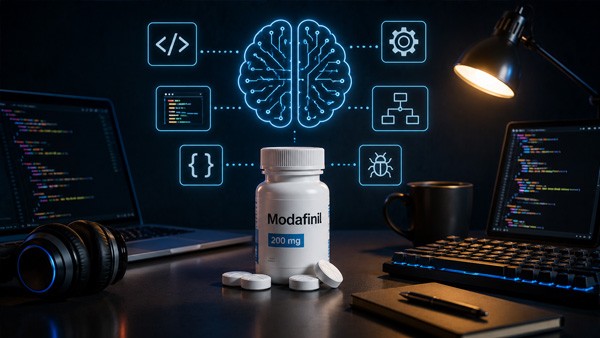
Modafinil has become quietly common in software engineering — particularly among senior engineers, founders, on-call SREs, and developers working remotely with asynchronous teams. The reasons are not surprising once you map the drug's profile to the realities of modern programming work: sustained 4-8 hour focus blocks for non-trivial coding tasks, the cognitive cost of context-switching that the drug appears to partially buffer, the asynchronous nature of distributed teams that allows flexible deep-work scheduling around morning dosing, the variable workload of shipping deadlines and incident response that creates high-demand periods needing extra capacity, and the relatively high cognitive demand of complex systems work where mild cognitive enhancement translates directly into better architectural decisions or fewer bugs.
This guide is written for programmers and developers considering modafinil for work performance. It treats the question with engineering rigor — measurable effects rather than vague claims, practical dosing protocols rather than generic advice, honest acknowledgment of limitations and side effects, and the recognition that drug-mediated productivity is one tool among many rather than a magic productivity multiplier. We cover the specific cognitive operations where modafinil meaningfully helps coding work, the differentiated dose strategies for different task types (architecture vs debugging vs code review vs greenfield building), timing patterns that fit asynchronous work schedules including async standups and global team collaboration, the post-work crash dynamics that affect personal life when 8+ hour modafinil sessions become routine, the four coding task type classifications that map work scenarios to modafinil approaches, the deep work block protocol that structures modafinil-supported sessions for maximum output, the on-call and sprint crunch protocols for high-demand periods, and the sustainable patterns that prevent dependence on the drug for normal work function.
| Work type | Recommended dose | Why this dose |
|---|---|---|
| Greenfield architecture / system design | 100 mg | Preserve cognitive flexibility; avoid tunnel vision |
| New feature implementation (clear spec) | 200 mg | Sustained focus for multi-hour build sessions |
| Bug hunt / debugging complex issue | 200 mg | Sustained attention to detail across many hours |
| Code review (large PR / many PRs) | 100-200 mg | Sustained attention without over-narrowing focus |
| Refactoring large legacy code | 200 mg | Pattern recognition + sustained focus across sprawling code |
| Technical writing / documentation | 100 mg | Cognitive flexibility for analytical writing |
| Meeting-heavy day with brief coding | Skip modafinil | Wrong tool — meetings don't benefit from sustained focus |
| Pair programming / mob programming | Skip or 100 mg max | Collaborative work doesn't need sustained-solo-focus boost |
| On-call / incident response | 100-200 mg if multi-hour | Acute focus during outage; avoid if shift <2 hours |
| Sprint demo / planning | Skip modafinil | Social/political work; not focus-driven |
The matrix's core principle: match dose to task type rather than defaulting to "200 mg every workday." Different programming work has different cognitive profiles, and the right modafinil approach varies. Some work doesn't benefit from modafinil at all and the drug is wasted (and side-effect cost is incurred) for no benefit.
💻 Why Modafinil Suits Coding
The fit between modafinil's pharmacological profile and the cognitive demands of programming is unusually good — better than the fit for many other professional domains. The specific alignments:
- Sustained attention across hours. Non-trivial programming requires holding the mental model of a system in working memory for extended periods. Modafinil's 10-14 hour single-dose coverage matches the natural "deep work" arc that programmers describe — long blocks of unbroken focus where context-switching costs are minimized.
- Working memory enhancement. Published cognitive studies show modafinil's largest effect size is on working memory tasks — exactly the cognitive operation involved in keeping track of variable state, call stacks, type relationships, and architectural dependencies across complex code. Effect size Cohen's d ~0.4-0.6, which translates to noticeably better ability to hold complex systems in mind.
- Resistance to fatigue from cognitive load. Programming work produces cognitive fatigue faster than most knowledge work because the working memory demands are constant rather than episodic. Modafinil's wakefulness-restoration mechanism helps maintain peak cognitive function deeper into the work day than would otherwise be possible.
- Smooth profile without crash during work hours. Unlike caffeine which produces 3-hour cycles of alertness and dips, modafinil provides a flat alertness curve across the work day. No 14:00 crash that interrupts deep work; no need for afternoon coffee that disrupts the next day's sleep.
- Compatible with sedentary work. Modafinil produces mild cardiovascular activation but doesn't require physical activity to dissipate. Programmers who sit for hours can take modafinil without the restlessness that some find uncomfortable with classical stimulants.
- Doesn't impair fine motor skills. Typing speed and accuracy are not degraded; mouse precision unaffected. Important for the practical reality of programming work that depends on rapid keyboard input.
- Works with asynchronous schedules. The flexibility of remote-async programming work allows dosing aligned to individual chronotype rather than fixed office hours. Night-owl developers can take modafinil at 10:00-11:00 and work into evening; early birds can take at 06:00 and finish core focused work by mid-afternoon.
- Schedule IV — low abuse liability. Compared to Adderall or Ritalin (Schedule II), modafinil has substantially lower abuse and dependence potential. Sustainable use across years of a programming career is realistic rather than risky.
- Reasonable cost. Generic modafinil at $1-2 per tablet from legitimate sources is affordable as a regular tool for a working professional.
What modafinil does NOT do for programmers:
- Cannot substitute for actual skill or experience. Modafinil enhances focused execution of cognitive operations you can already perform. It does not improve your understanding of computer science fundamentals, your knowledge of specific frameworks, or your debugging intuition. Junior developers don't become senior through pharmacology.
- Cannot improve code quality through sustained attention alone. Code quality depends on design judgment, refactoring instincts, and accumulated taste — all of which require experience rather than just focus. Modafinil-enhanced focus on poor design decisions just produces more poorly-designed code faster.
- Cannot help with creative breakthrough problems. Some programming problems require the "shower thought" mode of diffuse cognition — letting the unconscious work on a problem during walks, sleep, or unrelated activities. Modafinil's sustained focus actually inhibits this mode by keeping you in directed task-engagement.
- Cannot improve interpersonal aspects of programming. Code reviews, technical discussions, mentoring junior engineers, navigating organizational dynamics — these require social and emotional skills that modafinil does not enhance and may even slightly impair through subtle stiffness in social interaction.
- Cannot substitute for sleep. Programming is particularly sleep-sensitive — sleep deprivation degrades the working memory, pattern recognition, and judgment that programming requires. Modafinil can override the alertness consequences of sleep deprivation for one or two days, but cumulative sleep debt produces worse code than rest would prevent.
🐛 Best Dose for Bug-Hunt vs Architecture
Different programming task types respond differently to dose levels. The dose-task matching matters because the cognitive operations involved differ:
Bug hunting and debugging: Often the best modafinil use case. The cognitive operation involved — sustained attention to detail across many hours while holding the mental model of failure scenarios in working memory — is exactly what modafinil enhances. Standard dose: 200 mg morning. The full dose provides the sustained focus needed to work through complex bugs without losing the thread. Caffeine adds value here as long as it doesn't tip into anxiety. Particularly valuable for production incidents where you may have 4-8 hours of focused debugging ahead.
Architecture and system design: Different cognitive demands. Architecture requires cognitive flexibility — the ability to consider multiple design options, anticipate failure modes, weigh trade-offs across multiple dimensions. High-dose modafinil can produce tunnel vision that locks you into the first viable solution rather than exploring alternatives. Recommended dose: 100 mg morning. The lower dose preserves cognitive flexibility while still providing sustained focus for the multi-hour design sessions. Pair with frequent breaks (90-minute blocks with 15-minute walks between) to support the diffuse cognition that good architecture requires.
New feature implementation (clear specification): Standard use case. You know what to build; the work is sustained focus on translating specification into working code. Standard dose: 200 mg morning. Suits the multi-hour build-test-iterate cycle. The sustained focus matters more than cognitive flexibility because the design decisions are largely already made.
Code review: Cognitive operation is sustained attention across many small diffs without losing context as you move between unrelated changes. Dose depends on review volume: 100 mg for routine review of a few PRs; 200 mg for a large PR review day where you'll be doing 6+ hours of review work. Avoid heavy caffeine during review — the careful attention to subtle issues benefits from calm focus rather than amphetamine-style activation.
Refactoring large legacy code: Cognitively demanding — requires pattern recognition across sprawling codebases plus sustained focus to make changes without breaking unrelated functionality. Standard dose: 200 mg morning. Particularly valuable for multi-day refactoring projects where consistency of focus across days matters.
Technical writing and documentation: Analytical writing benefits from a similar profile to architecture work — cognitive flexibility plus sustained focus. Recommended dose: 100 mg morning. Lower dose supports the analytical clarity needed for good technical writing without the over-narrow focus that can produce dense, hard-to-follow documentation.
⏰ Timing for Async Standups
The shift to asynchronous remote work has changed how programmers structure their days. Async standups, distributed teams across time zones, and flexible schedules all change the modafinil timing calculus relative to traditional office work:
- Front-load focus blocks before async standup: Many remote teams have async standup at a fixed time (e.g., 10:00 or 11:00). Take modafinil at 06:30-07:30 so peak focus aligns with the morning deep-work window before standup. After standup, you're already in flow state.
- Schedule meeting-heavy days without modafinil: If your day is mostly meetings (sprint planning, retrospectives, pair programming, design review meetings), skip modafinil. The drug's value comes from sustained solo focus, which meetings don't allow. Wasted tablet plus unnecessary side-effect exposure.
- Time zone considerations for distributed teams: If you work with teams across time zones and have collaborative work blocks at unusual hours (e.g., 06:00 calls with European colleagues for US-based developers, or evening calls for Asia-Pacific), adjust modafinil timing to match your most demanding solo-work block rather than the collaborative blocks.
- Avoid modafinil on weekend duty days: If you're on-call across weekends, taking modafinil for routine non-incident time means you're impairing your weekend recovery while not addressing actual work demand. Wait until incidents actually occur before considering acute use.
- Don't take modafinil for purely reactive work: Pure reactive work (responding to messages, attending impromptu meetings, ad-hoc support) doesn't benefit from sustained focus and the side-effect cost isn't worth the modest benefit.
- Block calendar time for deep work that follows your modafinil window: Many engineers find their best work happens 2-6 hours after modafinil dose. Block this time on your calendar as "deep work" or "focus time" so collaborative obligations don't fragment your peak window.
- Communicate availability windows: Some teams have shared "focus hours" or "no-meeting" blocks. Use these to align modafinil-supported focus work with collective deep work norms.
- Don't take modafinil for Friday afternoons: Friday afternoon focus rarely produces shippable work; better to wind down and start fresh Monday. Save modafinil for the week's actual highest-leverage hours.
🛌 The Crash After 8h Sessions
The post-modafinil window has real implications for programmer life that many users underestimate. The "crash" isn't a sudden energy drop like caffeine withdrawal — it's a slower decompression that affects personal life and the next day's work in subtle ways:
- Cognitive depletion in the evening: After 8+ hours of sustained modafinil-supported focus, your cognitive reserves are genuinely depleted. The drug overrode the natural "your brain is tired" signal, but the actual tiredness underneath is still real. Evening activities — reading complex material, important conversations, decision-making about personal matters — are degraded.
- Reduced emotional bandwidth: Sustained focused work depletes emotional regulation reserves. Programmers who routinely do 8+ hour modafinil sessions sometimes notice they become irritable or short with family in the evening. The drug masks the fatigue but the underlying emotional depletion still produces interpersonal friction.
- Sleep architecture disruption: Even with proper bedtime cutoff timing, intensive modafinil-supported work days can leave sleep less restorative than usual. Working memory consolidation during sleep is partly proportional to neural activity during the day — intense work days require more sleep, not less.
- Difficulty winding down: The cognitive engagement built up during modafinil work doesn't disengage easily. Many users report feeling "wired but tired" in the evening — depleted enough to want rest but unable to mentally disengage. Structured wind-down (exercise, walks, social time) helps more than passive activities (Netflix while still thinking about work).
- Next-day momentum cost: The day after an intensive modafinil session often shows reduced productivity even without the drug. The body is recovering. Plan accordingly — don't schedule another intense modafinil day immediately after, and consider modafinil-free recovery days as part of the productivity strategy rather than wasted time.
- Weekend recovery requirement: Engineers who use modafinil 4-5 days per week need full weekends for recovery. Working through weekends consistently while using modafinil on weekdays produces cumulative depletion that becomes apparent over months.
Crash mitigation strategies:
- Hard stop time: Set a fixed end-of-work time (e.g., 17:00 or 18:00) regardless of modafinil window. Better to end work while still functional than to push until you crash.
- Physical exercise in late afternoon: 20-30 minutes of light cardio or walking helps metabolize residual drug effect and transitions you out of focus mode.
- Evening protein meal: Substantial protein helps with neurotransmitter recovery overnight. Heavy carb-only meals can accentuate evening fatigue.
- Quiet evening activity: Reading fiction, conversation, low-cognitive-load activities. Avoid evening problem-solving on personal matters that requires sharp judgment.
- Sleep prioritization: 8-9 hours rather than 7-8 on modafinil days. The body needs the extra recovery time.
- Scheduled rest days: No modafinil 2-3 days per week minimum, weekends included. Reset prevents cumulative depletion.
♻️ Sustainable Use Patterns
The biggest difference between productive long-term modafinil users and those who burn out is the use pattern. Sustainable patterns versus unsustainable patterns:
| Pattern | Sustainable? | Why |
|---|---|---|
| Daily 200 mg every workday + weekends off | Risky long-term | Tolerance builds; weekend recovery often inadequate |
| 3-4 days per week, fixed days (e.g., Mon-Tue-Thu) | Sustainable | Built-in recovery; tolerance limited |
| 2-3 days per week, demand-driven | Most sustainable | Used when actually needed; minimal tolerance |
| Sprint-based: 5 days during sprint crunch, 2 weeks off after | Sustainable | Matches actual work demand cycle |
| On-call rotation only | Sustainable | Acute use for high-demand periods |
| Daily for months without break | Unsustainable | Tolerance, sleep debt, dependence develop |
| "Whenever I feel I need it" | Drift-prone | Tends to escalate toward daily use without structure |
| 2× 200 mg per day (morning + afternoon) | Unsustainable | Worse side effects, worse sleep, diminishing returns |
Markers that your use pattern has become unsustainable:
- You're using modafinil more than 4 days per week regularly.
- You feel unable to focus adequately on workdays without modafinil.
- Your weekends require modafinil to function rather than feeling like recovery.
- You're experiencing accumulating side effects (persistent headaches, anxiety, sleep issues).
- You've increased dose because original 200 mg "doesn't work as well."
- You're using on collaborative-only days where the drug provides no real benefit.
- You're experiencing personal-life impact (irritability, withdrawn evenings, declined social activities) attributable to work intensity that modafinil enables.
- You're using modafinil for short work blocks (under 3 hours) where the side-effect cost isn't justified by the benefit.
🛠️ Coding Task Type Classification
Programming work decomposes into several distinct task types that benefit differentially from modafinil. The four-type classification:
Type 1 — "Architecture / Design Work." Multi-hour sessions thinking through system design, API contracts, data models, technology selection. Cognitive profile: requires both sustained focus AND cognitive flexibility (considering multiple options). Modafinil approach: 100 mg morning (lower dose preserves flexibility), 90-minute blocks with 15-minute walks between (supports diffuse cognition), avoid heavy caffeine. Don't expect breakthrough insights during the modafinil window itself — many architectural decisions clarify in the evening after work ends.
Type 2 — "Implementation / Build Work." Coding from spec, building features, writing tests, completing tasks that have been planned. Cognitive profile: sustained focus is the primary need; cognitive flexibility matters less because design decisions are made. Modafinil approach: 200 mg morning standard, possibly with morning coffee, work in 90-120 minute blocks with brief breaks. This is the classical modafinil-suits-programming use case.
Type 3 — "Debug / Bug Hunt Work." Tracking down failures, working through complex bugs, profiling performance issues. Cognitive profile: sustained attention to subtle detail across many hours while holding hypothesis space in working memory. Modafinil approach: 200 mg morning standard, can extend session length to 3+ hours per block when actively in the trail of a bug, frequent small hydration breaks. Particularly valuable for production incidents.
Type 4 — "Review / Mentorship Work." Code review, design review, mentoring junior engineers, technical interviews. Cognitive profile: sustained attention to others' work plus social/communicative skills. Modafinil approach: 100 mg if heavy review day; skip entirely if mostly interpersonal mentorship. The social component doesn't benefit from modafinil; sustained focus only matters for the document/code review portions.
| Task type | Dose | Session structure | Caffeine |
|---|---|---|---|
| Type 1 (Architecture) | 100 mg | 90-min blocks + walks | Minimal |
| Type 2 (Implementation) | 200 mg | 90-120 min blocks | 1 morning coffee OK |
| Type 3 (Debugging) | 200 mg | Variable; extend in flow | Strategic, not heavy |
| Type 4 (Review/Mentorship) | 100 mg or skip | Match meeting cadence | Minimal |
🎯 Deep Work Block Protocol
Modafinil enables sustained focus but does not automatically structure that focus productively. The deep work block protocol structures modafinil-supported sessions for maximum cognitive output:
- Pre-session (15 minutes): Take modafinil 60-90 minutes before intended session start. Substantial breakfast with the dose. Set up workspace — close unrelated tabs, silence notifications, prepare reference materials, have water bottle ready.
- Block 1 (90 minutes): First focused block. Most cognitively demanding work goes here while modafinil peak is climbing and mental reserves are fresh. Start with the hardest task. Single tab/window focus.
- Break 1 (15 minutes): Walk outside if possible — natural light and movement help. Brief hydration and snack. Do NOT check email or messages during break — defeats purpose. Eyes off screens.
- Block 2 (90 minutes): Second focused block. Continue same task or pivot to related work. Still within peak modafinil window.
- Break 2 (30 minutes — lunch): Substantial lunch with protein. Don't skip — appetite suppression makes this easy to do but degrades afternoon performance. Brief walk after eating if possible.
- Block 3 (90 minutes): Third focused block. Modafinil still peak plateau. Often this is the most productive block of the day — fully warmed up, peak drug effect, lunch fueled.
- Break 3 (15 minutes): Movement, hydration. Avoid afternoon caffeine that would worsen evening sleep.
- Block 4 (60-90 minutes): Fourth focused block. Often involves wrapping up, code review of own work, documentation, or transition tasks that close out the day productively.
- End of day (17:00-18:00): Hard stop. Document where you left off so tomorrow's pickup is friction-free. Commit any in-progress work to version control. Close laptop. Begin physical and mental disengagement from work.
- Evening (18:00 onward): Light physical activity, meal, social or quiet activities. No work email checking. Bedtime cutoff applied — typically by 22:30-23:00.
Variations of the protocol:
- Pomodoro variant: Replace 90-minute blocks with 25-minute focused work + 5-minute breaks. Better for users who find 90-minute blocks too long or for highly fragmented work types.
- Marathon variant for shipping deadlines: Extended blocks (2-3 hours) with shorter breaks (10 minutes). Used sparingly for shipping crunches; not sustainable as default.
- Pair programming variant: Skip modafinil; pair work doesn't benefit. If pair-programming all day, save modafinil for solo work days.
- Half-day variant: 100 mg dose; 2-3 blocks across morning only; afternoon for meetings or non-coding work. Suitable for hybrid days.
🚨 On-Call & Sprint Crunch Protocols
High-demand periods in programming work — production incidents, shipping deadlines, sprint crunches — represent the most legitimate use cases for modafinil. The protocols:
On-Call / Incident Response Protocol:
- Routine on-call time (no active incident): No modafinil. Acute use for actual incidents only.
- Active incident, expected duration <2 hours: No modafinil. Caffeine sufficient; incident will be resolved before modafinil onset.
- Active incident, expected duration 2-4 hours: 100 mg modafinil at incident start. Onset aligns with continued investigation work.
- Active incident, expected duration 4+ hours (major outage): 200 mg modafinil at incident start. Substantial breakfast/snack with the dose if possible. Hydration emphasized.
- Post-incident recovery: Whatever the incident duration, prioritize sleep recovery immediately after. Skip modafinil the following day even if a half-day of work remains. Body needs recovery from the acute stress plus drug effect.
- Postmortem the next day: No modafinil for postmortem itself unless lengthy. Postmortems are collaborative work where modafinil's solo-focus benefit doesn't apply.
Sprint Crunch Protocol:
- Sprint week 1 (early): No special modafinil pattern. Standard 0-2 days per week.
- Sprint week 2 (mid): If work scope expanded or behind schedule, escalate to 2-3 modafinil days. Honest assessment of whether the crunch is justified or symptomatic of bad sprint planning.
- Sprint final days: 3-4 modafinil days max even if final crunch is intense. Skip day before final day to protect sleep. Don't extend beyond 4 days even for shipping pressure.
- Sprint demo / sprint review day: No modafinil. Collaborative work; modafinil doesn't help.
- Post-sprint recovery (Friday or weekend after sprint): Full days off from modafinil. Sleep priority. Light work or no work depending on team culture.
- Following sprint (week 1): Reduced modafinil pattern relative to crunched sprint. Allow recovery to be complete before next intense period.
✨ Bottom Line
Modafinil suits programming work well because the cognitive profile match is unusually good: sustained focus across hours, working memory enhancement, fatigue resistance during cognitive load, smooth profile compatible with sedentary work, and compatibility with asynchronous schedules that allow timing optimization. The effect is modest (Cohen's d 0.4-0.6 for relevant cognitive tasks) but meaningful in practice — better debugging output, sustained focus through complex implementations, productive marathon sessions during deadlines.
The work-type → dose matrix matches different programming tasks to appropriate modafinil approaches: architecture work benefits from 100 mg (preserves cognitive flexibility), implementation and debugging from 200 mg (sustained focus is the primary need), code review varies by volume (100-200 mg), and meeting-heavy days don't benefit from modafinil at all. Defaulting to "200 mg every workday" wastes the drug on tasks that don't benefit and incurs side-effect cost without return.
The deep work block protocol (4 blocks of 90 minutes with structured breaks across the day) provides framework for converting modafinil-supported alertness into actual output. The on-call and sprint crunch protocols handle high-demand programming periods with structured escalation rather than ad-hoc daily use.
Sustainable patterns (2-4 days per week maximum with built-in recovery) outperform unsustainable patterns (daily use, dose escalation, weekend-included usage) over careers measured in years. The post-session crash is real and affects personal life in ways many users underestimate — exercise, evening recovery rituals, sleep prioritization, and modafinil-free recovery days mitigate the impact.
For programmers considering modafinil as a sustainable career tool, the right framing is "engineering optimization of cognitive bandwidth for specific high-leverage work" rather than "productivity multiplier for every workday." Daily use produces tolerance and dependence; selective use for genuinely demanding work sessions produces sustained benefit across years.
For pharmaceutical-grade modafinil with split-scored tablets allowing precise 100 mg or 50 mg dose management for the different task types described above, Modalert 200 mg from Sun Pharma is the most widely used legitimate generic for off-label cognitive use. For broader context on alternatives developers consider, see our companion articles Modafinil vs Caffeine, Modafinil vs Ritalin, Modafinil vs Vyvanse, Modafinil vs Armodafinil, and Modafinil vs Phenylpiracetam.
For side-effect management that matters during intensive work periods, see our companion articles Modafinil Headaches, Modafinil Insomnia, Modafinil and Anxiety, Modafinil Dehydration, Modafinil Appetite Loss, and Modafinil Cardiovascular Effects. Sedentary programmer lifestyle plus modafinil's mild cardiovascular effect means active management of cardiovascular health matters more than for active populations. For the parallel use-case article on academic context, see Modafinil for Students.
❓ Frequently Asked Questions
Does modafinil actually help with programming?
Yes, for specific task types and use patterns. Programming work that requires sustained focus across multi-hour blocks (debugging, implementation, refactoring) benefits meaningfully from modafinil's wakefulness and working memory enhancement. Effect size in cognitive studies is Cohen's d 0.4-0.6 — measurable but modest. Practically, this translates to better sustained focus during long sessions, fewer cognitive lapses during complex debugging, and more productive deep-work blocks. The drug doesn't make you a better engineer in terms of skill or judgment — it makes you a more focused executor of work you can already do.
What's the best dose for coding?
Depends on the task type. For implementation work or debugging (sustained focus on detail): 200 mg morning. For architecture or system design work (cognitive flexibility matters): 100 mg morning. For code review days: 100-200 mg depending on volume. For meeting-heavy days: skip modafinil. The matching of dose to task type matters more than just "what's my dose" — different programming work has different cognitive profiles.
Can modafinil help me debug better?
Debugging is one of the best modafinil use cases for programmers. The cognitive operation — sustained attention to subtle detail across many hours while holding the hypothesis space in working memory — is exactly what modafinil enhances. Standard 200 mg morning dose supports extended debugging sessions without losing the thread of investigation. Particularly valuable for complex production bugs where you might have 4-8 hours of focused investigation ahead.
How often should I use modafinil as a developer?
2-4 days per week maximum for sustainable long-term use. Daily use produces tolerance, sleep debt, and dependence over weeks to months — the cumulative cost exceeds the cumulative benefit. The best patterns: fixed days (e.g., Mon-Tue-Thu) for routine deep work, demand-driven (only when actually needed for high-leverage work), or sprint-based (heavier use during crunch weeks with recovery weeks between). Avoid drift toward daily use even if individual days seem productive.
Will modafinil make me code better in pair programming?
Probably not, and possibly slightly worse. Pair programming is a collaborative cognitive activity where social and communicative skills matter as much as individual focus. Modafinil's solo-focus enhancement doesn't translate to pair work, and some users report subtle stiffness in social interaction on modafinil that could affect the collaboration quality. Save modafinil for solo work days; skip it for pair-heavy days.
How do I handle modafinil during sprint crunches?
Sprint crunch is a legitimate use case but should be structured rather than panicked. Escalate to 3-4 modafinil days during final crunch days, but skip the day before final ship day to protect sleep. Don't extend beyond 4 days in a row even for shipping pressure. Plan recovery days post-sprint (no modafinil, sleep priority). The crunch use only works if it's followed by genuine recovery — chained crunches with no recovery produce burnout that affects the next sprint.
Should I use modafinil for on-call rotations?
Only for active incidents, not routine on-call time. Taking modafinil "in case" something happens during your on-call shift impairs your sleep and personal life without benefit. When an actual incident occurs and you expect 2+ hours of focused investigation work, 100-200 mg modafinil supports the session. For brief incidents (under 2 hours), caffeine alone is sufficient. Post-incident, prioritize sleep recovery — don't use modafinil to push through the next day if you handled a night incident.
What's the difference between modafinil and Adderall for coding?
Adderall produces stronger acute focus effect but with substantial trade-offs: Schedule II controlled substance with abuse and dependence liability, worse cardiovascular and appetite effects, produces afternoon crash that interrupts deep work, and prescription is more difficult. Modafinil is gentler, longer-acting (covers full work day without redosing), lower abuse liability, easier prescribing pathway, smoother profile compatible with sustained focus across the work day. For most developers, modafinil is the more sustainable choice; Adderall makes sense primarily for developers with diagnosed ADHD who have legitimate prescription.
Will my employer find out I'm using modafinil?
Almost certainly not. Most employers don't drug-test for cognitive enhancers, and even employers that do random drug testing typically don't test for modafinil specifically. Prescription medication use is private medical information. The exceptions: safety-critical roles (some defense, transportation, healthcare positions) may have stricter drug testing including controlled substances; security clearance roles may require disclosure of medication use. For typical software development roles, modafinil use is private and undetected. Practical privacy: be discreet with colleagues, don't post about it on professional social media, and recognize that some workplaces have cultural norms against medication use even if not formal policies.
Will daily modafinil damage my long-term coding ability?
Probably not directly, but indirectly through related mechanisms. Long-term safety data on modafinil itself is reassuring — no cognitive impairment from years of use at therapeutic doses. However, the lifestyle patterns that often accompany daily modafinil use can cause problems: chronic sleep debt impairs memory consolidation and learning, sedentary work intensity without recovery produces physical and mental burnout, and dependence on the drug for normal function suggests underlying issues (poor work-life boundaries, unrealistic productivity expectations, undiagnosed sleep disorder) that the drug masks rather than solves. Sustainable use patterns (2-4 days per week with recovery) protect long-term cognitive ability; chronic daily use indirectly threatens it through the lifestyle costs.
📚 References & Further Reading
- FDA prescribing information for Provigil (modafinil) — official drug profile.
- Battleday & Brem, European Neuropsychopharmacology 2015 — systematic review of modafinil cognitive enhancement in healthy non-sleep-deprived adults.
- Newport, Deep Work — foundational work on sustained focus and cognitive output.
- Sahakian & Morein-Zamir, Nature — academic essays on cognitive enhancement in professional contexts.
- Ericsson et al. — research on deliberate practice and sustained attention.
- American Academy of Sleep Medicine — practice parameters covering modafinil and shift work.
- Csikszentmihalyi, Flow — foundational work on cognitive flow states relevant to programming.
- Cain et al., Sleep — research on the effects of sleep restriction on technical performance.
- Cochrane reviews on cognitive enhancement in healthy adults.
- Modafinil for Students — companion use-case article in academic context.
- Modafinil vs Caffeine — comparison with the default programmer cognitive aid.
- Modafinil vs Ritalin — methylphenidate comparison.
- Modafinil vs Vyvanse — amphetamine-class comparison.
- Modafinil vs Armodafinil — R-enantiomer alternative for users with persistent issues.
- Modafinil vs Phenylpiracetam — nootropic comparison.
- Best Time to Take Modafinil — timing rules relevant to work-day planning.
- Modafinil Tolerance and Dose Escalation — long-term use considerations.
- Modafinil 200 mg Dosage Guide — standard dosing reference.
- Modafinil Headaches, Modafinil Insomnia, Modafinil and Anxiety, Modafinil Dehydration, Modafinil Appetite Loss, Modafinil Cardiovascular Effects, Modafinil Long-Term Side Effects — side-effect management articles relevant for working professionals.
- Modalert 200 mg, Modvigil 200 mg, Waklert 150 mg — primary product pages on the RXshop antinarcoleptic catalogue.
- RXshop Editorial Team — content reviewed by licensed pharmacist; for adult patient education, not a substitute for individual medical consultation.
Medical Disclaimer: The information in this article is for educational and informational purposes only and is not a substitute for professional medical advice, diagnosis, or treatment. Always seek guidance from a qualified healthcare provider with any questions you may have regarding a medical condition, and before starting, stopping or changing any medication.