Modafinil vs Caffeine: When Each Wins


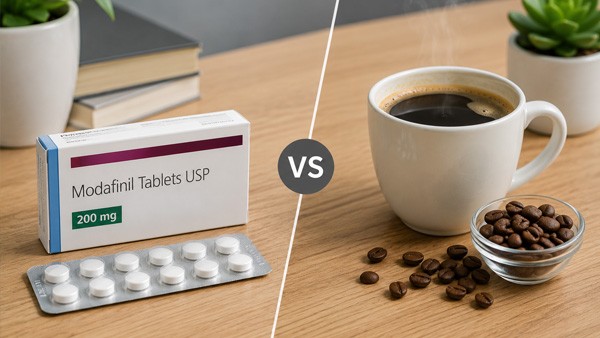
Caffeine is the most widely consumed psychoactive substance on Earth — and for most people, most of the time, it is enough. Two strong cups of coffee deliver about 200 mg of caffeine, produce noticeable alertness within 15-30 minutes, last 3-5 hours, cost almost nothing, and need no prescription. The argument for modafinil arises only when caffeine is not enough — when 12-14 hours of stable alertness matter more than a quick boost, when the post-caffeine crash interrupts the work window, when caffeine tolerance has flattened the effect, when underlying narcolepsy or shift work disorder demands stronger pharmacology. Comparing the two side-by-side is not really a contest between equals; it is a question of which tool fits which job.
This guide is organized as a head-to-head examination across every dimension that matters for the practical choice: neurochemistry, onset and duration, evidence from cognitive performance studies, side-effect comparison, dependence and withdrawal, cost-per-effect math, and the specific scenarios where caffeine alone is the smarter choice versus where modafinil delivers irreplaceable benefit. We close with the question many patients actually want answered — can you stack the two together — and a ten-question FAQ.
| Round | Caffeine | Modafinil | Winner |
|---|---|---|---|
| Onset speed | 15-30 min | 30-60 min | ☕ Caffeine |
| Duration | 3-5 hours | 10-14 hours | 💊 Modafinil |
| Crash factor | Notable rebound | Smooth taper | 💊 Modafinil |
| Cost per dose | $0.20-$0.50 | $0.80-$2.00 | ☕ Caffeine |
| Accessibility | Universal, no prescription | Prescription required | ☕ Caffeine |
| Tolerance buildup | Fast (weeks) | Slow (months) | 💊 Modafinil |
| Sleep disruption (proper timing) | Minimal | Minimal | 🤝 Tie |
| Cognitive enhancement (rested user) | Modest | Modest-Strong | 💊 Modafinil |
| Sleep deprivation rescue | Partial | Strong | 💊 Modafinil |
| Withdrawal severity | Headache + fatigue 2-3 days | Mild fatigue 1-2 days | 💊 Modafinil |
Final tally: Modafinil 6 / Caffeine 3 / Tie 1. But "winner" depends entirely on what you actually need — caffeine wins on accessibility and cost; modafinil wins on duration and effect quality. The scorecard frames the question, not the answer.
⚗️ Mechanism Side-by-Side
Caffeine is an adenosine receptor antagonist. Throughout the day, adenosine accumulates in the brain as a byproduct of cellular energy metabolism — it is the chemical signal that creates the sensation of mental fatigue. Adenosine binds to A1 and A2A receptors in arousal-relevant brain regions and suppresses neural firing, producing the gradually accumulating tiredness that builds across a waking day. Caffeine blocks adenosine from binding to these receptors. The blockade does not eliminate underlying tiredness; it temporarily silences the chemical messenger that signals it. When caffeine clears, accumulated adenosine binds with renewed strength, producing the post-caffeine crash. The drug works by hiding tiredness, not by curing it.
Modafinil engages multiple arousal pathways simultaneously without acting on adenosine. It weakly inhibits dopamine reuptake (similar mechanism to methylphenidate but at roughly 50-100× lower affinity), engages the histaminergic arousal system, activates orexin-producing neurons in the hypothalamus, and modulates norepinephrine signaling. The result is a synthetic engagement of the same brain pathways that produce natural wakefulness. Unlike caffeine, modafinil does not mask tiredness — it engages the alertness circuitry itself. This is why modafinil produces a cleaner subjective experience and a smoother taper rather than a crash.
The mechanism difference predicts every important downstream difference between the two drugs. Caffeine's masking-action explains the crash, the rapid tolerance, the headache withdrawal pattern (rebound adenosine sensitization), and the modest cognitive enhancement ceiling. Modafinil's direct arousal-pathway engagement explains the longer duration, the smoother profile, the slower tolerance development, and the more meaningful cognitive enhancement in sleep-deprived states. They are not competing drugs of the same class; they are different solutions to overlapping problems.
| Mechanism dimension | Caffeine | Modafinil |
|---|---|---|
| Primary target | Adenosine A1/A2A receptor antagonism | Dopamine transporter + histamine/orexin |
| Mode of action | Masks tiredness signal | Engages arousal pathways directly |
| Effect on adenosine | Blocks adenosine binding | No effect on adenosine |
| Effect on dopamine | Indirect modest increase | Direct weak DAT inhibition |
| Effect on histamine | None | Engages histamine arousal pathway |
| Effect on orexin | None | Activates orexin neurons |
| Post-effect rebound | Adenosine resurgence → crash | Smooth taper, no rebound |
| Drug class | Methylxanthine | Eugeroic (wake-promoting agent) |
⏱️ Onset and Duration
Caffeine and modafinil sit at opposite ends of the onset-duration spectrum. Caffeine's appeal is its rapid onset — measurable alertness within 15 minutes of consumption, full peak by 30-60 minutes, and a half-life of approximately 5 hours in healthy adults. The subjective effect window is 3-5 hours per dose, after which a noticeable wear-off begins. Many caffeine users compensate by re-dosing every 3-4 hours, which extends coverage but compounds total daily intake and accelerates tolerance.
Modafinil's onset is slower — measurable effect typically begins around 30-60 minutes after ingestion, with peak plasma concentration reached at 2-4 hours. The trade-off for slower onset is the long half-life of 12-15 hours, producing a subjective effect window of 10-14 hours per single dose. One morning modafinil dose covers an entire working day with smooth alertness throughout; matching that coverage with caffeine requires 3-4 separate doses spread across the day, each with its own peak-and-trough cycle.
The cup-of-coffee math makes the comparison concrete. One 200 mg modafinil tablet produces a duration of alertness comparable to drinking 8-10 cups of strong coffee spread across the day — but without the cumulative jitters, the stomach-acid issues, the bladder load, or the unpredictable concentration spikes that come from sequential caffeine doses. For sleep-deprived shift workers and narcolepsy patients, this duration advantage is the single most important practical reason modafinil exists as a separate clinical option from caffeine.
| Time post-dose | Coffee (200 mg caffeine, single cup) | Modafinil 200 mg (single tablet) |
|---|---|---|
| 0-15 min | Early onset detectable | No effect yet |
| 15-30 min | Clear effect | Beginning to detect |
| 30-60 min | Approaching peak | Climbing toward peak |
| 1-2 hours | Peak alertness | Continuing climb |
| 2-4 hours | Solid plateau; tapering begins | Reaching peak plateau |
| 4-6 hours | Noticeable wear-off — need top-up | Strong plateau continues |
| 6-8 hours | Largely worn off | Solid plateau |
| 8-12 hours | Gone; tiredness rebounds | Gentle taper |
| 12-16 hours | Long gone | Tapering to baseline |
| Total alertness window | 3-5 hours per dose | 10-14 hours per dose |
| Doses needed for full work day | 3-4 cups | 1 tablet |
🧠 Cognitive Performance Studies
The published evidence comparing caffeine and modafinil falls into three distinct categories: studies on rested healthy volunteers, studies on sleep-deprived healthy volunteers, and studies on patients with specific conditions (narcolepsy, OSA, SWSD, ADHD). The results differ meaningfully across these populations, which is part of why generic statements about "which is better cognitively" tend to mislead.
Rested healthy volunteers: Both caffeine and modafinil produce measurable cognitive improvements but the effect sizes are modest and the difference between drugs is small. Caffeine improves simple reaction time, sustained attention, and vigilance — well-replicated effects with effect sizes in the 0.2-0.4 (Cohen's d) range. Modafinil produces similar improvements in attention and vigilance but adds meaningful benefit on working memory, complex decision-making, and pattern recognition — effect sizes typically 0.3-0.6. The practical takeaway: in a well-rested user doing simple tasks, caffeine is essentially indistinguishable from modafinil. In a well-rested user doing complex tasks, modafinil shows a measurable but modest edge.
Sleep-deprived healthy volunteers: This is where modafinil's advantage becomes clinically large. Military studies (most notably from the US Army and French Air Force) have repeatedly shown that modafinil maintains cognitive performance during 24-48 hour sleep deprivation periods at levels significantly better than caffeine — and that the modafinil advantage grows as deprivation extends. By the 36-hour deprivation mark, caffeine users show measurable cognitive decline despite continued dosing; modafinil users maintain performance closer to baseline. The relevant trials are well-replicated and have shaped military aviation guidance on stimulant choice.
Clinical populations: For narcolepsy, OSA, and shift work sleep disorder, modafinil has direct FDA approval based on randomized controlled trials showing meaningful improvement in objective sleepiness measures (Maintenance of Wakefulness Test) and subjective sleepiness scales (Epworth Sleepiness Scale). Caffeine is not FDA-approved for any of these conditions and has not been formally tested as monotherapy. Patients with diagnosed sleep disorders should generally start with the regulated pharmacological option rather than self-medicating with caffeine, though many patients combine the two in practice.
| Cognitive task | Caffeine effect size | Modafinil effect size | Practical edge |
|---|---|---|---|
| Simple reaction time (rested) | ~0.3 (modest improvement) | ~0.3 (similar) | Caffeine adequate |
| Sustained attention (rested) | ~0.3 (modest improvement) | ~0.4 (slight edge) | Modafinil mild edge |
| Working memory (rested) | ~0.1 (minimal) | ~0.4 (meaningful) | Modafinil clear edge |
| Complex decision-making | ~0.1 (minimal) | ~0.5 (meaningful) | Modafinil clear edge |
| Pattern recognition | ~0.2 (minimal) | ~0.4 (meaningful) | Modafinil edge |
| Vigilance (sleep-deprived 24h) | ~0.5 (partial protection) | ~0.9 (strong protection) | Modafinil large edge |
| Memory consolidation (sleep-deprived) | ~0.3 (limited) | ~0.7 (strong) | Modafinil large edge |
| Mood/motivation (sleep-deprived) | Limited preservation | Better preservation | Modafinil clear edge |
⚠️ Side Effect Profiles
Both drugs have well-characterized side-effect profiles. The profiles overlap (both can cause headache, anxiety, insomnia) but differ in the specific combinations and severities that matter for daily decisions. Most users tolerate both reasonably well at moderate doses; problems concentrate at higher doses and longer durations of use.
The dose-effect ladder helps frame the comparison concretely. Each rung describes typical effects at increasing daily intake, side-by-side for both drugs:
- Low dose (caffeine 50-100 mg / modafinil 50-100 mg): Caffeine — single cup of coffee equivalent. Mild alertness boost, minimal side effects. Modafinil — half-tablet starting dose. Mild alertness boost, minimal side effects.
- Standard dose (caffeine 200 mg / modafinil 200 mg): Caffeine — two strong cups of coffee or one energy drink. Clear alertness, occasional mild jitters, possible mild diuretic effect. Modafinil — standard adult tablet. Clear alertness for 10-14 hours, ~25-35% headache rate, ~5-15% appetite suppression, possible mild anxiety.
- High dose (caffeine 400 mg / modafinil 400 mg): Caffeine — four cups or two energy drinks within several hours. Pronounced jitters, tachycardia common, anxiety likely, stomach upset, sleep disruption if late. Modafinil — high dose (above standard). Headache rate climbs to 40-50%, anxiety more pronounced, insomnia near-certain if dosed late, diminishing additional benefit.
- Excessive dose (caffeine 600+ mg / modafinil 600+ mg): Caffeine — clear toxicity territory, palpitations, anxiety attacks, GI distress, risk of arrhythmia. Modafinil — above any standard dosing range, side-effect amplification without proportional benefit, increasing arousal-system overload.
| Side effect | Caffeine frequency / character | Modafinil frequency / character |
|---|---|---|
| Headache (acute use) | ~10% at moderate doses | ~25-35% (most common modafinil SE) |
| Headache (withdrawal) | ~50% within 24-48h of cessation | Minimal withdrawal headache |
| Insomnia (if dosed late) | Strong — late caffeine destroys sleep | Moderate — late modafinil delays sleep |
| Anxiety / jitters | Common at >300 mg/day | ~5-10% at standard dose |
| Tachycardia | Common at higher doses | Mild at standard dose |
| Blood pressure increase | +2-5 mmHg at standard dose | +1-3 mmHg at standard dose |
| GI upset | Common — acidity, urgency | ~5-10% nausea |
| Diuresis | Notable diuretic effect | Minimal |
| Crash / rebound | Common — afternoon drop-off | Rare — smooth taper |
| Stevens-Johnson syndrome | Not associated | Very rare but specifically labeled |
| Cardiovascular event risk | Low at normal doses | Low at standard dose |
| Pregnancy safety | Limit to <200 mg/day | Category C — avoid |
☕ When Caffeine Is Enough
For most adults, most of the time, caffeine is the correct choice. The cases where caffeine is clearly sufficient — and where reaching for modafinil would be overkill — are common and worth naming explicitly:
Caffeine wins clearly when:
- You need a 2-4 hour focus boost, not all-day coverage.
- Your baseline sleep is adequate (7+ hours) and you are just looking for an edge.
- Cost matters and a $0.50 cup of coffee solves the problem.
- You lack a clinical indication for modafinil (no narcolepsy, OSA, SWSD, or other approved condition).
- You are pregnant or trying to conceive (modafinil is Category C; moderate caffeine is generally considered acceptable).
- You are sensitive to medications and would rather use the milder option.
- The task at hand is short (under 2 hours) and acute alertness is the only requirement.
- You are in a setting where prescription medications would be impractical (camping, travel, remote location).
Modafinil wins clearly when:
- You need 10+ hours of stable alertness from a single dose.
- You have diagnosed narcolepsy, OSA, or shift work sleep disorder.
- Caffeine tolerance has flattened the effect despite increasing dose.
- The post-caffeine crash interrupts your work window.
- You are sleep-deprived and need cognitive performance preservation that exceeds caffeine's ceiling.
- You need to avoid the cardiovascular load of high-dose caffeine.
- The task requires complex cognitive engagement (working memory, decision-making, sustained complex attention) where modafinil shows measurable edge.
- You work long shifts (10-14 hours) where caffeine re-dosing becomes impractical.
The time-of-day decision matrix below captures the most common everyday choice contexts:
| Situation | Sleep status | Time horizon | Best choice |
|---|---|---|---|
| Morning meeting prep | Rested | 2 hours | ☕ Coffee |
| 2-hour exam | Rested | 2 hours | ☕ Coffee |
| Full work day deep work | Rested | 10 hours | 💊 Modafinil |
| Night shift (12 hours) | Day sleeper | 12 hours | 💊 Modafinil |
| Cross-time-zone flight + meeting | Sleep-deprived | 14 hours | 💊 Modafinil |
| Casual weekend afternoon | Rested | 3 hours | ☕ Coffee |
| Narcolepsy daily management | Pathological sleepiness | All day | 💊 Modafinil |
| Emergency overnight project | About to be deprived | 20+ hours | 💊 Modafinil |
| 3 PM energy slump | Adequately rested | 2-3 hours | ☕ Coffee |
| Pre-driving long road trip | Rested | 4-6 hours | ☕ Coffee or modafinil |
🥂 Stacking — Can You Combine Them?
The most common question patients ask about modafinil is whether they can still drink coffee. The short answer is yes, with caveats. The long answer is worth understanding because the interaction is not symmetric — moderate caffeine on top of modafinil is generally fine, but heavy caffeine stacking amplifies side effects in predictable ways.
There is no direct dangerous pharmacological interaction between modafinil and caffeine — they act on entirely different receptor systems (adenosine vs dopamine/histamine/orexin) and do not compete for metabolism in ways that produce dangerous level changes. What they share is additive arousal effect. The combination produces more total alertness than either alone, more total cardiovascular activation, more total anxiety potential, and more total sleep disruption if dosed late.
Practical stacking guidelines:
- Moderate combination is fine: 1-2 cups of coffee (100-200 mg caffeine) alongside your modafinil 200 mg dose is well within tolerated combined load for most users.
- Reduce caffeine when starting modafinil: Most users naturally cut coffee intake by 30-50% during initial modafinil weeks because the underlying need for caffeine is reduced — alertness is already covered.
- Avoid heavy caffeine stacking: 3+ cups of coffee on top of modafinil produces noticeable jitter amplification, tachycardia, and anxiety in most users. The combined arousal load exceeds either alone.
- Caffeine timing matters: Morning coffee with morning modafinil is fine. Afternoon coffee on top of modafinil pushes sleep disruption risk meaningfully higher than either alone — both drugs have residual evening presence.
- Caffeine-sensitive users should be cautious: If you already get jitters from 1 cup of coffee, adding modafinil to your caffeine routine will amplify the jitter effect. Consider replacing rather than stacking.
- Avoid pre-workout / energy drinks during modafinil weeks: The high-caffeine concentrated formulations (200-400 mg caffeine plus stimulant blends) stack poorly with modafinil and produce uncomfortable arousal overload.
🔁 Withdrawal & Dependence Compared
The dependence and withdrawal profiles of the two drugs differ significantly and matter for long-term use planning. Both can produce some degree of physiological adaptation; the magnitude and the practical consequences are different.
Caffeine dependence is real and well-characterized. Regular daily caffeine consumption (200+ mg per day for weeks or longer) produces upregulation of adenosine receptors as the brain compensates for the receptor blockade. Stop suddenly and the now-amplified adenosine signal hits harder than before caffeine use, producing the classic withdrawal syndrome: headache (often severe) within 24-48 hours, fatigue, difficulty concentrating, irritability, occasionally nausea. The syndrome lasts 2-7 days depending on prior intake level. Tapering instead of stopping abruptly mitigates the symptoms substantially.
Modafinil dependence is minimal in standard clinical use. The DEA classifies modafinil Schedule IV (low abuse potential) specifically because the drug does not produce the reward-system engagement that characterizes addictive substances. Patients who use modafinil for years and then stop typically report mild rebound sleepiness for 1-2 days but no headache, no irritability, no craving, and no need for tapering. The contrast with caffeine withdrawal is striking — many patients who switch from heavy caffeine to modafinil find that the modafinil discontinuation experience is dramatically gentler than the coffee discontinuation experience would have been.
The implication for long-term use planning: caffeine carries higher real-world dependence cost than modafinil for chronic daily users, even though caffeine is the drug most people think of as benign. Heavy daily coffee drinkers attempting brief washout periods (vacation, travel, medical procedure) often encounter unpleasant withdrawal headache; modafinil users rarely face equivalent issues during similar washout windows.
💰 Cost-Per-Effect Math
The cost comparison sounds simple — caffeine is cheaper — but the per-effect math is more interesting than the per-dose math. The relevant question is not "what does one dose cost" but "what does a full work day of stable alertness cost":
| Strategy | Per-dose cost | Doses for full work day | Daily total | Annual (250 work days) |
|---|---|---|---|---|
| Brewed coffee at home | ~$0.30/cup | 3-4 cups | ~$0.90-$1.20 | ~$225-$300 |
| Coffee shop coffee | ~$3-5/cup | 3-4 cups | ~$9-$20 | ~$2,250-$5,000 |
| Energy drinks | ~$2-4/can | 2-3 cans | ~$4-$12 | ~$1,000-$3,000 |
| Modalert 200 mg (Sun Pharma generic) | ~$1-2/tablet | 1 tablet | ~$1-$2 | ~$250-$500 |
| Modvigil 200 mg (HAB generic) | ~$0.80-$1.40/tablet | 1 tablet | ~$0.80-$1.40 | ~$200-$350 |
| Provigil 200 mg (US brand) | ~$30-60/tablet | 1 tablet | ~$30-$60 | ~$7,500-$15,000 |
The economic conclusion: generic modafinil and home-brewed coffee end up in essentially the same per-day cost range when caffeine consumption is realistic for full-day coverage. Coffee shop habits cost dramatically more than generic modafinil. Brand-name Provigil costs dramatically more than both. The cost argument for caffeine over modafinil holds only if you compare modafinil against home-brewed coffee at minimal intake — not against any realistic full-day caffeine routine.
✨ Bottom Line
Caffeine and modafinil are not competing solutions to the same problem; they are different tools for different problems. Caffeine is the right choice for short focus windows, rested baseline users, casual cognitive enhancement, settings where prescriptions are impractical, and anyone whose alertness needs are well-covered by 2-3 cups of coffee. Modalert 200 mg (modafinil) from Sun Pharma is the right choice for narcolepsy and shift work sleep disorder, all-day alertness needs from a single dose, sleep-deprivation scenarios where caffeine's ceiling is inadequate, patients with caffeine tolerance that has flattened the effect, and anyone whose work day demands stable alertness without the caffeine crash and re-dose cycle.
For most patients combining the two is reasonable — moderate coffee on top of standard modafinil works fine and many users keep their morning coffee ritual while adding a modafinil tablet on demanding days. Heavy stacking (3+ cups plus modafinil) produces noticeable arousal overload and should be avoided. Both drugs have real but manageable side-effect profiles; both have predictable dependence patterns (caffeine more pronounced, modafinil minimal); both have economically reasonable cost structures in generic form.
For the broader pharmacological context, see our companion articles Modafinil vs Ritalin for the stimulant-class comparison and Modafinil vs Armodafinil for the R-enantiomer differences within the modafinil family.
❓ Frequently Asked Questions
Is modafinil just a stronger version of caffeine?
No — they are entirely different drugs with different mechanisms. Caffeine works by blocking adenosine receptors, masking the chemical signal of tiredness without addressing the underlying state. Modafinil works by directly engaging the dopamine, histamine, and orexin arousal pathways that produce natural wakefulness. The practical results are similar in some respects (both produce alertness) but the mechanism difference explains why modafinil lasts longer, produces no crash, develops tolerance more slowly, and provides better cognitive enhancement during sleep deprivation. Calling modafinil "stronger caffeine" is conceptually inaccurate.
How many cups of coffee equal one modafinil tablet?
In total alertness output across the day, one 200 mg modafinil tablet produces a sustained alertness window equivalent to drinking approximately 8-10 cups of coffee spread across 12 hours — but with smoother profile and no crash. In acute peak intensity at the 2-hour mark, one modafinil tablet is comparable to about 2-3 cups of coffee. The two drugs do not have a clean dose equivalency because they work on different mechanisms, but the duration math is roughly 1 tablet = 8-10 cups of total all-day coverage.
Will modafinil cure caffeine tolerance?
Indirectly, yes. If you reduce caffeine intake substantially during a period of modafinil use (most users naturally cut by 30-50% because alertness is already covered), your adenosine receptors gradually return to baseline sensitivity over 1-3 weeks. After this caffeine washout period, your sensitivity to coffee will be restored to near-baseline levels. Many users alternate periods of modafinil-primary use with caffeine-only periods specifically to reset caffeine tolerance between cycles. This is a real and effective strategy, though it requires deliberate management.
Can I drink coffee while taking modafinil?
Yes — 1-2 cups of coffee alongside standard modafinil dosing is fine for most users and does not produce dangerous interaction. Both drugs increase alertness through different mechanisms; combined effect is additive rather than synergistic. Heavy caffeine intake (3+ cups, energy drinks, pre-workout) on top of modafinil produces noticeable jitter amplification, tachycardia, and increased anxiety — generally not recommended. Most experienced modafinil users naturally reduce coffee intake during modafinil weeks because the alertness need is already covered.
Why does modafinil not cause a crash like caffeine does?
Caffeine works by blocking adenosine receptors, but adenosine continues accumulating throughout the day. When caffeine clears, the now-accumulated adenosine binds with renewed strength to its receptors, producing the post-caffeine crash. Modafinil works on completely different pathways (dopamine, histamine, orexin) and does not involve adenosine at all. When modafinil tapers, the underlying arousal-pathway engagement gradually fades but there is no rebound mechanism analogous to caffeine's adenosine resurgence. The result is a smooth taper rather than a crash.
Which is safer long-term?
Both are reasonably safe in moderate long-term use. Caffeine has thousands of years of human consumption history and the long-term safety profile in moderate intake (300 mg/day or less) is well-established. Modafinil has roughly 30 years of clinical use with established long-term safety in narcolepsy and OSA populations. The main long-term cautions for caffeine are dependence and the cardiovascular load of heavy consumption. The main long-term cautions for modafinil are the very rare Stevens-Johnson syndrome risk and tolerance development over years. Neither drug shows worrying long-term safety signals at moderate doses.
Will modafinil work if I'm not sleep-deprived?
Yes — modafinil produces cognitive enhancement in rested users, though the effect size is smaller than in sleep-deprived users. In rested healthy volunteers, modafinil shows reliable improvement on tasks requiring working memory, complex decision-making, and sustained attention on extended tasks. Simple tasks show little benefit beyond what caffeine provides. The drug's most dramatic benefit is in sleep-deprivation scenarios, where it preserves cognitive performance dramatically better than caffeine. If you are well-rested and doing simple tasks, caffeine is probably adequate.
Does modafinil have withdrawal like caffeine?
Much less. Caffeine withdrawal in regular daily users produces meaningful headache, fatigue, and irritability for 2-7 days after stopping — this is well-characterized and physiologically real. Modafinil discontinuation typically produces only mild rebound sleepiness for 1-2 days, no headache syndrome, no significant fatigue or irritability, and no craving. The dependence profile is one of modafinil's practical advantages over caffeine for long-term users — washout periods (vacation, travel, medical procedures) are dramatically easier than coffee washout would be.
Is caffeine bad if I'm taking modafinil for narcolepsy?
Not bad, but coordinate timing. Many narcolepsy patients on modafinil keep moderate morning coffee (1-2 cups) without issue and find the combination provides reliable alertness coverage. Heavy afternoon caffeine on top of modafinil is more problematic — both drugs have residual evening presence and combined late-day exposure can disrupt sleep. The general guidance: keep morning caffeine if you enjoy it; avoid afternoon caffeine when on modafinil; talk to your sleep physician about your specific caffeine pattern if it feels excessive or disruptive.
If caffeine is cheaper and accessible, why does anyone use modafinil?
Three primary reasons: (1) duration — one modafinil dose covers what would otherwise need 3-4 caffeine doses across the day, eliminating the re-dose logistics and the peak-and-trough pattern; (2) clinical indication — narcolepsy, OSA, and shift work sleep disorder respond to modafinil in ways caffeine cannot match; (3) effect quality — modafinil produces stable smooth alertness without the crash, the jitters, the GI effects, and the cardiovascular load that high-dose caffeine creates. For most casual users, caffeine is the right choice. For users whose alertness needs exceed what caffeine can sustainably provide, modafinil offers a meaningfully different profile that justifies the prescription pathway and modest additional cost.
📚 References & Further Reading
- Battleday & Brem, European Neuropsychopharmacology 2015 — systematic review of modafinil cognitive enhancement in healthy non-sleep-deprived adults.
- Caldwell et al., Aviation, Space, and Environmental Medicine — military helicopter pilot studies on modafinil during sustained operations.
- Wesensten et al., Sleep — head-to-head caffeine vs modafinil comparison in sleep-deprived volunteers.
- FDA prescribing information for Provigil (modafinil) — official mechanism, dosing, and safety profile.
- Fredholm et al., Pharmacological Reviews — comprehensive review of caffeine pharmacology and adenosine receptor pharmacology.
- American Academy of Sleep Medicine — practice parameters for narcolepsy, OSA, and SWSD covering modafinil's role.
- European Food Safety Authority — caffeine intake guidance and safety thresholds.
- WADA Prohibited List — caffeine and modafinil status in competitive sport.
- Modafinil vs Ritalin — methylphenidate comparison for the stimulant-class context.
- Modafinil vs Armodafinil — R-enantiomer comparison within the modafinil family.
- Modalert vs Provigil — generic vs brand comparison.
- Best Time to Take Modafinil — timing rules relevant to caffeine stacking.
- Modafinil Tolerance and Dose Escalation — long-term use considerations.
- Modafinil 200 mg Dosage Guide — standard dosing reference.
- Modalert 200 mg, Modvigil 200 mg, Waklert 150 mg — primary product pages on the RXshop antinarcoleptic catalogue.
- RXshop Editorial Team — content reviewed by licensed pharmacist; for adult patient education, not a substitute for individual medical consultation.
Medical Disclaimer: The information in this article is for educational and informational purposes only and is not a substitute for professional medical advice, diagnosis, or treatment. Always seek guidance from a qualified healthcare provider with any questions you may have regarding a medical condition, and before starting, stopping or changing any medication.