Modafinil vs Armodafinil: R-Enantiomer Differences


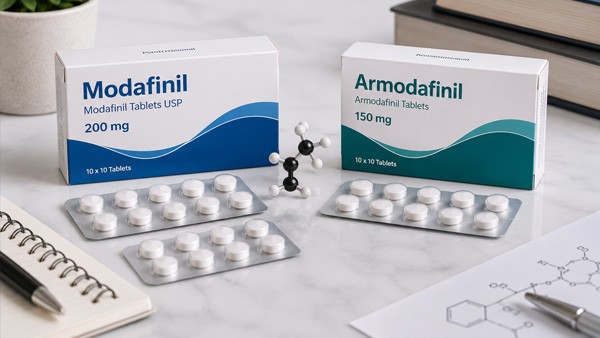
Armodafinil is modafinil with half the molecule removed. Specifically, the inactive (or rather, faster-clearing) S-enantiomer half. What remains is pure R-enantiomer — the longer-lasting, more sustained half of the parent compound — sold as Waklert 150 mg from Sun Pharma and other licensed generics. Whether this isolated-enantiomer approach produces a meaningfully different clinical experience or is mostly pharmacological theatre depends on which dimension you compare: half-life, subjective smoothness, daily plasma curve shape, or price-per-day.
This guide walks through every comparison axis a patient actually cares about — the molecular biology of why two products exist, the pharmacokinetic curves that explain the afternoon dip, the dose equivalence math that catches people switching for the first time, the subjective patient archetypes that emerge after months of comparative experience, a complete switching protocol, a cost-per-day breakdown, and an honest "who should avoid" section. By the end you should have a clear answer for your own situation — not just a hand-wavy "they are similar" verdict that leaves the actual choice unmade.
Modafinil half-life: ~12-15 hours (R-enantiomer ~15h + S-enantiomer ~4h mixed average)
Armodafinil half-life: ~15 hours (pure R-enantiomer only)
Modafinil standard dose: 200 mg morning
Armodafinil standard dose: 150 mg morning
Dose equivalence: 150 mg armodafinil ≈ 200 mg modafinil clinically
FDA approval years: Modafinil 1998 / Armodafinil 2007
Original developer: Cephalon (both products)
FDA brand names: Modafinil = Provigil / Armodafinil = Nuvigil
Common generics — modafinil: Modalert, Modvigil, Modaheal, Vilafinil
Common generics — armodafinil: Waklert, Artvigil, Armod, R-Modawake
Subjective profile: Modafinil = "sharper peak then taper" / Armodafinil = "smoother plateau"
Schedule: Both = Schedule IV (US), prescription-only (most countries)
🧬 The R-Enantiomer Explained
Many drug molecules exist as two mirror-image versions of each other — called enantiomers — that have identical chemical formulas but opposite three-dimensional orientations. Think of them as left-handed and right-handed versions of the same molecular structure. Despite identical atomic composition, the two hands often behave differently in the body because biological receptors are themselves three-dimensional shapes that bind one orientation more readily than the other. Common examples include ibuprofen (the S-enantiomer is the active anti-inflammatory; the R-form is largely inactive), citalopram (the S-form became escitalopram, sold separately), and methylphenidate (the d-enantiomer is the active component of dexmethylphenidate).
Modafinil is a 50/50 racemic mixture of R-modafinil and S-modafinil — both enantiomers in roughly equal amounts in every tablet. The two enantiomers have different pharmacokinetic properties: the S-enantiomer clears from plasma in about 4-5 hours, while the R-enantiomer persists for 13-15 hours. The clinical effect during the first few hours after a modafinil dose comes from both enantiomers; the effect during the second half of the day comes mostly from the R-enantiomer alone, after the S-half has cleared.
Armodafinil is what you get when you isolate just the R-enantiomer and market it as a separate product. Same molecular skeleton, same mechanism of action, same FDA-approved indications — but only the long-lasting half is present. The decision to develop armodafinil as a separate drug was partly clinical (the R-enantiomer's smoother concentration curve helps some patients) and partly commercial (Cephalon's modafinil patent was expiring; armodafinil allowed extended exclusivity for a closely-related molecule). Critics call this an "evergreening" patent strategy; defenders point to genuine clinical differences that emerge in shift-work and afternoon-dip patient populations.
Both molecules act on the same neurotransmitter systems — primarily blocking the dopamine reuptake transporter (DAT) with lower affinity than amphetamines, while also affecting histamine, orexin, and norepinephrine pathways. The receptor binding is essentially identical between the R and S forms; the difference between modafinil and armodafinil is therefore not about what receptors are engaged (the same ones in both cases) but about the plasma concentration curve shape over the day.
| Property | Modafinil | Armodafinil |
|---|---|---|
| Composition | 50/50 R + S enantiomer mix (racemic) | 100% R-enantiomer only |
| FDA approval year | 1998 (Provigil, Cephalon) | 2007 (Nuvigil, Cephalon) |
| FDA-approved indications | Narcolepsy, OSA, SWSD | Narcolepsy, OSA, SWSD (identical) |
| Mechanism | DAT inhibition + histamine/orexin | DAT inhibition + histamine/orexin (identical) |
| Schedule (US) | Schedule IV controlled | Schedule IV controlled |
| Standard adult dose | 200 mg morning (range 100-400 mg) | 150 mg morning (range 50-250 mg) |
| CYP3A4 induction | Yes — meaningful (affects contraceptives) | Yes — same magnitude |
⏰ Duration and Half-Life
The half-life numbers tell the whole shape-of-the-day story. Modafinil's mixed half-life (12-15 hours mean) reflects the blended elimination of both enantiomers — early in the day both are present, late in the day only the R-half is. The result is a concentration curve with a sharper initial peak (combined R+S effect) and a gradual taper through the second half of the day (R-only effect). Some patients describe a subtle "afternoon dip" around 13:00-16:00 — the moment when the S-enantiomer has largely cleared and the R-only level is still high but no longer reinforced by the S-contribution.
Armodafinil's pure-R half-life of ~15 hours produces a flatter, smoother concentration curve. No S-enantiomer to clear at hour 4-5; no afternoon dip from differential elimination. Patients describe armodafinil as more even-keeled across the day — less of a sharp "I clearly took something" peak in the morning, but more consistent alertness through the late afternoon. The total area-under-the-curve is similar at equivalent doses; the shape is what differs.
For most patients, the most consequential practical implication is the bedtime calculation. A modafinil 200 mg dose taken at 07:00 has tapered to a low enough plasma level by 22:00 that most patients can fall asleep without difficulty. An armodafinil 150 mg dose taken at the same 07:00 has tapered less by 22:00 — the slower elimination means meaningful residual presence at bedtime. For early-morning takers this is fine; for patients who take their dose at 09:00 or later, armodafinil's longer tail can push back natural sleep onset by 30-90 minutes compared to modafinil.
This explains the empirical observation that patients who switch from modafinil to armodafinil often complain about sleep disturbance for the first 1-2 weeks, then either adapt (by taking the dose 60-90 minutes earlier) or switch back to modafinil. The drug itself is not causing insomnia; the timing has not yet been adjusted for the longer half-life.
| Time post-dose | Modafinil 200 mg | Armodafinil 150 mg |
|---|---|---|
| 30-60 min (onset) | Detectable; slightly faster onset | Detectable; very similar timing |
| 2-4 hours (peak) | Sharp peak; "morning fog cleared" intensity | Lower peak; smoother climb |
| 4-10 hours (plateau) | Strong plateau; some subjective intensity | Smooth plateau; less acute "drug effect" |
| 10-14 hours (taper) | Subtle afternoon dip in some patients | Smoother taper; no notable dip |
| 14-18 hours (tail) | Tapering; meaningful by bedtime if dosed late | Slower taper; longer evening presence |
| Bedtime impact (07:00 dose) | Minimal for most patients | Slightly more residual; some patients notice |
| Bedtime impact (10:00 dose) | Some residual presence at 23:00 | Meaningful presence at 23:00; sleep delay risk |
Practical timing rules that follow from these curves:
- Modafinil cutoff: Take by 11:00 if you have a 23:00 bedtime. Later than 11:00 risks insomnia for half-life-sensitive patients.
- Armodafinil cutoff: Take by 09:30 if you have a 23:00 bedtime. The longer half-life shifts the cutoff window 60-90 minutes earlier than modafinil.
- Shift work exception: The FDA-approved SWSD indication uses 1 hour before shift start regardless of clock time. The cutoff rule applies to daytime alertness use, not to shift coverage.
- Half-dose for sensitive patients: Cutting either tablet in half effectively halves the residual evening presence and extends your allowable dosing window by ~2 hours.
⚖️ Dose Equivalence (150 mg arm = 200 mg mod)
The dose equivalence is the practical bridge between the two products. Because armodafinil contains only the more potent R-enantiomer rather than the racemic mixture, 150 mg of armodafinil delivers approximately the same wake-promoting effect as 200 mg of modafinil. The 50 mg numeric difference reflects the absent (and faster-clearing) S-enantiomer in the modafinil tablet that contributes to the morning peak but not to sustained later-day effect.
This equivalence is not exact — it reflects average clinical response, not patient-by-patient pharmacokinetic precision. Some patients find 150 mg armodafinil clearly stronger than 200 mg modafinil in subjective effect (typically those who are sensitive to R-enantiomer-driven sustained alertness); others find them virtually indistinguishable. The dose-response curve for both drugs flattens above the standard recommended dose, so doubling either does not double the effect — 300 mg armodafinil produces less proportional benefit than the 150 → 300 jump might suggest.
The equivalence table below covers all the common starting doses on either side, so a patient switching in either direction can match their established dose to the equivalent on the other product.
| Modafinil dose | Equivalent armodafinil dose | Patient profile |
|---|---|---|
| 100 mg | ~75 mg (half a 150 mg tablet) | Sensitive patients, elderly, low-dose starters |
| 200 mg | 150 mg (one tablet) | Standard adult dose, most narcolepsy/OSA patients |
| 300 mg | ~225 mg (1.5 tablets) | Patients with partial response at standard dose |
| 400 mg | ~250-300 mg (FDA max range) | Maximum recommended; diminishing returns above this |
| Split (100 + 100) | Split (75 + 75) | Two-dose patients for extended coverage |
💭 Subjective Differences
Beyond the objective pharmacokinetic differences, patient reports consistently describe distinct subjective experiences between the two products. The descriptions are individual and not universally shared, but the pattern is consistent enough across thousands of forum and clinical reports to be worth taking seriously even outside formal trial data.
Modafinil users typically describe a more distinct "I took something" feeling — sharper peak intensity around 2-3 hours post-dose, more pronounced contrast between drug-on and drug-off days, and occasionally that subtle afternoon dip. The drug feels more present in awareness, which some patients prefer for the psychological reassurance and others find slightly intrusive. The descriptor that comes up most often is "switched on" — as if a clarity dial moved from 4 to 7 within a discrete window.
Armodafinil users typically describe a more even-keeled experience — the alertness feels more like "I just happened to have a good day" than "I took a wake-promoting drug." Less acute peak, no afternoon dip, smoother plateau. Some patients find this subtler effect less satisfying because the drug's presence is harder to perceive; others find it ideal precisely because the alertness feels natural. The most common descriptor is "just normally functioning" — as if a constant baseline was restored rather than a temporary boost overlaid.
The fact that these subjective patterns persist across millions of patient-years of comparative use suggests they reflect real pharmacokinetic differences rather than placebo or expectation effects. The choice between the two products is partly about which subjective experience pattern suits the individual patient.
| Dimension | Modafinil typical report | Armodafinil typical report |
|---|---|---|
| Onset perception | Distinct "kicked in" moment ~60 min | Gradual; harder to pinpoint moment |
| Peak intensity | Sharp; clear "I'm on it" awareness | Mild; subtle background alertness |
| Mid-day stability | Possible 13:00-16:00 dip | Smooth; no dip |
| Late-afternoon coverage | Tapering noticeably by 17:00-19:00 | Still strong at 17:00-19:00 |
| Evening wind-down | Easier; drug largely gone | Slower; residual presence |
| Side effect intensity | Concentrated near peak hours | Distributed across longer day |
| Headache pattern | Often mid-morning if at all | More often late-day if at all |
| "Feel like a drug" sensation | More distinct | More subtle / natural |
🎯 When to Choose Which
Four patient archetypes consistently emerge from clinical practice and forum experience. Each pairs naturally with one product over the other:
Archetype 1 — "I need acute focus for distinct work blocks." Choose modafinil. The sharper peak intensity suits patients who need to be at maximum acute alertness during specific morning hours and are less concerned about afternoon plateau smoothness. Many off-label cognitive users fit this profile — students cramming for exams, professionals with morning-heavy deep work blocks, writers with their best output before noon.
Archetype 2 — "I get an afternoon dip on modafinil that bothers me." Choose armodafinil. The pure R-enantiomer's smoother curve eliminates the differential-elimination dip that creates the modafinil afternoon trough. Many narcolepsy and shift work patients fit this profile after months of modafinil use. This is the single most common reason for switching established patients from modafinil to armodafinil.
Archetype 3 — "I work long shifts (10-14 hours)." Choose armodafinil. The slower taper covers the late shift hours more reliably than modafinil's earlier wear-off. Many healthcare workers, long-haul drivers, military personnel, and shift workers fit this profile. The longer half-life is functionally a feature here rather than a sleep-disturbance liability.
Archetype 4 — "I prefer the drug being subtle rather than obvious." Choose armodafinil. The smoother subjective experience appeals to patients who prefer their wake-promotion to feel natural rather than pharmacological. Cost-sensitive patients with no acute-peak preference often default here, since the dose-per-mg cost can work out favorably.
Beyond these four primary archetypes, several secondary considerations push the choice one way or the other:
- Bedtime sensitivity: If you have a relatively early bedtime (22:00) and take your dose around 09:00 or later, modafinil is the safer choice. Armodafinil's longer tail can compress your wind-down window uncomfortably.
- Split-dose users: Patients who split their dose for extended coverage (e.g., 100 mg morning + 100 mg early afternoon) usually do better on modafinil. The shorter half-life makes the second dose timing forgiving; armodafinil's longer half-life means the second dose stacks dangerously close to bedtime.
- Drug-holiday users: Patients who take the drug only 3-4 days per week often prefer modafinil's faster washout — by the next morning the drug is essentially gone, making intermittent use cleaner. Armodafinil's slower washout creates a meaningful residual on the day after a dose.
- Cardiovascular caution: Both drugs have similar cardiovascular profiles, but the longer half-life of armodafinil means longer exposure to the modest pressor effect per dose. Patients with borderline hypertension or arrhythmia history may find modafinil's faster clearance preferable.
For the broader product ecosystem context, RXshop's catalogue includes Modalert 200 mg (modafinil) from Sun Pharma alongside three armodafinil options: Waklert 150 mg from Sun Pharma (same manufacturer), Artvigil 150 mg from HAB Pharmaceuticals (budget alternative), and Armod 150 mg from Emcure Pharmaceuticals.
🔄 Switching Protocol
Patients switching between the two products without a proper transition protocol often experience either inadequate alertness (if the dose is undershot) or sleep disturbance (if timing is not adjusted). The protocol below has worked reliably across both directions:
Switching from modafinil to armodafinil:
- Day 1: Take 150 mg armodafinil at the same morning time you previously took modafinil. Do not adjust timing on day 1 — establish baseline response first.
- Days 1-3: Track three things: onset clarity, mid-day stability, and bedtime ease. Most patients notice smoother mid-day immediately; bedtime issues (if any) emerge on day 2-3.
- Day 4-7: If bedtime is being pushed back, move morning dose 60-90 minutes earlier. Most armodafinil patients land on a 06:30-08:00 dose window vs the 07:30-09:30 window typical for modafinil.
- Week 2: Assess overall response. If alertness is excessive (over-stimulation), drop to 75 mg (half-tablet) for the next week and reassess. If alertness is inadequate, the 150 mg dose is your floor — go up only if your physician approves 225 mg.
- Week 3+: Settle on your final dose-and-timing combination. The switch is functionally complete by week 3 for most patients.
Switching from armodafinil to modafinil:
- Day 1: Take 200 mg modafinil at the same morning time. The dose equivalence is 150 mg arm → 200 mg mod, not 1:1.
- Days 1-3: Track for the appearance of an afternoon dip around 13:00-16:00. This is the most common new symptom after switching back to modafinil and is what brought many patients to armodafinil in the first place.
- Day 4-7: If the afternoon dip is bothersome, consider a split-dose protocol: 100 mg morning + 100 mg around 12:00. The two smaller doses smooth out the dip pattern that the single 200 mg dose creates.
- Week 2: Assess sleep. Modafinil's faster clearance usually means easier bedtime than armodafinil — this is one of the genuine benefits of switching back.
- Week 3+: Final dose pattern locked in. Single 200 mg morning OR split 100+100 are the two stable end-states.
💰 Cost Comparison (per-day economics)
Generic versions of both drugs from licensed Indian manufacturers cost dramatically less than the US brand-name versions (Provigil and Nuvigil). Within the generic market, the cost-per-day economics work out roughly equivalent between modafinil and armodafinil at standard doses — but a few wrinkles are worth knowing:
| Product | Active | Manufacturer | Tablets per pack | Cost-per-day comparison |
|---|---|---|---|---|
| Modalert 200 mg | Modafinil | Sun Pharma | 10 / 30 / bulk | Baseline (1.0×) |
| Modvigil 200 mg | Modafinil | HAB Pharma | 10 / 30 / bulk | ~0.7× (budget tier) |
| Waklert 150 mg | Armodafinil | Sun Pharma | 10 / 30 / bulk | ~1.0-1.1× |
| Artvigil 150 mg | Armodafinil | HAB Pharma | 10 / 30 / bulk | ~0.7× (budget tier) |
| Armod 150 mg | Armodafinil | Emcure Pharma | 10 / 30 / bulk | ~1.0× |
| Provigil 200 mg (US brand) | Modafinil | Teva / Cephalon | 30 / 100 | ~20-30× (US retail) |
| Nuvigil 250 mg (US brand) | Armodafinil | Teva / Cephalon | 30 / 100 | ~20-30× (US retail) |
The practical cost takeaways for most RXshop patients:
- Within the generic market, modafinil and armodafinil are economically equivalent at standard doses. Choice should be driven by clinical fit, not by per-tablet cost.
- Bulk packs (90-180 tablets) lower per-day cost by ~30-40% compared to 10-tablet packs. Established users with stable prescriptions should default to bulk.
- Budget-tier generics (Modvigil, Artvigil) from HAB Pharma cost ~30% less than Sun Pharma equivalents. Bioequivalence is established but manufacturer reputation is less premium.
- US brand-name purchase is almost never economical — the 20-30× price differential makes the licensed Indian generics the rational choice for cost-sensitive patients.
🚫 Who Should Avoid Both
Independent of which product is chosen, several patient categories should avoid both modafinil and armodafinil entirely:
- Prior Stevens-Johnson syndrome (SJS) or serious skin reaction to either drug: Cross-reactivity between modafinil and armodafinil is high — if you reacted to one, do not try the other. The two drugs are functionally the same molecule from an immunological standpoint.
- Left ventricular hypertrophy or recent myocardial infarction: Both drugs produce a modest pressor effect. The FDA labels for both products specifically caution against use in these populations.
- Severe hepatic impairment: Both drugs are extensively metabolized by the liver. Dose reductions of 50% or more are required in severe impairment; many physicians simply avoid both in this population.
- Pregnancy: Both products are FDA Pregnancy Category C with documented developmental toxicity in animal studies. The North American Antiepileptic Drug Pregnancy Registry has reported elevated congenital malformation rates. Both should be avoided in pregnancy and discontinued before planned conception.
- History of psychosis or mania: Both drugs have rare but documented case reports of triggering psychiatric episodes in vulnerable patients. Bipolar disorder, schizophrenia, and severe anxiety disorders are relative contraindications.
- Combined hormonal contraception users without backup method: Both products induce CYP3A4 and reduce hormonal contraceptive efficacy. Either switch to a non-hormonal method (IUD, etc.) or add barrier protection — and continue both for one month after stopping modafinil/armodafinil.
✨ Bottom Line
Modafinil and armodafinil are not "stronger vs weaker" — they are the same molecular family with different concentration-curve shapes. Modalert 200 mg (modafinil) from Sun Pharma delivers a sharper peak with faster taper through the day, suited to patients wanting acute focus and tolerating a possible afternoon dip. Waklert 150 mg (armodafinil) from the same manufacturer delivers a smoother plateau without the afternoon trough, suited to patients on long shifts or those who prefer subtle drug presence.
The 150 mg armodafinil dose is roughly clinically equivalent to 200 mg modafinil — do not switch numerically without adjusting for the equivalence. For patients new to the modafinil family, Modalert is the safer default with the broadest evidence base and most established prescribing experience. For established modafinil users experiencing afternoon dips or working long shifts, switching to Waklert is a reasonable evolution. For our earlier in-depth Armodafinil article covering Waklert in detail alongside the related products, see Armodafinil vs Modafinil: When the R-Enantiomer Wins.
❓ Frequently Asked Questions
Is armodafinil stronger than modafinil?
Not in the sense of producing a more intense peak effect. Armodafinil is the pure R-enantiomer of modafinil — milligram-for-milligram about 1.3× more potent at wake-promotion (which is why 150 mg armodafinil ≈ 200 mg modafinil clinically), but the difference between the two products is more about concentration-curve shape than peak intensity. Armodafinil is longer-lasting and smoother; modafinil has a sharper peak with earlier taper. Neither is "stronger" in a meaningful overall sense — they are differently shaped.
What's the right dose if I switch from Modalert to Waklert?
150 mg armodafinil (one Waklert tablet) is roughly equivalent to your standard 200 mg modafinil dose. Do not take 200 mg of armodafinil thinking you need to match the numeric modafinil dose — the absent S-enantiomer in armodafinil means 200 mg of pure R-form delivers meaningfully more drug exposure than 200 mg of racemic mixture. The standard adult armodafinil dose is 150 mg, full stop. If you are switching from modafinil 100 mg to armodafinil, start at half a Waklert tablet (75 mg).
Why does modafinil have an "afternoon dip" that armodafinil doesn't?
Differential enantiomer elimination. Modafinil is a 50/50 mix of R and S enantiomers; the S-enantiomer clears in 4-5 hours while the R-enantiomer persists for 13-15 hours. Around hours 4-6 after a morning dose, the S-half has largely cleared and you are left with R-only — a noticeable transition that some patients perceive as a brief energy dip. Armodafinil contains only the R-enantiomer from the start, so there is no S-component to clear, no differential elimination transition, and no afternoon dip. The smoother curve is the main practical reason patients switch from modafinil to armodafinil.
Can I take armodafinil at night for a night shift?
Yes — the FDA-approved shift work sleep disorder indication for armodafinil uses the same per-shift dosing pattern as modafinil: 150 mg approximately 1 hour before shift start. The longer half-life of armodafinil means the drug covers the late shift hours more reliably than modafinil's earlier taper, which is one of the main clinical reasons night shift workers often prefer Waklert. The trade-off: armodafinil also persists longer into post-shift hours, which can affect day-sleep onset if your sleep environment is not well-managed.
Which is better for narcolepsy?
Both are FDA-approved and clinically effective. Most narcolepsy patients are started on modafinil 200 mg morning dose because of the broader evidence base and longer prescribing experience. Patients who respond well but experience afternoon dips, or who have prominent late-day sleep attacks, are often switched to armodafinil 150 mg for the smoother coverage. There is no universal "better" — the choice follows individual response patterns and lifestyle fit.
Does armodafinil have fewer side effects than modafinil?
Not meaningfully different. The side-effect profile is essentially identical because the active R-enantiomer is the same molecule in both products. The same headache, nausea, anxiety, insomnia, and rare Stevens-Johnson syndrome risk apply to both. The drug-interaction profile is also identical — same CYP3A4 induction affecting hormonal contraception, same cardiovascular pressor effect, same nitrate and amphetamine cautions. Switching from modafinil to armodafinil is a curve-shape change, not a safety-profile change.
Can I take modafinil and armodafinil together?
Pharmacologically you can — they engage the same receptors and would simply stack as additional R-enantiomer exposure. Clinically there is no rational reason to do so. You would be paying for two products to achieve what one larger dose of either could deliver, with worse plasma curve control. If you need more wake-promoting effect than 200 mg modafinil or 150 mg armodafinil provides, increase the dose of one product (under medical supervision) rather than stacking both. The only legitimate combined use is when transitioning between the two — and even that should follow a clean switch protocol, not overlapping doses.
How long after my last modafinil dose can I take armodafinil?
For a clean transition, leave 24 hours between your last modafinil dose and your first armodafinil dose. Both drugs persist meaningfully in plasma for 18-24 hours, so taking them within the same 24-hour window means you are stacking R-enantiomer levels and risking over-stimulation. The safest pattern: take your last modafinil dose Monday morning, skip Monday afternoon and Tuesday morning, start armodafinil Wednesday morning. For switches in the other direction, same 24-hour gap applies.
Will armodafinil show up differently than modafinil on a drug test?
No — both drugs metabolize to the same urinary breakdown products, and standard drug screens do not distinguish between them. Neither drug appears on a typical 5-panel or 10-panel employment drug test (modafinil/armodafinil are not on the standard panels). Specialized testing for modafinil or armodafinil specifically would detect either drug as positive without distinguishing which one was taken. If you have a positive drug test concern for a sport or employment context, both drugs carry identical risk profile — neither is "safer" from a detection standpoint.
Why is armodafinil more expensive in the US but similarly priced in generic form?
US brand-name Nuvigil pricing reflects Cephalon's (now Teva's) patent strategy — armodafinil was developed specifically to extend exclusivity past modafinil's expiring patent, and the US brand-price premium captures that exclusivity value. In the generic market — where Indian manufacturers like Sun Pharma, HAB Pharmaceuticals, and Emcure produce both drugs — the manufacturing cost per tablet is essentially the same, so generic Waklert and Modalert end up priced comparably. The dramatic price differential exists only in the brand-name US retail market, not in the generic global supply.
📚 References & Further Reading
- FDA prescribing information for armodafinil (Nuvigil) — official R-enantiomer profile and dosing recommendations.
- FDA prescribing information for modafinil (Provigil) — racemic mixture profile for comparison baseline.
- Darwish et al., Clinical Pharmacokinetics — comparative pharmacokinetic studies establishing the 150 mg armodafinil ≈ 200 mg modafinil equivalence cited throughout.
- Wong et al., Journal of Clinical Pharmacology — head-to-head plasma concentration profile studies for modafinil vs armodafinil.
- American Academy of Sleep Medicine — practice parameters covering both modafinil and armodafinil in narcolepsy, OSA, and SWSD.
- Cephalon FDA briefing documents (2007) — original armodafinil approval submissions detailing R-enantiomer rationale.
- North American Antiepileptic Drug Pregnancy Registry — congenital malformation data for both drugs.
- Armodafinil vs Modafinil: When the R-Enantiomer Wins — earlier in-depth article on Waklert and the related armodafinil products.
- Modafinil 200 mg Dosage Guide — baseline dosing context for the modafinil side of the comparison.
- Best Time to Take Modafinil — timing rules that apply identically to armodafinil.
- Modafinil Tolerance and Dose Escalation — tolerance considerations that apply equally to armodafinil.
- Modalert vs Modvigil — manufacturer comparison for the modafinil side; same logic applies to choosing between Waklert / Artvigil / Armod on the armodafinil side.
- Modafinil and Birth Control — CYP3A4 induction details applying identically to armodafinil.
- Modalert 200 mg, Waklert 150 mg, Artvigil 150 mg, and Armod 150 mg — primary product pages on the RXshop antinarcoleptic catalogue.
- RXshop Editorial Team — content reviewed by licensed pharmacist; for adult patient education, not a substitute for individual medical consultation.
Medical Disclaimer: The information in this article is for educational and informational purposes only and is not a substitute for professional medical advice, diagnosis, or treatment. Always seek guidance from a qualified healthcare provider with any questions you may have regarding a medical condition, and before starting, stopping or changing any medication.