Modafinil vs Vyvanse: ADHD Medication Comparison


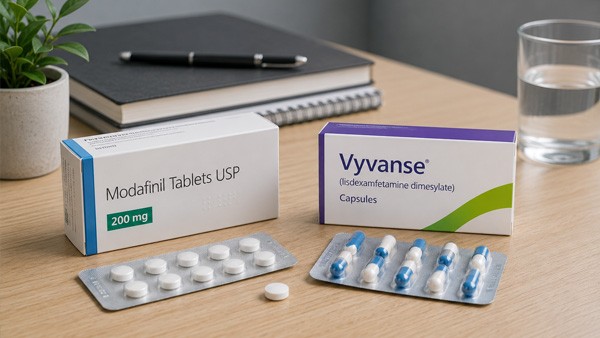
Vyvanse is not an amphetamine — until your body makes it one. The tablet you swallow contains lisdexamfetamine, a chemically inert prodrug consisting of dexamphetamine bound to the amino acid lysine. The molecule has no stimulant activity on its own; it only becomes active after red blood cells cleave off the lysine, releasing dexamphetamine into circulation gradually over hours. This unusual delivery mechanism is what gives Vyvanse its smoother long-duration profile and lower (though not zero) abuse potential compared to immediate-release amphetamines like Adderall. Modafinil, by contrast, is active from the moment it enters your bloodstream, engages an entirely different neurochemical system (histamine, orexin, dopamine reuptake), and is not an amphetamine at all in any pharmacological sense.
Comparing the two means comparing two fundamentally different strategies for sustained focus: amphetamine-pathway stimulation delivered through a clever prodrug shell (Vyvanse) versus eugeroic wake-pathway engagement that bypasses the amphetamine class entirely (modafinil). The two drugs overlap in clinical outcomes (both help focus, both treat narcolepsy off-label or on-label, both produce alertness for a working day) but differ profoundly in mechanism, regulatory schedule, abuse liability, cost structure, withdrawal pattern, and the populations where each is the clear best choice. This guide walks through every comparison dimension with the level of detail a patient or physician actually needs to make a real decision.
Step 1 → You swallow Vyvanse 50 mg. The tablet contains lisdexamfetamine dimesylate — d-amphetamine covalently bonded to L-lysine. Zero stimulant activity at this stage.
Step 2 → GI absorption: the intact lisdexamfetamine molecule is absorbed through the small intestine in 60-90 minutes. Still no stimulant activity.
Step 3 → Red blood cell enzymes cleave the lysine off, releasing free dexamphetamine into plasma. Now the drug is active.
Step 4 → Free dexamphetamine acts on dopamine transporters AND triggers vesicular dopamine release — the classical amphetamine mechanism.
Step 5 → The conversion happens gradually over 6-8 hours, producing the long smooth dexamphetamine plasma curve that defines Vyvanse's clinical profile.
The implication: Vyvanse cannot be snorted, smoked, or injected for rapid effect — the prodrug has to be metabolized over hours. This is why the FDA classifies Vyvanse as Schedule II (still high abuse potential) but with documented lower abuse liability than instant-release amphetamines. Modafinil skips this entire chain — it is active from the moment it enters circulation, on completely different receptors.
🧪 The Prodrug Difference
Lisdexamfetamine is what happens when a pharmaceutical company solves the abuse-liability problem of an existing drug by adding chemical handcuffs. Dexamphetamine has been used clinically since the 1930s; it works extremely well for ADHD and narcolepsy but carries significant abuse potential because the active drug enters circulation instantly when ingested, snorted, or injected. Shire (now Takeda) developed lisdexamfetamine in the early 2000s as a deliberate attempt to keep the clinical efficacy of dexamphetamine while making rapid abuse routes pharmacologically impossible. The strategy worked — Vyvanse delivers dexamphetamine effectively when taken orally as intended, but cannot be misused via fast routes because the rate-limiting enzymatic conversion happens at a fixed biological pace regardless of route.
The conversion process is governed by erythrocyte (red blood cell) enzymes that cleave the lysine off via hydrolysis. The reaction follows first-order kinetics — the rate depends on the amount of lisdexamfetamine present, not on dose-dependent saturation effects. Taking a higher Vyvanse dose produces more total dexamphetamine but does not accelerate the conversion rate per molecule. This is why Vyvanse's onset is slow (45-90 minutes to detectable effect) and its duration is long (10-14 hours of dexamphetamine coverage from a single morning dose), regardless of the absolute dose taken.
Modafinil's pharmacology is profoundly different. The molecule entering your bloodstream is the active drug — there is no conversion, no enzymatic activation, no prodrug shell. Modafinil engages a different set of brain pathways than amphetamines do. Where amphetamines (including the dexamphetamine released from Vyvanse) act primarily through dopamine reuptake blockade combined with active vesicular dopamine release, modafinil acts primarily through histamine arousal pathway engagement, orexin system activation, and weak (much weaker than amphetamines) dopamine reuptake inhibition. The mechanistic distance between modafinil and Vyvanse is larger than the distance between Vyvanse and most other ADHD stimulants — they are not in the same drug family at any meaningful level.
| Property | Vyvanse (lisdexamfetamine) | Modafinil |
|---|---|---|
| Drug class | Amphetamine prodrug | Eugeroic (wake-promoting agent) |
| Active molecule | Dexamphetamine (released after conversion) | Modafinil itself (no conversion) |
| Conversion site | Red blood cell enzymatic cleavage | None required |
| Primary mechanism | DAT inhibition + active dopamine release | Histamine/orexin + weak DAT inhibition |
| Vesicular dopamine release | Yes — classical amphetamine action | No |
| Onset (oral) | 45-90 min (slow due to conversion) | 30-60 min |
| FDA approval year | 2007 (Shire / Takeda) | 1998 (Cephalon / Teva) |
| FDA schedule | Schedule II (high abuse potential) | Schedule IV (low abuse potential) |
| Primary FDA indications | ADHD (6+ years), binge eating disorder | Narcolepsy, OSA, SWSD |
| Standard dose range | 30-70 mg morning (ADHD) | 100-200 mg morning |
⏱️ Duration of Action
Both drugs deliver long single-dose coverage, but the curves are shaped differently in clinically meaningful ways. Vyvanse's curve is governed by the gradual conversion rate; modafinil's curve is governed by its native long half-life. Both span roughly a working day from a single morning dose, but the texture of that day differs.
Vyvanse's plasma curve is bimodal-flat. The lisdexamfetamine itself peaks early (Tmax around 1 hour) but is pharmacologically inactive. The released dexamphetamine — which is what produces clinical effect — peaks around 4 hours and tapers gradually with an elimination half-life of 9-11 hours for dexamphetamine. The result is a long stable dexamphetamine plateau through the afternoon, then a gradual wind-down through evening. Most patients describe stable focus for 10-14 hours from a single dose.
Modafinil's plasma curve is single-peak. The drug itself peaks at 2-4 hours and clears with a 12-15 hour half-life. The plateau is similar in duration to Vyvanse but slightly more gradual in onset and less sharply defined at peak. Patients describe stable alertness for 10-14 hours from a single 200 mg dose — comparable duration to Vyvanse but with a different subjective texture, particularly around the onset window.
| Time post-dose (07:00) | Vyvanse 50 mg | Modafinil 200 mg |
|---|---|---|
| 0-30 min | Lisdexamfetamine absorbed, no effect yet | Beginning to detect mild effect |
| 30-60 min | Conversion starting, minimal effect | Climbing toward peak |
| 1-2 hours | Detectable effect building | Approaching peak plateau |
| 2-4 hours | Climbing toward dexamphetamine peak | Solid plateau |
| 4-6 hours | Peak plateau — strongest focus | Solid plateau continues |
| 6-10 hours | Solid stable plateau | Solid plateau |
| 10-12 hours | Tapering gradually | Gentle taper begins |
| 12-14 hours | Continuing taper | Continuing taper |
| 14-16 hours | Largely worn off | Mostly cleared |
| 16-24 hours | Cleared; possible mild rebound | Cleared smoothly, no rebound |
| Bedtime impact (23:00 sleep) | Mild residual; possible delay | Mild residual; possible delay |
💭 Subjective Experience
The subjective experience of Vyvanse and modafinil differs in ways that matter for choosing between them. Patient reports consistently describe distinct character profiles for each drug, even when objective outcomes (task performance, attention scores) are similar.
The four case profiles below describe the most common subjective patterns observed across ADHD and off-label use populations. Each is generalized from clinical and self-report data, not a single patient — but each captures a recognizable real-world profile.
Case Profile 1 — "The amphetamine clarity." A 34-year-old marketing professional with adult ADHD on Vyvanse 50 mg describes the experience: "Around 10 AM I notice everything just lines up. My thoughts feel ordered in a way they normally don't. I'm not euphoric exactly — but there's a subtle motivation lift, like I genuinely want to do the boring spreadsheet work. The afternoon is the best part — I'm still going strong at 4 PM when I'd normally be fading. The evening wind-down is gentle. The next morning I sometimes feel slightly flat until I take the next dose." This is the classical Vyvanse subjective signature — directed focus plus mild motivation enhancement plus stable long coverage.
Case Profile 2 — "The modafinil baseline restoration." A 41-year-old shift-working ER physician on Modalert 200 mg describes the experience: "I just feel awake. There's no 'high' or 'driven' feeling — it's more that the background fog of fatigue is gone. I notice it most by what's absent: no eyelid heaviness, no mental cycling between tiredness and forced alertness. By hour 10 of a shift I still feel functional. After my shift I can wind down within an hour or two. No crash, no rebound." This is the classical modafinil subjective signature — wakefulness restoration without classical stimulant character.
Case Profile 3 — "The Vyvanse anxiety underside." A 28-year-old graduate student with adult ADHD on Vyvanse 60 mg describes: "When I get the dose right it's amazing for studying. But on a stressful day, the same dose makes me jittery — like the focus turns into anxiety. My heart rate is higher, I notice every sound, and by 6 PM I'm both wired and exhausted. The crash at the end is real — I get irritable and tired around 8 PM in a way I don't on my off days." This is the classical amphetamine side-effect underside — focus-edge sliding into anxiety-edge on high-stress days.
Case Profile 4 — "The modafinil flatness complaint." A 39-year-old patient who tried both medications describes: "Modafinil keeps me awake but it doesn't make me want to do anything in particular. With Vyvanse I have motivation and direction. With modafinil I'm alert but I still have to push myself to start. For my ADHD that's actually inferior — the executive function piece doesn't get the lift that amphetamines give it." This is a common report from ADHD patients comparing the two: modafinil's effect is more "alertness restoration" and less "motivation enhancement" than Vyvanse's, which matters for the specific executive function deficits ADHD patients experience.
📊 ADHD Treatment Outcomes
The published evidence on ADHD treatment outcomes consistently favors Vyvanse over modafinil for ADHD specifically. This is not a marginal finding — the effect-size gap between the two drugs in ADHD-specific outcomes is meaningful, and the regulatory positions reflect it.
Vyvanse has full FDA approval for ADHD in both pediatric (6+ years) and adult populations. The approval is based on multiple randomized controlled trials showing meaningful improvement on standard ADHD rating scales (ADHD-RS, AISRS) compared to placebo, with effect sizes typically in the Cohen's d 0.8-1.1 range — large by clinical research standards. Vyvanse is included as a first-line treatment option in essentially all major ADHD treatment guidelines (American Academy of Pediatrics, American Psychiatric Association, NICE, CADDRA, AACAP).
Modafinil's ADHD evidence base is more modest. Cephalon attempted FDA approval for pediatric ADHD in 2006 but the application was rejected — primarily due to a Stevens-Johnson syndrome case in a pediatric trial, though efficacy data were also borderline compared to existing stimulants. Modafinil is therefore used off-label in adult ADHD, typically as second-line for patients who cannot tolerate stimulants or who have specific contraindications to amphetamine-class drugs. The off-label efficacy is real but modest — effect sizes typically Cohen's d 0.4-0.6, roughly half of what stimulants deliver. Treatment guidelines do not list modafinil as first-line for ADHD.
| ADHD outcome dimension | Vyvanse | Modafinil |
|---|---|---|
| FDA approval for ADHD | Yes — pediatric (6+) and adult | No — off-label only |
| Guideline position | First-line (all major guidelines) | Not in primary guidelines |
| Effect size on ADHD-RS | Large (Cohen's d ~0.8-1.1) | Modest (Cohen's d ~0.4-0.6) |
| Inattention improvement | Large | Moderate |
| Hyperactivity improvement | Moderate-large | Modest |
| Impulsivity improvement | Moderate | Modest |
| Executive function gains | Strong | Modest |
| Motivation enhancement | Notable | Minimal |
| Pediatric use | Well-established from age 6+ | Not approved; SJS pediatric concern |
| Long-term outcome data | Strong follow-up evidence | Limited ADHD-specific long-term data |
For non-ADHD off-label cognitive enhancement use, the comparison is less clear-cut. In healthy non-ADHD adults, the cognitive enhancement effects of Vyvanse and modafinil are similar in magnitude but different in character — Vyvanse tends to enhance motivation and persistence on long tasks more than modafinil; modafinil tends to enhance sustained attention on complex tasks more than Vyvanse. For sleep-deprivation rescue, modafinil has the larger evidence base and is the standard military choice; Vyvanse has less formal evidence in this niche.
🔁 Switching Between the Two
Switching between Vyvanse and modafinil follows different protocols depending on direction. The differences matter because the drugs have non-overlapping side-effect profiles, non-overlapping receptor systems, and non-overlapping rebound patterns.
Switching from Vyvanse to modafinil:
- Day 0: Take last Vyvanse dose as normal.
- Day 1: No Vyvanse. No modafinil yet. Expect mild rebound symptoms — flat mood, lower motivation, mild fatigue. This is the dexamphetamine clearance window. Use the day to establish your unmediated baseline so you can compare to modafinil response.
- Day 2: Start modafinil at 100 mg (half-tablet) morning. Do not stack with leftover Vyvanse. Track response: alertness, focus, mood, side effects.
- Days 3-7: Continue 100 mg if adequate. Increase to 200 mg starting Day 4 if focus is inadequate. Expect modafinil to feel "less driving" than Vyvanse — this is the expected subjective shift, not inadequate dosing.
- Week 2: Settle on the working dose (usually 200 mg morning). Reassess function. If executive function and motivation are not adequately covered, switching back to a stimulant may be the right call — modafinil is not a universal stimulant replacement.
- Week 3-4: Final assessment. Most former Vyvanse patients either find modafinil works for their non-stimulant needs (alertness, sleep disorder, ADHD secondary symptoms) or determine that the stimulant family was meeting needs that modafinil cannot match. Both outcomes are common and informative.
Switching from modafinil to Vyvanse:
- Day 0: Take last modafinil dose as normal.
- Day 1: No modafinil. No Vyvanse yet. Expect mild rebound sleepiness; otherwise minimal symptoms (modafinil withdrawal is much milder than amphetamine rebound).
- Day 2: Start Vyvanse at 30 mg (the lowest standard starting dose). Do not start at the dose equivalent of your modafinil — the two drugs are not numerically equivalent, and Vyvanse should be titrated upward conservatively.
- Days 3-14: Titrate Vyvanse upward in 10-20 mg increments every 5-7 days under physician guidance. Standard adult adult Vyvanse dose range is 30-70 mg; most patients land at 50-60 mg.
- Week 3-4: Settle on the working dose. Expect the subjective shift — Vyvanse feels "more driven" than modafinil. Some patients welcome this; others find it intrusive.
- Week 5+: Final regimen. Check cardiovascular metrics at week 6 (heart rate, blood pressure). Sleep often takes 2-3 weeks to fully normalize on stimulant-class medications.
❌ Failure Modes — When Each Drug Disappoints
Both medications have predictable failure modes — the specific ways each one disappoints patients who would have done better on the other. Recognizing these patterns helps avoid the months of suboptimal treatment that often precede a switch.
| Failure mode | If you're on... | Likely better alternative |
|---|---|---|
| "It keeps me awake but I can't get started on tasks" | Modafinil | Switch to Vyvanse — motivation/executive function gap not covered by eugeroic |
| "I feel jittery and anxious all day" | Vyvanse | Switch to modafinil — amphetamine-class anxiety not present in eugeroic class |
| "My heart rate is consistently elevated" | Vyvanse | Switch to modafinil — cardiovascular load is lower |
| "I crash hard at 6 PM" | Vyvanse | Switch to modafinil — smoother taper, no rebound |
| "I have lost 8 kg unintentionally" | Vyvanse | Switch to modafinil — much less appetite suppression |
| "Sleep is destroyed despite morning-only dosing" | Vyvanse | Try modafinil — slightly easier on sleep architecture |
| "I can't tolerate Schedule II prescribing logistics" | Vyvanse | Switch to modafinil — Schedule IV is far more practical |
| "I have ADHD and modafinil only covers half my symptoms" | Modafinil | Switch to Vyvanse — ADHD-specific efficacy is much higher |
| "I feel emotionally flat / less like myself" | Vyvanse | Try modafinil — less personality-modulating |
| "The drug stops working after a few weeks" | Either | Tolerance — assess holidays, dose, formulation before switching |
| "I have a history of stimulant misuse" | Vyvanse | Switch to modafinil — Schedule IV with much lower abuse liability |
⚖️ Abuse Liability & Schedule II Reality
The scheduling difference between Vyvanse and modafinil has practical consequences that affect daily patient experience as much as the drugs themselves do. Both drugs are controlled substances, but the legal frameworks differ dramatically:
- Vyvanse is Schedule II (US). This classification places lisdexamfetamine alongside other amphetamines, methylphenidate, cocaine, oxycodone, and morphine — drugs with documented high abuse potential. Practical consequences for patients: each prescription requires a new written prescription (no refills allowed by law); pharmacies cannot accept telephoned Vyvanse prescriptions; carrying Vyvanse across international borders requires documentation in many countries and is outright prohibited in several (Japan, UAE, parts of Asia); insurance prior authorization is frequent; and the DEA tracks Schedule II prescription histories more aggressively than lower schedules.
- Modafinil is Schedule IV (US). This classification places modafinil alongside benzodiazepines (diazepam, lorazepam) — drugs with recognized but low abuse potential. Practical consequences: prescriptions can be refilled up to 5 times within 6 months; telephone prescriptions are allowed; international travel is much easier; insurance prior authorization is less common; DEA oversight is lighter.
- Why Vyvanse is Schedule II despite being a prodrug: The DEA scheduling reflects the active drug released (dexamphetamine) rather than the parent prodrug. Although Vyvanse's prodrug design makes rapid abuse routes pharmacologically impossible, the released dexamphetamine itself has high abuse potential, and chronic high-dose oral Vyvanse use can produce dependence. The Schedule II classification recognizes this reality.
- Why modafinil is Schedule IV despite being a stimulant cousin: Modafinil's subjective effect is sufficiently different from amphetamine class that abuse rates have been consistently low in real-world data. The drug does not produce the reward-system engagement that drives amphetamine misuse. Schedule IV reflects measured low abuse potential rather than assumed safety.
- For patients with abuse history concerns: Modafinil is the dramatically safer choice. Patients with personal or family histories of stimulant misuse, methamphetamine dependence, or amphetamine-class abuse should generally avoid Vyvanse unless ADHD severity makes other options clearly inadequate. Modafinil offers an alternative path that does not engage the abuse-liability pathway in the same way.
💵 Cost Reality
Cost economics differ substantially between the two drugs in ways that influence real-world choice — particularly for uninsured patients or those facing high copays:
| Product | Brand status | Generic availability | Typical 30-day cost (US retail) | Typical 30-day cost (legitimate generic channel) |
|---|---|---|---|---|
| Vyvanse 50 mg (brand) | Takeda brand | Generic launched 2023 in US | ~$300-$400 brand / ~$100-$200 generic | n/a (Schedule II) |
| Modafinil 200 mg (US generic) | Various generic manufacturers | Widely available since 2012 | ~$30-$80 (with insurance) | ~$24-$60 (international generic) |
| Provigil 200 mg (brand) | Teva brand | Generic available | ~$900-$1,800 | n/a |
| Modalert 200 mg (Sun Pharma) | Generic brand | n/a — is generic | n/a | ~$24-$60 |
Key cost-relevant points:
- Vyvanse generic only launched in 2023 in the US, after Takeda's exclusivity expired. Generic Vyvanse pricing has been gradually decreasing but still runs $100-$200 per month at US pharmacies — meaningfully more expensive than generic modafinil even at modafinil's US retail tier.
- International generic Vyvanse supply is limited compared to modafinil. Schedule II restrictions complicate international generic supply chains in ways that Schedule IV modafinil avoids entirely.
- Insurance coverage tends to favor Vyvanse for ADHD diagnosis because of its first-line guideline position. Modafinil ADHD coverage often requires prior authorization documenting stimulant failure or contraindication.
- For off-label cognitive use, the cost gap widens dramatically — generic modafinil from legitimate international channels runs ~$1 per tablet, while Vyvanse generic at US retail runs $4-7 per dose. For non-ADHD off-label users, the cost-per-effect math strongly favors modafinil.
✨ Bottom Line
Vyvanse and modafinil address overlapping clinical territory through fundamentally different pharmacology. Vyvanse (lisdexamfetamine) delivers dexamphetamine slowly through enzymatic conversion, producing classical amphetamine-class focus, motivation, and executive function enhancement with the side-effect, cost, and scheduling load that come with Schedule II amphetamines. It is the right choice for diagnosed ADHD, particularly when executive function deficits dominate; for patients without abuse-liability concerns; and for patients whose insurance and prescribing logistics can accommodate Schedule II restrictions.
Modalert 200 mg (modafinil) from Sun Pharma engages an entirely different arousal system — histamine, orexin, and weak dopamine reuptake — producing wakefulness restoration without classical stimulant character. It is the right choice for narcolepsy, OSA, and shift work sleep disorder (all FDA-approved); for patients with cardiovascular sensitivity; for patients with stimulant abuse history concerns; for patients prioritizing Schedule IV prescribing simplicity; and for off-label cognitive use where the lower cost and lower abuse liability matter.
For ADHD specifically, Vyvanse delivers larger clinical effect sizes than modafinil — the evidence base is unambiguous on this point. For non-ADHD wakefulness needs, modafinil is the clearly better choice. For patients with both ADHD and significant sleep-disorder symptoms, modafinil sometimes covers both needs adequately while avoiding the stimulant load, but this is a clinical judgment call requiring physician assessment of which symptom set dominates.
For broader pharmacological context, see our companion articles Modafinil vs Ritalin for the methylphenidate comparison, Modafinil vs Armodafinil for the R-enantiomer comparison, Modalert vs Provigil for the generic vs brand modafinil context, and Modafinil vs Caffeine for the cognitive-enhancement baseline comparison.
❓ Frequently Asked Questions
Is Vyvanse stronger than modafinil?
For ADHD-specific outcomes, yes — Vyvanse delivers measurably larger effect sizes than modafinil on ADHD rating scales, with Cohen's d typically 0.8-1.1 for Vyvanse vs 0.4-0.6 for modafinil. For general wakefulness without ADHD diagnosis, the two drugs deliver similar duration alertness but with different subjective character — Vyvanse adds motivation and executive function enhancement that modafinil does not match. The drugs are not in the same pharmacological class, so "stronger" depends on what outcome you measure. For ADHD: Vyvanse stronger. For pure wakefulness: roughly equivalent. For sleep-deprivation rescue: modafinil has better evidence.
Can modafinil replace Vyvanse for ADHD?
Sometimes, but it is usually a downgrade. Modafinil is used off-label in adult ADHD primarily as second-line when patients cannot tolerate stimulants or have specific contraindications. For most ADHD patients, switching from Vyvanse to modafinil reduces ADHD symptom control — particularly for executive function, motivation, and task initiation, where amphetamines deliver benefit that modafinil's mechanism does not match. Modafinil can be the right choice for ADHD patients with stimulant abuse history, severe cardiovascular issues, or strong adverse reactions to amphetamine-class drugs — but as a routine replacement for Vyvanse it usually underperforms.
Why is Vyvanse a prodrug?
Lisdexamfetamine was designed specifically to keep the clinical efficacy of dexamphetamine while reducing abuse potential through routes other than oral ingestion. Because the active dexamphetamine is only released after enzymatic conversion by red blood cell enzymes — a rate-limited process — the drug cannot be snorted, smoked, or injected for rapid effect. Crushing or dissolving Vyvanse tablets does not bypass the conversion requirement. This is a deliberate design feature that meaningfully reduces abuse risk compared to immediate-release amphetamines like Adderall, while preserving the clinical benefit when taken orally as intended.
Will I feel "high" on Vyvanse?
At therapeutic doses for ADHD, no. The slow conversion process and gradual dexamphetamine release prevent the rapid plasma rise that produces classical amphetamine euphoria. Vyvanse at standard ADHD doses (30-70 mg) feels like clear focus and mild motivation enhancement — not the intense rush some people associate with amphetamine misuse. Higher doses can produce more pronounced stimulant subjective effect, but this also amplifies side effects without proportional benefit. Patients taking Vyvanse as prescribed typically describe the experience as "functional alertness" rather than anything intoxicating.
Which has worse side effects?
Vyvanse has more pronounced cardiovascular effects (heart rate increases of 5-15 bpm, blood pressure increases of 3-10 mmHg at therapeutic doses), more pronounced appetite suppression (often clinically significant), more anxiety potential at higher doses, and more pronounced wear-off effects in the evening. Modafinil has higher headache rates (25-35% vs Vyvanse's 10-20%) but much milder cardiovascular impact, milder appetite suppression, and less anxiety amplification. Both can disrupt sleep if dosed late. The cardiovascular profile difference is the most clinically important — modafinil is dramatically easier on the heart and BP than Vyvanse.
Can I take Vyvanse and modafinil together?
Generally no, and only under explicit physician direction for specific scenarios. Combined use stacks dopaminergic tone, cardiovascular activation, anxiety potential, and sleep disruption. Some specialists prescribe both for patients with narcolepsy plus comorbid ADHD where modafinil alone does not cover ADHD symptoms and Vyvanse alone does not cover all-day sleepiness — but this is rare specialist territory, not a patient self-management option. For switches between the two, allow 24-48 hours between last dose of one and first dose of the other.
Why is Vyvanse Schedule II and modafinil Schedule IV?
DEA scheduling reflects the active drug class and documented abuse liability. Vyvanse releases dexamphetamine, which is the same active drug class as Adderall, methamphetamine medical use, and other Schedule II amphetamines — all with high documented abuse potential. The prodrug design reduces abuse routes (cannot be snorted/injected for rapid effect) but does not eliminate the underlying amphetamine class concern, so Schedule II classification persists. Modafinil's subjective effect profile is sufficiently different from amphetamine class — less reward-system engagement, less euphoric character — that real-world abuse rates have been low enough to support Schedule IV classification.
How long after Vyvanse can I sleep?
Vyvanse 50 mg taken at 07:00 produces dexamphetamine that peaks around 11:00 and tapers through evening — by 22:00 most of the drug has cleared but residual effect is meaningful. Most patients can sleep at 23:00 with single morning Vyvanse dosing, but sleep onset may be delayed 30-60 minutes and sleep quality may be affected for the first 2-3 weeks of treatment until tolerance to sleep effects develops. Late afternoon or evening Vyvanse dosing reliably destroys sleep and should be avoided. Modafinil's sleep impact is slightly milder than Vyvanse's but similar in general pattern — morning-only dosing for both drugs.
Does Vyvanse have withdrawal?
Yes, in patterns characteristic of amphetamine-class drugs. Discontinuation after chronic regular use produces fatigue, low mood, increased appetite (rebound from suppression), irritability, sleep disturbance, and sometimes mild depressive symptoms for 3-10 days. Tapering is generally recommended for high-dose long-term users to minimize symptoms. Modafinil discontinuation typically produces only mild rebound sleepiness for 1-2 days with no comparable withdrawal syndrome — this asymmetric withdrawal profile is one of modafinil's practical advantages for patients planning long-term intermittent use.
Is one better for studying or off-label cognitive enhancement?
For pure cognitive enhancement in non-ADHD users, the choice depends on what aspect of cognition matters most. Vyvanse provides stronger motivation and executive function enhancement — better for grinding through tedious work, long study sessions requiring sustained mental effort, and tasks requiring persistent attention. Modafinil provides cleaner wakefulness restoration with less amphetamine-class side-effect load — better for tasks requiring complex decision-making, working memory engagement, and long-duration mental tasks where the lower cardiovascular and anxiety load matters. For long-term off-label use, modafinil's lower abuse liability, lower cardiovascular load, and easier prescribing pathway make it the more sustainable choice for most non-ADHD users.
📚 References & Further Reading
- FDA prescribing information for Vyvanse (lisdexamfetamine) — official prodrug mechanism, dosing, and safety profile.
- FDA prescribing information for Provigil (modafinil) — official wake-promoting agent profile.
- Pennick, Drug Design, Development and Therapy 2010 — comprehensive review of lisdexamfetamine pharmacokinetics and prodrug design rationale.
- Adler et al., Journal of Clinical Psychiatry — Vyvanse adult ADHD efficacy trials.
- Biederman et al., Pediatrics — Vyvanse pediatric ADHD efficacy data.
- American Academy of Pediatrics — ADHD clinical practice guidelines covering lisdexamfetamine first-line role.
- CADDRA (Canadian ADHD Resource Alliance) — adult ADHD treatment algorithm.
- FDA briefing documents (2006) — pediatric modafinil ADHD application rejection rationale.
- DEA scheduling rationale — Schedule II for amphetamine class vs Schedule IV for modafinil.
- Takeda corporate filings — Vyvanse patent timeline and generic exclusivity expiry.
- Modafinil vs Ritalin — methylphenidate comparison.
- Modafinil vs Armodafinil — R-enantiomer comparison within the modafinil family.
- Modalert vs Provigil — generic vs brand modafinil comparison.
- Modafinil vs Caffeine — cognitive enhancement baseline comparison.
- Best Time to Take Modafinil — timing rules relevant to switching.
- Modafinil Tolerance and Dose Escalation — long-term use considerations.
- Modalert 200 mg, Modvigil 200 mg, Waklert 150 mg — primary product pages on the RXshop antinarcoleptic catalogue.
- RXshop Editorial Team — content reviewed by licensed pharmacist; for adult patient education, not a substitute for individual medical consultation.
Medical Disclaimer: The information in this article is for educational and informational purposes only and is not a substitute for professional medical advice, diagnosis, or treatment. Always seek guidance from a qualified healthcare provider with any questions you may have regarding a medical condition, and before starting, stopping or changing any medication.