Strattera 80mg vs 100mg: When to Step Up to the Higher Dose


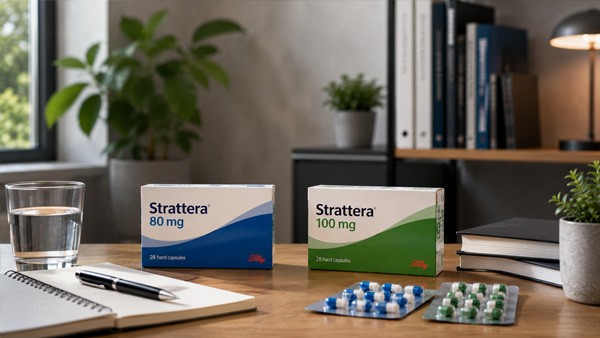
The decision to step up from 80 mg to 100 mg of Strattera (atomoxetine) is one of the most important dose-related decisions in adult ADHD treatment — and one of the most overlooked. Most adults reach 80 mg as their target dose per the standard titration protocol (40 mg starting → 80 mg target after 7 days) and remain there indefinitely as the appropriate maintenance dose. For approximately 70-80% of adults, 80 mg provides optimal balance of therapeutic effectiveness and side effect tolerability — it's the legitimate "sweet spot" for most patients. However, approximately 20-30% of adults experience suboptimal ADHD symptom control at 80 mg and may benefit from stepping up to 100 mg, the FDA-approved maximum adult dose. The clinical evidence on 80 mg vs 100 mg shows: 100 mg provides modest additional benefit on average but at the cost of increased side effects; certain patient profiles benefit more than others; cost differences may be meaningful with generic atomoxetine pricing in 2026; a structured 4-week trial protocol can determine individual patient response; and reverting to 80 mg if 100 mg doesn't justify the trade-offs is the correct decision.
This guide provides comprehensive information about the 80 mg vs 100 mg dose decision for adults on Strattera. We address why 80 mg is the optimal dose for most patients (effectiveness plateau, side effect profile), when 80 mg proves insufficient (specific clinical signs of suboptimal response), what the marginal benefit data actually shows for 100 mg (clinical trial evidence, real-world experience), how side effects increase at the higher dose (specific symptom intensification patterns), current 2026 cost differences between 80 mg and 100 mg with generic pricing, a structured 4-week 100 mg trial protocol with assessment milestones, how to revert to 80 mg if 100 mg doesn't work out, four patient profile archetypes that benefit differently from 100 mg, annual cost calculator framework, when NOT to increase to 100 mg even if symptoms persist, and the bottom-line decision framework for this dose escalation choice.
🎯 80 mg — Optimal for 70-80% of adults:
• Effectiveness: Therapeutic for most; FDA-approved target dose
• Side effects: Tolerable for most after initial adaptation
• Cost (2026 generic): ~$20-50/month typical
• Recommendation: Stay at 80 mg if ADHD symptoms reasonably controlled
📈 100 mg — Beneficial for 20-30% of adults:
• Effectiveness: Modest additional symptom control on average
• Side effects: 15-25% increase in side effect intensity
• Cost (2026 generic): ~$25-65/month typical
• Recommendation: Consider if 80 mg insufficient after 4-6 week trial
🚫 Above 100 mg — Not recommended:
• FDA maximum dose: 100 mg for adults
• No demonstrated additional benefit above 100 mg
• Significant side effect increase at higher doses
• If 100 mg insufficient: Consider alternative medications, not higher Strattera doses
💡 Decision framework:
Started 40 mg → titrated 80 mg → 4-6 weeks assessment → IF good control: stay 80 mg → IF inadequate control: trial 100 mg for 4 weeks → IF 100 mg works: maintain → IF 100 mg doesn't help: revert to 80 mg → IF still inadequate: alternative medications.
🎯 Why 80mg Is the Sweet Spot for Most
The clinical and pharmacological reasoning for 80 mg as the standard adult dose:
- FDA-approved target dose: Standard adult treatment target per labeling.
- Effectiveness plateau: Studies show diminishing returns above 80 mg for most patients.
- Optimal therapeutic index: Best balance of effectiveness vs side effects.
- Patient acceptability: Most patients tolerate this dose long-term.
- Cost-effective: Lower cost than 100 mg with comparable effectiveness for most.
Effectiveness profile at 80 mg:
- ADHD symptom reduction: Significant improvement in attention, impulsivity, executive function for most responders.
- Response rate: ~60-70% of patients show clinically meaningful response at 80 mg.
- Sustained benefit: Once therapeutic effect established (weeks 4-6), benefit maintained long-term.
- Functional improvement: Work, academic, relationship functioning improvements.
- Quality of life: Significant improvements documented.
Tolerability profile at 80 mg:
- Initial side effects resolved for most by week 2-4.
- Sustainable side effect burden: Most patients accept ongoing mild side effects for the benefit.
- Cardiovascular effects modest: 5-10 bpm HR increase; 1-3 mmHg BP increase.
- Sexual side effects: Common but usually manageable.
- GI tolerance: Generally good after adaptation.
Why most patients shouldn't escalate to 100 mg:
- Marginal additional benefit: Clinical trials show modest improvements at higher dose.
- Disproportionate side effect increase: 25% dose increase → 15-25% side effect increase.
- Cost-benefit unfavorable for most.
- Treatment satisfaction often equal at 80 mg as 100 mg.
- Long-term sustainability better at lower effective dose.
Body weight considerations:
- FDA labeling: Adult dose not weight-based (unlike pediatric dose at 1.2 mg/kg/day).
- Pharmacokinetic reality: Larger adults may need higher dose for equivalent plasma levels.
- Practical approach: Body weight one factor in 80 vs 100 mg decision.
- Patients >100 kg: More likely to benefit from 100 mg.
- Patients <60 kg: May find 80 mg fully sufficient or even excessive.
📉 When 80mg Isn't Enough
Specific clinical signs that 80 mg may be insufficient:
After 4-6 weeks at 80 mg:
- Persistent attention difficulties despite Strattera treatment.
- Continuing impulsivity issues affecting work or relationships.
- Executive function problems persisting: Planning, organization, task initiation.
- Time management struggles ongoing.
- Working memory deficits unchanged.
- Hyperactivity/restlessness persisting (less common adult presentation but possible).
Distinguishing inadequate response from non-response:
- Some improvement but insufficient: 80 mg working partially; 100 mg may close the gap.
- No improvement at all: Strattera may not be right medication; 100 mg unlikely to suddenly work.
- Initial good response then waning: Tolerance issue; dose increase may help.
- Variable response: Some days good, some days poor; dose increase or different approach.
Body weight as factor:
- Adults >100 kg: Pediatric weight-based dosing (1.2 mg/kg/day) would suggest 120+ mg; may benefit from 100 mg maximum.
- Adults 70-100 kg: 80 mg generally appropriate; weigh response.
- Adults <70 kg: 80 mg usually sufficient; 100 mg may be excessive.
Functional assessment:
- Work performance: Improved but still struggling vs significantly improved.
- Academic performance: Grades, productivity, concentration.
- Daily task completion: Household tasks, errands, scheduling.
- Relationship functioning: Communication, attentiveness, follow-through.
- Self-rating scales: ASRS (Adult ADHD Self-Report Scale), CAARS (Conners' Adult ADHD Rating Scale).
Other factors to rule out before increasing dose:
- Adherence issues: Patient actually taking Strattera daily?
- Timing optimization: Morning vs evening dose timing.
- Drug interactions: CYP2D6 inducers reducing levels (rare).
- Lifestyle factors: Sleep deprivation, alcohol, caffeine excess, cannabis use all undermining treatment.
- Comorbidities: Untreated anxiety, depression, sleep disorders affecting apparent ADHD response.
- Diagnostic accuracy: Is it really ADHD or another condition?
📊 100mg: Marginal Benefit Data
What clinical evidence shows about 100 mg vs 80 mg:
Clinical trial data:
- Original FDA approval studies: Established 100 mg as maximum effective adult dose.
- Dose-response curve: Significant improvement from 60 mg → 80 mg; modest improvement from 80 mg → 100 mg; no further improvement above 100 mg.
- Effect size at 100 mg vs 80 mg: Average ~10-15% additional symptom reduction in responders.
- Variable individual response: Some patients show no difference; others substantial difference.
- No clear predictors for who will benefit from dose increase.
Real-world clinical experience:
- ~25-30% of patients who try 100 mg after inadequate 80 mg response show meaningful improvement.
- ~70-75% stay at 80 mg long-term as most effective sustainable dose.
- Prescriber experience: 100 mg trial worthwhile when 80 mg shows partial response.
- Patient satisfaction: Often similar between 80 mg and 100 mg long-term users.
What 100 mg typically improves (when it helps):
- Additional attention enhancement for those with persistent attention difficulties.
- Better task initiation for those struggling with executive function start.
- Improved sustained focus for longer tasks.
- Reduced impulsivity for those with continuing impulsive behavior.
- More complete therapeutic response in some patients.
What 100 mg typically doesn't change:
- Onset of action: Still takes 4-6 weeks for full effect; dose increase doesn't accelerate.
- Fundamental mechanism: Same noradrenergic effect at higher concentration.
- Cardiovascular impact: Modest additional HR/BP increase but same nature.
- Sleep effects: Similar pattern, possibly slightly more pronounced.
Comparison to dose-response in other ADHD medications:
- Stimulants: Often clear dose-response with substantial difference between doses; easier to titrate.
- Strattera: Flatter dose-response curve above 80 mg; harder to detect additional benefit.
- Wellbutrin: Similar plateau at moderate-high doses for ADHD use.
- Intuniv/Kapvay: Different pattern; specific titration approaches.
Statistical significance vs clinical significance:
- Statistical significance: Clinical trials may show statistically significant 80 mg vs 100 mg difference.
- Clinical significance: Whether the patient or clinician notices the difference in daily life.
- Patient-reported outcomes: Real-world meaningfulness varies.
- Effect size considerations: Small but real effects may not justify side effect increase.
⚠️ Side Effect Increase at 100mg
Specific side effect pattern intensification at 100 mg:
Cardiovascular effects:
- Heart rate: Additional 3-5 bpm increase typical.
- BP: Additional 1-2 mmHg increase.
- Subjective awareness: Some patients notice palpitations at 100 mg they didn't at 80 mg.
- Long-term monitoring: Continued cardiovascular checks important.
Gastrointestinal effects:
- Nausea: May re-emerge briefly with dose increase; usually resolves.
- Dry mouth: Often more pronounced at 100 mg.
- Decreased appetite: Slightly more significant.
- Constipation: Possibly worsened.
- Heartburn or dyspepsia: Some increase.
Neurological/psychiatric effects:
- Fatigue: May increase, particularly initially with dose increase.
- Insomnia: Slightly more pronounced.
- Headache: May briefly return then resolve.
- Mood changes: Some patients notice; monitor per FDA Black Box for suicidal ideation.
- Anxiety: Some patients more anxious at higher dose.
- Cognitive fog: Rare but possible.
Sexual side effects:
- Erectile dysfunction: May worsen at higher dose.
- Decreased libido: Often more pronounced.
- Delayed orgasm: Possibly more significant.
- Vaginal dryness in women: May worsen.
Urinary effects:
- Urinary hesitation: May increase, particularly in men with BPH.
- Difficulty emptying bladder: Possibly worsened.
- UTI risk: If urinary retention significant.
Sweating and autonomic effects:
- Excessive sweating: Often more pronounced at 100 mg.
- Hot flashes: Some patients experience.
- Temperature regulation issues.
Side effect cost-benefit assessment:
- If 100 mg provides meaningful additional benefit: Often acceptable side effect trade-off.
- If 100 mg provides marginal benefit: Side effect cost may not justify.
- Patient preference matters: Some prioritize maximum symptom control; others prioritize tolerability.
- Quality of life metric: Overall well-being should improve with dose increase, not decline.
💵 Cost Difference (Generic Pricing 2026)
2026 generic atomoxetine pricing reality:
- Generic atomoxetine widely available since brand exclusivity expired.
- Significant price reduction from brand Strattera era.
- Cost still meaningful for some patients without insurance.
- Insurance coverage variable.
- Pharmacy discount programs can reduce out-of-pocket significantly.
Typical 2026 monthly costs (USD, generic):
- 40 mg daily (starting dose): ~$15-35/month with insurance; $25-50 without.
- 60 mg daily: ~$18-40/month with insurance; $30-55 without.
- 80 mg daily: ~$20-50/month with insurance; $35-65 without.
- 100 mg daily: ~$25-65/month with insurance; $40-80 without.
Annual cost differential 80 mg vs 100 mg:
- Insurance copay difference: Often $5-20/month, ~$60-240/year.
- Out-of-pocket difference: $5-15/month, ~$60-180/year.
- Some insurance plans: Same copay for all strengths.
- Generic vs brand: Brand Strattera still available at much higher cost (typically $300-500/month).
Strategies to minimize Strattera costs:
- Use generic atomoxetine rather than brand Strattera.
- GoodRx and similar discount programs often reduce price significantly.
- 90-day supply often costs less per pill than 30-day.
- Mail-order pharmacy can provide discount through insurance.
- Pharmacy comparison shopping — significant price variation between pharmacies.
- Manufacturer coupons for brand (rare with generic available).
- Patient assistance programs for uninsured patients.
Cost-effectiveness considerations:
- If 100 mg meaningfully improves functioning: Modest additional cost often worthwhile.
- If 100 mg doesn't add clear benefit: Cost difference (small but ongoing) supports staying at 80 mg.
- Long-term thinking: Years of treatment make small monthly differences meaningful annually.
- Compare to overall ADHD-related costs: Untreated ADHD has significant productivity, relationship, accident costs that effective treatment offsets.
🗓️ Trial of 100mg: 4-Week Protocol
Structured 4-week 100 mg trial protocol:
Pre-trial assessment (current 80 mg state):
- Document current ADHD symptom severity using validated scale (ASRS, CAARS).
- Document current side effect profile.
- Note specific symptoms hoping to improve.
- Baseline cardiovascular status: BP, heart rate.
- Functional assessment: Work, academic, daily functioning.
- Quality of life rating.
Week 1 — Initial transition:
- Day 1: Switch from 80 mg capsule to 100 mg capsule. Same daily timing.
- Expect: Brief side effect re-emergence days 1-5 — nausea, fatigue, possible headache.
- Continue: Take with food, hydrate well.
- Monitor: BP, heart rate weekly.
- Track symptoms in diary daily.
Week 2 — Adaptation phase:
- Side effects typically diminishing.
- Begin assessing subtle changes: Attention, focus, executive function.
- Note any clear changes vs 80 mg baseline.
- Continue daily diary.
- Cardiovascular check.
Week 3 — Therapeutic assessment:
- Side effects should be back to baseline or close.
- Therapeutic effect should be evident if going to help.
- Compare to specific pre-trial goals.
- Functional assessment update.
- Prescriber check-in.
Week 4 — Decision point:
- Final assessment of 100 mg trial.
- Use same scales as pre-trial for objective comparison.
- Side effect comparison: Tolerable or excessive?
- Functional improvement assessment.
- Decision: Continue 100 mg, revert to 80 mg, or other adjustment.
Decision criteria after 4-week trial:
- Clear additional benefit + tolerable side effects: Continue 100 mg as new maintenance dose.
- Marginal benefit but significant side effect increase: Revert to 80 mg.
- No benefit + similar side effects: Revert to 80 mg.
- No benefit + worse side effects: Definitely revert to 80 mg.
- Variable response (some improvement some worsening): Difficult call; individualized discussion.
Patient communication during trial:
- "This is a 4-week trial, not a permanent change."
- "We'll assess together at week 4 whether to continue."
- "Track symptoms daily — both improvements and side effects."
- "Reverting to 80 mg is a valid outcome, not a failure."
- "Goal: optimize your treatment, whatever dose that is."
↩️ Going Back to 80mg
De-escalation from 100 mg to 80 mg when 100 mg doesn't justify trade-offs:
Reasons to revert:
- No clear additional benefit after 4-week trial.
- Side effects too significant to justify any modest benefit.
- Cardiovascular concerns: Concerning BP or HR elevation.
- Cost concerns: Additional cost not worth marginal benefit.
- Quality of life decline: Side effects affecting daily life more than benefit improves it.
- Patient preference: Reasonable to prefer better tolerability.
How to revert:
- Simply switch back: Day 1 take 80 mg capsule instead of 100 mg.
- No taper needed for dose reduction (taper needed for full discontinuation).
- Same timing and food considerations.
- Side effects should improve within 1-2 weeks.
- Therapeutic effect returns to 80 mg baseline.
What to expect after reversion:
- Side effects diminish: 1-2 weeks for full improvement.
- Therapeutic effect: Returns to previous 80 mg level — what you had before trying 100 mg.
- No discontinuation withdrawal: Different from stopping Strattera entirely.
- Validation of decision: Some patients realize 80 mg was actually working better all along.
When 80 mg revert leaves you back at "inadequate":
- If 100 mg didn't help and 80 mg is still insufficient: Strattera may not be optimal medication for you.
- Consider alternative medications: Stimulants, Wellbutrin, Intuniv, Qelbree.
- Consider combination approaches: Strattera + stimulant sometimes synergistic.
- Address comorbidities: Sometimes apparent ADHD inadequacy reflects untreated anxiety/depression.
- Specialist consultation: Adult ADHD specialist for complex cases.
Documentation for prescriber:
- Trial outcome: What 100 mg added (or didn't).
- Side effects observed.
- Patient preference.
- Future plans: Alternative considerations if 80 mg insufficient.
- Insurance documentation: If switching medications, prior trial documented.
👤 Patient Profile Analysis
Four patient archetype framework for 80 mg vs 100 mg decision:
Profile A — "Standard Responder" (~60% of patients). 80 mg provides clear therapeutic effect with acceptable side effects. Good functional improvement, satisfied with treatment, side effects manageable. Recommendation: maintain 80 mg long-term. No need to trial 100 mg unless circumstances change. This profile represents most Strattera adult patients.
Profile B — "Partial Responder" (~20% of patients). 80 mg provides some improvement but not optimal control. Functional gains incomplete, some ADHD symptoms persistent, side effects tolerable. Recommendation: 4-week 100 mg trial reasonable. Significant chance of meaningful additional benefit. Most likely group to benefit from dose escalation.
Profile C — "Non-Responder" (~15% of patients). 80 mg provides no clear benefit after adequate trial (4-6 weeks). Symptoms unchanged or barely changed, side effects present without offsetting benefit. Recommendation: 100 mg unlikely to suddenly produce response if 80 mg gave nothing. Consider alternative medications rather than dose escalation. Wasting time on 100 mg trial when fundamental issue is medication mismatch.
Profile D — "Side Effect Limited" (~5% of patients). 80 mg provides some benefit but side effects significant. Functional improvement but side effect burden problematic. Recommendation: do NOT increase to 100 mg — will worsen side effects. Consider reducing to 60 mg if effective, or alternative medications. Sometimes lower dose with better tolerability provides better overall functioning than higher dose.
| Patient profile | 80 mg outcome | 100 mg recommendation | Expected benefit |
|---|---|---|---|
| A. Standard responder (60%) | Good response, tolerable side effects | Maintain 80 mg | No need to escalate |
| B. Partial responder (20%) | Partial response, room for improvement | 4-week 100 mg trial reasonable | 25-30% chance of meaningful benefit |
| C. Non-responder (15%) | No clear benefit after adequate trial | Skip 100 mg; explore alternatives | 100 mg unlikely to suddenly work |
| D. Side effect limited (5%) | Some benefit, problematic side effects | Do NOT increase; consider reduction | Higher dose worsens side effect burden |
💰 Annual Cost Calculator
Annual cost framework for 80 mg vs 100 mg decision:
With insurance (typical copay structure):
- 80 mg annual cost: ~$240-600 typical (copay $20-50/month).
- 100 mg annual cost: ~$300-780 typical (copay $25-65/month).
- Annual difference: ~$60-180.
Without insurance (generic, pharmacy varies):
- 80 mg annual cost: ~$420-780 ($35-65/month).
- 100 mg annual cost: ~$480-960 ($40-80/month).
- Annual difference: ~$60-180.
With GoodRx or similar discount:
- 80 mg annual cost: ~$240-420 ($20-35/month).
- 100 mg annual cost: ~$300-480 ($25-40/month).
- Annual difference: ~$60-180.
Brand Strattera (rare in 2026):
- 80 mg annual cost: $3,600-5,000+ without insurance.
- 100 mg annual cost: $3,800-6,000+ without insurance.
- Annual difference: $200-400.
- Recommendation: Use generic whenever possible.
Cost-effectiveness calculations:
- If 100 mg meaningfully improves functioning: $60-180/year additional cost easily justified (small fraction of typical adult income; significant productivity benefit).
- If 100 mg provides marginal benefit: Cost-benefit shifts; revert to 80 mg.
- If 100 mg provides no benefit: Additional cost unjustified.
Strategies to minimize Strattera costs:
- Generic atomoxetine (not brand Strattera).
- 90-day supply for cost per pill reduction.
- GoodRx, RxSaver, similar discount programs.
- Pharmacy comparison shopping.
- Mail-order pharmacy through insurance.
- Patient assistance programs for uninsured.
- Generic-only prescription indicated to pharmacy.
- Annual prescription review for cost optimization opportunities.
🚫 When NOT to Increase to 100mg
Situations where 100 mg should be avoided despite symptom persistence:
Medical contraindications:
- Cardiovascular concerns: BP elevation at 80 mg, arrhythmias, significant cardiac history.
- Recent cardiovascular events: MI, stroke, severe angina.
- Severe hypertension not controlled.
- Significant liver impairment.
- Pregnancy: Lowest effective dose preferred.
- Older adults with frailty.
Side effect-related reasons:
- Significant side effects at 80 mg already: Higher dose will worsen.
- Pattern of severe side effects: Patient has demonstrated low tolerance threshold.
- Patient quality of life compromised by 80 mg side effects.
- Sexual side effects significantly impacting relationship.
- Sleep disruption significant.
Treatment response patterns:
- No response at all at 80 mg after 6+ weeks: Strattera likely not right medication; not dose issue.
- Initial response then loss of response: Different problem (tolerance, adherence, lifestyle factor).
- Variable response patterns: Often reflect other factors, not dose.
Drug interaction considerations:
- Concurrent CYP2D6 inhibitors: Strong inhibitors (fluoxetine, paroxetine, bupropion) already producing elevated atomoxetine levels — 80 mg with inhibitor may equal 100 mg without.
- CBD products: Similar consideration; may already be at "100 mg equivalent."
- Quinidine: Strong CYP2D6 inhibitor.
Pharmacogenomic considerations:
- CYP2D6 poor metabolizers: Already have elevated atomoxetine levels at standard dose; 100 mg unnecessary and risky.
- Known intermediate metabolizer: Often optimal at 80 mg or even lower.
- Genetic testing helpful when dose escalation considered.
Lifestyle and contextual factors:
- Poor adherence: Solve adherence first before considering dose change.
- Untreated comorbidities: Sleep apnea, depression, anxiety often appearing as inadequate ADHD response.
- Lifestyle factors: Heavy alcohol, cannabis use, sleep deprivation undermining treatment.
- Recent life stressors: Increased symptoms may reflect stress not medication inadequacy.
Better alternatives when 80 mg insufficient and 100 mg not appropriate:
- Combination therapy: Strattera + stimulant for synergistic effect.
- Switch to stimulant: Different mechanism; may work better.
- Add Intuniv: Different non-stimulant mechanism.
- Wellbutrin: Off-label ADHD treatment.
- Qelbree (viloxazine): Newer non-stimulant similar to Strattera.
- Behavioral interventions: CBT for ADHD, coaching.
- Address comorbidities first.
✨ Bottom Line
The 80 mg vs 100 mg Strattera dose decision is among the most important and overlooked decisions in adult ADHD treatment. The Verdict Card establishes the framework: 80 mg is optimal for 70-80% of adults (effectiveness, tolerability, cost-effectiveness); 100 mg benefits 20-30% who have inadequate response at 80 mg; above 100 mg is not recommended (no demonstrated benefit, significant side effect increase). Decision framework: starting 40 mg → titrated 80 mg → 4-6 weeks assessment → if good control stay 80 mg → if inadequate control trial 100 mg for 4 weeks → if 100 mg works maintain → if 100 mg doesn't help revert to 80 mg → if still inadequate consider alternative medications.
Why 80 mg is the sweet spot for most: FDA-approved target, effectiveness plateau (diminishing returns above), optimal therapeutic index, patient acceptability, cost-effective. ~60-70% response rate at 80 mg, sustained benefit long-term, modest cardiovascular effects, manageable side effect profile after adaptation.
When 80 mg isn't enough: persistent attention difficulties, continuing impulsivity, executive function problems, time management struggles, working memory deficits — all after adequate 4-6 week trial. Distinguish inadequate response (some improvement but insufficient) from non-response (no improvement). Rule out adherence, timing, drug interactions, lifestyle factors, comorbidities, diagnostic accuracy before increasing dose.
The Data Point — only ~25-30% of patients who escalate to 100 mg after inadequate 80 mg response show meaningful additional benefit. Most patients who increase won't gain meaningful improvement. 4-week trial protocol essential; if 100 mg doesn't demonstrate clear benefit by week 4, revert to 80 mg.
Side effect increases at 100 mg: cardiovascular (additional 3-5 bpm, 1-2 mmHg), gastrointestinal (nausea may re-emerge, dry mouth, decreased appetite intensify), neurological/psychiatric (fatigue, insomnia, headache, mood, anxiety), sexual (ED, libido, orgasm changes), urinary (hesitation, retention), autonomic (sweating, temperature regulation). Side effect cost-benefit assessment essential.
2026 generic atomoxetine pricing: 80 mg ~$20-50/month with insurance ($35-65 without); 100 mg ~$25-65/month with insurance ($40-80 without); annual differential $60-180. Brand Strattera much higher cost ($3,600-6,000/year) — use generic. Strategies: GoodRx, 90-day supply, pharmacy comparison, mail-order, patient assistance programs.
4-week 100 mg trial protocol: pre-trial baseline documentation (validated scale, side effects, functional assessment, BP/HR), week 1 transition (brief side effect re-emergence expected), week 2 adaptation phase, week 3 therapeutic assessment, week 4 decision point. Decision criteria: clear additional benefit + tolerable side effects → continue 100 mg; marginal benefit + significant side effects → revert; no benefit → revert.
Going back to 80 mg: simply switch capsule day 1, no taper needed for dose reduction, side effects improve 1-2 weeks, therapeutic effect returns to baseline. Reverting is valid outcome, not failure. If 80 mg still inadequate after revert, consider alternatives (stimulants, Wellbutrin, Intuniv, Qelbree, combinations).
Four patient profile framework: Profile A Standard Responder (60% — maintain 80 mg), Profile B Partial Responder (20% — 100 mg trial reasonable, best candidates for benefit), Profile C Non-Responder (15% — skip 100 mg, explore alternatives), Profile D Side Effect Limited (5% — do NOT increase, consider reduction or alternatives).
Annual cost calculator framework: with insurance $60-180 differential; without insurance $60-180 differential; brand much higher. Cost-effectiveness: meaningful benefit justifies modest cost; marginal benefit doesn't.
When NOT to increase to 100 mg: medical contraindications (cardiovascular, recent events, severe hypertension, liver impairment, pregnancy, older frail adults); significant side effects at 80 mg; no response at all at 80 mg (not dose issue); CYP2D6 inhibitor co-medications; CYP2D6 poor metabolizers; untreated comorbidities; lifestyle factors. Better alternatives: combination therapy, switch medications, address comorbidities first.
The fundamental principle: dose escalation without improvement = side effect cost without therapeutic benefit. The 4-week structured trial with clear decision criteria optimizes individual patient outcomes. Reverting to 80 mg is a legitimate and common outcome.
For broader Strattera dosing and treatment context, see Strattera Starting Dose for Adults (the protocol preceding this decision), Strattera and Alcohol, Strattera and Caffeine, Strattera and SSRI/SNRI (CYP2D6 inhibitor context — affects dose decisions), Strattera and MAOIs, Strattera and Birth Control, Strattera and Marijuana, Strattera and Antihistamines, Strattera and Albuterol, Cardiovascular Effects, Liver Health, FDA Black Box SI, Sleep Effects, Long-Term Side Effects, Weight Loss, Sexual Side Effects, and Withdrawal.
For Strattera comparison cluster (when considering alternatives after Strattera dose optimization fails): vs Adderall, vs Vyvanse, vs Concerta, vs Ritalin, vs Modafinil, vs Wellbutrin, vs Intuniv, vs Qelbree.
For modafinil as off-label ADHD alternative if Strattera dose optimization unsuccessful, Modalert 200 mg from Sun Pharma provides Schedule IV option.
❓ Frequently Asked Questions
Should I increase from 80mg to 100mg of Strattera?
Depends on your response at 80 mg. If 80 mg gives good ADHD control with acceptable side effects (Profile A — 60% of patients), maintain 80 mg. If 80 mg gives partial response with room for improvement (Profile B — 20%), 4-week 100 mg trial reasonable. If 80 mg gives no response after adequate trial (Profile C — 15%), 100 mg unlikely to suddenly work; explore alternatives. If 80 mg gives significant side effects (Profile D — 5%), don't increase; consider reduction or alternatives.
How much better is 100mg vs 80mg of Strattera?
Modest additional benefit on average. Clinical trial data shows ~10-15% additional symptom reduction in responders. Only ~25-30% of patients who escalate to 100 mg after inadequate 80 mg response show meaningful additional benefit. Most patients who increase won't gain substantial improvement. Effect varies significantly by individual — some patients have clear benefit, others have none.
What side effects increase at 100mg vs 80mg?
Cardiovascular: additional 3-5 bpm heart rate, 1-2 mmHg BP. GI: nausea may re-emerge briefly, dry mouth, decreased appetite intensify, more constipation. Neurological: fatigue, insomnia, headache, possibly anxiety. Sexual: ED, libido, orgasm changes worsen for some. Urinary: hesitation, retention. Autonomic: sweating, temperature regulation. Side effect cost-benefit assessment essential.
How long should I trial 100mg before deciding?
4 weeks for structured trial. Pre-trial document baseline (validated ADHD scale, side effects, functional assessment, BP/HR). Week 1: brief side effect re-emergence expected. Week 2: adaptation. Week 3: therapeutic assessment. Week 4: decision point with same scales for objective comparison. If unclear benefit by week 4, 100 mg unlikely to suddenly help with longer trial.
How much more does 100mg cost than 80mg?
Modest difference with 2026 generic atomoxetine pricing. With insurance: ~$5-15/month difference, $60-180/year. Without insurance: ~$5-15/month, $60-180/year. With GoodRx discount: similar range. Brand Strattera much higher (use generic). If 100 mg meaningfully improves functioning, modest additional cost easily justified. If marginal benefit, cost-benefit shifts toward 80 mg.
What if 100mg doesn't help?
Revert to 80 mg. Simply switch capsule day 1, no taper needed for dose reduction. Side effects improve 1-2 weeks. Therapeutic effect returns to 80 mg baseline. Reverting is valid outcome, not failure. If 80 mg still insufficient, consider alternatives: combination therapy (Strattera + stimulant), switch to stimulant, add Intuniv, Wellbutrin, Qelbree, or address comorbidities first.
Can I go higher than 100mg of Strattera?
Not recommended. 100 mg is FDA-approved maximum for adults. No demonstrated additional benefit above 100 mg. Significant side effect increase at higher doses. If 100 mg insufficient after adequate trial, consider Strattera ineffective for your ADHD and explore alternative medications rather than escalating beyond FDA-approved maximum.
How will I know if 100mg is actually working better?
Use validated ADHD self-report scales (ASRS, CAARS) at baseline (80 mg) and end of 4-week 100 mg trial. Objective comparison removes subjective bias. Track functional improvements: work performance, task completion, attention duration, impulsivity. Note specific symptoms hoping to improve before trial. Daily symptom diary during trial. Significant change should be clear, not just "maybe a little better."
Should I increase Strattera dose if I'm bigger/heavier?
Body weight is one factor among several. FDA adult dosing not weight-based (unlike pediatric 1.2 mg/kg/day). Adults >100 kg may need 100 mg more often. Adults 70-100 kg usually 80 mg appropriate. Adults <70 kg often 80 mg sufficient or even excessive. However, response varies — body weight doesn't dictate dose alone. Try 80 mg first, assess response, consider 100 mg if inadequate response and weight supports.
What if I'm on fluoxetine (Prozac) and considering 100mg Strattera?
Generally don't increase. Fluoxetine is strong CYP2D6 inhibitor — already produces elevated atomoxetine levels at standard dose. Your 80 mg with fluoxetine may equal 100 mg without fluoxetine in plasma effect. Increasing to 100 mg with fluoxetine produces potentially excessive levels. Discuss with prescriber. Same consideration for paroxetine (Paxil), bupropion (Wellbutrin), quinidine, high-dose CBD.
📚 References & Further Reading
- FDA prescribing information for Strattera (atomoxetine) — adult dose escalation.
- Atomoxetine adult clinical trials — dose-response data.
- American Academy of Family Physicians — adult ADHD treatment guidelines.
- American Psychiatric Association — adult ADHD management.
- Clinical Pharmacogenetics Implementation Consortium — CYP2D6 atomoxetine dosing guidance.
- Generic Pharmaceutical Association — generic atomoxetine pricing data.
- GoodRx prescription price comparison — atomoxetine 80 mg vs 100 mg pricing.
- Strattera dosing protocol: Starting Dose for Adults (the protocol preceding 80 vs 100 mg decision)
- Strattera lifestyle/interaction cluster: Alcohol, Caffeine, SSRI/SNRI, MAOIs, Birth Control, Marijuana, Antihistamines, Albuterol
- Strattera safety cluster: Long-Term, Cardiovascular, Liver Health, FDA Black Box SI, Sleep, Weight Loss, Sexual Side Effects, Withdrawal
- Strattera comparison cluster: vs Adderall, vs Vyvanse, vs Concerta, vs Ritalin, vs Modafinil, vs Wellbutrin, vs Intuniv, vs Qelbree
- Modalert 200 mg, Modvigil 200 mg, Waklert 150 mg — primary product pages.
- RXshop Editorial Team — content reviewed by licensed pharmacist; for adult patient education, not a substitute for individual medical consultation.
Medical Disclaimer: The information in this article is for educational and informational purposes only and is not a substitute for professional medical advice, diagnosis, or treatment. Always seek guidance from a qualified healthcare provider with any questions you may have regarding a medical condition, and before starting, stopping or changing any medication.