Modafinil for Shift Workers: FDA-Approved Use


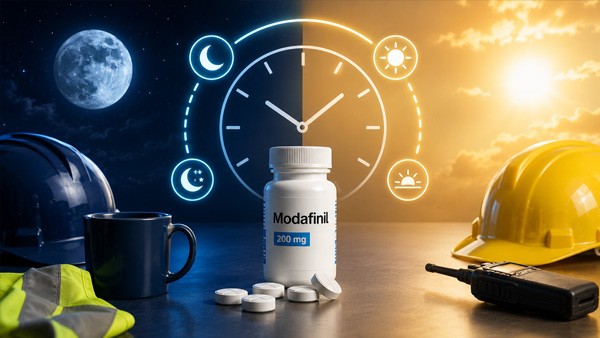
Shift work is the one off-label modafinil use case that isn't off-label. Shift Work Sleep Disorder (SWSD) is an FDA-approved indication for modafinil — alongside narcolepsy and obstructive sleep apnea, it is one of three conditions for which the drug has formal FDA approval based on randomized controlled trials. The approval reflects the clinical reality: shift workers face genuine physiological challenges that no amount of "good sleep hygiene" can fully overcome, and pharmacological wake-promotion has measurable benefit for safety, performance, and quality of life during night and rotating shifts. Approximately 15-30% of workforce in developed countries works some form of non-traditional shift schedule, and a meaningful subset of those workers — particularly in healthcare, aviation, public safety, transportation, and 24-hour manufacturing — experience SWSD severity that warrants medical intervention.
This guide is written for shift workers considering modafinil and for healthcare providers prescribing it for SWSD. It treats the topic with the regulatory clarity it deserves: this is a medically legitimate use with FDA-approved protocol, distinct from the more ambiguous off-label cognitive enhancement contexts covered in companion student and programmer articles. We cover the clinical definition of Shift Work Sleep Disorder and how it differs from ordinary sleepiness, the exact FDA-approved dosing protocol that emerged from Cephalon's pivotal trials, the industries where shift work modafinil use is most concentrated and the role-specific considerations, the critical recovery-sleep protection strategies that determine long-term health outcomes for shift workers, the long-term health considerations that affect shift workers regardless of modafinil use, the four major shift pattern classifications that map specific shift configurations to appropriate modafinil approaches, the recovery sleep protection checklist that operationalizes daytime sleep environment optimization, and industry-specific protocols that adapt the general framework to healthcare, aviation, law enforcement, transportation, and manufacturing contexts.
| Time relative to shift | Action |
|---|---|
| T-8 hours (pre-shift sleep) | Sleep block 6-8 hours before shift start in darkened bedroom; avoid alarm interruptions |
| T-2 hours (pre-shift wake) | Wake up, shower, light meal with caffeine if desired; bright light exposure to signal "morning" |
| T-1 hour (pre-shift) | Take modafinil 200 mg with food. Travel to work. Hydrate. |
| T-0 (shift start) | Modafinil onset beginning; bright workplace lighting maintains alertness |
| T+2-4 hours (early shift) | Modafinil peak; this is your strongest alertness window — prioritize complex tasks here |
| T+4-8 hours (mid shift) | Modafinil plateau; regular hydration and snacks; brief activity breaks help |
| T+8-12 hours (late shift) | Drug still active; lower light exposure if shift ends approaching morning to start sleep transition |
| End of shift (T+8 or T+12) | Wear sunglasses for commute home; eat light meal; avoid screens; prepare bedroom |
| T+1 hour post-shift | Begin recovery sleep in darkened bedroom; aim for 6-8 hours uninterrupted |
| T+9-10 hours post-shift | Wake up; remainder of day for personal activities; meal at "normal" time |
| T+12-16 hours post-shift | Continue normal activity until next pre-shift sleep window |
The protocol's key principles: take modafinil 1 hour before shift start (not at shift start — onset takes 30-60 minutes), protect the post-shift recovery sleep absolutely (this is non-negotiable for sustainable shift work), use light/dark exposure as adjunct circadian signaling, and maintain consistent timing across shift days.
🌙 What Is Shift Work Sleep Disorder
Shift Work Sleep Disorder is a clinically defined circadian rhythm sleep-wake disorder recognized by the American Academy of Sleep Medicine in the International Classification of Sleep Disorders. It is not the same as "feeling tired at work" — SWSD has specific diagnostic criteria that distinguish it from ordinary shift work fatigue:
- Insomnia and/or excessive sleepiness for at least 3 months in association with a recurring work schedule that overlaps with the usual sleep time.
- The sleep disturbance and excessive sleepiness are temporally associated with the work schedule.
- The symptoms persist throughout the shift cycle and not just on rare difficult days.
- The condition is not better explained by another sleep disorder, medical condition, mental disorder, or medication/substance use.
- The symptoms cause clinically significant distress or impairment in social, occupational, or other important areas of functioning.
Approximately 10-30% of shift workers meet formal diagnostic criteria for SWSD. The risk varies by shift pattern — fixed night shifts produce higher SWSD rates than fixed evening shifts; rotating shifts produce higher rates than fixed shifts of any type; faster rotation (every 2-3 days) is worse than slower rotation (weekly or monthly). Individual susceptibility also varies — some workers adapt to shift work over years without significant SWSD, while others develop severe SWSD within weeks of starting shift work despite identical schedule demands.
The underlying biology is straightforward: human circadian rhythm is fundamentally anchored to the solar day through retinal light exposure. Shift work creates a conflict between the work schedule (when you need to be alert) and the circadian system (which is signaling "should be asleep now" based on light/dark cues). This conflict produces:
- Excessive sleepiness during work hours when the circadian system is signaling sleep.
- Difficulty falling asleep during daytime sleep windows when the circadian system is signaling wakefulness.
- Fragmented and shortened sleep during recovery periods (daytime sleep tends to be 1-3 hours shorter than equivalent nighttime sleep).
- Cumulative sleep debt that compounds across shift cycles.
- Downstream effects: increased cardiovascular risk, metabolic dysfunction, mood disturbance, accident risk during commute and work, and accelerated aging markers over years to decades of shift work.
Modafinil addresses the alertness side of this equation pharmacologically — it cannot fix the underlying circadian disruption, but it can substantially reduce the sleepiness symptom during the work shift. SWSD treatment ideally combines modafinil with sleep hygiene optimization, light/dark exposure management, and (where possible) shift schedule changes that reduce circadian conflict.
💊 FDA-Approved Modafinil Protocol
The FDA approval for SWSD specifies modafinil 200 mg taken approximately 1 hour before the start of the work shift. This protocol emerged from Cephalon's pivotal Phase III trials (Czeisler et al., 2005 in the New England Journal of Medicine being the most-cited), which demonstrated meaningful improvement in objective alertness measures (Maintenance of Wakefulness Test) and subjective sleepiness scales (Epworth Sleepiness Scale, Karolinska Sleepiness Scale) compared to placebo in SWSD patients.
FDA-approved protocol details:
- Standard dose: 200 mg per work shift (one tablet).
- Timing: Approximately 1 hour before shift start. Not at shift start; not "morning" in clock terms; specifically 1 hour before YOUR shift starts regardless of clock time.
- Frequency: Taken only on shift work days — not on days off. The chronic exposure across multiple shifts is what was studied; daily continuous use is not part of the SWSD indication.
- Maximum benefit: Onset within 30-60 minutes; peak alertness benefit 2-4 hours post-dose; effect spans 8-12 hour shift cleanly.
- What the FDA approval covers: Improvement in wakefulness, reduction in excessive sleepiness, improvement in objective alertness measures. The approval does NOT specifically claim improvement in shift-work-related cardiovascular outcomes, metabolic outcomes, or long-term health markers — modafinil addresses the alertness symptom, not the underlying circadian disruption.
- What the FDA approval does NOT cover: Recommendation to extend modafinil use to days off. Recommendation for higher doses. Recommendation for use in shift workers without diagnosed SWSD.
Dose adjustments and variations from the standard protocol:
- 100 mg starting dose: For sensitive patients, elderly shift workers, or those new to modafinil, starting at 100 mg (half tablet) for the first 1-2 weeks is reasonable. Escalate to 200 mg if alertness improvement is inadequate.
- 200 mg standard dose: Works for majority of SWSD patients. Most physicians stay at this dose long-term.
- 300-400 mg: Higher doses have been studied but do not consistently produce better alertness outcomes — diminishing returns kick in above 200 mg. Side effect increase is real. Generally not recommended.
- Split-dose strategies: 100 mg at start + 100 mg at mid-shift has been tried by some practitioners for very long shifts (16+ hours). Not standard FDA protocol; should be physician-directed if used.
- Armodafinil alternative: Nuvigil/Waklert (armodafinil 150 mg) is the R-enantiomer alternative also FDA-approved for SWSD. Smoother plasma curve and slightly longer duration may better fit longer shifts. See Modafinil vs Armodafinil.
- Caffeine alongside: Acceptable and often used. Most SWSD patients combine modafinil with strategic coffee — typically a cup near the dosing time and maybe one mid-shift for brief alertness boosts. Avoid heavy caffeine late in shift that disrupts recovery sleep.
🏥 Industries with Most Use
Shift work modafinil use is concentrated in industries where safety-critical work happens overnight or in rotating schedules. The major industries and their specific patterns:
- Healthcare (nursing, emergency medicine, ICU): The largest single category of shift work modafinil use. Hospital nursing routinely involves 12-hour shifts including overnight coverage; emergency medicine physicians often work rotating shifts; intensive care requires continuous coverage. Safety-critical decision-making during overnight hours plus the prevalence of SWSD diagnosis make this a major use population. Many hospital occupational health systems now formally support modafinil prescription for shift workers with documented SWSD.
- Aviation (pilots, air traffic control, cabin crew): Long-haul flight crews, overnight cargo operations, and air traffic controllers managing global aviation all face severe circadian disruption. The military aviation context produced some of the early modafinil research (Caldwell et al. studies on sustained operations). Commercial aviation modafinil use is heavily regulated — varies by airline, country aviation authority, and specific role.
- Law enforcement (police, federal agents): Patrol officers working rotating shifts including overnight, detectives working long investigations, federal agents on extended operations. The fitness-for-duty implications matter; many departments have informal or formal positions on modafinil use.
- Transportation (long-haul truckers, train operators): Federal regulations vary by country. US DOT regulations include hours-of-service rules but generally don't prohibit prescribed modafinil use for SWSD. Practical use is common among long-haul truckers despite legal grey areas in some contexts.
- Manufacturing and industrial (24-hour operations): Factories with continuous production schedules, refineries, power plants, mines. Safety stakes vary by industry but include life-critical scenarios. Modafinil use depends heavily on specific company policy and union agreements.
- Public safety (firefighters, paramedics): Long shift structures (24-hour shifts common) combined with unpredictable workload create severe fatigue patterns. Modafinil use is common but heavily contextualized by specific service medical policies.
- Maritime (deck officers, engineering crews): Ships operate continuously; bridge watches rotate. Modafinil use depends on flag state regulations and company policy.
- Military (operational deployments): US, UK, and several other militaries have studied and approved modafinil for sustained operations contexts. Specific use is heavily regulated within military medical systems.
- Energy (oil and gas extraction, offshore workers): Rotating schedules of 2 weeks on / 2 weeks off with continuous duty during on-rotations. SWSD prevalence high in this population.
- Tech operations (24/7 SRE, on-call engineers): Growing category — site reliability engineers and on-call rotation coverage for production systems. Most tech companies don't have formal modafinil policies; usage is private.
🛏️ Protecting Recovery Sleep
The single most important determinant of shift worker long-term health is recovery sleep quality. Modafinil addresses the alertness side of the equation during the shift, but it does nothing to make daytime sleep easier or more restorative. Recovery sleep protection is the harder half of shift worker health management:
The fundamental challenge: daytime sleep is intrinsically lower-quality than nighttime sleep because the circadian system is signaling wakefulness, ambient light penetrates even closed eyes, noise is higher, body temperature is higher, and social/environmental interruption is more likely. Without active protection, shift workers chronically get 1-3 hours less effective sleep than equivalent night-sleepers — and this deficit compounds over years.
The recovery sleep protection checklist below operationalizes daytime sleep environment optimization. Each element matters; the cumulative effect of implementing all of them is substantial:
- Blackout curtains or blinds (essential). Daytime light directly suppresses melatonin and disrupts sleep architecture even through closed eyelids. Blackout curtains achieving <1% light transmission are non-negotiable. Layer thick curtains over blackout liners for maximum effect; budget options include blackout window films or cardboard during transition until permanent installation.
- Eye mask backup. Even with blackout curtains, ambient light from door frames, electronics, etc., can interfere. Quality eye mask provides redundant protection. Test for comfort — uncomfortable mask is worse than no mask.
- White noise generator or earplugs (essential). Daytime environment is loud — traffic, neighbors, deliveries, family activity, household sounds. White noise machine masks ambient sound; quality foam or silicone earplugs as backup. Some shift workers use both.
- Cool bedroom temperature (16-19°C / 60-67°F). Body temperature naturally rises during day; cooling the room helps trigger sleep onset. Air conditioning, fan, or thermostat adjustment. Cooler is better for sleep than warmer.
- Phone on Do Not Disturb with selective overrides. Configure phone to silence all calls and texts during sleep window except for family emergencies. Don't trust yourself to ignore notifications — they degrade sleep even when you don't fully wake up.
- Family/household awareness and cooperation. Family members need to understand that your sleep window is non-negotiable. Children play quietly or outside; partner doesn't vacuum or do laundry during your sleep. This is often the hardest element to implement.
- Consistent sleep window timing. Even with shift changes, try to anchor your sleep window to consistent clock time as much as possible. Sleeping 09:00-17:00 every shift day is healthier than rotating sleep window across shifts.
- Pre-sleep wind-down routine. Same 30-60 minute wind-down routine before daytime sleep as you would for nighttime sleep. Showers, reading, calming activity. Avoid screens for 30 minutes before sleep.
- Avoid caffeine in late shift. Heavy caffeine in the last 4-6 hours of your shift will compound modafinil's residual effect and degrade recovery sleep quality. Front-load caffeine to early/mid shift.
- Eat the right meal before recovery sleep. Light protein-containing meal rather than heavy carb-only meal. Avoid alcohol "to help sleep" — degrades sleep architecture.
- No screens in bedroom during sleep window. Even when you wake briefly, screen exposure disrupts return to sleep. TV in bedroom is particularly counterproductive.
- Bedroom is for sleep only during your sleep window. Don't work, eat, or do other activities in bedroom that train your brain to associate the space with wakefulness.
- Pre-emptive bathroom visit. Empty bladder right before sleep; reduces probability of mid-sleep awakening.
- Sunglasses on commute home. Morning light exposure on your way home from night shift signals "wake up" to your circadian system at exactly the wrong moment. Dark sunglasses reduce this effect.
- Bright light therapy on waking. 30 minutes of bright light exposure (10,000 lux therapy lamp or natural bright light) when you wake from recovery sleep signals "morning" to your circadian system and supports the next pre-shift wake.
💪 Long-Term Shift Worker Health
Shift work itself — independent of modafinil use — has well-documented long-term health consequences that affect shift workers regardless of cognitive enhancement strategy:
- Cardiovascular disease risk: Long-term shift work is associated with 20-30% elevated risk of cardiovascular events, possibly through chronic sleep deprivation, metabolic dysfunction, and elevated cortisol. Annual cardiovascular screening matters more for shift workers.
- Metabolic syndrome risk: Shift work elevates risk of type 2 diabetes, metabolic syndrome, and weight gain. Mechanism involves circadian disruption of glucose metabolism and disrupted eating patterns.
- Cancer risk (specific cancers): WHO IARC classifies night shift work as "probably carcinogenic to humans" (Group 2A) based on evidence linking long-term night shift work to breast cancer in women and prostate cancer in men. Mechanism not fully understood but probably involves melatonin disruption and circadian dysfunction.
- Mood disorder risk: Depression and anxiety rates are elevated in shift workers compared to day workers. Bidirectional relationship — depression worsens shift work tolerance and shift work worsens depression.
- Gastrointestinal issues: Shift workers have higher rates of peptic ulcer disease, IBS, and other GI conditions. Probably related to disrupted meal timing and stress.
- Reproductive impacts (women): Long-term night shift work is associated with menstrual irregularities, pregnancy complications, and possibly fertility effects.
- Reduced life expectancy: Some long-term cohort studies suggest 1-3 year reduced life expectancy for career-long shift workers compared to day workers, though the magnitude varies by study and population.
How modafinil fits into long-term shift worker health:
- Modafinil addresses alertness, not underlying circadian disruption. The drug makes shift work easier to perform but doesn't fix the upstream biology that creates long-term health risk. Modafinil use should not be a substitute for thinking about whether to continue shift work long-term.
- Better alertness reduces accident risk. One direct health benefit of modafinil for shift workers is reduced commute crashes, workplace accidents, and clinical errors — all of which have real health consequences.
- Better alertness supports recovery sleep timing. Workers who can stay alert through shift end without using residual energy reserves often have easier post-shift sleep initiation than exhausted workers.
- Modafinil itself has acceptable long-term safety profile. Standard modafinil use over years to decades is well-tolerated in most users. See Modafinil Long-Term Side Effects for comprehensive long-term safety data.
- Career-long shift work + career-long modafinil use is poorly studied. The combination of decades of shift work plus decades of modafinil use has not been specifically researched. Conservative practice: try to limit total shift work years where possible; consider rotation to day shifts later in career.
- Annual health screening matters more. Shift workers benefit from comprehensive annual physicals including cardiovascular assessment, metabolic panel, mental health check-in. Modafinil users add bloodwork monitoring (see Long-Term article for protocol).
📋 Shift Pattern Classification
Different shift work configurations require different modafinil approaches. The four-pattern classification:
Pattern 1 — "Fixed Night Shifts." Working overnight (e.g., 22:00-06:00 or 23:00-07:00) consistently across weeks or months. Cognitive demands consistent; circadian adaptation possible over weeks. Modafinil approach: Standard 200 mg, 1 hour before shift start, on every shift night. Skip days off. With consistent timing, circadian adaptation partially develops over 2-4 weeks, reducing (but not eliminating) need for pharmacological support. Many fixed-night workers find they can lower dose to 100 mg after the adaptation period.
Pattern 2 — "Rotating Shifts." Schedule cycles through day, evening, and night shifts on a regular pattern (e.g., 2 days + 2 evenings + 2 nights + 2 off). Worse circadian disruption than fixed shifts; adaptation never fully develops because the pattern changes. Modafinil approach: 200 mg before each non-day shift (evening and night shifts). Skip day shifts (modafinil not needed; would disrupt next nighttime sleep). The rotating pattern requires more aggressive recovery sleep protection between shifts because the body never settles into any rhythm.
Pattern 3 — "Long Shifts (12-hour or 16-hour)." Single shifts of unusual length. Common in healthcare, aviation, and some industrial contexts. Modafinil approach: 200 mg, 1 hour before shift start, with possible second 100 mg dose at mid-shift for 16+ hour shifts under physician guidance. The challenge is the second half of the shift when modafinil is still active but cognitive reserves are depleted by extended duty time. Recovery sleep after 12+ hour shift particularly important.
Pattern 4 — "On-Call Rotating." Carrying on-call duty without fixed schedule; called in unpredictably. Modafinil approach: NOT used preventively while waiting for calls. Acute use when actual call comes in IF you anticipate 4+ hours of work. For brief callouts (under 2 hours), caffeine alone is more appropriate. The unpredictable timing makes prophylactic dosing inappropriate — you'd be impairing sleep on nights nothing happens.
| Shift pattern | Modafinil approach | Special consideration |
|---|---|---|
| Pattern 1 (Fixed night) | 200 mg pre-shift; consider lowering to 100 mg after 2-4 weeks adaptation | Adaptation possible; lower dose often adequate later |
| Pattern 2 (Rotating) | 200 mg before evening and night shifts; skip day shifts | No adaptation; protect recovery sleep absolutely |
| Pattern 3 (Long 12-16h) | 200 mg pre-shift; possible second 100 mg mid-shift for 16+h | Post-shift recovery sleep critically important |
| Pattern 4 (On-call) | NOT preventive; acute use during incidents only if 4+ hours | Prophylactic dosing inappropriate |
✅ Recovery Sleep Protection Checklist
Use this checklist to audit your recovery sleep environment. Each unchecked item is a potential improvement that could meaningfully extend your effective sleep duration:
| Element | Standard | Status check |
|---|---|---|
| Blackout curtains or blinds | <1% light transmission | Look out at noon with curtains closed — should be near-dark |
| Eye mask backup | Comfortable, blocks all light | Test by wearing in lit room |
| White noise generator | Continuous sound 40-60 dB | Should mask normal ambient noise |
| Earplugs backup | Quality foam or silicone | Test for comfort during full sleep |
| Bedroom temperature | 16-19°C / 60-67°F | Verify with thermometer during your sleep window |
| Phone Do Not Disturb | All notifications silenced except family emergency | Configure VIP exceptions; test that other notifications are silent |
| Family awareness | Sleep window respected by household | Communicate explicitly; check actual compliance |
| Consistent sleep timing | Same clock time across shift days | Track sleep onset times for 2 weeks |
| Wind-down routine | 30-60 min before sleep, no screens | Establish ritual; track adherence |
| Late-shift caffeine elimination | None in last 4-6 hours of shift | Track shift caffeine timing |
| Pre-sleep meal | Light protein, no heavy carbs or alcohol | Review typical post-shift eating pattern |
| No screens in bedroom | Phone away from bed; no TV | Remove screen sources from bedroom |
| Bedroom for sleep only | No work, eating, complex activities | Audit current bedroom use |
| Bathroom before sleep | Empty bladder right before | Build into wind-down routine |
| Commute home protection | Sunglasses if morning sun exposure | Buy quality sunglasses; use even on cloudy days |
| Post-sleep bright light | 30 min bright light exposure on waking | Light therapy lamp or natural bright light |
🏭 Industry-Specific Protocols
The general modafinil protocol applies across industries, but specific industry contexts have practical variations:
Healthcare (nursing, emergency medicine):
- Standard protocol: 200 mg, 1 hour before 12-hour shift start.
- Special consideration: patient interaction quality matters; some healthcare workers find half-dose (100 mg) preserves bedside manner while providing adequate alertness for clinical work.
- Document modafinil use in your own medical record; mention if seeking treatment for any cardiovascular or psychiatric issue.
- Many hospitals have formal occupational health policies; check yours.
Aviation (pilots, ATC):
- Heavily regulated — varies by aviation authority and airline.
- US FAA: modafinil generally not approved for pilots without specific FAA medical certification consultation.
- Military aviation: established protocols exist for sustained operations.
- Cabin crew: less restricted but check airline policy.
Law enforcement (police, federal):
- Generally permitted with prescription but department policies vary.
- Fitness-for-duty implications should be discussed with department medical office.
- Duty weapon implications: be aware of any cognitive or judgment changes that could affect appropriate use of force decisions.
Transportation (truckers, train operators):
- US DOT medical examiner clearance required for commercial drivers.
- Modafinil generally compatible with DOT certification but must be disclosed.
- Standard protocol applies; particularly important for long-haul drivers to combine with hours-of-service compliance.
Manufacturing / industrial:
- Less centralized regulation; depends on company and union.
- Safety-critical machinery operators may face additional scrutiny.
- Document prescription with occupational health.
✨ Bottom Line
Modafinil for shift work is the one FDA-approved indication for what is otherwise widely off-label cognitive enhancement use. Shift Work Sleep Disorder is a clinically defined condition affecting 10-30% of shift workers, with measurable benefit from modafinil 200 mg taken approximately 1 hour before shift start. The FDA approval reflects Cephalon's Phase III trials demonstrating improvement in objective alertness measures and subjective sleepiness scales compared to placebo in SWSD patients.
The full shift cycle protocol (T-8 hours pre-shift sleep through T+10 hours post-shift recovery) provides hour-by-hour structure that maximizes both shift performance and recovery sleep quality. The four shift pattern classifications (fixed night, rotating, long shifts, on-call rotating) map specific shift configurations to appropriate modafinil approaches. Industry-specific protocols (healthcare, aviation, law enforcement, transportation, manufacturing) adapt the general framework to specific occupational contexts with their distinct regulatory environments.
The recovery sleep protection checklist (blackout curtains, white noise, cool temperature, household cooperation, etc.) operationalizes daytime sleep environment optimization. This is the harder half of shift worker health management — modafinil addresses the alertness side of the equation, but recovery sleep quality determines long-term outcomes. Shift workers who use modafinil for shift alertness while neglecting recovery sleep ultimately get worse long-term outcomes than shift workers who prioritize both.
Long-term shift work itself carries health risks independent of modafinil — cardiovascular disease, metabolic syndrome, certain cancers (night shift classified as Group 2A by WHO IARC), mood disorders. Modafinil makes shift work easier to perform but doesn't fix the upstream biology that creates these risks. Shift workers should plan their careers with this awareness, including consideration of rotating to day shifts later in career when possible.
For pharmaceutical-grade modafinil with consistent dosing for SWSD use, Modalert 200 mg from Sun Pharma is the most widely used legitimate generic. For users where modafinil's profile is suboptimal for long shifts, Waklert 150 mg (armodafinil) is an FDA-approved alternative for SWSD with slightly smoother plasma curve — see Modafinil vs Armodafinil.
For broader context on modafinil use in other contexts, see our companion articles Modafinil for Students and Modafinil for Programmers covering the off-label cognitive enhancement contexts. For side-effect management that matters for shift workers specifically, see Modafinil Insomnia (sleep timing protocols apply to shift work bedtime management), Modafinil Cardiovascular Effects (shift workers have elevated cardiovascular baseline risk), Modafinil Long-Term Side Effects (long-term safety for career-long use), and Modafinil Dehydration (hydration matters more during long shifts).
❓ Frequently Asked Questions
Is modafinil FDA-approved for shift workers?
Yes — Shift Work Sleep Disorder (SWSD) is one of three FDA-approved indications for modafinil, alongside narcolepsy and obstructive sleep apnea. The approval is based on Cephalon's Phase III trials demonstrating improvement in objective alertness measures and subjective sleepiness scales compared to placebo in patients with diagnosed SWSD. This makes shift work the one major modafinil use case that isn't off-label — formal FDA-supported indication with specific dosing protocol.
When should I take modafinil before my shift?
Approximately 1 hour before shift start. This timing accounts for modafinil's 30-60 minute onset and ensures the drug is reaching effective plasma levels by the time you're expected to perform. Taking it AT shift start means you're un-medicated for the first hour. For a night shift starting at 23:00, take modafinil at 22:00. For a shift starting at 19:00, take at 18:00. The 1-hour lead time is part of the FDA-approved protocol.
What dose for shift work?
Standard is 200 mg per shift, taken 1 hour before shift start. For sensitive patients or those new to modafinil, starting at 100 mg for the first 1-2 weeks is reasonable. Higher doses (300-400 mg) have been studied but don't consistently produce better alertness outcomes — diminishing returns kick in above 200 mg with increased side effects. For very long shifts (16+ hours), some practitioners use 200 mg + 100 mg mid-shift, but this is not standard FDA protocol and should be physician-directed.
Do I take modafinil on my days off?
No. The FDA approval and the underlying clinical studies use modafinil only on shift work days. Days off should be drug-free recovery time. Taking modafinil on off days produces unnecessary side-effect exposure, doesn't address SWSD (which is specifically tied to shift work), and can disrupt the day-off sleep that supports recovery. The shift-day-only pattern is part of the protocol.
How do I protect my daytime sleep?
Comprehensive bedroom environment optimization: blackout curtains achieving <1% light transmission (essential), eye mask backup, white noise generator or earplugs, cool bedroom temperature (16-19°C), phone on Do Not Disturb, family awareness of your sleep window, consistent sleep timing, wind-down routine before sleep, no late-shift caffeine, light protein meal before sleep, no screens in bedroom, bathroom before sleep, sunglasses on morning commute home, bright light therapy on waking. Each element matters; the cumulative effect is substantial.
Will modafinil prevent the long-term health consequences of shift work?
No. Modafinil addresses the alertness symptom of shift work but doesn't fix the underlying circadian disruption that drives long-term health risks. Long-term shift work itself is associated with 20-30% elevated cardiovascular risk, increased metabolic syndrome risk, classification by WHO IARC as Group 2A probable carcinogen for night shift specifically, elevated mood disorder rates, and possibly 1-3 year reduced life expectancy. Modafinil makes shift work easier to perform but doesn't fix this upstream biology. Career planning should include awareness of long-term shift work risks regardless of pharmacological support.
Can I use modafinil for rotating shifts?
Yes — for the non-day shifts in your rotation. Take 200 mg 1 hour before each evening or night shift. Skip day shifts (modafinil not needed; could disrupt next nighttime sleep). The rotating pattern produces worse circadian disruption than fixed shifts because adaptation never fully develops — this means more aggressive recovery sleep protection between shifts becomes essential. Many rotating shift workers find their schedule produces enough cumulative sleep debt that modafinil alone isn't fully sufficient.
Is modafinil safer than caffeine for shift work?
Different risk profile, not strictly "safer." Modafinil produces sustained alertness across a full shift from one morning dose; caffeine requires repeated doses every 3-5 hours with associated peaks and dips. Modafinil's side-effect profile (headache, mild anxiety, dry mouth) differs from caffeine's (jitters, GI effects, withdrawal headache, cardiovascular activation). For most shift workers, the combination — modafinil for sustained baseline alertness plus moderate caffeine for acute boosts — works better than either alone. See Modafinil vs Caffeine for comprehensive comparison.
Does my insurance cover modafinil for SWSD?
Often yes for diagnosed SWSD in the US — SWSD is one of the FDA-approved indications, which usually triggers insurance coverage. Prior authorization may be required. For other shift workers without formal SWSD diagnosis, coverage is harder to obtain. Internationally, coverage varies dramatically by country health system. Many shift workers without insurance coverage purchase generic modafinil through international pharmacy channels — at $1-2 per tablet, the cash cost is comparable to most insurance copays anyway.
Will modafinil affect my job's drug testing?
Generally no. Modafinil is not on standard 5-panel or 10-panel employment drug screens. Specialized testing can detect modafinil but is rarely performed for routine employment screening. For DOT-regulated transportation workers, modafinil is generally compatible with medical certification but must be disclosed during medical examiner evaluations. For aviation, military, and security-clearance roles, more stringent disclosure may be required. Check your specific industry and role requirements rather than assuming.
📚 References & Further Reading
- FDA prescribing information for Provigil (modafinil) — SWSD indication, dosing, and safety data.
- FDA prescribing information for Nuvigil (armodafinil) — comparative SWSD approval.
- Czeisler et al., New England Journal of Medicine 2005 — pivotal SWSD trial.
- Erman et al., Clinical Therapeutics 2007 — 12-month SWSD extension safety study.
- American Academy of Sleep Medicine — practice parameters for shift work sleep disorder.
- International Classification of Sleep Disorders (ICSD-3) — formal diagnostic criteria for SWSD.
- WHO IARC — classification of night shift work as Group 2A probable carcinogen.
- Caldwell et al., Aviation, Space, and Environmental Medicine — military aviation sustained operations modafinil studies.
- Boivin & Boudreau, Pathologie Biologie — comprehensive review of shift work health impacts.
- Wright et al., Sleep Medicine Reviews — review of pharmacological interventions for shift work disorder.
- Sallinen & Kecklund, Scandinavian Journal of Work, Environment & Health — shift work and sleep research.
- US Department of Transportation Federal Motor Carrier Safety Administration — medical certification guidance.
- FAA Aerospace Medical Certification — civilian aviation pharmacological policy.
- Modafinil for Students — companion use-case article in academic context.
- Modafinil for Programmers — companion use-case article in software engineering context.
- Modafinil vs Armodafinil — R-enantiomer alternative also approved for SWSD.
- Modafinil vs Caffeine — comparison with the default shift worker alertness strategy.
- Best Time to Take Modafinil — timing rules adapted to shift work in this article.
- Modafinil Tolerance and Dose Escalation — long-term use considerations for career-long shift workers.
- Modafinil Insomnia, Modafinil Cardiovascular Effects, Modafinil Long-Term Side Effects, Modafinil Dehydration, Modafinil Headaches, Modafinil and Anxiety, Modafinil Appetite Loss, Modafinil Stevens-Johnson Syndrome — side-effect management articles relevant for shift workers.
- Modalert 200 mg, Modvigil 200 mg, Waklert 150 mg — primary product pages on the RXshop antinarcoleptic catalogue.
- RXshop Editorial Team — content reviewed by licensed pharmacist; for adult patient education, not a substitute for individual medical consultation.
Medical Disclaimer: The information in this article is for educational and informational purposes only and is not a substitute for professional medical advice, diagnosis, or treatment. Always seek guidance from a qualified healthcare provider with any questions you may have regarding a medical condition, and before starting, stopping or changing any medication.