Modafinil vs Phenylpiracetam: Nootropic Comparison


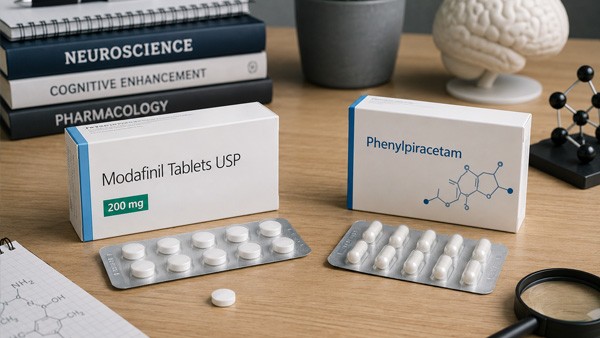
Modafinil is a wake-promoting prescription medication approved by the FDA, EMA, and most major regulators worldwide. Phenylpiracetam (originally marketed in Russia as Phenotropil) is a phenyl-substituted derivative of piracetam developed by the Soviet Anti-doping Research Bureau in 1983, used by cosmonauts for cognitive performance and emotional stability during space missions, and prescribed in Russia and several post-Soviet states for stroke recovery, attention deficits, and cognitive impairment. Outside that specific regulatory geography, phenylpiracetam exists in a legal grey zone — sold as a "research chemical" or dietary supplement in many Western markets, not approved by the FDA for any indication, not formally tested in modern Phase III trials, and banned in sport by WADA since 2014.
This is not a comparison between two equivalent products. It is a comparison between a regulated pharmaceutical with three decades of FDA-supervised clinical use and a Soviet-era nootropic with mostly Russian-language clinical literature and an evidence base that does not meet contemporary Western standards. The comparison still matters because phenylpiracetam is genuinely popular in nootropic and biohacker communities, the subjective effects are real, and many users consider it a legitimate alternative to modafinil for cognitive enhancement. This guide walks through every dimension of comparison — mechanism, strength of effect, tolerance, side effects, legality, evidence quality, real-world usage patterns, and sports doping status — with the honest answer rather than the marketing one from either side.
| Regulatory dimension | Modafinil | Phenylpiracetam |
|---|---|---|
| FDA approval | ✓ Approved 1998 | ✗ Never approved |
| EMA approval | ✓ Approved | ✗ Not approved |
| Russian Ministry of Health | ✓ Prescription | ✓ Prescription (Phenotropil) |
| US Schedule | Schedule IV | Unscheduled (legal grey zone) |
| WADA status | Prohibited in-competition | Prohibited in-competition since 2014 |
| Modern Phase III trials | Extensive — dozens of RCTs | Limited — mostly Russian small studies |
| English-language evidence base | Hundreds of peer-reviewed publications | Sparse — most data Russian-language |
| Pharmacopoeial status | Listed in US/EU pharmacopoeia | Listed in Russian State Pharmacopoeia only |
| Manufacturing oversight (Western markets) | cGMP regulated | Supplement-grade or unregulated |
| Insurance reimbursement | Yes for FDA indications | No anywhere |
The asymmetry matters because it shapes every downstream comparison — evidence quality, side-effect characterization, dose standardization, and product purity all reflect the regulatory gap.
⚛️ Different Drug Classes
The two drugs share almost nothing pharmacologically. They are not in the same class, they do not engage the same receptors, they were developed for different purposes, and they produce different subjective effects despite some overlap in functional outcomes (alertness, focus). Treating them as alternatives in the same category is a category error that produces confused expectations.
Modafinil is a eugeroic. The drug acts on the brain's natural wakefulness pathways — specifically the histaminergic arousal system, the orexin (hypocretin) neurons of the lateral hypothalamus, and (with weak affinity) the dopamine transporter. The molecular structure has no relationship to amphetamines, racetams, or classical stimulants. Modafinil was developed in France in the 1970s by Lafon Laboratories specifically as a wake-promoting agent for narcolepsy, an indication where it has remained the gold-standard first-line treatment for over two decades.
Phenylpiracetam is a racetam. The racetam family is a chemically diverse set of nootropic compounds sharing a 2-pyrrolidone backbone — piracetam was the original (1964), aniracetam, oxiracetam, pramiracetam, and phenylpiracetam followed. Phenylpiracetam is piracetam with a phenyl group added to the molecular structure, which substantially improves blood-brain barrier penetration and adds mild psychostimulant properties absent in plain piracetam. The proposed mechanism involves positive allosteric modulation of AMPA glutamate receptors, increased acetylcholine and dopamine signaling, possible NMDA modulation, and effects on the GABAergic system. The mechanism is less precisely characterized than modafinil's because the Western pharmacological literature on phenylpiracetam is comparatively sparse.
Developmental origin shapes the drug profiles in ways worth noting. Modafinil emerged from Western pharmaceutical R&D under regulatory expectations of Phase I-III trials, rigorous safety characterization, and broad clinical indication validation. Phenylpiracetam emerged from Soviet anti-doping and military research priorities — the original development goal was a substance that would enhance cognitive performance under extreme stress (cosmonaut missions, military operations) without producing the classical stimulant profile that would be detected by Western anti-doping systems of the era. The two drugs were optimized for fundamentally different criteria, and the resulting compounds reflect those differences.
| Property | Modafinil | Phenylpiracetam |
|---|---|---|
| Drug class | Eugeroic (wake-promoting) | Racetam derivative (nootropic) |
| Year of development | 1976 (Lafon, France) | 1983 (Soviet research bureau) |
| Original use case | Narcolepsy treatment | Cosmonaut cognitive performance |
| Primary mechanism | Histamine/orexin + weak DAT | AMPA modulation + ACh/dopamine signaling |
| Molecular relationship | Sulfinyl acetamide compound | Phenyl-substituted pyrrolidone |
| FDA approval status | Approved (Provigil, 1998) | Not approved |
| Half-life | ~12-15 hours | ~3-5 hours |
| Standard daily dose | 200 mg once daily | 100-200 mg, 2-3× daily (per Russian guidance) |
| Subjective character | Sustained alertness, calm focus | Mild stimulant character + cognitive lift |
| Drug schedule status | US Schedule IV; EU prescription | Unscheduled in US; Russian prescription |
⚡ Strength of Effect
Subjective strength reports from users who have tried both drugs cluster around a consistent pattern: phenylpiracetam feels more immediately stimulating in the first 30-60 minutes, modafinil feels stronger and more sustained over the full working day. The two are roughly comparable in peak intensity but differ substantially in duration profile and in the type of cognitive enhancement each produces.
Phenylpiracetam's effect begins within 30-45 minutes of an oral dose. Users describe a mild stimulant character similar to a strong cup of coffee combined with subtle cognitive lift — increased verbal fluency, improved working memory, mild physical energy boost, and an emotional steadying effect that distinguishes it from pure stimulants. The peak runs 1-3 hours; the tail tapers gradually over the next 2-3 hours. Total subjective effect window is approximately 4-6 hours per dose. To cover a full working day, users typically take 2-3 doses across the day (morning, noon, mid-afternoon).
Modafinil's effect begins within 30-60 minutes, climbs more gradually to peak at 2-4 hours, and maintains a steady plateau for 8-10 hours before tapering smoothly through evening. The subjective character is less stimulant-like and more "background fog lifted" — users report it as wakefulness restoration rather than acute energization. Total effect window is 10-14 hours per dose, single morning administration.
| Effect dimension | Modafinil 200 mg | Phenylpiracetam 100 mg |
|---|---|---|
| Onset | 30-60 min | 30-45 min |
| Peak intensity (acute) | Moderate-strong sustained | Moderate stimulant peak |
| Subjective character | Wake restoration, calm focus | Mild stimulant + cognitive lift |
| Verbal fluency boost | Modest | Notable |
| Physical energy boost | Mild | Notable |
| Working memory boost | Meaningful | Meaningful (per Russian data) |
| Emotional steadying | Neutral | Reported by users |
| Total effect window | 10-14 hours | 4-6 hours |
| Doses per day for full coverage | 1 | 2-3 |
| Sleep deprivation rescue | Strong evidence base | Limited Western data |
📈 Tolerance Build-up Speed
The single biggest practical difference between the two drugs is how rapidly each loses effectiveness with repeated daily use. Phenylpiracetam tolerance develops dramatically faster than modafinil tolerance — a fact widely acknowledged in both Russian clinical literature and Western nootropic community reports, and one that fundamentally shapes how the two drugs can be used in real life.
Russian prescribing guidance for phenylpiracetam typically limits courses to 30-60 days followed by extended washout periods (often weeks to months). The clinical reasoning is that effect diminishes substantially after roughly 2-3 weeks of daily use; by week 4-6, many users report the drug feels significantly weaker than initial doses, requiring either dose escalation (with diminishing returns) or cycling protocols (drug holidays). The tolerance development is hypothesized to involve AMPA receptor downregulation and dopamine system adaptation, though the precise mechanism is not fully characterized.
Modafinil tolerance develops far more slowly. Most users taking modafinil 200 mg morning dose for narcolepsy or off-label cognitive use report stable effect for months or years without meaningful diminution. Some long-term users notice subtle effect reduction over years of continuous daily use, but the tolerance pattern is not the rapid decay observed with phenylpiracetam. Drug holidays are useful but not clinically essential for most modafinil users; for phenylpiracetam users, drug holidays are functionally mandatory if the drug is to remain effective.
This tolerance asymmetry has practical implications:
- Phenylpiracetam is essentially an "occasional use" nootropic. Daily use destroys the effect within weeks. It is well-suited to specific high-demand days, exam periods, presentations, deadline pushes — not to chronic daily cognitive support.
- Modafinil is suitable for daily use. The slow tolerance development means narcolepsy patients can use it indefinitely; off-label cognitive users can sustain benefit across months of regular use without aggressive cycling protocols.
- Phenylpiracetam users develop sophisticated cycling protocols (3 weeks on, 4 weeks off; or 2 days per week only; or 1-week-per-month patterns) specifically because daily use is not sustainable. These cycling protocols are part of the practical knowledge in nootropic communities but absent from clinical pharmacology.
- Modafinil cycling is mainly about preserving sensitivity for occasional users; it is not pharmacologically necessary for daily users in the same way.
| Tolerance dimension | Modafinil | Phenylpiracetam |
|---|---|---|
| Speed of tolerance onset (daily use) | Months to years | 2-3 weeks |
| Full effect loss timeline (daily use) | Rare even after years | 4-6 weeks typically |
| Recommended cycle pattern | None required; optional drug holidays | 30-60 day courses with months washout |
| Daily use sustainability | Long-term sustainable | Not sustainable beyond weeks |
| Dose escalation success | Modest at best | Marginal (diminishing returns) |
| Recovery time after tolerance | Days to weeks | Weeks to months |
| Best-use frequency | Daily / morning routine | Occasional / event-driven |
⚠️ Side Effect Profiles
The side-effect characterization differs in quality between the two drugs. Modafinil's side-effect profile is documented through FDA-supervised trials enrolling thousands of patients across multiple phase III studies — the prevalence rates are statistically robust and clinically actionable. Phenylpiracetam's side-effect profile is characterized through smaller Russian clinical studies and self-report data from nootropic communities — the prevalence rates are approximate, and rare or delayed side effects may be underrepresented in the literature.
Both drugs are reported to be reasonably well tolerated at typical doses in most users. The character of side effects differs in ways that matter for choosing between them:
Modafinil's common side effects are headache (25-35%, often the most common complaint), nausea (5-10%), anxiety (5-10%), insomnia if dosed late (5-15%), and mild appetite suppression. Rare but specifically labeled risks include Stevens-Johnson syndrome (~1-5 cases per million), serious psychiatric symptoms in vulnerable patients, and CYP3A4 induction effects on hormonal contraception.
Phenylpiracetam's common side effects reported in Russian literature and community data include irritability and emotional volatility (particularly at higher doses or with prolonged use), insomnia if dosed late in the day, mild headache, and occasionally GI upset. The side-effect frequency is harder to quantify precisely because of the smaller and less rigorous evidence base.
| Side effect | Modafinil (FDA trial data) | Phenylpiracetam (Russian + community data) |
|---|---|---|
| Headache | ~25-35% (most common SE) | ~10-15% (anecdotal) |
| Insomnia (if dosed late) | ~5-15% | ~10-20% (shorter window so timing easier) |
| Anxiety | ~5-10% | ~5-10% |
| Irritability / emotional volatility | ~5% | Notable risk per Russian data |
| Heart rate increase | +1-3 bpm | Mild increase reported |
| Blood pressure increase | +1-3 mmHg | Mild increase reported |
| Appetite suppression | ~5-15% mild | Mild, less prominent than stimulants |
| GI upset | ~5% | Occasional |
| Stevens-Johnson syndrome | Rare but labeled (~1-5/million) | Not reported in available literature |
| Long-term safety database | Decades, robust | Limited, mostly Russian short-course studies |
📜 Legality and Sourcing
The legal landscape for these two drugs is dramatically different and shapes how patients in different countries can actually access each one. The differences are also evolving — phenylpiracetam's regulatory position has tightened in several jurisdictions over the past decade as anti-doping authorities, supplement regulators, and customs agencies have caught up with the nootropic market.
- Modafinil — United States: Schedule IV controlled substance. Prescription required. Generics widely available; international generic supply (Modalert, Modvigil) accessible through legitimate pharmacy channels. Importing modafinil for personal use requires prescription documentation.
- Modafinil — European Union: Prescription medicine in all member states. EMA approved. Generic supply available. Personal importation typically requires prescription.
- Modafinil — Russia: Prescription medicine. Limited availability; modafinil is more difficult to obtain in Russia than phenylpiracetam.
- Modafinil — UK / Canada / Australia: Prescription medicine across all three. Standard prescription pathway.
- Phenylpiracetam — United States: Not FDA approved as a drug. Not scheduled. Frequently sold as a "research chemical" or in supplement-grade form via online retailers. The legal status is grey — not illegal to possess but not approved for human consumption. FDA has issued warning letters to some retailers marketing nootropic supplements with unapproved drug ingredients.
- Phenylpiracetam — European Union: Not centrally approved. National regulation varies. Sold as a research chemical in some countries; effectively unavailable through normal channels in others. The UK Psychoactive Substances Act 2016 may apply in some sale contexts.
- Phenylpiracetam — Russia: Approved prescription medicine (Phenotropil) for cognitive deficit, stroke recovery, and attention disorders. Manufactured by Russian pharmaceutical companies under State Pharmacopoeia standards. The most legitimate regulatory environment for phenylpiracetam globally.
- Phenylpiracetam — Australia: Scheduled as a prescription-only medicine since 2018. Importation for personal use restricted.
- Phenylpiracetam — Canada: Not approved as a drug or natural health product; effectively unregulated and not legally sold for human consumption.
The sourcing question for phenylpiracetam is more complex than for modafinil precisely because the product is not produced under pharmaceutical-grade regulatory oversight in most of the Western market. The quality concerns are real:
- Purity and identity: Some research-chemical-grade phenylpiracetam from less reputable suppliers has been found to contain incorrect compounds, contamination, or significant dose variance. Modafinil from licensed Indian generic manufacturers (Sun Pharma, HAB Pharmaceuticals) is produced under cGMP oversight with documented bioequivalence to brand reference.
- Dose accuracy: Pharmaceutical-grade tablets carry strict dose-accuracy requirements (typically ±5% of labeled content). Research-chemical or supplement-grade phenylpiracetam capsules may have wider variance.
- Stability and storage: Pharmaceutical products have documented shelf-life and storage requirements. Research-grade products may not.
- Manufacturing oversight: Pharmaceutical generics are produced in inspected facilities. Research-grade products often come from facilities without comparable oversight.
🔬 Evidence Quality — What We Actually Know
One of the most important honest comparisons between the two drugs is the quality and quantity of evidence supporting each. The asymmetry here is large and matters for any decision based on clinical claims:
| Evidence dimension | Modafinil | Phenylpiracetam |
|---|---|---|
| Number of Phase III RCTs | Dozens | Limited; mostly small Russian trials |
| Total patients in pivotal trials | Thousands | Hundreds (Russian studies) |
| Major peer-reviewed publications | Hundreds in English-language journals | Sparse English-language; many Russian-only |
| Independent replications | Multiple across labs and countries | Limited Western replications |
| FDA submission dossier | Complete, public | Never submitted |
| Post-marketing surveillance | ~25+ years globally | Russian use only with limited surveillance |
| Cochrane review available | Yes, multiple | No |
| Meta-analyses available | Multiple in major journals | None of comparable scope in English |
| Mechanism characterization | Detailed at receptor + circuit level | Partial — AMPA modulation hypothesis |
| Pharmacokinetic data | Complete (absorption, distribution, metabolism, elimination) | Approximate |
| Drug interaction profile | Comprehensively characterized | Largely uncharacterized |
This is not to suggest phenylpiracetam does not work — Russian clinical use across decades and consistent self-report data from Western users both suggest the drug produces real effects. It is to suggest that the evidence supporting phenylpiracetam is of a different quality than the evidence supporting modafinil, and the comparison should be framed honestly rather than as a head-to-head between equivalents.
🔁 Stacking and Cycling Patterns
Nootropic communities have developed sophisticated usage patterns for both drugs, but the patterns differ substantially because of the tolerance asymmetry and effect duration differences. Understanding common real-world usage helps frame the choice between them:
Common modafinil usage patterns:
- Daily morning routine: 200 mg every morning for narcolepsy or chronic off-label cognitive support. Sustainable for months/years.
- 5-on-2-off: 200 mg weekday mornings only, weekends off. Common pattern for off-label professional use.
- Event-driven: Used only on demanding days (deadlines, long meetings, travel). Most occasional users default here.
- Half-dose modulation: 100 mg morning instead of 200 mg for sensitive users or those who want milder effect.
- Split dosing: 100 mg morning + 100 mg noon. Less common but used for patients with afternoon dip on single morning dose.
Common phenylpiracetam usage patterns:
- 30-day course + 60-90 day washout: Most common pattern aligned with Russian prescribing guidance. Allows full effect during the course window.
- 2-3 days per week only: Specifically structured to avoid daily tolerance buildup. Used by long-term occasional users.
- Event-driven only: Used only on specific high-demand days (exams, presentations, athletic events outside competition). Avoids tolerance entirely.
- Combined with choline source: Common stack — phenylpiracetam plus alpha-GPC or CDP-choline. The racetam family is hypothesized to deplete acetylcholine; choline supplementation may mitigate side effects and enhance effect.
- Sub-100 mg micro-dosing: Some users take 50-75 mg specifically to reduce tolerance development. Effect is milder but courses can extend longer.
🏅 WADA / Sports Doping Status
Both drugs are prohibited in competition by the World Anti-Doping Agency (WADA), but the histories and detection profiles differ:
- Modafinil: Added to WADA Prohibited List in 2004 following Olympic doping cases. Specifically prohibited in-competition under the S6 Stimulants category. Detection windows are 24-48 hours by standard urine testing methods; specialized testing extends detection further.
- Phenylpiracetam: Added to WADA Prohibited List in 2014 specifically because of its Soviet-era development as a performance enhancer for cosmonauts and military personnel. The 2014 addition closed what had been a gap in the prohibited list — phenylpiracetam had been used by some Russian athletes precisely because it was not on prior WADA lists. Detection is now routine in WADA-accredited labs.
- For competitive athletes: Neither drug can be used in or near competition without risking sanctions. Both have been the subject of high-profile doping cases in competitive sport. Therapeutic Use Exemptions are theoretically available for both but rarely granted.
- For recreational athletes / non-competition use: WADA rules do not apply to non-competitive athletic activity. The drugs remain legal to use in this context within the broader regulatory frameworks of each country.
✨ Bottom Line
Modafinil and phenylpiracetam are not really competing products in the same market — they occupy different positions on the regulatory, evidence-quality, and usage-pattern spectrum, and they serve overlapping but not identical use cases. Modalert 200 mg (modafinil) from Sun Pharma is the rational choice for chronic daily cognitive support, narcolepsy and sleep-disorder treatment, situations requiring 10+ hours of single-dose coverage, users wanting pharmaceutical-grade quality assurance, and any context where the FDA evidence base matters.
Phenylpiracetam is the rational choice for occasional high-demand cognitive events (exams, presentations, deadline pushes), users who prefer the mild stimulant character and emotional steadying effect, users specifically seeking the verbal-fluency and physical-energy boost that distinguishes phenylpiracetam from pure wakefulness agents, and users in regulatory environments where modafinil access is restricted but phenylpiracetam is available. The faster tolerance buildup means phenylpiracetam is fundamentally an event-driven nootropic, not a daily-routine drug.
The two can occupy complementary positions in a thoughtful cognitive enhancement strategy: modafinil for chronic baseline support, phenylpiracetam reserved for occasional acute high-demand days. Daily use of both stacked is not advisable and not well-characterized. For users entering nootropic use for the first time, modafinil is the safer starting point because of the better evidence base, the more predictable dosing, the more reliable supply chain, and the more characterized side-effect profile. Phenylpiracetam can be added as occasional use once a baseline modafinil response pattern is understood, if the user has access to high-quality phenylpiracetam supply.
For broader comparison context, see our companion articles Modafinil vs Caffeine, Modafinil vs Ritalin, Modafinil vs Vyvanse, Modafinil vs Armodafinil, and Modalert vs Provigil.
❓ Frequently Asked Questions
Is phenylpiracetam stronger than modafinil?
In acute peak intensity, the two are roughly comparable at standard doses (100-200 mg of each). Per-dose subjective effect is similar in magnitude. The comparison breaks down on duration: phenylpiracetam lasts 4-6 hours per dose while modafinil lasts 10-14 hours per dose, meaning total daily effect strongly favors modafinil. Phenylpiracetam has more pronounced stimulant character (more verbal fluency boost, more physical energy lift); modafinil has more pronounced wakefulness restoration character. Neither is universally "stronger" — they are differently shaped.
Why does phenylpiracetam stop working after a few weeks?
Phenylpiracetam tolerance develops rapidly — within 2-3 weeks of daily use, effect diminishes substantially; by week 4-6 the drug often feels notably weaker. The hypothesized mechanism involves AMPA glutamate receptor downregulation and adaptive changes in dopamine signaling. This rapid tolerance is well-documented in both Russian clinical literature and nootropic community reports and is the reason daily phenylpiracetam use is not sustainable. Modafinil tolerance develops far more slowly, allowing sustained daily use over months to years.
Is phenylpiracetam legal?
Depends on your country. In Russia, it is an approved prescription medicine (Phenotropil). In Australia, it is Schedule 4 prescription-only since 2018. In Canada, it is not approved and not legally sold for human consumption. In the United States, it is not FDA approved as a drug and not scheduled — sold in a grey zone as "research chemical" or supplement-grade product. In the EU and UK, the situation varies by country and may be affected by psychoactive substances legislation. The legal status is meaningfully more complex than modafinil's straightforward prescription-medicine status.
Can I take phenylpiracetam and modafinil together?
Pharmacologically the combination has not been formally studied. They engage different receptor systems (eugeroic pathways for modafinil vs AMPA modulation for phenylpiracetam) so direct interaction is theoretically limited. Practical reports from nootropic users suggest the combination produces additive alertness without dangerous interaction at moderate doses. The honest answer is that the combination is poorly characterized and should be approached conservatively if at all — start with one drug at a time, establish baseline response, and only consider combining if a specific functional need requires it.
Which is safer?
Modafinil has dramatically better-characterized long-term safety because of its multi-decade FDA-supervised clinical use and comprehensive post-marketing surveillance. Phenylpiracetam's long-term safety is poorly characterized in modern Western pharmacology — Russian clinical data covers short-course use mostly, and Western long-term databases do not exist. This does not mean phenylpiracetam is dangerous; it means the safety profile is less well-known. Conservative users prioritize the better-characterized drug, especially for chronic daily use.
Is the Russian Phenotropil the same as research-chemical phenylpiracetam sold online?
Chemically yes — same active compound. Practically the products differ in manufacturing oversight, dose accuracy, purity guarantees, and quality consistency. Russian Phenotropil is manufactured under State Pharmacopoeia standards with documented quality control. Research-chemical-grade phenylpiracetam sold online via supplement retailers varies dramatically in quality — some products are pharmaceutical-grade purity, others have significant impurities or dose variance. The product label "phenylpiracetam" does not guarantee the same quality as a regulated pharmaceutical brand.
Will phenylpiracetam show up on a drug test?
For employment drug screens — no, phenylpiracetam is not on standard 5-panel or 10-panel tests and would not produce a positive result for amphetamines or other tested substances. For competitive sports drug testing — yes, phenylpiracetam has been on the WADA Prohibited List since 2014 and is specifically tested for in WADA-accredited labs. Athletes subject to WADA testing should not use phenylpiracetam in or near competition. Modafinil has the same WADA prohibition status (since 2004).
Which is better for ADHD?
Neither is FDA-approved for ADHD, but the comparison still has clinical relevance. Modafinil has some off-label evidence base in adult ADHD as second-line for stimulant non-responders. Phenylpiracetam is used for attention deficits in Russian clinical practice but the Western evidence base for ADHD specifically is minimal. For ADHD, the better-evidenced approach is stimulant medications (Vyvanse, Ritalin, Adderall, etc.) — see our companion comparison articles. Among the two drugs discussed here, modafinil has slightly better ADHD evidence, but neither is a first-line choice.
How should I cycle phenylpiracetam to avoid tolerance?
Common community cycling patterns include: 30-day course followed by 60-90 day washout (closest to Russian prescribing pattern), 2-3 days per week only with weekend washouts, event-driven use only with no regular daily intake, and sub-100 mg micro-dosing to extend course length. The simplest pattern that preserves effect indefinitely is "occasional event-driven use" — using phenylpiracetam only when a specific cognitive demand justifies it rather than as a daily routine. Modafinil does not require this kind of aggressive cycling because tolerance develops far more slowly.
For first-time nootropic users, which should I try first?
Modafinil for most users. The reasons: better-characterized side-effect profile so you know what to expect, more reliable supply chain so quality is more predictable, more sustainable use pattern so initial positive response can extend into daily use, prescription pathway provides physician oversight that grey-zone supplement use does not, and the larger evidence base means more reliable expectations about effect. Phenylpiracetam can be added later as occasional high-demand-day use once baseline modafinil response is understood and a quality phenylpiracetam source is identified — starting nootropic exploration with the less-characterized grey-zone product is generally not the best first step.
📚 References & Further Reading
- FDA prescribing information for Provigil (modafinil) — official mechanism, dosing, and safety profile.
- Malykh & Sadaie, Drugs 2010 — review of piracetam and racetam family pharmacology including phenylpiracetam.
- Russian State Pharmacopoeia — Phenotropil monograph and prescribing guidance.
- Akhapkina & Voronina — Russian clinical studies on phenylpiracetam in stroke recovery and cognitive deficit (translated abstracts available in English-language databases).
- Battleday & Brem, European Neuropsychopharmacology 2015 — systematic review of modafinil cognitive enhancement in healthy adults.
- WADA Prohibited List (current year) — official anti-doping status for modafinil (since 2004) and phenylpiracetam (since 2014).
- American Academy of Sleep Medicine — practice parameters covering modafinil's FDA-approved indications.
- FDA warning letters to nootropic supplement retailers — regulatory position on unapproved drug ingredients in dietary supplements.
- Therapeutic Goods Administration (Australia) — phenylpiracetam Schedule 4 listing rationale (2018).
- Modafinil vs Caffeine — cognitive enhancement baseline comparison.
- Modafinil vs Ritalin — methylphenidate comparison.
- Modafinil vs Vyvanse — lisdexamfetamine comparison.
- Modafinil vs Armodafinil — R-enantiomer comparison.
- Modalert vs Provigil — generic vs brand modafinil comparison.
- Best Time to Take Modafinil — timing rules relevant to nootropic stacking.
- Modafinil Tolerance and Dose Escalation — direct context for the tolerance comparison.
- Modalert 200 mg, Modvigil 200 mg, Waklert 150 mg — primary product pages on the RXshop antinarcoleptic catalogue.
- RXshop Editorial Team — content reviewed by licensed pharmacist; for adult patient education, not a substitute for individual medical consultation.
Medical Disclaimer: The information in this article is for educational and informational purposes only and is not a substitute for professional medical advice, diagnosis, or treatment. Always seek guidance from a qualified healthcare provider with any questions you may have regarding a medical condition, and before starting, stopping or changing any medication.