Modafinil for Jet Lag: Recovery and Pre-Trip Use


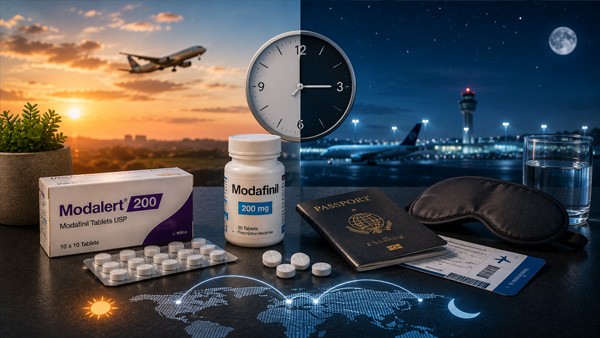
Jet lag is the single most common acute circadian disorder in modern life, affecting an estimated 90% of long-distance travelers to some degree and causing meaningful functional impairment lasting 3-10 days depending on direction and number of time zones crossed. The biology is uncomplicated and unforgiving: your suprachiasmatic nucleus circadian pacemaker takes approximately 1 day per time zone to fully realign when displaced, regardless of how much you want to function on local time immediately. For a New York → Tokyo trip (13 time zones eastward), full circadian realignment takes roughly two weeks — longer than most business trips. The functional result is sleepiness during local daytime, alertness during local nighttime, cognitive impairment, mood disturbance, gastrointestinal disruption, and decreased athletic and intellectual performance during the misalignment window. For business travelers, athletes competing internationally, and frequent flyers, jet lag represents real productivity and performance cost.
Modafinil has become a common tool for managing jet lag — supported by the FDA-approved indication for shift work sleep disorder (which involves similar circadian misalignment biology) and by extensive off-label experience. The drug cannot accelerate circadian realignment itself, but it can effectively mask the alertness symptoms of misalignment, allowing the traveler to function productively while the underlying circadian system catches up. This guide covers the specific mechanics of why jet lag hits hard, the well-documented asymmetry between eastward and westward travel that affects strategy, modafinil timing protocols matched to arrival contexts, the critical role of light exposure that operates alongside pharmacological alertness support, the four flight profile classifications mapping specific trip types to optimal modafinil approaches, the pre-flight adjustment week strategies for high-stakes travel, the in-flight decision tree for modafinil use during long flights, and the day-by-day post-arrival recovery protocol that gets travelers back to productive baseline as quickly as the biology permits.
Eastward travel: 1 day per time zone (approximately)
Westward travel: 0.7 days per time zone (approximately — easier)
North-south travel: Minimal jet lag (same time zone shifts)
MODAFINIL DEPLOYMENT DAYS:
Trip ≤ 24 hours at destination: 1 day of modafinil (arrival day if needed)
Trip 1-3 days at destination: 1-3 days of modafinil for productive period
Trip 4+ days at destination: 2-4 days of modafinil during initial adjustment
Round-the-world (RTW): Use sparingly; full recovery requires longer than the trip
Worked example: New York → London (5 hours eastward, 3-day business trip):
• Natural recovery time: ~5 days for full circadian realignment
• Trip duration: 3 days
• Strategy: 200 mg morning on Days 1-2 of trip for productive function during meetings; light exposure on arrival to support natural realignment; full recovery happens after returning home
The formula reflects the unforgiving biology: modafinil masks symptoms but does not accelerate circadian realignment itself. Strategy is to deploy modafinil during the high-stakes portion of trip while letting natural biology (with light exposure support) do the underlying adjustment work.
🌐 Why Jet Lag Hits Hard
The biology of jet lag explains why pharmacological intervention only partially addresses the problem:
- The suprachiasmatic nucleus (SCN) is your master clock. Located in the hypothalamus, this cluster of approximately 20,000 neurons coordinates the body's circadian rhythms — sleep-wake cycle, hormone secretion, body temperature, digestion, immune function, and dozens of other physiological processes. The SCN is anchored primarily by light exposure to the retina.
- SCN adjustment takes approximately 1 day per time zone for eastward travel and 0.7 days per time zone for westward travel. This rate is set by the SCN's biological adjustment capacity and cannot be substantially accelerated by current pharmacology. Cross 8 time zones eastward = approximately 8 days for full circadian realignment.
- Peripheral organ clocks adjust at different rates than SCN. The liver, gut, heart, and other organs have their own subsidiary clocks that normally synchronize to SCN signals. After time zone change, these peripheral clocks adjust at different rates — producing the well-documented digestive disruption, performance variability, and mood instability characteristic of jet lag's first week.
- Sleep architecture is disrupted independent of total duration. Jet lag affects sleep quality even when total sleep time is normal. REM sleep timing shifts, deep sleep distribution changes, and frequent awakenings replace consolidated sleep. The resulting sleep is less restorative than equivalent duration in your normal time zone.
- Hormonal cascade disruption. Cortisol (peaks around natural waking time), melatonin (rises with darkness), growth hormone (peaks early in sleep), and many other hormones operate on circadian schedules. Jet lag puts these hormonal patterns out of phase with new local time, contributing to fatigue, mood disturbance, and impaired physical recovery.
- Cognitive performance impairment is substantial. Studies of business travelers, athletes, and military personnel during jet lag periods show 10-30% decrements in cognitive tests including reaction time, working memory, decision-making, and pattern recognition. This is comparable to mild alcohol intoxication for performance impact.
- Immune function temporarily suppressed. Jet lag mildly suppresses immune function, contributing to the well-known phenomenon of post-travel illness — colds and other infections shortly after arrival from long-distance trips.
How modafinil addresses the jet lag biology:
- Directly addresses the alertness symptoms during local daytime hours when SCN is signaling "should be asleep." Modafinil's wake-promoting mechanism (histamine, orexin, dopamine pathways) operates independently of the circadian system itself.
- Does NOT accelerate SCN adjustment. The drug does not speed up the underlying circadian realignment. Travelers on modafinil still go through the full circadian adjustment biology; they just function better during the misalignment window.
- Does NOT address peripheral organ clock adjustment or hormonal cascade disruption directly.
- Does NOT improve immune function during the jet lag window.
- The honest framing: modafinil is a productivity tool during jet lag, not a jet lag cure. It allows you to function during the period when natural circadian biology would otherwise impair function.
↔️ Eastward vs Westward Asymmetry
The well-documented asymmetry between eastward and westward travel is one of the most important practical facts about jet lag management:
Eastward travel (e.g., New York → London, Los Angeles → Tokyo) is harder. Reasons:
- You're advancing your sleep time. Going to bed earlier than your natural schedule is biologically harder than going to bed later. The "phase advance" required for eastward travel is harder than the "phase delay" required for westward travel.
- You're shortening your subjective day. Time zones lost means less time to be awake before your body wants to sleep. Adjustment requires sleeping when not naturally tired.
- Most people's natural rhythm is slightly >24 hours. Human SCN free-runs at approximately 24.2 hours when isolated from light cues. Westward travel slightly extends your natural day; eastward travel goes against your natural drift.
- Recovery rate: approximately 1 day per time zone for eastward. 5-hour eastward shift = ~5 days; 8-hour eastward shift = ~8 days for full realignment.
Westward travel (e.g., London → New York, Tokyo → Los Angeles) is easier. Reasons:
- You're delaying your sleep time. Staying up later than your natural schedule is biologically easier than going to bed earlier.
- You're lengthening your subjective day. Time zones gained means more time to be awake before sleep is required. Adjustment uses natural delayed sleep onset.
- Recovery rate: approximately 0.7 days per time zone for westward. 5-hour westward shift = ~3.5 days; 8-hour westward shift = ~5.5 days for full realignment.
The asymmetry has direct implications for modafinil strategy:
- Eastward travel: modafinil during local daytime is more often needed. Your body's natural sleep window aligns with destination's daytime, producing strong sleepiness during high-stakes meeting hours. Modafinil 200 mg taken at destination morning helps maintain alertness during the work day.
- Westward travel: modafinil less often needed in afternoon, more often needed for late-evening work. Your body wants to sleep at destination's evening (which aligns with home morning). Modafinil mid-afternoon at destination can support evening work or social activities.
- Time-of-day modafinil dosing differs by direction. Eastward: morning dosing aligned with destination local time. Westward: later dosing to cover destination evening when home-time biology wants sleep.
- Recovery period planning differs. Eastward trips longer than 7 days mean you're recovering most of the trip; shorter trips mean you function on modafinil throughout and recover after returning. Westward trips have faster natural recovery, making shorter modafinil deployment adequate.
⏰ Modafinil Timing After Landing
Specific dosing protocols for different arrival scenarios:
Morning arrival after eastward overnight flight: The classic business traveler scenario — leave New York at 22:00, arrive London at 10:00 local (5:00 home time, after a partial-sleep overnight flight). Modafinil approach: take 200 mg shortly after clearing customs, ideally around 11:00 local time. This puts peak modafinil during afternoon meetings. Goal: function through end of business day (17:00-18:00 local), then bed at 22:00-23:00 local to begin circadian adjustment. Skip modafinil on day 2 if possible to allow natural sleep recovery.
Afternoon arrival after eastward day flight: Less common but happens with some routings. Arriving 15:00-17:00 local time with home-time evening biology pushing for sleep. Modafinil approach: if you arrived alert from the flight, no immediate dose needed. If you arrived sleepy, 100 mg can support evening function — but be cautious about taking modafinil after 15:00 local (will affect that night's sleep). Often better to push through with caffeine for the few remaining hours and prioritize sleep at local evening.
Evening arrival: Don't take modafinil on arrival. The goal is to align with local sleep time. Push through to local bedtime (22:00-23:00), prioritize sleep, take modafinil next morning if needed.
Morning arrival after westward overnight flight: Less common scenario. Some sleep onboard plus arrival at local morning (when your body thinks it's evening). Modafinil approach: 100-200 mg morning of arrival depending on how much sleep you got and how alert you feel. Westward travel generally requires less modafinil than eastward.
Arrival at unusual hours (3 AM local, etc.): Sleep until local morning, then start modafinil on local morning if needed. Don't take modafinil at 3 AM to "stay awake until proper bedtime" — that's working against the natural sleep opportunity.
Multi-stop trips: Each leg has its own consideration. Often best to use modafinil only on legs with critical work; let off-days be natural recovery time.
Dosing principles for jet lag use:
- Take modafinil at local destination morning time (analogous to standard 1-hour-before-shift for SWSD).
- 200 mg is standard adult dose; 100 mg if you're sensitive or want to reduce side-effect risk during important meetings.
- Don't take after 11:00 local time on any day you want to sleep at local bedtime. The 14-hour bedtime rule still applies and matters more during jet lag when sleep matters more.
- Eat substantial breakfast with the dose. Empty-stomach side effects worse during travel stress.
- Hydrate aggressively. Airline cabins dehydrate everyone; modafinil's mild diuretic effect compounds this; managing dehydration matters more during travel.
- Don't double-dose during the day. One morning dose covers full work day. Adding afternoon dose ruins next night's sleep.
☀️ Combining with Light Exposure
Light exposure is the most powerful natural circadian intervention available. Combining modafinil with proper light management produces better outcomes than either alone:
For eastward travel (phase advance needed):
- Morning bright light at destination: 30+ minutes of sunlight or 10,000-lux therapy lamp within 1-2 hours of waking at destination local time. Critical for SCN advancement.
- Avoid bright light in destination evening: Bright light at destination evening (which corresponds to your home-time afternoon) reinforces wrong circadian timing. Sunglasses if outdoors after dinner; dim indoor lighting.
- Outdoor activity in destination morning: Walking, sightseeing, exercise in destination morning maximizes both light exposure and circadian signaling through physical activity.
- Curtains open at destination wake time: Even hotel curtains can be opened to maximize ambient morning light during breakfast.
For westward travel (phase delay needed):
- Avoid bright morning light at destination: Wear sunglasses on morning commute or outdoor activity at destination. Avoid bright outdoor exposure before 10:00 local.
- Bright light in destination afternoon and evening: Reinforces "wakefulness" during destination's later hours, helping phase delay your circadian system.
- Outdoor activity in destination afternoon/evening: Sightseeing or walks during destination evening hours.
- Keep room bright in destination evening: Counter to standard sleep hygiene; for westward travel, brighter evening environment helps delay sleep onset to align with new local time.
The combined modafinil + light protocol:
- Day 1 at destination: Modafinil morning + appropriate light exposure (bright morning for eastward, bright afternoon for westward).
- Day 2 at destination: Modafinil morning if function still required + continued light protocol. SCN beginning to adjust.
- Day 3+ at destination: Modafinil increasingly optional as natural adjustment progresses. Light exposure continues to drive realignment.
- Day 5-7+: Natural circadian realignment largely complete for moderate time zone shifts. Modafinil typically not needed for shorter trips.
📅 Jet Lag Recovery Plan
Comprehensive recovery plan for moderate-to-severe jet lag (5+ time zones, eastward):
Pre-departure (3-7 days before flight):
- Shift sleep schedule 1 hour per day in the direction of destination time (for eastward, earlier; for westward, later).
- Adjust light exposure to match the shift.
- Prioritize good sleep quality in the days before travel (jet lag is worse with pre-existing sleep debt).
- Plan first 2-3 days of trip with lighter schedule if possible.
Day of departure:
- Standard sleep night before travel (don't try to be "extra rested" — that makes adjustment harder).
- Light meal before flight, hydrate well.
- If long flight with overnight component, plan in-flight sleep aligned to destination night time.
During flight:
- Set watch to destination time on boarding. Mental adjustment begins immediately.
- Eat and sleep according to destination time during flight where possible.
- Avoid alcohol (degrades sleep quality and dehydrates).
- Hydrate aggressively throughout flight.
- If destination night during flight, sleep with eye mask and earplugs.
- If destination day during flight, stay awake — use book/movie/work to avoid sleeping.
Arrival day:
- Eastward morning arrival: modafinil 200 mg shortly after landing. Light exposure ASAP. Push through to local bedtime.
- Eastward evening arrival: skip modafinil, sleep at local bedtime.
- Westward morning arrival: light morning meal, modafinil 100-200 mg if needed for function, plan for early evening sleepiness.
- Westward evening arrival: stay awake until local bedtime, prioritize sleep at local night.
Days 2-4 at destination:
- Continue light exposure protocol matched to direction of travel.
- Modafinil morning dose if functional alertness is required and natural alertness inadequate.
- Sleep at local night time even if not fully tired — get into bed in dark room.
- Avoid afternoon naps longer than 20-30 minutes (disrupt night sleep).
- Maintain local meal times to support peripheral organ clock adjustment.
Day 5+ at destination:
- For shorter trips, you may be heading home around this point.
- For longer trips, natural adjustment is largely complete for moderate time zone shifts.
- Modafinil typically not needed beyond initial days.
Return travel:
- Same principles apply in reverse direction.
- Recovery at home easier psychologically (familiar environment, normal commitments deferred).
- For frequent travelers, having structured return routine matters as much as outbound protocol.
✈️ Flight Profile Classification
Different flight profiles warrant different modafinil approaches. The four major flight types:
Profile 1 — "Eastward Short" (e.g., NYC → London, 5-6 time zones). Most common business travel pattern. Significant jet lag but recoverable within trip duration if trip is 5+ days. Modafinil approach: 200 mg arrival day morning, possibly day 2; reassess by day 3. Standard approach works well; this is the canonical use case.
Profile 2 — "Eastward Long" (e.g., NYC → Tokyo, 13 time zones; LAX → Mumbai, 12-13 time zones). Severe jet lag exceeding any short trip duration. Modafinil approach: 200 mg morning for first 3-4 days of trip; light exposure protocol critical; expect impaired performance even with optimal management; plan for substantial recovery period after returning home. For trips less than 7 days, you're essentially never fully adjusted to destination time — function is supported but not optimized.
Profile 3 — "Westward Short" (e.g., London → NYC, 5-6 time zones westward). Easier than eastward equivalent. Faster natural recovery. Modafinil approach: 100 mg morning of arrival if needed, often optional by day 2. Many westward travelers don't need modafinil at all for short westward trips.
Profile 4 — "Westward Long" (e.g., Tokyo → NYC, 13 time zones westward; Sydney → London, 11 time zones). Still substantial but more manageable than eastward equivalent. Modafinil approach: 100-200 mg morning for first 2-3 days; recovery typically faster than the eastward equivalent of same magnitude.
| Flight profile | Time zones / direction | Modafinil approach | Recovery time |
|---|---|---|---|
| Profile 1 (Eastward short) | 5-6 east | 200 mg days 1-2 of trip | ~5-6 days natural |
| Profile 2 (Eastward long) | 10-13 east | 200 mg days 1-4 of trip | ~10-13 days natural |
| Profile 3 (Westward short) | 5-6 west | 100 mg day 1 if needed | ~3-4 days natural |
| Profile 4 (Westward long) | 10-13 west | 100-200 mg days 1-3 | ~7-9 days natural |
📅 Pre-Flight Adjustment Week
For high-stakes travel (major business meetings, athletic competitions, important family events), pre-flight circadian shifting can substantially reduce jet lag impact:
Pre-flight shifting protocol (eastward travel):
- 5-7 days before flight: Begin shifting sleep schedule 30-60 minutes earlier per day in direction of destination.
- Morning light exposure: Bright light within 30 minutes of waking at your shifted earlier time.
- Evening light avoidance: Dim lights earlier in evening to support advance phase.
- Meal timing shifts: Eat dinner earlier on shifted schedule.
- Exercise timing: Avoid late-evening exercise that delays sleep onset.
- Caffeine cutoff earlier: Last caffeine 8+ hours before new shifted bedtime.
- By day of flight: Should be 2-4 hours closer to destination time than your normal schedule. Full destination adjustment cannot be achieved pre-flight, but partial adjustment substantially reduces jet lag severity.
For westward travel pre-shifting (less commonly done but works):
- Shift sleep 30-60 minutes later per day in direction of destination.
- Evening bright light exposure.
- Morning light avoidance (sunglasses if needed).
- Meal timing shifts later.
- Allow evening exercise to support phase delay.
Pre-flight shifting realities:
- Not always practical for busy professionals — meeting and family obligations don't shift with you.
- Most effective for trips ≥5 days where pre-flight effort pays off in trip productivity.
- Combine with modafinil during trip itself for compound benefit.
- Athletes and high-stakes travelers find this worth the effort.
- Casual business travelers often skip pre-shifting and rely on modafinil + light at destination.
🛫 In-Flight Decision Tree
Whether to take modafinil during the flight depends on the specific situation:
- If destination night during flight: Try to sleep during flight; modafinil counterproductive. Use eye mask, earplugs, recline if possible.
- If destination day during flight and you need to stay awake: 100-200 mg modafinil during destination morning helps. Move watch to destination time; eat at destination meal times; stay awake against home-time biology.
- If long layover and you need to stay alert: Modafinil if layover is multi-hour and important to be productive (work, important calls during layover).
- If multi-leg trip with short connections: Usually skip in-flight modafinil; save for arrival day at final destination.
- If you have important meeting immediately on arrival: Take modafinil during latter portion of flight (timed to peak around meeting). 100-200 mg approximately 2-3 hours before scheduled meeting.
- If pre-flight sleep was inadequate: Modafinil can support function but won't replace the missed sleep. Plan recovery sleep as soon as possible after arrival.
In-flight modafinil best practices:
- Take with food (meal service typically aligns).
- Hydrate aggressively — cabin air dehydrates substantially.
- Don't combine with alcohol (sometimes free in business class — easy to over-consume).
- Don't take if you anticipate trying to sleep during flight.
- Test in non-flight context first if first-time user — don't make first dose a transatlantic flight.
✨ Bottom Line
Modafinil for jet lag is a productivity tool during the circadian misalignment window, not a jet lag cure. The drug effectively masks alertness symptoms during local daytime when your circadian system is signaling sleep, allowing functional performance for meetings, athletic events, or important activities while natural circadian realignment occurs underneath.
The time zone recovery formula reflects unforgiving biology: eastward travel requires approximately 1 day per time zone for full circadian realignment; westward travel approximately 0.7 days per time zone. The eastward-westward asymmetry has direct implications for strategy — eastward trips often require more modafinil deployment and combined light exposure protocols.
Light exposure is the most powerful natural circadian intervention available — bright morning light for eastward travel (phase advance), bright afternoon/evening light for westward travel (phase delay). Modafinil addresses symptoms; light exposure addresses underlying circadian biology. The combination produces substantially better outcomes than either alone.
The four flight profile classifications (Eastward Short / Eastward Long / Westward Short / Westward Long) map specific trip types to optimal modafinil approaches and realistic recovery expectations. Profile 2 (Eastward Long) represents the most challenging case where even optimal management produces only partial function during shorter trips.
Pre-flight adjustment week protocols (30-60 minute daily sleep shift in direction of destination, combined with light exposure timing changes) substantially reduce jet lag severity for high-stakes travel. Not always practical for busy professionals but worth the effort for athletes, key business meetings, and important events.
The day-by-day arrival protocol structures the first week at destination with modafinil during the productive window plus light exposure protocol throughout. By day 5-7, natural circadian adjustment is largely complete for moderate time zone shifts and modafinil typically becomes unnecessary.
For pharmaceutical-grade modafinil for jet lag use, Modalert 200 mg from Sun Pharma is the most widely used legitimate generic. Split-scored tablets allow easy reduction to 100 mg for westward travel or for sensitive users. Pack in original packaging with prescription documentation if traveling internationally — modafinil is legal in most countries but customs may inspect.
For broader context on circadian-related modafinil use, see our comprehensive Modafinil for Shift Workers article — the FDA-approved indication that shares mechanism with jet lag use. For travel-specific use cases, see Modafinil for Entrepreneurs (business travel context), Modafinil for Truck Drivers (transportation context), and other use-case companions.
For comparison with alternatives travelers consider, see Modafinil vs Caffeine (default traveler alertness strategy) and Modafinil vs Armodafinil.
For side-effect management during travel-stress periods, see Modafinil Dehydration (compounded by cabin air), Modafinil Headaches, Modafinil Insomnia (critical for jet lag recovery — getting destination night sleep matters), and Modafinil and Anxiety (travel stress can amplify).
❓ Frequently Asked Questions
Does modafinil cure jet lag?
No — modafinil masks the alertness symptoms of jet lag during local daytime but does not accelerate the underlying circadian realignment. Your suprachiasmatic nucleus still requires approximately 1 day per time zone for full realignment regardless of modafinil use. The drug allows productive function during the misalignment window; light exposure and time are what actually adjust your circadian biology. Realistic framing: modafinil is a productivity tool during jet lag, not a jet lag cure.
When should I take modafinil after landing?
For eastward travel with morning arrival: 200 mg shortly after clearing customs, ideally around 11:00 local time. This puts peak modafinil during afternoon meetings. For eastward evening arrival: skip modafinil, sleep at local bedtime. For westward travel: 100-200 mg morning if needed for function. Don't take modafinil after 11:00 local time on any day you want to sleep at local bedtime — the 14-hour bedtime rule matters more during jet lag when sleep matters more.
How much modafinil for jet lag?
200 mg standard adult dose for eastward travel where significant alertness support needed. 100 mg for westward travel or for sensitive users. Higher doses (300-400 mg) not better — produce more side effects without proportional benefit. Take with substantial breakfast; hydrate aggressively (travel and modafinil both dehydrate). Don't double-dose during the day — one morning dose covers full work day.
Why is eastward travel worse than westward?
Three reasons: (1) phase advance (going to bed earlier) is biologically harder than phase delay (going to bed later); (2) eastward shortens your subjective day while westward lengthens it; (3) human natural circadian rhythm is slightly >24 hours, so westward travel mildly aligns with this natural drift while eastward goes against it. Recovery rate: ~1 day per time zone for eastward vs ~0.7 days per time zone for westward. This asymmetry has direct implications for modafinil deployment strategy.
Should I take modafinil during the flight?
Depends on the situation. If destination night during flight: try to sleep, skip modafinil. If destination day during flight and you need to stay awake: 100-200 mg helps. If important meeting immediately on arrival: take 2-3 hours before scheduled meeting. Best practices: take with food, hydrate aggressively, don't combine with alcohol, don't take if you anticipate trying to sleep during flight. Don't make a transatlantic flight your first modafinil dose ever.
Does light exposure work with modafinil?
Yes — combined modafinil + light exposure protocol produces better outcomes than either alone. For eastward travel: bright morning light at destination (sunlight or 10,000-lux therapy lamp 30+ minutes within 1-2 hours of waking); avoid bright evening light. For westward travel: avoid bright morning light (sunglasses); bright light in destination afternoon/evening. Modafinil addresses alertness symptoms; light exposure addresses underlying circadian biology. The combination is the gold-standard non-prescription jet lag intervention plus drug support.
Can I take modafinil to pre-adjust before flying?
Generally not recommended. Pre-flight circadian shifting works better through sleep schedule changes and light exposure timing rather than modafinil. Using modafinil pre-flight to "get ahead of jet lag" doesn't actually accelerate circadian adjustment — it just adds drug exposure without benefit. Save modafinil for the actual destination period when alertness support is needed.
How many days should I take modafinil during a trip?
Depends on trip length and direction. Short trip (1-3 days): modafinil for productive period (1-3 days typically). Medium trip (4-7 days): modafinil days 1-3, then reassess. Long trip (8+ days): modafinil days 1-4 for initial adjustment, then natural recovery takes over. Eastward generally requires more days of deployment than westward. Round-the-world trips: use sparingly because full recovery requires longer than the trip itself.
Is modafinil legal in other countries?
Variable by country. Legal with prescription in most major business destinations (US, EU, UK, Canada, Australia, Japan, Singapore, etc.). Restricted in some countries with strict drug import rules (UAE — strictly prohibited; some Middle Eastern countries; some parts of Asia). Always research specific destination country regulations before traveling with modafinil. Carry in original packaging with prescription documentation. Customs may inspect; declare if asked. For frequent international travelers, check destination requirements as part of trip planning.
Will modafinil affect my sleep at destination?
If taken according to 14-hour bedtime rule, no — modafinil dose taken in destination morning will be largely cleared by local bedtime. If taken too late in destination day (after 11:00-12:00 local for typical 23:00 bedtime), residual modafinil will impair destination sleep onset and prolong jet lag recovery. Critical principle: respect bedtime cutoff even more strictly during jet lag because every night of inadequate sleep extends total recovery time. Sleep matters more during jet lag adjustment than during normal time-zone life.
📚 References & Further Reading
- FDA prescribing information for Provigil (modafinil) — official drug profile.
- Sack, Sleep Medicine Clinics — comprehensive jet lag review.
- Eastman & Burgess, Sleep Medicine Reviews — light exposure protocols for circadian adjustment.
- American Academy of Sleep Medicine — practice parameters for jet lag and circadian rhythm disorders.
- Auger et al., Journal of Clinical Sleep Medicine — clinical practice guideline for circadian rhythm sleep-wake disorders.
- Burgess et al., Chronobiology International — pre-flight circadian shifting research.
- Czeisler et al., New England Journal of Medicine 2005 — modafinil for shift work sleep disorder (shared mechanism with jet lag).
- Waterhouse et al., Lancet — jet lag review including modafinil considerations.
- Drake et al. — circadian rhythm sleep-wake disorders treatment review.
- Roenneberg et al., Chronobiology International — population chronotype distribution.
- Modafinil for Shift Workers — comprehensive FDA-approved circadian indication article.
- Modafinil for Entrepreneurs, Modafinil for Truck Drivers, Modafinil for Students, Modafinil for Programmers, Modafinil for ADHD, Modafinil for Depression — companion use-case articles.
- Modafinil vs Caffeine — comparison with default traveler alertness strategy.
- Modafinil vs Armodafinil — R-enantiomer alternative.
- Best Time to Take Modafinil — timing rules adapted to travel.
- Modafinil Dehydration — compounded by cabin air; particularly relevant for travel.
- Modafinil Headaches, Modafinil Insomnia, Modafinil and Anxiety, Modafinil Cardiovascular Effects, Modafinil Long-Term Side Effects — side-effect management articles relevant for frequent travel use.
- Modalert 200 mg, Modvigil 200 mg, Waklert 150 mg — primary product pages on the RXshop antinarcoleptic catalogue.
- RXshop Editorial Team — content reviewed by licensed pharmacist; for adult patient education, not a substitute for individual medical consultation.
Medical Disclaimer: The information in this article is for educational and informational purposes only and is not a substitute for professional medical advice, diagnosis, or treatment. Always seek guidance from a qualified healthcare provider with any questions you may have regarding a medical condition, and before starting, stopping or changing any medication.