Modafinil Cardiovascular Effects: Heart Rate and BP


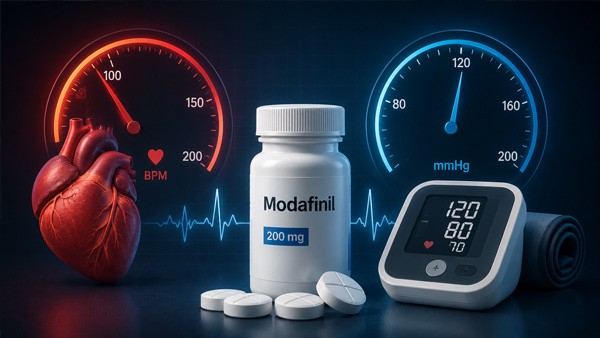
Modafinil produces mild cardiovascular activation — small but real and persistent across the duration of use. The mean effects across published studies are an increase of approximately 1-3 bpm in resting heart rate and 1-3 mmHg in systolic blood pressure at the standard 200 mg dose. These numbers are clinically modest in healthy patients — comparable to the cardiovascular effect of a strong cup of coffee — and most users tolerate them without intervention or even noticeable subjective awareness. For patients with pre-existing cardiovascular disease, the same small effects matter more because they stack on top of an already-elevated baseline, and the FDA-labeled contraindications reflect this stratification.
This guide addresses the cardiovascular question with the granularity it deserves: the actual numbers from published trials rather than vague "may affect heart" warnings, the specific pre-existing conditions that contraindicate modafinil use, the warning symptoms that warrant immediate discontinuation versus those that warrant only clinical follow-up, the pre-use screening that catches contraindications before the first dose, the four-tier cardiac risk stratification that maps patient profiles to appropriate caution levels, the at-home BP/HR monitoring protocol that catches problematic trends early during use, and the symptom-to-action decision matrix that tells you what to do when something feels off. The goal is calibrated clinical accuracy rather than either dismissive reassurance or alarmism.
| Measurement | 🟢 Expected on modafinil | 🟡 Watch closely | 🔴 Stop & consult |
|---|---|---|---|
| Resting heart rate | Baseline +1-3 bpm | Baseline +5-10 bpm | Baseline +15 bpm or >100 bpm |
| Systolic blood pressure | Baseline +1-3 mmHg | Baseline +5-10 mmHg | Baseline +15 mmHg or >160 |
| Diastolic blood pressure | Baseline +1-2 mmHg | Baseline +5-10 mmHg | >100 mmHg sustained |
| Chest sensation | None / subtle awareness | Mild palpitations | Pain, pressure, tightness |
| Heart rhythm | Regular, slightly faster | Occasional irregular beats | Sustained irregular / racing |
| Exercise tolerance | Unchanged / mildly improved | Mildly decreased | Significantly decreased |
| Dizziness / fainting | None | Mild lightheadedness on standing | Syncope, near-syncope |
The dashboard frames your self-monitoring. Anything in the green column is expected and not concerning. Anything in the yellow column warrants closer attention and physician consultation at routine follow-up. Anything in the red column is reason to stop the drug and seek same-day medical evaluation.
❤️ Average Heart Rate Increase
The heart rate effect of modafinil is one of the most consistently reproduced findings in the safety literature. Across multiple randomized controlled trials and open-label extension studies enrolling thousands of patients, the mean resting heart rate increase at standard 200 mg dose is approximately +1 to +3 beats per minute. This is a small effect — for comparison, a single cup of coffee typically increases heart rate by 2-5 bpm, and moderate physical activity increases it by 30-80 bpm. The modafinil effect is in the lower range of recognized cardiovascular activators.
The mechanism is straightforward. Modafinil engages noradrenergic and dopaminergic pathways that increase sympathetic nervous system tone. The cardiovascular system responds to elevated sympathetic activity with increased heart rate (via beta-1 adrenergic receptor stimulation in the sinoatrial node) and modest blood pressure elevation (via beta-1 cardiac effects plus alpha-1 vasoconstriction). The magnitude of the effect is much smaller than classical stimulants because modafinil's adrenergic engagement is mild relative to amphetamines or methylphenidate — but it is real and present throughout the drug's plasma window.
Individual variation around the mean is meaningful. Most users experience the +1-3 bpm average. Some users (typically those with high baseline sympathetic activity or stimulant sensitivity) experience +5-10 bpm. A small minority experience +10-15 bpm — usually traceable to higher dose, concurrent caffeine intake, or pre-existing condition that amplifies sympathetic response. The dose-effect relationship is roughly linear up to standard doses and then flattens — doubling dose to 400 mg does not double the HR effect, though it does increase it modestly.
| Modafinil dose | Typical HR increase | HR increase 95th percentile | Practical relevance |
|---|---|---|---|
| 100 mg (half tablet) | +1-2 bpm | +5 bpm | Minimal in most users |
| 200 mg (standard) | +1-3 bpm | +8 bpm | Standard expected pattern |
| 300 mg | +2-5 bpm | +10 bpm | Slightly higher; noticeable in some |
| 400 mg (high) | +3-6 bpm | +12 bpm | Above standard; worth monitoring |
| 200 mg + 200 mg caffeine | +3-7 bpm | +15 bpm | Additive — common stacking pattern |
| 200 mg + 400 mg caffeine | +5-10 bpm | +18 bpm | Stacking exceeds either alone meaningfully |
🩸 Blood Pressure Changes
The blood pressure effect parallels the heart rate effect in magnitude and mechanism. Mean increases across studies at standard 200 mg dose are approximately +1 to +3 mmHg systolic and +1 to +2 mmHg diastolic. Again — modest in absolute terms, but clinically relevant context for patients with borderline or established hypertension.
Several specific BP considerations matter for long-term modafinil users:
- The effect is persistent rather than progressive. If you have +2 mmHg at month 1, you typically have +2 mmHg at month 12. The mild elevation does not accumulate further over time. This is reassuring — the long-term BP effect is the same as the short-term BP effect, not worse.
- Peak effect aligns with peak plasma. Highest BP elevation typically occurs 2-4 hours after dosing, parallel to the modafinil plasma peak. By evening as drug levels taper, BP returns toward baseline.
- White-coat effect is real. Patients aware they are being measured during modafinil use sometimes show larger BP elevation in clinic than ambulatory at-home monitoring would suggest. Home BP monitoring (described in the dedicated section below) gives more accurate trend data than office readings alone.
- Stacking with caffeine amplifies the effect. The combination of standard modafinil dose plus 2-3 cups of coffee produces noticeably higher BP elevation than modafinil alone — typically additive (modafinil's +2 mmHg plus caffeine's +5 mmHg = +7 mmHg total).
- Already-treated hypertension may need dose adjustment. Patients on antihypertensive medications starting modafinil sometimes find their previously-controlled BP creeps up by 5-10 mmHg, requiring slight increase in antihypertensive dose. This is manageable but requires monitoring during the first 3 months of modafinil use.
- New-onset hypertension on modafinil is uncommon. Approximately 3-5% of long-term users develop new hypertension (sustained BP >140/90) attributable to modafinil. This rate is meaningfully above background but still represents a minority of users.
- BP reversibility on discontinuation. The BP effect reverses fully within 1-2 weeks of stopping modafinil. There is no evidence of permanent vascular changes from long-term use at therapeutic doses.
🫀 Pre-Existing Heart Conditions
The FDA-labeled contraindications and cautions for modafinil reflect the clinical understanding that mild cardiovascular effects matter more when added to pre-existing cardiac disease. The relevant conditions:
Absolute contraindications (do not use modafinil):
- Left ventricular hypertrophy: Heart muscle thickening from chronic hypertension or other causes. Modafinil's mild pressor effect risks worsening this structural change over time.
- Mitral valve prolapse with significant regurgitation: The cardiac stress of mild sympathetic activation is not appropriate for this valve disorder.
- Recent myocardial infarction (within 6 months): Healing cardiac tissue should not be subjected to additional cardiac demand from sympathetic activation.
- Cardiogenic shock or acute heart failure: Absolute contraindication; modafinil would worsen demand-supply mismatch.
- Severe ventricular arrhythmia history: Modafinil's sympathetic activation could trigger recurrence.
- Wolff-Parkinson-White syndrome with atrial fibrillation: Risk of rapid ventricular response with sympathetic activation.
Relative cautions (use only after cardiology consultation):
- Treated hypertension: Generally safe but requires BP monitoring and possible antihypertensive dose adjustment.
- Stable coronary artery disease without recent MI: Often acceptable with cardiologist input and BP monitoring.
- Atrial fibrillation, well-rate-controlled: Risk-benefit decision with cardiologist input; may be acceptable depending on rate control adequacy.
- Heart failure with preserved ejection fraction (HFpEF): Conservative practice is to avoid; some specialists permit with monitoring.
- Long QT syndrome: Theoretical risk of QT prolongation interaction; cardiology consultation needed before use.
- Pacemaker or implantable defibrillator: Generally acceptable but device-monitoring follow-up should be aware of drug change.
- History of stimulant-induced arrhythmia: Suggests sympathetic sensitivity; cautious approach with low starting dose.
Conditions where caution is generally unnecessary:
- Healthy adults without family history of cardiovascular disease.
- Mild well-controlled hypertension on monotherapy.
- History of mild benign arrhythmia (e.g., occasional PACs) without symptoms.
- Mitral valve prolapse without regurgitation or symptoms.
- Athletes with sinus bradycardia (typical resting HR 45-60 bpm).
🚨 Warning Signs to Stop
Specific cardiovascular symptoms warrant immediate discontinuation of modafinil and prompt medical evaluation. These are not minor monitoring observations — they are stop-the-drug-today indicators:
- 🔴 Chest pain, pressure, or tightness. Sustained chest discomfort during modafinil use can indicate myocardial ischemia. Stop modafinil immediately; same-day emergency evaluation. Do not assume it is anxiety or muscle strain without ruling out cardiac causes.
- 🔴 Sustained heart rate >100 bpm at rest. Tachycardia at rest is not the normal modafinil pattern. Sustained elevation above your established baseline by >15 bpm warrants stopping the drug and physician evaluation.
- 🔴 Severe shortness of breath, particularly at rest. Dyspnea during modafinil use can indicate cardiac dysfunction or arrhythmia. Stop modafinil; emergency evaluation.
- 🔴 Syncope (fainting) or near-syncope. Loss of consciousness or near-loss during modafinil use warrants emergency evaluation — possible arrhythmia, blood pressure regulation problem, or other serious issue.
- 🔴 Sustained irregular heart rhythm. Occasional skipped beats (PACs, PVCs) are common and usually benign. Sustained irregular rhythm, atrial fibrillation pattern (irregularly irregular), or palpitations lasting hours warrant stopping modafinil and cardiac evaluation.
- 🔴 Severe headache plus elevated BP >180/110. This combination suggests hypertensive emergency. Stop modafinil; emergency evaluation.
- 🔴 Swelling of legs/ankles, sudden weight gain. Can indicate fluid retention from cardiac dysfunction. Stop modafinil; physician evaluation within 24-48 hours.
- 🔴 Visual changes, numbness, weakness on one side. Could indicate stroke or transient ischemic attack. Emergency evaluation immediately; stop modafinil.
- 🟡 New onset of mild palpitations. Not emergency, but warrants discussion with physician at routine follow-up. May resolve with dose reduction or caffeine elimination.
- 🟡 BP that creeps above 140/90 on consistent home monitoring. Warrants physician evaluation and possible intervention but not emergency.
📋 Pre-Use Screening
The pre-use cardiac screening below should be completed before starting modafinil. The checklist is conservative — most healthy adults will pass everything quickly, but anyone with positive findings should discuss with their physician before proceeding:
| Screening item | Method | Action if abnormal |
|---|---|---|
| Resting BP measurement | Home or clinic, 3 readings on different days | If >140/90 — manage hypertension before starting modafinil |
| Resting heart rate measurement | 5-minute quiet sit, count 60 seconds | If >90 bpm at rest — evaluate underlying cause first |
| Personal history: prior MI, angina, arrhythmia | Recall and document | Positive history — cardiology consultation before modafinil |
| Family history: early cardiac death (<55 male / <65 female) | Recall and document | Positive history — consider ECG before modafinil |
| Symptoms: chest pain on exertion, shortness of breath | Self-report | Positive symptoms — evaluate before modafinil |
| Current cardiac medications | Medication review | Document; coordinate with prescribing physician |
| ECG (selective — if any of the above positive or age >50) | Standard 12-lead ECG | Cardiology referral if abnormalities |
| Echocardiogram (only if symptomatic or LVH suspected) | Cardiac ultrasound | Cardiology consultation if abnormalities |
The screening level should be proportional to risk:
- Healthy young adult (<40 years), no personal/family history: BP and HR check is sufficient. ECG not routinely required.
- Healthy middle-aged adult (40-60 years), no personal/family history: BP, HR, plus consider baseline ECG.
- Adult with risk factors but no diagnosed disease: BP, HR, ECG, and discuss with primary care before starting.
- Adult with diagnosed cardiac disease: Full cardiology evaluation including ECG and possibly echo before starting; ongoing cardiology coordination throughout use.
- Older adult (>65 years): Lower threshold for ECG; conservative starting dose (100 mg) with close monitoring; cardiology input recommended.
🎯 Cardiac Risk Stratum Classification
Patients differ meaningfully in how cautiously they should approach modafinil cardiovascular monitoring. The four-tier stratification below maps patient profiles to appropriate caution levels:
Stratum 1 — "Low cardiac risk." Healthy adult with normal BP, normal HR, no personal or family cardiac history, no diabetes, normal lipid profile if known. Modafinil cardiovascular monitoring is minimal: confirm baseline BP and HR before starting, recheck at 3 months, then routine annual surveillance. The probability of clinically significant cardiovascular issue is low. Standard 200 mg dose is appropriate starting point.
Stratum 2 — "Modest cardiac risk." Adult with one risk factor — mild controlled hypertension, family history of cardiovascular disease, mild dyslipidemia, smoking history, or age >60. Modafinil cardiovascular monitoring is moderate: baseline BP and HR plus ECG before starting, recheck BP/HR at 1 month, 3 months, 6 months, then annual. Standard 200 mg dose acceptable but consider starting at 100 mg for the first month to assess individual response before escalating.
Stratum 3 — "Significant cardiac risk." Adult with multiple risk factors — uncontrolled hypertension, diabetes plus dyslipidemia, history of TIA or minor stroke, family history of early cardiac death, recent abnormal stress test, or known coronary artery disease without recent MI. Modafinil should be initiated only with cardiology input. Full pre-use evaluation including ECG and possibly echocardiogram. Start at 100 mg; monitor weekly BP for first month; cardiology re-evaluation at 3 months. Some patients in this stratum should not use modafinil at all — the risk-benefit assessment requires specialist input.
Stratum 4 — "Contraindicated." Adult with any FDA-labeled absolute contraindication — left ventricular hypertrophy, mitral valve prolapse with regurgitation, recent MI, severe ventricular arrhythmia, cardiogenic shock, Wolff-Parkinson-White with atrial fibrillation. Modafinil should not be used. Alternative wakefulness or cognitive enhancement strategies should be discussed with the patient's care team.
| Risk stratum | Profile | Recommended approach | Monitoring frequency |
|---|---|---|---|
| Stratum 1 (Low) | No cardiac risk factors | Standard approach, 200 mg start | Baseline, 3 months, annual |
| Stratum 2 (Modest) | 1 risk factor, mild | Cautious approach, consider 100 mg start | Baseline, 1 mo, 3 mo, 6 mo, annual |
| Stratum 3 (Significant) | Multiple risk factors | Specialist input, 100 mg start mandatory | Baseline, weekly first month, then monthly to 6 mo, then quarterly |
| Stratum 4 (Contraindicated) | FDA absolute contraindication | Do not use modafinil | N/A — alternative strategy |
🏠 At-Home BP/HR Monitoring Protocol
For users in Strata 1-2, simple at-home monitoring with a basic automated BP cuff provides the data that catches problems early and reassures about the common-but-mild findings. The protocol below works for most users:
Equipment: Standard upper-arm automated BP cuff (wrist cuffs are less accurate; finger devices are not reliable). Costs $30-80 USD for adequate devices. Single device shared by household members is fine.
Pre-modafinil baseline establishment:
- Measure BP and HR at the same time of day (typically morning before coffee) for 7 consecutive days before starting modafinil.
- For each measurement: sit quietly for 5 minutes, feet flat on floor, arm supported at heart level, no talking during measurement. Take 2 readings 2 minutes apart; average them.
- Calculate your 7-day average. This is your baseline.
Early modafinil monitoring (first 30 days):
- Measure BP and HR at the same time of day, 2-3 hours after taking modafinil (during peak window) for the first 30 days.
- Track daily readings. Look for trend rather than reading-to-reading variability.
- Expected pattern: small increase from baseline (+1-3 mmHg systolic, +1-3 bpm HR). Stable across days.
- Concerning pattern: sustained increase >5 mmHg or >5 bpm from baseline that does not stabilize. Worth discussing with physician.
- Stop-the-drug pattern: any reading >160/100 or sustained HR >100 bpm.
Maintenance monitoring (after first 30 days):
- Reduce to once-weekly measurement at the same morning time.
- Track for 3 months to confirm stable pattern.
- After 3 months, monthly measurement is sufficient for most users.
- Re-establish baseline if you change dose, add caffeine, or develop any new symptoms.
Documenting your readings: Simple notebook or spreadsheet works. Track date, time, BP, HR, modafinil dose, time since last dose, caffeine intake that day, anything notable. This data becomes valuable if you ever need physician input — actual measurements over weeks beat verbal recall.
🗺️ Symptom → Action Decision Matrix
When something feels off cardiovascularly during modafinil use, the matrix below maps the specific symptom to the appropriate action. Use this rather than guessing or relying on online symptom checkers:
| Symptom | First action | Escalation if persists |
|---|---|---|
| Mild awareness of heart beating | Take BP/HR reading; hydrate; reduce caffeine that day | Discuss at next routine appointment |
| Occasional skipped beats | Take BP/HR; reduce caffeine; track frequency | Discuss at next routine appointment if >3 per day |
| Mild palpitations during peak window | Stop activities, breathe slowly, hydrate | Reduce dose or stop modafinil; physician consult within 1 week |
| Sustained palpitations >30 minutes | Take BP/HR; sit down; breathe slowly | Same-day urgent care or telehealth physician consult |
| Mild chest discomfort, fleeting | Stop activity, rest, take BP/HR | Same-day physician contact even if resolved |
| Sustained chest pain or pressure | STOP modafinil. Call emergency services. | Emergency evaluation |
| Shortness of breath at rest | STOP modafinil. Sit, take BP/HR. | Same-day emergency or urgent care |
| Dizziness on standing | Take BP standing vs sitting; hydrate | Reduce dose; physician consult within 1 week |
| Sustained tachycardia >100 bpm at rest | STOP modafinil. Sit quietly. Recheck in 30 min. | Urgent care if still elevated |
| Syncope or near-syncope | STOP modafinil. Lie down. Have someone with you. | Emergency evaluation |
| BP reading >180/110 | STOP modafinil today. Recheck after 30 minutes. | Same-day urgent care if still elevated |
| Leg/ankle swelling, sudden weight gain | STOP modafinil. Take BP/HR. | Physician evaluation within 24-48 hours |
| Vision changes, weakness one side, slurred speech | Call emergency services immediately. | Emergency evaluation |
✨ Bottom Line
Modafinil's cardiovascular effects are mild in absolute terms but real and persistent throughout drug use. Mean increases at standard 200 mg dose are approximately +1-3 mmHg blood pressure and +1-3 bpm heart rate — comparable to a strong cup of coffee. For Stratum 1 patients (healthy adults without cardiac risk factors), these effects are clinically minor and require minimal monitoring beyond baseline and annual surveillance. For Stratum 2 patients (single risk factor), cautious approach with more frequent early monitoring is appropriate. For Stratum 3 patients (significant cardiac risk), specialist input and careful surveillance are necessary throughout use. For Stratum 4 patients with FDA-labeled absolute contraindications, modafinil should not be used at all.
The pre-use cardiac screening — baseline BP and HR, family and personal history review, ECG if indicated by risk factors — catches contraindications before the first dose. The at-home BP/HR monitoring protocol (7-day baseline before starting, daily measurement for first 30 days, weekly for 3 months, monthly thereafter) catches problematic trends early. The symptom-to-action decision matrix tells you what to do when something feels off, ranging from "discuss at next appointment" through "stop modafinil and call emergency services" depending on severity.
Warning signs warranting immediate stop and medical evaluation: chest pain or pressure, sustained tachycardia >100 bpm, severe dyspnea, syncope, sustained irregular rhythm, hypertensive readings >180/110, leg swelling with weight gain, or neurological symptoms. These are not minor monitoring observations — they are stop-the-drug-today indicators.
For most appropriately selected patients in Strata 1-2, modafinil's cardiovascular profile is well-tolerated and does not require discontinuation. The combination of conservative starting approach, structured baseline establishment, and structured monitoring catches the rare problems while reassuring users about the common-but-mild findings.
For pharmaceutical-grade modafinil with split-scored tablets allowing flexible dose management throughout cardiac monitoring, Modalert 200 mg from Sun Pharma remains the most widely used generic. For users where cardiovascular sensitivity is a primary concern, Waklert 150 mg (armodafinil) sometimes produces a slightly smoother cardiovascular profile due to the smoother plasma curve — see Modafinil vs Armodafinil for the comparison.
For broader context on related cardiovascular considerations during modafinil use, see our companion articles Modafinil and Anxiety (anxiety-related cardiovascular sensations that mimic cardiac symptoms), Modafinil vs Caffeine (caffeine stacking compounds cardiovascular load), and Modafinil Long-Term Side Effects (sustained cardiovascular monitoring across years of use).
❓ Frequently Asked Questions
How much does modafinil raise heart rate?
The mean increase at standard 200 mg dose is approximately +1-3 bpm — small in absolute terms, comparable to the effect of a single strong cup of coffee. Individual variation around this mean is real; some users experience +5-10 bpm and a small minority experience +10-15 bpm, usually traceable to higher dose, concurrent caffeine intake, or pre-existing sympathetic sensitivity. The effect peaks at the modafinil plasma peak (2-4 hours post-dose) and tapers as drug levels decline through the day.
Will modafinil raise my blood pressure?
Likely yes, but by a small amount. Mean increases across published studies are +1-3 mmHg systolic and +1-2 mmHg diastolic at standard 200 mg dose. The effect persists throughout drug use without progressive worsening. For healthy adults without hypertension, this is clinically minor. For patients with established hypertension or borderline BP, the small effect matters more because it stacks on already-elevated baseline — and may require slight adjustment of antihypertensive medication. Home BP monitoring during the first 30 days of modafinil use catches any problematic trends.
Is modafinil safe if I have high blood pressure?
Generally yes, with proper monitoring, if your hypertension is well-controlled on medication. Most patients with controlled hypertension tolerate modafinil without issue, sometimes requiring slight increase in their antihypertensive dose. If your hypertension is uncontrolled (sustained BP >140/90 despite treatment), manage that first before starting modafinil. If your hypertension is severe (>160/100 or stage 2), modafinil is relative contraindication and should be discussed with your cardiologist before any use.
Can modafinil cause a heart attack?
Very rarely, in patients with significant pre-existing coronary disease. Modafinil itself does not cause heart attacks in healthy adults at therapeutic doses — long-term studies and post-marketing surveillance do not show MI signal above expected background. In patients with pre-existing severe coronary artery disease, any drug producing sympathetic activation theoretically increases demand and could precipitate ischemia. This is why modafinil is contraindicated in patients with recent MI or severe coronary disease. For appropriately selected patients without these risk factors, MI risk attributable to modafinil is essentially zero.
What if my heart races on modafinil?
Take your pulse and count for a full 60 seconds. If <100 bpm and resolving: hydrate, eliminate caffeine that day, reduce future dose. If sustained >100 bpm: stop modafinil for today, sit quietly, recheck in 30 minutes. If still elevated or recurring: seek urgent care or same-day physician consultation. If accompanied by chest pain, shortness of breath, dizziness, or syncope: emergency evaluation immediately. Persistent racing heart on modafinil is a stop-the-drug-and-investigate situation, not a continue-and-hope situation.
Should I get an ECG before starting modafinil?
Depends on your risk profile. For healthy adults under 40 without family history of cardiac disease, ECG is not routinely required — BP/HR baseline measurement is sufficient. For adults 40-60 with any cardiovascular risk factor (family history, hypertension, smoking, diabetes), baseline ECG is reasonable. For adults >60, baseline ECG is generally recommended even without specific risk factors. For anyone with personal cardiac history or symptoms, ECG is required, and cardiology consultation is recommended before starting.
Does the cardiovascular effect of modafinil get worse over time?
No. The cardiovascular effect is persistent but not progressive — if you have +2 mmHg at month 1, you typically have +2 mmHg at month 12 and beyond. Long-term studies up to 3 years show no progressive worsening. This is reassuring for chronic users: the early cardiovascular response is the same as the sustained response, not worse. Annual BP/HR monitoring catches any new issues but the cardiovascular pattern itself does not deteriorate with continued use.
Can I combine modafinil with my blood pressure medication?
Generally yes, with monitoring. Modafinil does not have major drug-drug interactions with most antihypertensives (ACE inhibitors, ARBs, calcium channel blockers, thiazide diuretics, beta-blockers). The interaction to watch for is the additive effect — modafinil's mild pressor effect partially counters your antihypertensive's effect, sometimes requiring slight dose increase of the antihypertensive. Monitor BP for 3 months after starting modafinil and adjust antihypertensive dose if needed under physician guidance.
What's the difference between modafinil cardiovascular effects and Adderall or Ritalin?
Substantially gentler. Methylphenidate (Ritalin) typically raises BP by 3-10 mmHg and HR by 5-15 bpm; amphetamines (Adderall, Vyvanse) similar or slightly higher. Modafinil's +1-3 mmHg and +1-3 bpm are meaningfully smaller than either stimulant class. For patients with cardiovascular sensitivity or borderline disease, modafinil is the substantially preferable option among wakefulness-promoting agents. See Modafinil vs Ritalin and Modafinil vs Vyvanse for full comparisons.
What's the safest way to use modafinil if I'm cardiovascularly cautious?
Start at 100 mg (half tablet) rather than 200 mg. Eliminate or substantially reduce caffeine during initiation. Establish 7-day BP/HR baseline before starting. Monitor daily during first 30 days. Stop and seek evaluation if any warning signs develop. After 3 months of stable response, taper monitoring to weekly then monthly. Have a clear exit plan if cardiovascular issues develop — modafinil is not the only option, and discontinuation is graceful. The combination of conservative starting approach plus systematic monitoring plus willingness to stop catches problems early and minimizes risk for cardiovascularly cautious users.
📚 References & Further Reading
- FDA prescribing information for Provigil (modafinil) — cardiovascular adverse effect profile and contraindications.
- FDA prescribing information for Nuvigil (armodafinil) — comparative cardiovascular safety data.
- Roth et al., Sleep — cardiovascular safety analysis in modafinil long-term studies.
- Black & Houghton, Sleep 2006 — 12-month extension cardiovascular monitoring data in OSA patients.
- Mitler et al., Sleep Medicine — 40-week safety study including detailed cardiovascular parameters.
- American Heart Association — clinical guidelines on hypertension management and stimulant medication considerations.
- American College of Cardiology — practice guidelines on cardiac evaluation before initiating CNS stimulants.
- European Society of Cardiology — guidelines on cardiovascular safety of psychotropic medications.
- JNC 8 / 2017 ACC/AHA Hypertension Guidelines — BP thresholds for diagnosis and management.
- Cochrane reviews on modafinil safety — periodic meta-analyses summarizing cardiovascular outcome data.
- FDA Adverse Event Reporting System (FAERS) — post-marketing cardiovascular adverse event surveillance.
- Modafinil Headaches — companion side-effect management article.
- Modafinil Insomnia: How to Sleep After Taking It — companion sleep management article.
- Modafinil and Anxiety — companion anxiety article; anxiety symptoms can mimic cardiac symptoms.
- Modafinil Long-Term Side Effects — companion long-term safety article with cardiovascular long-term data.
- Modafinil vs Ritalin — methylphenidate cardiovascular comparison.
- Modafinil vs Vyvanse — amphetamine-class cardiovascular comparison.
- Modafinil vs Armodafinil — R-enantiomer cardiovascular comparison.
- Modafinil vs Caffeine — relevant for caffeine stacking effect on cardiovascular load.
- Modalert 200 mg, Modvigil 200 mg, Waklert 150 mg — primary product pages on the RXshop antinarcoleptic catalogue.
- RXshop Editorial Team — content reviewed by licensed pharmacist; for adult patient education, not a substitute for individual medical consultation.
Medical Disclaimer: The information in this article is for educational and informational purposes only and is not a substitute for professional medical advice, diagnosis, or treatment. Always seek guidance from a qualified healthcare provider with any questions you may have regarding a medical condition, and before starting, stopping or changing any medication.