Modalert vs Provigil: Generic vs Brand

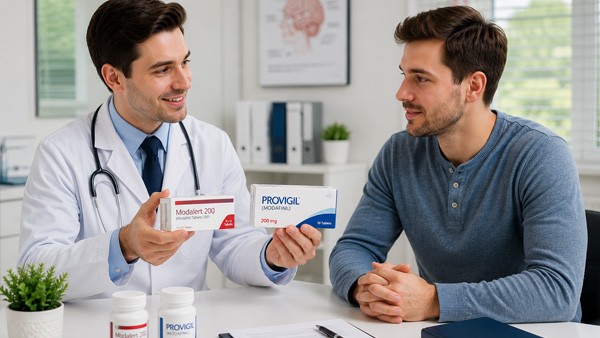
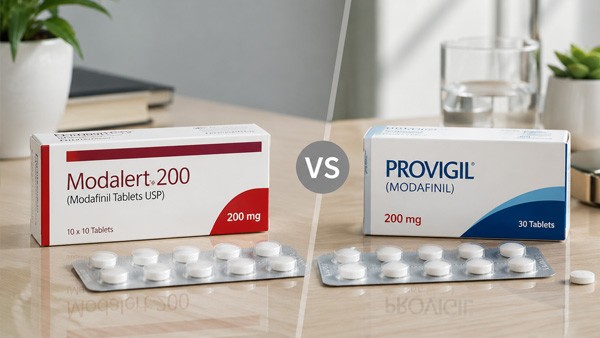
Modalert and Provigil contain the same active ingredient at the same dose with the same FDA-required bioequivalence profile. The only meaningful differences are the manufacturer name printed on the blister, the inactive excipients (binders, coatings, fillers) that vary between manufacturers without affecting clinical action, and the price — which differs by approximately one order of magnitude. Modalert 200 mg from Sun Pharma typically costs $0.80-$2.00 per tablet in legitimate generic channels; Provigil 200 mg from Teva (the current US brand-name holder after acquiring Cephalon) typically costs $30-$60 per tablet at US retail pharmacies. Both contain 200 mg of modafinil, both produce the same wake-promoting effect, both are subject to regulatory oversight — and one of them costs roughly 30-50× more than the other.
This guide explains why two products with identical active ingredients can sell at such radically different prices, what bioequivalence actually means in regulatory and clinical terms, who Sun Pharma is and why their manufacturing reputation matters, the narrow legitimate scenarios where the brand-name product might genuinely be preferable, the historical patent story that created the price differential in the first place, how legitimate generic supply chains actually work, and — critically — how to distinguish a real licensed generic from a counterfeit. The price difference is real and economically meaningful; understanding why it exists is what lets patients make an informed choice rather than a confused one.
| Product | Typical per-tablet cost | 30-day supply |
|---|---|---|
| Provigil 200 mg (US brand, Teva) | $30 – $60 | $900 – $1,800 |
| Modalert 200 mg (Sun Pharma generic) | $0.80 – $2.00 | $24 – $60 |
| Multiplier | ~30-50× | ~30-50× |
Same molecule. Same dose. Same FDA bioequivalence requirements. Different price by one full order of magnitude.
🧬 Same Active Ingredient
The active pharmaceutical ingredient (API) in both products is modafinil — 2-[(diphenylmethyl)sulfinyl]acetamide — at a standard dose of 200 mg per tablet. The molecular structure, molecular weight (273.35 g/mol), pharmacological mechanism, and metabolic pathway are identical across both products because they contain literally the same chemical compound. There is no version of modafinil that is "stronger" or "weaker" based on which manufacturer produced it — 200 mg of modafinil from Sun Pharma's Sikkim plant has the same molecular action as 200 mg of modafinil from Teva's Provigil supply chain.
What does differ between any two modafinil products are the inactive excipients — the binders, fillers, disintegrants, coatings, colorants, and other non-API components that hold the tablet together and control its dissolution. Provigil uses one set of excipients (lactose monohydrate, magnesium stearate, microcrystalline cellulose, povidone, croscarmellose sodium, talc, and pregelatinized starch per the FDA label); Modalert uses Sun Pharma's own excipient blend optimized for their manufacturing process. The excipient differences are real but clinically inconsequential for the vast majority of patients — they affect how the tablet looks, how it dissolves, and how it tastes, but not what the drug does in your bloodstream.
The only patients for whom excipient differences matter clinically are those with specific allergies or intolerances to particular excipients. Lactose-intolerant patients sensitive enough to react to small lactose quantities should check whether either product contains lactose. Patients with confirmed allergies to specific dyes, gluten, or sulfites should similarly verify the excipient list. For everyone else — meaning >99% of users — the excipient differences are not detectable and not clinically relevant.
| Property | Provigil 200 mg (Teva) | Modalert 200 mg (Sun Pharma) |
|---|---|---|
| Active ingredient | Modafinil 200 mg | Modafinil 200 mg (identical molecule) |
| Chemical formula | C₁₅H₁₅NO₂S | C₁₅H₁₅NO₂S |
| Molecular weight | 273.35 g/mol | 273.35 g/mol |
| Enantiomer composition | 50/50 R + S racemic mix | 50/50 R + S racemic mix |
| FDA bioequivalence requirement | Reference standard | Must meet 80-125% AUC + Cmax range |
| Mechanism of action | DAT inhibition + histamine/orexin | DAT inhibition + histamine/orexin (identical) |
| Half-life | ~12-15 hours | ~12-15 hours |
| Tablet appearance | White, oval, scored, "PROVIGIL 200 MG" | White, oval, scored, "Modalert 200" |
📊 Bioequivalence Data
Bioequivalence is the regulatory standard that allows a generic drug to be marketed as therapeutically equivalent to a brand-name reference product. The FDA standard, harmonized internationally with the EMA and most other major regulators, requires that the generic produce plasma concentrations of the active ingredient that fall within 80-125% of the reference product for both AUC (area under the curve — total drug exposure) and Cmax (peak concentration). The test uses a randomized crossover design in healthy volunteers with each subject taking both products on separate occasions with a washout period in between. Pharmacokinetic parameters are then compared statistically with 90% confidence intervals.
The 80-125% range may sound wide but is actually quite tight in pharmacological terms — it represents a confidence interval, not a tolerance, and the actual point estimates for most legitimate generics fall in the 95-105% range vs the reference. For modafinil specifically, published bioequivalence studies for Sun Pharma's generic modafinil (and other licensed Indian generics including HAB's Modvigil) consistently report AUC ratios in the 96-102% range and Cmax ratios in 94-104% — well within the regulatory threshold and clinically indistinguishable from the brand reference.
For the patient, the practical meaning is this: after you swallow Modalert and after you swallow Provigil, the curves of modafinil concentration in your bloodstream over the next 24 hours are statistically indistinguishable. The same amount of drug enters circulation, reaches the same peak at the same time, and clears at the same rate. The clinical effect — wakefulness, focus, side effects — is therefore identical within measurement error.
| Bioequivalence parameter | FDA requirement | Typical generic modafinil result |
|---|---|---|
| AUC ratio (test/reference) | 90% CI within 80-125% | Point estimate typically 96-102% |
| Cmax ratio (test/reference) | 90% CI within 80-125% | Point estimate typically 94-104% |
| Tmax (time to peak) | No specific limit; descriptive | 2-4 hours both products |
| Half-life | No specific limit; descriptive | 12-15 hours both products |
| Dissolution profile | Must match reference | f2 similarity factor >50 (matches) |
| Manufacturing GMP | FDA inspection of facility | Sun Pharma facilities FDA-inspected |
| Stability | 2-year shelf life demonstrated | Same 2-year shelf life |
💵 Price Comparison (10×+)
The price gap between brand-name Provigil and licensed generic Modalert is among the largest in the modern pharmaceutical market for a drug with no clinical difference between products. The gap exists for structural reasons that have nothing to do with manufacturing cost or drug quality and everything to do with patent economics, US healthcare market dynamics, and the long historical tail of the brand-name commercial position.
Provigil's US retail price reflects the original Cephalon (now Teva) brand-name pricing strategy. When Cephalon originally launched Provigil in 1998, the drug was patent-protected and the company recouped R&D investment plus profit through high US retail pricing. The patent has since expired, generic equivalents are now available even in the US market, but the brand-name Provigil price has remained stubbornly high because some prescriptions still specify "dispense as written" and some insurance formularies still cover brand. The result is that Provigil 200 mg can run $30-60 per tablet at US pharmacies in 2026 — essentially the same nominal price as in 2010, despite the patent expiry.
Modalert's pricing reflects the cost of legitimate generic manufacturing in India under stringent regulatory oversight, combined with the much smaller margin structure of the generic market. Sun Pharma manufactures Modalert in WHO-approved facilities, the API is sourced from validated suppliers, and the finished product undergoes the same quality testing as any pharmaceutical. The per-tablet cost reflects actual manufacturing economics — ingredient cost, labor, facility overhead, quality control, packaging, logistics — plus a reasonable margin. There is no R&D cost to recover because the originator drug's R&D was completed and amortized decades ago.
| Tablets | Provigil 200 mg (US retail) | Modalert 200 mg (licensed generic) | Savings |
|---|---|---|---|
| 10 tablets | $300 – $600 | $15 – $25 | ~95% cheaper |
| 30 tablets (1 month) | $900 – $1,800 | $24 – $60 | ~96% cheaper |
| 90 tablets (3 months) | $2,700 – $5,400 | $72 – $180 | ~97% cheaper |
| 180 tablets (6 months) | $5,400 – $10,800 | $144 – $360 | ~97% cheaper |
| Annual cost | ~$10,800 – $21,600 | ~$288 – $720 | ~97% cheaper |
🏭 Quality Control at Sun Pharma
Sun Pharma is the largest pharmaceutical company in India and the world's fourth-largest specialty generic pharmaceutical company by revenue. Founded in 1983 in Vapi, India, Sun Pharma has grown through organic expansion and major acquisitions (including the 2014 acquisition of Ranbaxy, then-India's largest pharmaceutical company) to operate manufacturing facilities across India, the US, Israel, and several other countries. The company supplies generic and branded pharmaceuticals to over 150 countries and is publicly listed on the Bombay Stock Exchange.
Sun Pharma's manufacturing facilities are inspected and approved by major international regulators, including the US FDA, the UK MHRA, the European EMA, the WHO prequalification program, and numerous national regulatory authorities. The Halol, Dadra, and Mohali facilities have all received FDA clearance to manufacture products for the US market — including some products sold under generic labels in US pharmacies. Modalert specifically is manufactured at FDA-inspected facilities under cGMP (current Good Manufacturing Practice) standards harmonized with US and European requirements.
This international regulatory footprint matters because it means Modalert is not a "Western product made cheaply in India by lower standards" — it is manufactured under the same quality framework that produces drugs for US and European pharmacy shelves. The same Sun Pharma facilities that produce Modalert for the international generic market also produce generic drugs for US distribution under different brand names. The quality standards do not differ based on which market the finished product is shipped to; they reflect the regulatory framework of the manufacturing facility, which is FDA-cleared.
Sun Pharma has had compliance challenges in some product lines over the years — like any large pharmaceutical manufacturer — and has been subject to FDA warning letters at specific facilities at specific times. The Halol facility had FDA observations in 2015-2017 that were subsequently remediated; the Mohali facility had separate observations that were similarly resolved. These compliance histories are public and detailed in FDA inspection databases. Modalert specifically has not been subject to product recalls or quality complaints in legitimate distribution channels.
| Sun Pharma quality dimension | Status |
|---|---|
| US FDA registration | Multiple facilities registered and approved |
| UK MHRA approval | Yes — exports to UK market |
| EU EMA approval | Yes — exports to EU market |
| WHO prequalification | Multiple products WHO-PQ listed |
| cGMP compliance | Standard across approved facilities |
| Public stock listing | BSE / NSE — subject to financial transparency |
| Annual revenue (2024) | ~$5+ billion USD globally |
| Countries served | 150+ |
| Product portfolio breadth | 2,000+ formulations across therapy areas |
🎯 When Brand Might Matter
For most patients, the choice between Modalert and Provigil is a straightforward economic one — same drug, dramatically cheaper option, no clinical reason to pay the premium. But there are a handful of narrow scenarios where the brand-name product might genuinely be preferable. Knowing these helps patients make an informed choice rather than a defensive one driven by generic skepticism that is empirically unfounded.
Persona 1 — "Excipient-sensitive patient." Patients with confirmed allergies to specific inactive ingredients used in one product but not the other have a real clinical reason to prefer the alternative. If you have a documented lactose intolerance severe enough to react to small lactose quantities, check both excipient lists and choose the lactose-free option. This applies to <1% of patients but is a real consideration when it does apply.
Persona 2 — "Insurance-covered brand patient." Patients whose insurance covers brand Provigil with minimal copay (rare in the US market but possible) and does not cover generic equivalents have an economic reason to use brand. In this case the patient is not actually paying $30-60 per tablet; the insurance company is. The patient's out-of-pocket may be $10-30 per month regardless of brand status.
Persona 3 — "Clinical trial participant or research subject." Patients enrolled in clinical research studying modafinil specifically may be required to use the brand-name reference product for protocol consistency. This is a study-design constraint, not a clinical preference.
Persona 4 — "Strong placebo-responder with brand bias." A subset of patients respond more strongly to medications they perceive as "premium" — the placebo effect is real and well-documented. Patients with strong brand bias may genuinely experience better subjective benefit from Provigil than Modalert, even though the pharmacokinetics are identical. This is a real phenomenon but obviously not a sustainable basis for paying 30-50× more for clinically identical product.
Beyond these four narrow personas, several common reasons cited for "preferring brand" do not actually justify the price differential:
- "Brand feels stronger": Pharmacokinetically impossible — same dose, same molecule, same bioequivalence. The perception is psychological.
- "Generic gives me side effects brand didn't": Possible but rare — usually traces to a specific excipient sensitivity rather than the active drug. Try a different licensed generic before assuming brand-specific benefit.
- "Generic is made overseas so I don't trust it": Many US-distributed generic drugs are also manufactured in India and other international locations under the same FDA framework. Country of manufacture is not a quality indicator.
- "Brand has been around longer": Both products contain the same molecule with the same decades of clinical use. The brand name is older; the API is the same age.
- "My doctor prescribed Provigil specifically": Ask why. If the answer is "habit" or "marketing relationship", switching to generic is reasonable. If the answer is a specific clinical reason (excipient allergy, formulary constraint), that reason should be documented.
📜 Patent History — Why Generics Exist Now
Understanding the modafinil generic story requires a brief patent timeline. The story is typical of modern pharmaceutical lifecycle economics:
- 1976: Modafinil first synthesized by Lafon Laboratories (France).
- 1986: Initial European approvals under the brand name Modiodal.
- 1998: FDA approval of Provigil (modafinil) in the United States, marketed by Cephalon under a composition-of-matter patent. Cephalon held exclusive US marketing rights with strong patent protection.
- 1998-2010: Cephalon enjoyed exclusive Provigil marketing in the US, generating peak annual revenues exceeding $1 billion. The brand-name pricing structure established during this period set the high US retail price that persists today.
- 2007: Cephalon launched armodafinil (Nuvigil) — the R-enantiomer-only product — to extend exclusivity past the impending modafinil patent expiry. (See our companion article Modafinil vs Armodafinil for the R-enantiomer story.)
- 2011-2012: US patent litigation between Cephalon and several generic manufacturers (Teva, Mylan, Apotex, Sun Pharma, Ranbaxy) settled, with generic launches authorized to begin. Cephalon paid generic manufacturers to delay launch — later subject to FTC antitrust investigation.
- 2012: Teva acquired Cephalon for ~$6.8 billion, taking ownership of Provigil and Nuvigil.
- 2012-present: Generic modafinil widely available in the US through various manufacturers. International generic supply (including Sun Pharma's Modalert) had been available legally outside the US for years prior, since international patents expired earlier than US patents in many jurisdictions.
- 2026 (current): Modafinil is fully generic globally. Brand-name Provigil continues to be sold in the US at premium pricing primarily through insurance-formulary momentum and prescription-habit inertia. The clinical-equivalence case for generic switching is well-established and uncontested by regulators.
📦 How Legitimate Generic Supply Works
The path from Sun Pharma's manufacturing facility to a patient's medicine cabinet involves several legitimate intermediaries, each adding regulatory oversight and traceability:
- Manufacturing: Sun Pharma manufactures Modalert at one of its FDA-approved facilities in India under cGMP standards. Each manufacturing lot is documented with batch numbers, manufacture dates, and quality test results.
- Quality release: Each batch undergoes finished-product testing for API content, dissolution profile, impurities, and stability indicators before release for distribution.
- Distribution: Released product enters licensed wholesale distribution channels. Wholesalers operate under their own country's pharmacy regulations and maintain chain-of-custody documentation.
- Export: For products intended for international markets, customs documentation, certificates of analysis, and country-of-origin documentation accompany each shipment.
- Pharmacy receipt: Licensed pharmacies receive product with full documentation of source, batch number, expiry date, and storage conditions during transport.
- Patient dispensing: Patient receives product in original blister packaging with manufacturer information, batch number, and expiry date printed on the foil.
At any point in this chain, the product can be traced back to its manufacturing batch and forward to its final dispensing record. Counterfeit products break this chain — they appear in pharmacies through unofficial sourcing, lack proper batch documentation, and cannot be traced backward to a legitimate manufacturing facility. This is what makes counterfeit detection possible.
🛡️ Red Flags — Counterfeits vs Legitimate Generics
The biggest risk to patients buying generic modafinil is not the legitimate generic product itself (which is clinically equivalent to brand) — it is the risk of buying counterfeit product that contains incorrect dose, contaminated material, or no active ingredient at all. Knowing how to distinguish legitimate generics from counterfeits matters more than knowing the bioequivalence statistics:
Red flags that suggest counterfeit risk:
- No manufacturer name on blister: Legitimate Modalert blisters clearly print "Sun Pharma" and "Modalert 200" on the foil. Unlabeled tablets in plain blisters are a major red flag.
- No batch number or expiry date: Every legitimate pharmaceutical blister carries a printed batch (lot) number and an expiry date. Missing either is disqualifying.
- Pricing dramatically below the ~$0.80-$2.00 per tablet range: Sub-$0.30 per tablet is too cheap to be manufactured legitimately at scale and is a counterfeit indicator.
- Inconsistent tablet appearance within a single blister: Variations in size, color, scoring depth, or surface finish between tablets in the same pack suggest non-standard production.
- Tablet that crumbles when scored or has unusual smell/taste: Quality-controlled tablets have consistent mechanical properties and bland taste.
- Source pharmacy with no licensing documentation: Legitimate pharmacies can document their licensing and source chain. Sources that cannot are higher counterfeit risk.
- Packaging in language inconsistent with declared origin: Sun Pharma's Modalert is packaged with consistent English-language labeling globally. Substantially different packaging warrants scrutiny.
- Effect substantially different from previous batches: If your subjective response from a new source is dramatically different from previous legitimate purchases, suspect dose variance or counterfeit.
Green flags that support legitimate sourcing:
- Clear manufacturer name and product name printed on blister foil.
- Visible batch number and expiry date.
- Pricing within the realistic generic market range ($0.80-$2.00 per 200 mg tablet).
- Consistent tablet appearance across the entire pack.
- Pharmacy source with transparent licensing and documentation.
- Familiar packaging consistent with previous legitimate purchases.
- Clinical effect consistent with established personal baseline response.
✨ Bottom Line
Modalert and Provigil contain the same active ingredient, at the same dose, with the same FDA-required bioequivalence profile, producing the same clinical effect — at prices that differ by approximately one order of magnitude. Modalert 200 mg from Sun Pharma is manufactured at FDA-inspected facilities under cGMP standards, regulated by multiple international authorities, and supplied through legitimate generic channels at $0.80-$2.00 per tablet. Provigil from Teva is the brand-name version of the same molecule, priced at $30-60 per tablet at US retail pharmacies, with no clinical performance difference.
For the vast majority of patients, the rational choice is the licensed generic — the savings are substantial, the regulatory framework ensures equivalent quality, and the clinical equivalence is uncontested. Brand Provigil remains a reasonable choice only for the narrow personas where it genuinely matters: confirmed excipient allergies, favorable insurance coverage, research-protocol requirements, or strong personal brand bias accepted as a real (though expensive) placebo modulator. For everyone else, Modalert delivers identical clinical benefit at 1/30 to 1/50 the cost.
For the budget-tier alternative within the legitimate generic market, see Modvigil 200 mg from HAB Pharmaceuticals — another bioequivalent modafinil at slightly lower per-tablet cost than Modalert. For the manufacturer-quality comparison between Sun Pharma's Modalert and HAB's Modvigil, see our companion article. For the R-enantiomer comparison, see Modafinil vs Armodafinil.
❓ Frequently Asked Questions
Is Modalert the same as Provigil?
Pharmacologically yes — same active ingredient (modafinil), same dose (200 mg), same mechanism of action, same FDA bioequivalence profile, same clinical effect. The differences are the manufacturer (Sun Pharma vs Teva), the inactive excipients (binders, fillers, coatings that vary between manufacturers without affecting drug action), the country of manufacture (India vs US/Europe), the price (Modalert ~$1 per tablet, Provigil ~$30-60 per tablet at US retail), and the brand name printed on the blister. For the vast majority of patients, the two products are interchangeable.
Why is Provigil so expensive when generics exist?
US brand-name pricing reflects market friction rather than current production cost. Provigil's price was set during Cephalon's exclusive marketing period (1998-2012) and has remained high since because: insurance formularies historically favored brand through opaque rebate arrangements, physicians often write "dispense as written" by habit, and patients without insurance often do not know to ask for the generic equivalent. The patent expired over a decade ago; the high price persists through inertia, not through any clinical or production justification. Generic modafinil costs roughly 1/30 to 1/50 of brand Provigil for the same molecule at the same dose.
Is Sun Pharma a reputable manufacturer?
Yes. Sun Pharma is the largest pharmaceutical company in India and the fourth-largest specialty generic pharmaceutical company globally. The company operates manufacturing facilities approved by the US FDA, UK MHRA, European EMA, and WHO prequalification program. Sun Pharma supplies pharmaceuticals to over 150 countries and is publicly listed on Indian stock exchanges with full financial transparency. The company has had specific facility-level compliance challenges over the years (like any large pharmaceutical manufacturer) but the overall manufacturing standards and international regulatory footprint are well-established. Modalert specifically is manufactured at FDA-inspected facilities under cGMP standards.
What does "bioequivalent" actually mean?
Bioequivalence is the regulatory standard that ensures a generic drug produces the same blood concentrations of active ingredient as the brand-name reference. The FDA standard requires that the generic produce plasma AUC (total drug exposure) and Cmax (peak concentration) within 80-125% of the reference product, measured in a randomized crossover study in healthy volunteers with 90% confidence intervals. The range sounds wide but represents statistical confidence intervals; actual point estimates for legitimate generics typically fall in the 95-105% range. After you swallow the bioequivalent generic, the drug concentration curve in your bloodstream is statistically indistinguishable from the brand reference.
Will I notice a difference switching from Provigil to Modalert?
For the vast majority of patients, no. The active ingredient is identical, the bioequivalent dose produces statistically identical plasma concentrations, and the clinical effect is the same. A small subset of patients report subjective differences after switching — these usually trace to one of three causes: (1) placebo / nocebo effect related to brand expectations, (2) specific excipient sensitivity to a binder or coating used in one product but not the other, or (3) confirmation bias around unrelated daily variation. If you switch and notice a real difference, try a different legitimate generic before assuming the brand is uniquely beneficial — the specific excipient is more likely the relevant variable than the brand status.
Are generic modafinil products from different manufacturers interchangeable?
Yes. Modalert (Sun Pharma), Modvigil (HAB Pharmaceuticals), Modaheal (Healing Pharma), Vilafinil (Centurion Laboratories), and Provigil (Teva brand) all contain the same modafinil molecule at the same standard 200 mg dose under the same bioequivalence framework. Patients can switch between them based on price, manufacturer preference, or simple availability without clinical concern. Some patients report subjective preferences between specific generic manufacturers, usually traceable to excipient differences — but the active drug action is the same across all licensed legitimate sources.
How do I know my Modalert is legitimate and not counterfeit?
Check for: clear "Sun Pharma" and "Modalert 200" printing on the blister foil, visible batch number and expiry date, consistent tablet appearance across the pack, pricing within the realistic $0.80-$2.00 per tablet range, transparent pharmacy source documentation, and clinical effect consistent with previous batches. Red flags suggesting counterfeit: missing manufacturer name, missing batch number, sub-$0.30 per tablet pricing, inconsistent tablet appearance, unusual smell or taste, and clinical effect substantially different from previous legitimate batches. The biggest risk in the generic market is not the legitimate generic itself but counterfeit product mimicking legitimate manufacturing.
Does insurance cover Modalert or only Provigil?
In most US insurance contexts, generic modafinil is covered when prescribed; brand Provigil is often covered only with higher copays or step-therapy requirements (try generic first). Specific coverage depends on the patient's plan formulary. Internationally — where Modalert is the typical product — coverage varies dramatically by country health system. Many patients buy Modalert outside their insurance coverage entirely because the cash price ($24-60 for a 30-day supply) is comparable to typical insurance copays anyway, removing the friction of formulary navigation.
Why don't US pharmacies sell Modalert specifically?
US pharmacies sell generic modafinil — typically labeled as "modafinil" without a brand name, manufactured by various FDA-approved generic suppliers. The specific brand "Modalert" from Sun Pharma is sold internationally, predominantly through pharmacies serving the international market. Sun Pharma does supply generic modafinil to US pharmacies but under the generic "modafinil" label rather than the international "Modalert" brand. The clinical product is the same; the labeling differs by market.
If Modalert is cheaper, why would anyone choose Provigil?
Realistically, very few patients should choose Provigil over a legitimate generic given the 30-50× price differential and identical clinical effect. Legitimate reasons to choose brand include: (1) documented allergies to specific excipients used in generic but not brand formulations (rare, <1% of patients), (2) insurance coverage that genuinely favors brand with lower out-of-pocket cost than generic, (3) clinical trial enrollment requiring brand reference for protocol consistency, and (4) personal brand bias accepted as an expensive but real placebo modulator. Beyond these narrow scenarios, the brand premium does not deliver corresponding clinical value.
📚 References & Further Reading
- FDA prescribing information for Provigil (modafinil) — official brand reference product profile.
- FDA Orange Book — therapeutic equivalence ratings for modafinil generics.
- FDA Abbreviated New Drug Application (ANDA) framework — regulatory standard for generic approval.
- US Code of Federal Regulations 21 CFR 320 — bioavailability and bioequivalence requirements.
- WHO prequalification program documentation — Sun Pharma facility approvals.
- Sun Pharma annual reports (BSE / NSE filings) — corporate structure, facility footprint, financial disclosures.
- FDA inspection database — Sun Pharma facility inspection histories.
- Federal Trade Commission v. Cephalon (2008-2015) — antitrust litigation over generic-launch delays.
- Davit et al., Annals of Pharmacotherapy — comprehensive review of FDA bioequivalence outcomes for approved generics.
- Modafinil vs Armodafinil — companion comparison covering R-enantiomer differences.
- Modafinil vs Ritalin — methylphenidate comparison.
- Modafinil 200 mg Dosage Guide — baseline dosing context.
- Best Time to Take Modafinil — timing rules.
- Modafinil Tolerance and Dose Escalation — long-term use considerations.
- Modalert 200 mg, Modvigil 200 mg, Waklert 150 mg — primary product pages on the RXshop antinarcoleptic catalogue.
- RXshop Editorial Team — content reviewed by licensed pharmacist; for adult patient education, not a substitute for individual medical consultation.
Medical Disclaimer: The information in this article is for educational and informational purposes only and is not a substitute for professional medical advice, diagnosis, or treatment. Always seek guidance from a qualified healthcare provider with any questions you may have regarding a medical condition, and before starting, stopping or changing any medication.