Modafinil for Truck Drivers and Long-Haul Driving


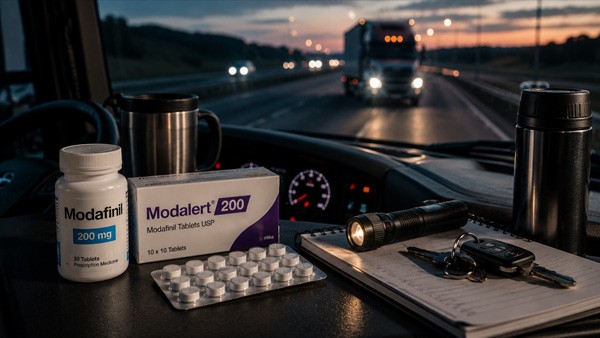
Drowsy driving causes approximately 100,000 reported crashes annually in the United States, kills an estimated 6,400 people per year, and is responsible for fatigue-related fatalities at rates that may exceed alcohol-related driving fatalities in some categories. Commercial truck drivers face this risk professionally — long-haul drivers routinely cover 600-700 miles per shift, work irregular hours that include overnight driving, and operate equipment whose mass and momentum make fatigue-related crashes catastrophic for the driver and for other road users. The combination of safety-critical work, irregular schedules, and chronic sleep restriction in the trucking industry has created widespread off-label modafinil use among commercial drivers — sometimes with prescriptions for diagnosed sleep disorders, often without medical oversight at all. The question of whether this use pattern improves safety or compromises it depends entirely on how the drug is used: as adjunct to adequate sleep within DOT-compliant hours-of-service patterns, modafinil can meaningfully reduce drowsy driving risk; as substitute for sleep used to extend driving hours beyond safe limits, modafinil increases crash risk by masking the fatigue warning that would otherwise force the driver to stop.
This guide is written for commercial truck drivers considering modafinil and for fleet safety managers evaluating its place in driver health programs. We treat the topic with the safety seriousness that 80,000-pound vehicles operating on public roads deserve — calibrated honesty about benefits, clear acknowledgment of the misuse failure modes, and explicit regulatory framing. We cover the actual scope of the drowsy driving problem in commercial trucking, the DOT Federal Motor Carrier Safety Administration regulatory framework that affects modafinil use by CDL holders, the unforgiving reality that modafinil cannot replace sleep over multi-day timeframes, best practices for legitimate medical use in commercial driving contexts, the specific scenarios where modafinil use is dangerous rather than helpful, the four-stage fatigue state classification with corresponding driving decisions, the regulatory compliance table covering DOT medical certification implications, and the roadside self-fatigue assessment that drivers can use to make stop-or-continue decisions during actual shifts.
Did you sleep at least 7 hours in the past 24 hours?
→ NO: Do not drive. Modafinil cannot substitute for inadequate sleep. Park; sleep; reassess.
→ YES: Continue below.
Are you taking modafinil for diagnosed SWSD / OSA / narcolepsy with prescription?
→ YES: Standard FDA-approved protocol applies. Take 1 hour before shift. Continue below.
→ NO (using off-label): Reconsider. Off-label use without prescription violates DOT medical certification rules. Higher legal and safety risk.
Is your DOT medical examiner aware of your modafinil use?
→ YES: Documented and compliant. Continue below.
→ NO: You are non-compliant with DOT medical certification requirements. Address before continuing commercial driving.
Have you eaten and hydrated adequately?
→ YES: Take modafinil 1 hour before shift start; begin shift.
→ NO: Eat and hydrate first; modafinil on empty stomach amplifies side effects that may impair driving.
If at ANY point during shift you experience the "pull-over criteria" below: Pull over immediately. No modafinil dose justifies continuing impaired driving.
😴 The Drowsy Driving Problem
The data on drowsy driving in commercial trucking is severe and underreported:
- NHTSA estimates approximately 100,000 reported drowsy driving crashes annually in the US across all driver populations, with approximately 6,400 deaths and 50,000+ injuries. The actual number is almost certainly higher because drowsy driving is hard to detect post-crash unlike alcohol intoxication.
- Commercial drivers are disproportionately affected. Long-haul trucking involves overnight driving, irregular schedules, and chronic sleep restriction. Studies suggest fatigue contributes to 13-30% of commercial vehicle crashes — substantially higher than the general population fatigue contribution rate.
- Cognitive impairment from sleep deprivation is comparable to alcohol intoxication. 17 hours awake = equivalent to 0.05% BAC; 21 hours awake = equivalent to 0.08% BAC (legal limit for non-commercial drivers; commercial drivers have 0.04% threshold). 24+ hours awake = severely impaired.
- Microsleeps are particularly dangerous. Drowsy drivers experience brief involuntary sleep episodes lasting 2-30 seconds. At 65 mph, a 4-second microsleep means traveling the length of a football field with eyes closed. The driver often does not realize a microsleep occurred.
- Obstructive sleep apnea is highly prevalent in commercial drivers. Estimates suggest 25-40% of commercial drivers have OSA, often undiagnosed. OSA produces fragmented sleep that leaves drivers chronically sleep-deprived even with apparently adequate sleep duration. OSA is associated with substantially elevated crash risk.
- Shift Work Sleep Disorder is common in irregular-schedule commercial driving. The unpredictable schedules of trucking exacerbate circadian disruption and SWSD development.
- Hours-of-Service regulations exist specifically because of drowsy driving safety. The federal HOS rules limit consecutive driving hours, mandate rest breaks, and require off-duty periods specifically to address fatigue-related crash risk.
How modafinil legitimately addresses the drowsy driving problem:
- For drivers with diagnosed SWSD: FDA-approved indication. Modafinil 200 mg 1 hour before shift produces measurable improvement in alertness during the work shift.
- For drivers with diagnosed OSA on CPAP treatment: FDA-approved indication. Modafinil addresses residual sleepiness in patients adequately compliant with CPAP but still experiencing daytime sleepiness.
- For drivers with diagnosed narcolepsy: FDA-approved indication, though narcolepsy generally disqualifies CDL holding without specialist clearance.
- For drivers using modafinil off-label without prescription: Not appropriate for commercial driving. Bypasses DOT medical certification requirements and creates safety and legal risk.
• Microsleep episodes (head nodding, brief eyes closing)
• Difficulty keeping eyes focused on road
• Drifting between lanes or wandering across lane lines
• Missing exits, turns, or road signs you should have noticed
• Not remembering the last several miles driven
• Yawning repeatedly with watering eyes
• Heavy eyelids that feel difficult to keep open
• Restlessness and irritability with no clear cause
• Driving slower than normal speed without realizing
• Tunnel vision or losing peripheral awareness
No modafinil dose justifies continuing to drive once any of these occur. The drug is masking severe fatigue at a level your body cannot tolerate. Pull over safely; rest at least 20-30 minutes; if symptoms persist, sleep before continuing.
📋 DOT and Regulatory Status
The Federal Motor Carrier Safety Administration (FMCSA) regulates commercial driver medical fitness through 49 CFR Part 391, Subpart E. The relevant regulations for modafinil use:
- DOT Medical Examiner Certification (DOT Physical): Required every 24 months for CDL holders. The medical examiner evaluates physical and mental fitness for commercial driving. All prescribed medications must be disclosed during this examination.
- Prescription medication disclosure: Drivers must report all prescription medications. The examiner determines whether each medication is compatible with safe commercial driving.
- Modafinil compatibility with DOT certification: Generally compatible when prescribed for specific FDA-approved indications (SWSD, OSA, narcolepsy with specialist clearance). The examiner evaluates the underlying medical condition and the specific medication context.
- Sleep apnea screening and treatment requirements: FMCSA has specific guidance on OSA screening, diagnosis, and treatment. Drivers diagnosed with moderate-to-severe OSA require CPAP compliance documentation. Modafinil for residual sleepiness on adequate CPAP is generally acceptable.
- Off-label use without prescription: Not compliant with DOT medical certification. Using modafinil without a valid prescription and without examiner knowledge violates the disclosure requirements.
- Drug testing implications: DOT drug tests are 5-panel screens for major drug classes (marijuana, cocaine, amphetamines, opiates, PCP). Modafinil is not on standard DOT panels — drivers will not test positive for modafinil under typical post-accident or random testing. However, this does not legalize off-label use; the disclosure requirements still apply.
- Adderall and Ritalin implications: Schedule II stimulants for ADHD have more complex DOT certification implications than Schedule IV modafinil. Some drivers with diagnosed ADHD use modafinil specifically to avoid the Schedule II complications associated with stimulants.
- Hours of Service compliance: Modafinil use does not change HOS requirements. The maximum 11-hour driving time within 14-hour work day must be respected regardless of pharmacological alertness support. Modafinil does not exempt drivers from mandatory rest breaks or off-duty periods.
- Logbook implications: Sleep periods recorded in driver logbooks must be actual sleep, not modafinil-supported wakeful rest. Falsifying logbooks to show sleep that didn't occur is a federal violation independent of drug use.
- State-level variations: Some states have additional regulations affecting commercial drivers' medication use. Drivers operating in multiple states should be aware of state-specific requirements.
Regulatory compliance principles for commercial drivers using modafinil:
- Have a valid prescription from a physician for a specific medical indication.
- Inform your DOT medical examiner at every certification appointment.
- Carry prescription documentation with you during commercial driving.
- Respect HOS regulations regardless of how alert you feel on modafinil.
- Address underlying conditions rather than masking symptoms — if you have OSA, get CPAP treatment; if you have SWSD, optimize sleep schedule where possible.
- Use the drug for what it's prescribed for, not to extend driving hours beyond safe limits.
😴 Modafinil vs Real Sleep
The single most important fact for commercial drivers considering modafinil: modafinil cannot replace sleep over multi-day timeframes. The drug masks fatigue but does not fix the underlying biology that creates safety risk.
What modafinil does for driver alertness:
- Provides subjective alertness during the drug window. Drivers report feeling more alert and less drowsy during the 10-14 hour modafinil effect window.
- Improves objective alertness measures. Maintenance of Wakefulness Test and other formal alertness measures show improvement on modafinil compared to placebo.
- Reduces microsleep frequency. The brief involuntary sleep episodes that pose the greatest crash risk are reduced (though not eliminated) by modafinil.
- Supports performance on relatively short missions. A single shift covered by adequate sleep beforehand plus modafinil during the shift is reasonable.
What modafinil does NOT do for drivers:
- Cannot replace the memory consolidation function of sleep. Sleep is when episodic memory and procedural learning consolidate. Modafinil does not provide this function. Multi-day sleep restriction degrades the cognitive performance that safe driving requires — pattern recognition, judgment, response selection.
- Cannot restore reflex speed degraded by sleep deprivation. Reaction time impairment from sleep loss is not fully reversed by modafinil. Drivers feel alert but objective response times remain slowed.
- Cannot prevent eventual collapse. Cumulative sleep deprivation produces eventual involuntary sleep regardless of pharmacology. The collapse comes — drivers report being "fine" right until they're not, then experience involuntary sleep at the worst possible moment.
- Cannot fix sleep architecture damage. Sleep stages (REM, deep sleep) have specific restorative functions. Even when modafinil provides waking alertness, the lack of restorative sleep stages produces cumulative cognitive and physical decline.
- Cannot extend safe driving hours beyond HOS limits. Federal HOS regulations reflect actual biological limits of driver safety. Modafinil cannot expand these limits even if you feel capable of driving longer.
- Cannot make multi-day shifts safe. A driver pushing through 60+ hour weeks on modafinil is accumulating sleep debt that masks behind chemical alertness but produces real cognitive impairment. Crash risk climbs even though subjective alertness feels acceptable.
The honest framework for modafinil and sleep in commercial driving:
- Sleep is the foundation; modafinil is a supplement. Adequate sleep within HOS limits is non-negotiable; modafinil can support alertness during shifts where the sleep foundation is adequate but circadian timing is challenging.
- Modafinil for legitimate medical indications (SWSD, OSA) addresses biological dysfunction; modafinil to extend hours beyond HOS limits creates safety problem.
- Track sleep duration objectively. Use sleep tracker or honest logbook. Self-perception of sleep adequacy is unreliable under chronic restriction.
- Sleep debt accumulates even when modafinil masks it. Plan recovery periods between intense work weeks; one weekend off doesn't recover from weeks of restriction.
- If you can't function safely without modafinil, you have a serious problem. Dependence on the drug for basic driving safety suggests either undiagnosed sleep disorder requiring medical evaluation or unsustainable work pattern requiring schedule changes.
🛣️ Best Practices Behind the Wheel
For drivers with legitimate medical indication using modafinil during commercial driving shifts, evidence-based best practices:
- Take modafinil 1 hour before shift start. Standard FDA-approved protocol. Allows onset to occur before driving begins. Don't take it at shift start (will be un-medicated for first hour) or hours before (peak may occur before you need it).
- Eat substantial breakfast with the dose. Avoids the empty-stomach side effects (nausea, headache, anxiety) that could impair driving. Provides sustained energy through the shift.
- Hydrate aggressively throughout the shift. Modafinil's mild dehydration effect combined with the typical low fluid intake of long-haul driving produces dehydration that impairs cognitive function. Keep large water bottle in cab; refill at every stop.
- Take federally-required rest breaks. The 30-minute break required by HOS rules is not optional, regardless of how alert you feel on modafinil.
- Stop for full nights of sleep. 10-hour off-duty periods required by HOS should be used for actual sleep, not for partial sleep followed by extending drive plans. Quality sleep during rest periods determines next-day safety.
- Monitor for fatigue signs throughout shift. Use the pull-over criteria above. Modafinil reduces but does not eliminate fatigue. The signs still occur; recognizing them matters.
- Strategic caffeine use. Moderate coffee (1-2 cups) at start of shift is compatible with modafinil. Heavy caffeine (3+ cups, energy drinks) creates cardiovascular load and anxiety risk that can impair driving. Plan caffeine timing around bathroom availability on route.
- Eat real meals at scheduled times. Modafinil's appetite suppression can leave drivers skipping meals during shifts. Inadequate fueling impairs cognitive function regardless of drug support. Use Hours of Service breaks for actual meals.
- Use bright cabin lighting if available. Light exposure supports alertness independent of pharmacology. Cabin reading lights, dashboard illumination at night.
- Talk to dispatcher honestly about fatigue. If you're approaching fatigue limits, your dispatcher needs to know. Modafinil doesn't change the conversation — it just means you can have it earlier with more options.
- Use commercial driver fatigue management training. Many trucking companies provide formal training programs. Use them as part of overall safety approach.
- Maintain consistent sleep schedule on home days. Recovery sleep on home days needs to be substantial — 8-9 hours nightly. Driver lifestyle that includes adequate home-day sleep supports safer work-day driving.
❌ When Not to Take It
Specific scenarios where modafinil use is inappropriate for commercial drivers:
- 🔴 Using off-label without prescription: Non-compliant with DOT medical certification. Creates legal liability and safety problem. Get a proper prescription if you legitimately need it; don't self-medicate as a commercial driver.
- 🔴 Without disclosing to DOT medical examiner: Even with prescription, undisclosed use during DOT physical means you're certified under false pretenses. Risk to medical certificate.
- 🔴 To extend driving hours beyond HOS limits: Federal violation regardless of alertness. HOS rules exist because of biological fatigue limits that modafinil cannot override.
- 🔴 To compensate for chronic inadequate sleep: Indicates either undiagnosed sleep disorder requiring medical evaluation or unsustainable work pattern requiring schedule changes. Masking symptoms with modafinil postpones the underlying problem.
- 🔴 With existing cardiovascular contraindications: Modafinil's mild cardiovascular effects can be problematic in drivers with significant heart disease, recent MI, severe arrhythmia history. CDL medical certification may already address some of these.
- 🔴 During acute illness: Sick drivers should not be driving regardless of pharmacological support. Cold, flu, fever, infection — pull off the road, recover, then continue.
- 🔴 When current dose is producing side effects affecting driving: Headache severe enough to distract, anxiety affecting concentration, sleep disruption affecting alertness — these mean your modafinil management needs adjustment, not continued use.
- 🔴 In combination with substances that impair driving: Alcohol, marijuana (illegal for CDL holders anyway), prescription opioids, benzodiazepines, illegal stimulants. Combining modafinil with impairing substances creates compound impairment.
- 🔴 First-time use during commercial driving: Test modafinil response in non-driving context first. First-use side effects could affect driving safety. The first dose should not be while operating a commercial vehicle.
- 🟡 During CDL retesting periods: Be especially careful with documentation, side effect management, and disclosure during periods when you're being formally evaluated.
🚦 Fatigue State Classification
Driver fatigue exists on a continuum. The four-stage classification with corresponding driving decisions:
State 1 — "Alert." Eyes focused, attentive to road, full peripheral awareness, good reaction time, no microsleeps. Driving safe at all speeds within HOS limits. Modafinil's window covered if used; sleep was adequate. Continue normal operations.
State 2 — "Mild Fatigue." Occasional yawning, slight eye strain, subtle decrease in alertness but full lane control maintained. Driving safe with caution. Take a 15-30 minute rest break at next safe location. Coffee or other moderate stimulation appropriate. Resume driving after break if alertness restored. If on modafinil, dose is working; minor fatigue is normal even with drug support.
State 3 — "Moderate Fatigue." Frequent yawning, watering eyes, difficulty maintaining steady speed, occasional drifting toward lane lines, missing minor road signs. Driving impaired enough to be safety concern. Pull over for substantial rest (45+ minutes minimum, ideally nap if available). Modafinil may not be sufficient — if dose already maximum, body is signaling sleep need that drug can't override. Reassess shift plan; may need to stop for the day.
State 4 — "Severe Fatigue." Microsleeps, sustained drifting across lane lines, missing exits or turns, not remembering recent driving, struggling to keep eyes open. Driving dangerous — immediate crash risk. PULL OVER NOW. No additional modafinil dose will safely override this state. Required intervention: full sleep period (4+ hours minimum) before continuing. Notify dispatcher; you are off-duty for medical/safety reasons.
| Fatigue state | Signs | Action | Modafinil consideration |
|---|---|---|---|
| 1 (Alert) | Full attention, normal reactions | Continue normal operations | Working as intended if dosed |
| 2 (Mild fatigue) | Occasional yawning, slight strain | 15-30 min rest break | Continue dose; minor fatigue normal |
| 3 (Moderate fatigue) | Drifting, missed signs, watering eyes | 45+ min rest, possible nap | Dose insufficient for current state |
| 4 (Severe fatigue) | Microsleeps, sustained lane drift | STOP — full sleep period | NO additional dose; body needs sleep |
📜 DOT/FMCSA Regulation Compliance Table
Regulatory compliance details for commercial driver modafinil use:
| Requirement | Modafinil compliance | Documentation needed |
|---|---|---|
| DOT Medical Examiner Certification | Disclose modafinil use; examiner evaluates compatibility | Medical examiner report; prescription documentation |
| Prescription documentation | Valid prescription from licensed physician required | Original or copy of prescription; pharmacist record |
| Hours of Service | Not affected by modafinil use; HOS limits still apply | HOS logs; ELD records |
| Random drug testing (5-panel) | Modafinil not on standard panel; no positive test | Drug test records |
| Post-accident testing | Same as random; modafinil not on panel | Test records following accidents |
| OSA screening (BMI >33, neck >17") | If diagnosed with moderate-severe OSA, requires CPAP compliance documentation | OSA diagnosis; CPAP compliance reports |
| Medication disclosure forms | List all prescriptions including modafinil | Medical examination forms; carrier records |
| State CDL renewal | Variable by state; some require medication disclosure | State-specific forms; CDL renewal documentation |
| International border crossing | Modafinil legal in US; restricted in some other countries (Japan, UAE) | Customs declaration; prescription documentation |
| Fleet drug policy | Varies by company; some employers test for additional substances | Employer policies; written notification |
🛣️ Roadside Self-Fatigue Assessment
Drivers can use this self-test during shifts to assess fatigue level. Conduct at next safe stop if any signs concern you:
- Eye check: Are your eyes burning, watering, or feeling heavy? Are you blinking more than usual? (Yes = fatigue developing)
- Microsleep check: Have you had any moments where you "came to" not remembering the last few seconds? (Yes = stop driving now)
- Lane position: Have you drifted across lane lines in the last hour? (Yes once = warning; yes repeatedly = stop)
- Speed control: Are you driving slower than your usual speed without consciously deciding to slow down? (Yes = fatigue affecting performance)
- Sign recognition: Are you missing road signs you should have noticed? Did you pass an exit you should have taken? (Yes = attention impaired)
- Memory of recent driving: Can you recall the road conditions and other vehicles from the last 5 minutes? (No = significant fatigue)
- Hand position: Are your hands gripping the wheel tightly with strain to stay attentive? (Yes = working too hard to stay awake)
- Posture: Are you having difficulty keeping your head upright? Nodding occasionally? (Yes = severe fatigue)
- Emotional state: Feeling restless, irritable, or impatient with no clear cause? (Yes = often early fatigue sign)
- Yawning frequency: Yawning every few minutes? (Yes = significant fatigue)
Action thresholds:
- 0-2 yes answers: Probably mild fatigue. Take 15-minute break with coffee or modafinil dose if scheduled.
- 3-4 yes answers: Moderate fatigue. 45+ minute break required. Consider whether to continue shift.
- 5+ yes answers: Severe fatigue. STOP driving immediately. Full sleep period before continuing. Notify dispatcher.
- Any "stop driving" trigger (microsleep, sustained drifting): Severity overrides count. Stop driving immediately regardless of other answers.
✨ Bottom Line
Modafinil for commercial truck drivers is appropriate for specific medical indications (Shift Work Sleep Disorder, Obstructive Sleep Apnea on adequate CPAP, narcolepsy with specialist clearance) with valid prescription, disclosed to DOT medical examiner, and used within Hours of Service regulations. In this legitimate use pattern, modafinil 200 mg 1 hour before shift start can meaningfully reduce drowsy driving risk and improve shift alertness for drivers with diagnosed sleep disorders.
Modafinil is NOT appropriate for: off-label use without prescription (violates DOT medical certification), extending driving hours beyond HOS limits (federal violation), compensating for chronic inadequate sleep (masks underlying problem), masking acute illness, or first-time use during commercial driving (test response in non-driving context first).
The four-stage fatigue classification (Alert / Mild / Moderate / Severe) provides actionable decision framework during shifts. The pull-over criteria identify when modafinil dose cannot safely override fatigue and driving must stop immediately. The 10-item roadside self-fatigue assessment helps drivers make stop-or-continue decisions during shifts based on objective signs rather than subjective "I feel fine" assessment.
The unforgiving reality: modafinil cannot replace sleep over multi-day timeframes. It masks fatigue but doesn't fix the underlying biology that creates crash risk. Drivers attempting to use modafinil to extend their effective work hours beyond what adequate sleep would support are increasing crash risk, not reducing it. The drug supports sleep-adequate drivers; it does not rescue sleep-deprived drivers from the consequences of sleep deprivation.
The DOT regulatory framework requires prescription, disclosure to medical examiner, compliance with HOS regardless of pharmacological alertness, and integration with required OSA screening for high-risk drivers. Commercial drivers using modafinil should treat regulatory compliance as part of safe driving practice rather than as bureaucratic burden.
For pharmaceutical-grade modafinil for commercial driver use with valid prescription, Modalert 200 mg from Sun Pharma is the most widely used legitimate generic. The 200 mg standard FDA-approved SWSD dose applies to commercial drivers as it does to other shift workers.
For broader context on the FDA-approved indication that covers most legitimate commercial driver use, see our comprehensive Modafinil for Shift Workers article. For comparison with caffeine (the default trucker alertness strategy), see Modafinil vs Caffeine. For armodafinil alternative, see Modafinil vs Armodafinil.
For side-effect management during long shifts, see Modafinil Headaches, Modafinil Dehydration (particularly relevant for long-haul drivers), Modafinil and Anxiety, Modafinil Insomnia (recovery sleep matters for commercial drivers), Modafinil Cardiovascular Effects (sedentary driver lifestyle plus modafinil), and Modafinil Long-Term Side Effects (career-long use considerations).
❓ Frequently Asked Questions
Is modafinil legal for truck drivers?
Yes, with prescription and disclosure to DOT medical examiner. Modafinil is FDA-approved for Shift Work Sleep Disorder, Obstructive Sleep Apnea (with CPAP), and narcolepsy. Commercial drivers prescribed modafinil for these conditions can continue commercial driving as long as the medication is disclosed during DOT medical certification and the underlying condition is being properly treated. Off-label use without prescription violates DOT medical certification requirements and is not appropriate for commercial driving.
Will modafinil show up on my DOT drug test?
No. Standard DOT 5-panel drug tests screen for marijuana, cocaine, amphetamines, opiates, and PCP. Modafinil is not on this panel and will not produce a positive test result. Specialized testing could detect modafinil but is not part of routine DOT drug testing for commercial drivers. This does not legalize off-label use — the disclosure requirements during DOT medical certification still apply, and using modafinil without prescription remains non-compliant with FMCSA medical regulations.
Can modafinil help me extend my hours behind the wheel?
No — and trying is a federal violation plus safety risk. Hours of Service regulations exist because of biological fatigue limits that modafinil cannot override. Maximum 11 hours of driving in a 14-hour work day, mandatory 30-minute rest break, 10 consecutive hours off-duty between shifts. Modafinil can support alertness during HOS-compliant shifts but cannot safely extend driving time beyond HOS limits. Drivers attempting to extend hours with modafinil increase crash risk while violating federal regulations.
What's the dose for truck drivers?
Standard FDA-approved dose: 200 mg taken 1 hour before shift start. This applies to commercial drivers with diagnosed SWSD, OSA, or narcolepsy with prescription. Same protocol as other shift workers — see our comprehensive Modafinil for Shift Workers article for detailed shift-cycle protocol. Higher doses (300-400 mg) are not better and produce more side effects without proportional benefit.
Can I drive on modafinil if I haven't slept enough?
No. Modafinil cannot replace sleep. Driving when you haven't slept adequately (less than 7 hours in past 24 hours) is unsafe regardless of pharmacological support. The drug masks fatigue signs but does not restore the cognitive function impaired by sleep deprivation. Reaction time, judgment, memory consolidation — all remain impaired despite subjective feeling of alertness. If you're inadequately slept, pull off the road and sleep. No modafinil dose justifies driving in this state.
What if I have sleep apnea?
Get evaluated and treated. FMCSA requires OSA screening for high-risk drivers (BMI >33, neck circumference >17 inches, other risk factors). If diagnosed with moderate-to-severe OSA, CPAP compliance is required to maintain CDL. Once on adequate CPAP treatment, modafinil for residual sleepiness is an FDA-approved indication that may help with persistent fatigue. The OSA treatment is primary; modafinil is supplement, not substitute.
Can I take modafinil for night driving on a long route?
If you have diagnosed SWSD with prescription, yes — the FDA-approved use case. Take 200 mg 1 hour before night shift starts. If you don't have diagnosed SWSD and are using off-label without prescription, this is not appropriate for commercial driving. Get evaluated for sleep disorder if night driving consistently produces fatigue you can't manage with proper sleep schedule.
What's the difference between modafinil and energy drinks for truckers?
Energy drinks: high caffeine (200-400 mg per can) + sugar; produce alertness for 3-5 hours then crash; cardiovascular load with repeated use; dehydration; widely available without prescription. Modafinil: prescription medication; 200 mg single morning dose covers 10-14 hour shift smoothly without crash; gentler cardiovascular profile; doesn't require multiple doses through shift. For prescribed medical use, modafinil is generally better for sustained shift coverage. Energy drinks are reasonable for occasional acute alertness boost but not for chronic use.
Can I lose my CDL for using modafinil?
Not for prescribed legitimate use with proper disclosure. Modafinil with valid prescription, disclosed to DOT medical examiner, and used for FDA-approved indication is compatible with CDL holding. However, you could lose CDL for: off-label use without prescription (medical examiner certification violation), undisclosed use during DOT physical (certification under false pretenses), using modafinil to extend hours beyond HOS limits (federal HOS violation), or driving impaired despite modafinil (DUI-equivalent consequences). Compliance protects CDL; non-compliance threatens it.
Should I tell my employer I take modafinil?
Generally yes for prescribed medical use. Many fleet safety policies require disclosure of prescription medications affecting driving capacity. Open disclosure with employer occupational health protects you legally and supports safety culture. Employer awareness also helps with reasonable accommodations if needed (sleep schedule coordination, OSA treatment compliance support). Hiding prescribed medication from employer creates potential liability and undermines safety partnerships. Some employers may have specific policies — check your driver handbook and discuss with occupational health representative.
📚 References & Further Reading
- FMCSA — 49 CFR Part 391, Subpart E — Physical Qualifications and Examinations for commercial drivers.
- FMCSA Medical Examiner Handbook — guidelines for commercial driver medical certification.
- FMCSA Hours of Service regulations — 49 CFR Part 395.
- NHTSA Drowsy Driving Research — statistics on drowsy driving crashes and fatalities.
- American Academy of Sleep Medicine — practice parameters for shift work sleep disorder and obstructive sleep apnea.
- American Trucking Associations — fatigue management training programs.
- Commercial Driver Medical Advisory Criteria — sleep apnea screening and management.
- FDA prescribing information for Provigil (modafinil) — SWSD indication and dosing.
- Czeisler et al., New England Journal of Medicine 2005 — SWSD pivotal trial.
- Erman et al., Clinical Therapeutics 2007 — SWSD 12-month extension safety.
- Howard et al., American Journal of Respiratory and Critical Care Medicine — sleep disorders in commercial drivers.
- Mitler et al. — fatigue and crash risk in commercial vehicle operations.
- Dawson & Reid, Nature — alcohol equivalents of sleep deprivation impairment.
- Modafinil for Shift Workers — comprehensive FDA-approved indication article.
- Modafinil for Students, Modafinil for Programmers, Modafinil for Entrepreneurs, Modafinil for ADHD, Modafinil for Depression — companion use-case articles.
- Modafinil vs Caffeine — comparison with default driver alertness strategy.
- Modafinil vs Armodafinil — R-enantiomer alternative.
- Best Time to Take Modafinil — timing rules adapted to shift work.
- Modafinil Headaches, Modafinil Dehydration, Modafinil and Anxiety, Modafinil Insomnia, Modafinil Cardiovascular Effects, Modafinil Long-Term Side Effects, Modafinil Stevens-Johnson Syndrome — side-effect management articles relevant for commercial driver use.
- Modalert 200 mg, Modvigil 200 mg, Waklert 150 mg — primary product pages on the RXshop antinarcoleptic catalogue.
- RXshop Editorial Team — content reviewed by licensed pharmacist; for adult patient education, not a substitute for individual medical consultation.
Medical Disclaimer: The information in this article is for educational and informational purposes only and is not a substitute for professional medical advice, diagnosis, or treatment. Always seek guidance from a qualified healthcare provider with any questions you may have regarding a medical condition, and before starting, stopping or changing any medication.