Modafinil Dosage for Studying and Exams


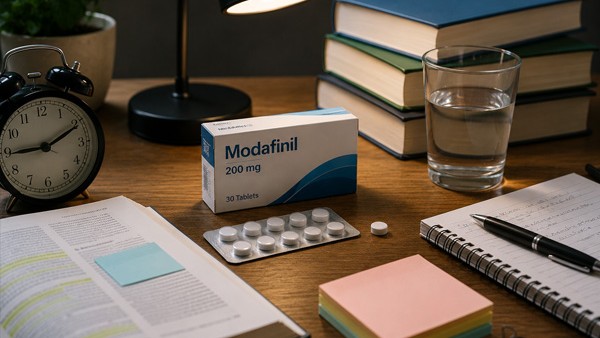
Roughly 10% of UK university students have used Modalert (modafinil) 200 mg or its equivalents for academic purposes at some point — a usage pattern that has grown steadily across competitive academic environments over the past decade. The drug is FDA-approved for narcolepsy, sleep apnea, and shift work sleep disorder, not for cognitive enhancement in healthy students. The student use is unambiguously off-label, and the question of whether it actually helps is more nuanced than the "real-life Limitless pill" reputation suggests. This article walks through what students need to know to make an informed decision — the dosing math, the right pairing with study technique, the genuine limitations the marketing rarely mentions, and the recovery plan that follows an exam-prep cycle.
If you want the broader dosing context first, see our Modafinil 200 mg Dosage Guide. For first-time dosing protocol, see First Time Taking Modafinil. For timing strategy, see Best Time to Take Modafinil. This article assumes you have read or know that material and focuses specifically on the student use-case.
The honest student-use answer is that modafinil's evidence base for cognitive enhancement in well-rested healthy students is modest at best. Most of the perceived benefit is sleep-debt correction — patients who chronically run on poor sleep feel sharper because the drug compensates for that deficit. Students who fix sleep, exercise, and caffeine timing for the week before an exam often perform as well as students who add modafinil to a baseline of poor sleep hygiene. Modafinil is not the academic shortcut the forum culture sometimes implies.
🎓 Why Students Use Modafinil
The student use-case is driven by a recognisable pattern. Long study marathons — back-to-back hours of dense material that exceed normal attention capacity — push students to look for chemical assistance once coffee stops working. Sleep-debt accumulation through exam weeks makes the next day's productive output drop below the threshold needed for the volume of material being covered. Anticipatory exam anxiety drives students to want guaranteed alertness for the exam itself rather than gambling on natural arousal that morning.
For each of these motivations, modafinil delivers some of what is hoped for. Long study marathons become more sustainable — alertness through hour 8 of focused work is genuinely easier on modafinil than on coffee alone. Sleep-debt correction works because removing pathological sleepiness is exactly what the drug does. Exam-day alertness is reliable when timing is right.
What modafinil does NOT do is more important than what it does, and is the conversation most peer-to-peer student usage misses. The drug does not improve working memory beyond baseline, does not strengthen memory consolidation (the process that converts study material into retained knowledge), and does not improve creative problem-solving in well-rested adults. The cognitive effect is narrowing the attention spotlight, not making the underlying brain function smarter.
⚖️ Dose Selection by Body Weight
Modafinil dosing is not strongly weight-dependent the way some drugs are — the standard adult dose is 200 mg regardless of whether the patient weighs 55 kg or 95 kg. However, body weight does shape the practical starting dose for students who are first-time users and the long-term maintenance dose for sensitive responders. The decision framework below covers most student situations:
Start at 100 mg (half a Modalert tablet) regardless of whether it is your first time or a regular study session. Lower body mass means higher plasma concentration per mg of drug; the standard 200 mg dose can feel substantially more intense. Many smaller patients stay at 100 mg long-term.
Standard 200 mg morning dose after first-week titration at 100 mg. This is the median student profile. The dose-response curve flattens above 200 mg in this weight range, so increasing further does not improve outcomes.
Still 200 mg standard dose — body weight above 90 kg does not require dose escalation. The pharmacokinetics flatten at the high end. If 200 mg feels inadequate, the answer is timing review and sleep hygiene, not a higher dose. The 400 mg dose is reserved for refractory clinical cases under specialist supervision, not for routine student use.
The single biggest dosing mistake students make is starting at 200 mg on a high-stakes day. The cleaner approach is to use a free Saturday at least one week before any consequential exam to test your response at 100 mg, then titrate to 200 mg on day three if the first dose was clean. This eliminates the "I felt awful and the drug ruined my exam" scenario that produces most negative student experiences.
📚 Pairing with Study Technique
Modafinil amplifies the technique you bring to it. The same dose delivered to a student using scientifically-validated study methods produces dramatically more retained learning than the same dose delivered to a student passively re-reading textbooks. The drug's narrow attention-focusing effect is best paired with techniques that demand active cognitive engagement:
- 🧠 Active recall — testing yourself on material rather than re-reading it. Modafinil's sustained focus makes long active-recall sessions feasible where they would otherwise fatigue quickly. The combination produces measurably better retention than passive review.
- 🔁 Spaced repetition — software-driven flashcards (Anki, Quizlet) that schedule review based on forgetting curves. Modafinil's wake-promotion allows longer single-session capacity to push through bigger card decks; the spaced repetition itself drives the retention.
- ✍️ Practice problems — working through worked examples and timed problem sets. Particularly relevant for STEM and medical students. Modafinil's reduced fatigue lets you maintain accuracy through longer problem sets than coffee alone supports.
- 📝 Note synthesis — rewriting lecture notes in your own words, building concept maps from raw material. The deliberate cognitive effort here is amplified by modafinil's focus effect.
- 🎯 Pomodoro time-blocking — 25-minute focused work blocks with 5-minute breaks. Modafinil supports extending these to 45-60 minute blocks without the typical fatigue accumulation, but breaks are still necessary for memory consolidation.
What modafinil pairs poorly with: passive textbook reading, highlighting (one of the least effective study techniques even without drugs), and cramming new material the night before an exam. The first two produce no retention regardless of drug; the third asks modafinil to compensate for inadequate spaced learning, which it cannot do.
🧠 The Hidden Risk of Reduced Retention
The single most under-discussed concern with student modafinil use is the relationship between the drug and memory consolidation. Most retention happens during sleep — slow-wave sleep transfers daytime learning from short-term to long-term memory, and REM sleep integrates new information with existing knowledge structures. Modafinil's main side effect, when dosed late, is sleep disruption. The same sleep that consolidates the day's studying. Students who use modafinil to extend study sessions late into the evening can inadvertently reduce the retention of the very material they spent the extra hours studying.
This assumes that learning is purely a function of hours-on-task, and that doubling study time doubles retained knowledge. Both assumptions are wrong.
The practical implication: modafinil for studying must be paired with strict sleep protection, not used to compress sleep further. Dose only in the morning, never after 12:00, never to extend study sessions past midnight. The retained-learning math only works when consolidating sleep happens after the study session. Without that, the additional study hours produce diminishing returns measurable on the exam itself.
🔋 After-Exam Recovery
The exam-prep cycle takes a measurable physiological toll even when modafinil is used responsibly. Most students who use modafinil through an exam week end the cycle with accumulated sleep debt, modest dehydration, elevated stress hormones, and depleted cognitive resources. The 5-day recovery protocol below restores baseline efficiently:
1️⃣ Day 1 (immediately after the last exam): stop modafinil entirely. Drink 2-3 L of water. Eat a normal balanced meal — no carb-loading, no "reward binge" that disrupts the recovery. Light activity (walk, gentle stretching) for 30 minutes. Sleep at your normal bedtime, not earlier.
2️⃣ Day 2: sleep until you wake naturally (likely 9-10 hours). Continue aggressive hydration. Avoid caffeine entirely or limit to one cup in the morning. Light cardio (30-45 min) reduces cortisol and supports sleep that night.
3️⃣ Day 3: normal sleep timing. Resume your usual caffeine pattern. The accumulated cognitive fatigue should be clearly improving by now. Avoid making major decisions or starting demanding projects on day 3 — your judgment is still recovering.
4️⃣ Day 4-5: baseline restoration. Sleep, exercise, and normal eating restore cognitive function to its pre-exam baseline. Most students feel completely normal by day 5 if the cycle was managed responsibly.
5️⃣ Beyond day 5 — if fatigue persists: consider whether the exam cycle masked a longer-term issue (chronic sleep deprivation, underlying anxiety/depression, poor general health). Persistent fatigue beyond a 5-day recovery is not a normal post-exam pattern and warrants attention.
✨ Bottom Line
Student use of Modalert (modafinil) 200 mg for studying and exam preparation is widespread and well-tolerated for most patients, but the cognitive enhancement claims are more modest than the "smart drug" reputation suggests. The drug's primary benefit is removing sleepiness, not creating supernormal cognition. 100 mg for students under 60 kg or first-time users, 200 mg for the standard 60-90 kg range, no benefit from going higher at any weight. Pair the drug with active recall, spaced repetition, and practice problems — not passive textbook reading. Protect consolidating sleep ruthlessly: dose in the morning, never after 12:00, never to extend sessions past midnight. The retained-learning math only works when sleep happens after studying. Follow exam weeks with a 5-day recovery cycle of normal sleep, hydration, and light exercise — boring but effective. For the broader honest framing on whether modafinil is right for student use at all, the comparison with Adderall and the piracetam comparison articles are worth reading.
❓ Frequently Asked Questions
What's the best modafinil dose for studying?
For most adult students in the 60-90 kg weight range, 200 mg morning dose is standard after first-week titration at 100 mg. Students under 60 kg often do best long-term at 100 mg. Body weight over 90 kg does not require dose escalation — pharmacokinetics flatten at the high end. There is no benefit from going above 200 mg for routine studying; the 400 mg dose is reserved for refractory clinical cases, not student use.
Can I take modafinil only on exam day?
Possible but risky if it is your first-ever dose. Any first-time modafinil experience should happen on a low-stakes free day at least one week before an exam — never on the exam day itself. The unpredictable individual response (anxiety, jitteriness, headache, or rare adverse reactions) is incompatible with high-stakes performance. If you have used modafinil before and tolerated it well, dosing on exam day is reasonable: 200 mg at 06:00-07:00 for a morning exam, or 08:00-09:00 for an afternoon exam.
Will modafinil actually help me remember what I studied?
Indirectly, by extending sustainable study time and reducing fatigue during active recall sessions. Directly on memory consolidation — no. Memory consolidation happens primarily during sleep, particularly slow-wave sleep. Modafinil does not improve consolidation; if dosed late, it can actually impair it by disrupting the sleep that converts daytime learning into retained knowledge. The honest framing: modafinil helps you study longer; sleep determines what you retain.
How late can I take modafinil if I'm studying for tomorrow's exam?
No later than 12:00 — and ideally never after 10:00. The 12-15 hour half-life means a noon dose still has meaningful activity at midnight, which disrupts the consolidating sleep you need for the exam itself. Late-day dosing destroys the retention math. If you missed the morning window, the cleaner answer is to skip the dose, study without it, and prioritise sleep for the night before. Modafinil has no withdrawal — a single missed dose is harmless.
How do I avoid the crash after a modafinil study session?
The "crash" most students describe after modafinil is actually accumulated sleep debt from displaced rest, not a pharmacological withdrawal. Modafinil itself has no withdrawal syndrome — it tapers smoothly without rebound. The recovery answer is the 5-day protocol described in the article: stop modafinil after the exam cycle ends, sleep 8-10 hours nightly, hydrate aggressively, exercise lightly, eat normally. Most students feel back to baseline by day 5 if the cycle was managed responsibly.
Is modafinil better than Adderall for studying?
Different drugs for different student profiles. Adderall has stronger acute focus effects and higher abuse potential; modafinil has milder acute effects and dramatically lower abuse potential. For students with confirmed ADHD, Adderall has stronger primary evidence. For students seeking general study enhancement without an ADHD diagnosis, modafinil is the safer choice — but the honest answer is that neither drug is the right first step for healthy students; fixing sleep, exercise, and caffeine timing typically delivers more. See our Modafinil vs Adderall comparison for the full picture.
📚 References & Further Reading
- Battleday RM & Brem AK, European Neuropsychopharmacology — systematic review of modafinil's cognitive enhancement effects in healthy adults.
- Lewis et al. — survey data on cognitive enhancer use among UK university students.
- FDA prescribing information for modafinil (Provigil) — official dosing recommendations; basis for the 200 mg standard.
- American Academy of Sleep Medicine — practice parameters on modafinil dosing and timing rules referenced in this article.
- Modafinil 200 mg Dosage Guide — broader dose-response context.
- First Time Taking Modafinil — first-week protocol students should follow before any exam-day use.
- Best Time to Take Modafinil — detailed timing strategy for student exam-day scenarios.
- Splitting Modafinil Tablets — practical guide to 100 mg dosing via tablet splitting.
- Modafinil vs Adderall: Which Cognitive Enhancer Works Better? — comparison for students considering either drug.
- Modafinil vs Piracetam: A Clear Side-by-Side Comparison — alternative cognitive-enhancement option comparison.
- Modafinil and Coffee — caffeine pairing rules for students who stack with coffee during study sessions.
- Modalert 200 mg and Waklert 150 mg — primary product pages.
- RXshop Editorial Team — content reviewed by licensed pharmacist; for adult patient education, not a substitute for individual medical consultation.
Medical Disclaimer: The information in this article is for educational and informational purposes only and is not a substitute for professional medical advice, diagnosis, or treatment. Always seek guidance from a qualified healthcare provider with any questions you may have regarding a medical condition, and before starting, stopping or changing any medication.