How to Take Modalert Properly: A Usage Guide

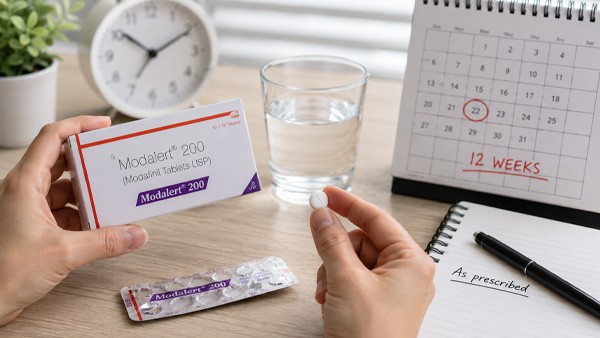

Modalert is a generic form of modafinil, a wakefulness-promoting medication used for excessive sleepiness in narcolepsy, in shift work sleep disorder, and as an addition where sleepiness persists despite properly treated obstructive sleep apnoea.
Most of what determines whether it works well comes down to a handful of practical decisions: when it is taken, what it is taken with, what else is in the medicine cabinet, and which symptoms mean stopping rather than persevering. This guide covers those in order.
🧠 The single most consequential fact about this medication, and the one most often omitted: modafinil reduces the effectiveness of hormonal contraception — the pill, patch, ring and implant — during use and for about a month after stopping. Additional non-hormonal contraception is required throughout. This appears in the prescribing information for every modafinil product and is left out of most discussion of the drug.
🕑 When to take it
Timing matters more than with most medications, because the half-life is around twelve hours. A tablet taken at midday is still working late in the evening.
| Situation | When to take it |
|---|---|
| Narcolepsy | In the morning, at a consistent time. Some people split the dose, taking half in the morning and half at midday, where afternoon sleepiness is the problem |
| Obstructive sleep apnoea with residual sleepiness | In the morning, alongside continued CPAP or other treatment of the apnoea |
| Shift work sleep disorder | About one hour before the shift begins |
Taking it late is the commonest self-inflicted problem. Someone who takes a tablet at two in the afternoon because the day is dragging then sleeps badly that night, is more tired the following day, and takes another. That is how an escalating cycle begins, and the fix is simply moving the dose earlier.
Food does not prevent it working, though it delays the onset by an hour or so. A large meal beforehand means waiting longer for the effect, not losing it. Take it with or without food, whichever suits, but be consistent so the timing is predictable.
💊 Dose
The standard adult dose is 200 mg once daily, and higher doses have not been shown to add proportionate benefit while producing more side effects.
Several practical points:
- Some people do well on 100 mg, which is worth trying first in anyone sensitive to medication or anxious about starting
- Splitting the dose — half in the morning, half around midday — suits some people with narcolepsy whose sleepiness returns in the afternoon, provided the second half is not too late
- Older people and those with liver impairment generally need a lower dose, since clearance is reduced
- Increasing the dose because it seems to be working less is a decision for the prescriber rather than the patient, and is often not the right answer
❓ Missed doses
Simple rule: if it is still early enough that being awake for the next twelve hours or so is appropriate, take it. If not, skip it entirely.
Never take a double dose to compensate. A missed day of a wakefulness medication is an inconvenient day, not a medical problem, whereas a double dose produces headache, anxiety, palpitations and a night without sleep.
🔗 What it interacts with
Modafinil affects several liver enzymes, which means it changes the levels of a number of other drugs. This section is worth reading against your own medicine cabinet.
| Interaction | Effect |
|---|---|
| Hormonal contraception | Effectiveness reduced during treatment and for about a month after. Additional non-hormonal contraception required |
| Ciclosporin and some immunosuppressants | Levels reduced, which matters after transplantation |
| Some anticonvulsants | Levels may move in either direction; monitoring needed |
| Warfarin | Anticoagulation may be affected; closer monitoring advised |
| Diazepam, phenytoin, propranolol, omeprazole | Levels may rise, since modafinil slows their breakdown |
| Some antidepressants | Levels of certain tricyclics and SSRIs may rise |
| Caffeine and other stimulants | Additive anxiety, tremor, raised heart rate and insomnia |
| Alcohol | Unpredictable combination; the wakefulness masks intoxication without reducing impairment |
Tell any prescriber or pharmacist that you take modafinil before starting anything new, including anything bought without prescription.
🔴 Warning signs that mean stopping
🔴 Any rash means stopping the drug and seeking medical assessment the same day. Serious skin reactions including Stevens-Johnson syndrome and toxic epidermal necrolysis have been reported with modafinil, which is why every prescribing document carries a warning about it. Most rashes turn out to be trivial; the ones that are not progress quickly. Treat the following as urgent: rash of any kind, particularly with fever, sore throat, mouth or eye ulcers, blistering, peeling skin, or swelling of the face, lips or tongue. Do not take another dose while waiting to be seen.
Other reasons to stop and seek advice promptly:
- Chest pain, palpitations or an irregular heartbeat
- New or worsening anxiety, agitation, aggression or panic
- Hallucinations, unusual thoughts, or losing touch with reality
- Thoughts of self-harm
- Severe or persistent headache not responding to fluids and simple analgesia
- Yellowing of the skin or eyes, or dark urine
😕 Common side effects and what to do
Most side effects are mild, appear early and settle. Several respond to simple adjustments rather than requiring the drug to be abandoned.
| Effect | What helps |
|---|---|
| Headache | The commonest complaint by a wide margin. Drink considerably more water than usual, since reduced thirst awareness contributes; simple analgesia; often settles after the first week or two; a lower dose helps if it persists |
| Insomnia | Almost always a timing problem. Move the dose earlier |
| Nausea | Take with food |
| Reduced appetite | Eat by schedule rather than by hunger; expect it rather than being surprised |
| Dry mouth | Fluids, sugar-free gum |
| Anxiety or jitteriness | Reduce caffeine first, which is usually the additive factor; consider a lower dose |
| Dizziness | Check blood pressure; rise slowly; ensure adequate fluids |
| Diarrhoea or stomach upset | Usually settles; take with food |
The headache point deserves emphasis because it accounts for most of the people who stop in the first week. It is frequently a hydration problem: modafinil reduces awareness of thirst as well as of tiredness, and people simply drink less without noticing. Deliberately increasing fluid intake resolves a substantial share of it.
⚠️ Who should not take it
Not suitable for anyone who has had a serious reaction to modafinil or armodafinil, particularly a rash; in pregnancy, given registry data raising concern about congenital malformations; and where there is significant structural heart disease or a history of arrhythmia associated with stimulant use.
Requires assessment and caution in liver or kidney impairment, where dose reduction is usual; in uncontrolled high blood pressure; in anyone with a history of psychosis, mania or bipolar disorder; in anxiety disorders, which it can amplify; and in anyone with a history of substance misuse, since the abuse potential is low but not absent.
Breastfeeding is generally avoided, as data is limited.
Blood pressure and heart rate are worth checking periodically, particularly in anyone with existing cardiovascular risk, since modest increases occur.
🚗 Driving and machinery
The advice here is more nuanced than the standard warning suggests.
In someone with a genuine sleep disorder, modafinil improves driving safety, because untreated excessive sleepiness is itself a major crash risk. That is a substantial part of why it is prescribed.
What still applies: do not drive until you know how it affects you individually, since a minority experience dizziness or impaired concentration early on. And do not assume the medication makes it safe to drive while severely sleep-deprived — it suppresses the sensation of sleepiness without eliminating the underlying impairment, which is a genuinely dangerous combination.
Anyone with narcolepsy should also be aware that licensing authorities in most countries require notification, and that driving is generally permitted once symptoms are adequately controlled.
⏳ How long to take it
The older guidance that treatment should be limited to twelve weeks reflects the duration of certain clinical trials rather than a safety limit, and it does not apply to the conditions modafinil is licensed for.
Narcolepsy is lifelong, and treatment continues indefinitely with periodic review. Shift work sleep disorder persists as long as the shift pattern does. Residual sleepiness in treated sleep apnoea likewise continues while the underlying condition does.
Stopping does not require a taper in the physical sense — there is no withdrawal syndrome comparable to that of sedatives or opioids. What returns is the underlying sleepiness, sometimes abruptly, which can feel like withdrawal but is the original condition reappearing.
Psychological reliance is a different matter and is genuinely common among people using it for productivity rather than for a diagnosed condition. Anyone in that position who finds working without it difficult after months of daily use is describing something real, even though it is not physical dependence.
📦 Storage and practicalities
Store at room temperature, away from heat, direct light and damp. Bathrooms and kitchens are the two worst places in most homes for exactly those reasons.
Keep it in the original blister until taken, so the batch number and expiry remain identifiable, and keep it out of reach of children.
Check the expiry date, and do not use tablets that have changed in appearance, come from a damaged blister, or lack manufacturer, batch and expiry details.
🚫 What it does not do
Being clear about this prevents both disappointment and genuine harm.
It does not treat sleep apnoea. It relieves the sleepiness while the apnoea continues to interrupt oxygen supply, strain the heart and raise blood pressure through the night. Used instead of CPAP it removes the warning sign while the damage continues.
It does not replace sleep. It suppresses the perception of sleepiness without addressing the physiological need, and chronic sleep restriction carries consequences that alertness does not offset.
It does not treat depression, ADHD or chronic fatigue syndrome. It is not approved for any of them, and in conditions where the problem is a limited energy envelope rather than insufficient alertness, masking the limit is actively unhelpful.
It does not shift the body clock, which is why it helps someone tolerate jet lag without shortening it.
It is not a nootropic in the marketing sense. Benefit in sleep-deprived people is clear and substantial. In well-rested people, results are modest and inconsistent, affecting attention and motivation more than reasoning, with some studies finding people overestimate the quality of the work they produce.
🏅 Sport and testing
Modafinil is on the World Anti-Doping Agency prohibited list, so anyone subject to testing in competitive sport needs either to avoid it or to hold a therapeutic use exemption.
It is also a controlled substance in most countries, which is worth knowing when travelling: carry it in the original packaging with documentation, and check the rules of the destination, since a small number of countries restrict it more tightly than the country of purchase.
✅ A short checklist for anyone starting. Take it early in the morning at a consistent time. Drink more water than feels necessary, which prevents most headaches. Cut caffeine substantially for the first week. Expect a headache in the first days and expect it to settle. Arrange additional contraception if relevant. Check your other medicines for interactions. And know that any rash means stopping and being seen the same day.
🧑⚕️ When to go back to the prescriber
- It is not working after a fair trial at an adequate dose
- It was working and is working less, which may reflect the underlying condition, sleep debt, or another cause rather than the drug
- Side effects persist beyond the first couple of weeks
- Any new medication is started, including over the counter
- Pregnancy is planned or possible
- Blood pressure has risen or palpitations have appeared
- Mood, anxiety or thinking have changed
- Sleepiness persists despite treatment, which may mean the underlying cause has not been fully identified
That last point matters more than it appears. Modafinil treats a symptom, and persistent sleepiness on adequate treatment is a reason to revisit the diagnosis rather than to increase the dose. Untreated sleep apnoea, insufficient sleep, thyroid disease, anaemia, depression and medication effects all produce sleepiness, and several can coexist with a sleep disorder.
Modafinil is stocked as Modalert in the wakefulness category, alongside armodafinil as Waklert, Artvigil and Armod. It is a prescription medicine and belongs after a diagnosis rather than instead of one.
❓ Frequently asked questions
What time should I take Modalert?
Early in the morning at a consistent time for daytime sleepiness, or about an hour before a night shift begins. The half-life is around twelve hours, so a tablet taken at midday is still working late in the evening. Taking it late is the commonest self-inflicted problem: poor sleep that night, more tiredness the next day, another tablet, and an escalating cycle that is fixed simply by moving the dose earlier.
Does it affect birth control?
Yes, and this is the most consequential thing to know about it. It reduces the effectiveness of the pill, patch, ring and implant during treatment and for about a month after stopping, so additional non-hormonal contraception is needed throughout. This appears in the prescribing information for every modafinil product and is omitted from most general discussion of the drug.
Should I take it with food?
Either is fine. Food delays the onset by an hour or so without reducing how much is absorbed, so a large meal beforehand means waiting longer for the effect rather than losing it. Taking it with food helps if it causes nausea. The important thing is consistency, so the timing of the effect is predictable from day to day.
What if I miss a dose?
If it is still early enough that being awake for the next twelve hours or so makes sense, take it. If not, skip it entirely and take the next dose at the usual time. Never double up to compensate — a missed day is an inconvenience, while a double dose produces headache, anxiety, palpitations and a night without sleep.
Why do I get a headache on it?
It is the commonest side effect by a wide margin, and frequently a hydration problem: modafinil reduces awareness of thirst as well as of tiredness, so people drink less without noticing. Deliberately increasing fluid intake resolves a substantial share of it. It also tends to settle after the first week or two, and a lower dose helps where it persists.
I have a rash. Is that serious?
Stop the drug and be seen the same day. Serious skin reactions including Stevens-Johnson syndrome have been reported with modafinil, which is why every prescribing document warns about it. Most rashes prove trivial, but the ones that are not progress quickly. Treat rash with fever, sore throat, mouth or eye ulcers, blistering, peeling skin or facial swelling as urgent, and do not take another dose while waiting.
Can I drink coffee with it?
Small amounts, but the effects add. Anxiety, jitteriness, tremor, raised heart rate and insomnia are all commoner when the two are combined, and cutting caffeine substantially for the first week is one of the more effective ways of avoiding those. If you are experiencing anxiety on modafinil, caffeine is usually the first thing to reduce before considering a lower dose.
Is it only meant to be taken for twelve weeks?
No — that figure reflects the duration of certain clinical trials rather than a safety limit, and it does not apply to the conditions modafinil is licensed for. Narcolepsy is lifelong and treatment continues indefinitely with periodic review. Shift work sleep disorder persists as long as the shift pattern does, and residual sleepiness in treated sleep apnoea continues while the underlying condition does.
What happens when I stop?
No physical taper is needed — there is no withdrawal syndrome comparable to sedatives or opioids. What returns is the underlying sleepiness, sometimes abruptly, which can feel like withdrawal but is the original condition reappearing. Psychological reliance is a separate matter and is genuinely common among people using it for productivity rather than a diagnosed condition.
Can I drive on it?
In someone with a genuine sleep disorder it improves driving safety, since untreated excessive sleepiness is itself a major crash risk. Do not drive until you know how it affects you individually, since a minority experience dizziness or impaired concentration early. And do not assume it makes driving safe while severely sleep-deprived — it suppresses the sensation without removing the impairment.
It is working less well than it did. Should I increase the dose?
Not on your own, and often that is not the answer. Reduced effect may reflect accumulated sleep debt, a change in the underlying condition, a new medication, or another cause of sleepiness entirely — untreated sleep apnoea, thyroid disease, anaemia or depression can coexist with a sleep disorder. Persistent sleepiness on adequate treatment is a reason to revisit the diagnosis rather than to escalate.
Which other medicines interact with it?
Hormonal contraception most importantly. Also ciclosporin and some immunosuppressants, several anticonvulsants, warfarin, and drugs whose levels can rise because modafinil slows their breakdown — diazepam, phenytoin, propranolol, omeprazole and certain antidepressants. Tell any prescriber or pharmacist you take it before starting anything new, including products bought without a prescription.
📑 Sources and editorial
- FDA prescribing information for modafinil, including warnings on serious rash, psychiatric effects and the contraceptive interaction
- Summary of product characteristics for modafinil-containing medicines
- American Academy of Sleep Medicine guidance on treatment of central disorders of hypersomnolence
- European Medicines Agency review of modafinil-containing medicines and pregnancy outcomes
- Pharmacokinetic studies of modafinil absorption, food effect and enzyme interactions
- World Anti-Doping Agency prohibited list
- Related reading: armodafinil vs modafinil
- Related products: wakefulness category
- RXshop Editorial Team — reviewed by James Carter, MD, Neurology and Sleep Medicine
Medical Disclaimer: The information in this article is for educational and informational purposes only and is not a substitute for professional medical advice, diagnosis, or treatment. Always seek guidance from a qualified healthcare provider with any questions you may have regarding a medical condition, and before starting, stopping or changing any medication.