Modafinil Headaches: Causes and How to Stop Them


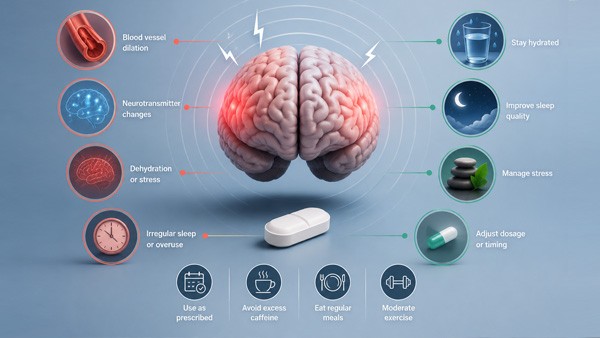
Headache is the single most common side effect of modafinil — affecting approximately 34% of users in pooled FDA trial data, more common than insomnia, anxiety, nausea, or any other reported adverse effect. The headache is almost always the bilateral tension-type variety rather than migraine, typically begins 1-3 hours after dosing during the modafinil peak window, and tapers off as plasma levels decline through the afternoon. For most users it is mild and self-limiting; for a smaller subset it is persistent enough to seriously affect tolerability and lead to discontinuation. The good news is that modafinil headaches are predictable, mechanistically understood, and in the large majority of cases preventable through a small number of practical interventions.
This guide is structured as a practical troubleshooting manual rather than a passive description of the side effect. The aim is to take a user from "I have headaches on modafinil" to either "my headaches are now controlled" or "I have enough information to discuss this productively with my physician." We cover the underlying neurochemistry of why modafinil produces headaches in the first place, the three modifiable factors that drive most cases (hydration, dose, and caffeine stacking), the dose-reduction strategy that works for the largest fraction of users, the headache subtypes you should be able to distinguish, a structured 7-day headache journal to identify your specific triggers, the treatment escalation ladder from over-the-counter relief to specialist consultation, and the red-flag symptoms that warrant stopping modafinil and seeking medical evaluation.
| Action set | Specific steps |
|---|---|
| 🟢 3 things to TRY immediately | (1) Drink an extra 500-750 ml water within an hour of your morning dose. (2) Reduce or skip morning coffee for 3 days while tracking headache. (3) If on 200 mg, drop to 100 mg (half-tablet) for 3 days to test dose-dependency. |
| 🟡 2 things to AVOID immediately | (1) Stop taking the tablet on an empty stomach — eat a meal containing at least 300 calories before dosing. (2) Stop taking modafinil after 10:00 AM if your headache is late-day — late dosing extends the irritation window into evening. |
| 🔴 1 sign to STOP immediately | Any rash anywhere on the body, even small or mild, even unrelated-looking — stop modafinil and call your physician today. This is the Stevens-Johnson syndrome warning sign and overrides everything else on this page. |
For approximately 60-70% of users with modafinil headaches, the 3-2-1 triage above resolves the problem within a week. If your headaches persist after a clean trial of all three changes, work through the rest of this guide systematically.
🧠 Why Modafinil Causes Headaches
The headache mechanism with modafinil is multifactorial — meaning there is no single switch that produces or eliminates headache, but several contributory factors that combine in different ways for different users. Understanding the contributing mechanisms is what makes targeted intervention possible rather than guesswork.
Vasoactive effects on cerebral vessels. Modafinil produces mild vasoconstriction in cerebral and meningeal blood vessels, similar to (though milder than) classical stimulants. The vasoconstriction itself is not strongly headache-producing, but the rebound vasodilation as modafinil clears — typically late afternoon to evening — can produce a tension-type headache pattern in vasoactive-sensitive users. This is why some users report headaches that begin not during the modafinil peak but during the wear-off window.
Dopaminergic and noradrenergic engagement. Modafinil weakly inhibits dopamine reuptake and modulates norepinephrine signaling. Both pathways have known relationships to headache generation in susceptible individuals — particularly people with personal or family history of migraine, where altered monoamine signaling is part of the underlying biology. Modafinil's effect on these systems is mild compared to classical stimulants, but enough to provoke headache in predisposed users.
Histaminergic arousal pathway. Modafinil engages histamine arousal neurons in the tuberomammillary nucleus. Histamine has complex relationships with headache — it is both a potential trigger (histamine release can provoke headache) and part of normal arousal signaling. The histamine effect probably explains a fraction of modafinil-associated headache, particularly in users with histamine-sensitivity or those who also notice headaches from histamine-rich foods.
Dehydration amplification. Modafinil produces mild diuretic effect plus reduces thirst sensation in some users — meaning fluid intake often drops on modafinil days without the user noticing. Even mild dehydration is one of the most common everyday headache triggers in the general population; modafinil amplifies this by producing the dehydration while also masking the thirst signal that would normally prompt fluid replacement.
Caffeine interaction. Many modafinil users continue their habitual coffee intake on modafinil days. Both substances produce mild dehydration; both produce mild vasoactive effects; the combination produces additive load. Heavy caffeine on top of modafinil is one of the most common reversible causes of persistent headache in the user base.
💧 The Hydration Connection
Hydration is the single most actionable factor in modafinil headache management. A substantial fraction of modafinil headaches resolve completely with deliberate fluid intake — and the same headaches return when fluid intake drops. The relationship is causal enough that users who systematically increase water intake during modafinil days often report dramatic improvement within 2-3 days.
Modafinil affects hydration through two mechanisms simultaneously. First, it produces mild diuretic effect — increased urine output relative to fluid intake, similar to (though milder than) caffeine. Second, it reduces thirst perception in some users — the alertness-promoting effect appears to interfere with the normal thirst signal, meaning your body is asking for fluid but you are not receiving the message. The combination of increased fluid output plus reduced fluid intake reliably produces mild dehydration unless deliberately countered.
Practical hydration protocol that works for most users:
- Pre-dose hydration: Drink 250-500 ml of water before taking modafinil. This establishes a hydration baseline before the diuretic effect begins.
- First-hour hydration: Another 250-500 ml within the first hour after dosing. This is the window when most users would normally have a coffee — replace some of that with water.
- Hourly maintenance: Aim for 200-300 ml of water every 1-2 hours through the morning and into early afternoon. Total morning fluid intake should be 1.5-2 liters by noon on modafinil days.
- Use electrolytes for high-output days: If you are physically active on modafinil days, the combination of exercise sweat loss plus modafinil diuresis can produce notable electrolyte depletion. Add a pinch of salt to one of your water bottles, or use a low-calorie electrolyte drink.
- Don't substitute coffee or tea for water: They contain water but also contain caffeine that adds to the diuretic load. They are net positive for hydration only in modest quantities. Replace at least some of your coffee with plain water on modafinil days.
- Monitor urine color: Pale yellow is the target. If your urine is consistently dark yellow or amber through the day, you are dehydrated regardless of how much you think you drank.
| Time of day | Target fluid intake | Notes |
|---|---|---|
| Pre-dose (07:00-08:00) | 250-500 ml water | Establish baseline before drug effect |
| First hour post-dose | 250-500 ml water | Counter early diuretic effect |
| Mid-morning (10:00-12:00) | 500-750 ml total | Peak modafinil window — keep flowing |
| Lunch hydration (12:00-13:00) | 250-500 ml water with meal | Food-paired hydration |
| Afternoon (13:00-17:00) | 500-750 ml total | Maintenance through plateau window |
| Evening tapering (17:00-21:00) | Normal intake | Diuretic effect minimal; reduce to avoid sleep interruption |
| Total morning + afternoon target | 2-3 liters water | Higher than non-modafinil days |
☕ Caffeine Stacking Problem
Heavy caffeine combined with modafinil is the second-largest cause of preventable modafinil headache. Many users automatically continue their normal 2-4 cup daily coffee habit on modafinil days, not realizing that the combined arousal load and dehydration load produce a headache pattern that would not occur with either substance alone. The fix is straightforward — reduce caffeine on modafinil days — but it requires deliberate behavior change.
The interaction has three mechanisms. First, both substances produce mild vasoactive effects on cerebral blood vessels — the additive load is meaningful even if neither alone is strongly headache-producing. Second, both substances produce diuretic effect, compounding the dehydration mechanism described above. Third, both substances increase cardiovascular sympathetic tone — combined activation can produce the muscle tension and jaw clenching that secondarily generates tension-type headache.
The caffeine reduction protocol that works for most users:
- Cut total daily caffeine by 50-75% on modafinil days. If your normal intake is 3 cups of coffee, target 1 cup on modafinil days for the first week.
- Move your coffee earlier in the day. Combined caffeine + modafinil in the late morning or afternoon increases sleep disruption and prolongs headache window. If you keep coffee, finish it before 09:00.
- Switch to lower-caffeine alternatives during transition: Black tea has roughly half the caffeine of brewed coffee; green tea has a third; herbal tea is caffeine-free. Switching for 1-2 weeks while modafinil tolerance develops can substantially reduce headaches.
- Don't quit caffeine cold-turkey simultaneously with starting modafinil: Caffeine withdrawal headache is more reliable than modafinil-induced headache. Sudden caffeine cessation on top of modafinil produces compounded headache. Taper caffeine over 5-7 days if reducing intake significantly.
- Watch out for hidden caffeine: Many cold medications, "energy" products, pre-workout supplements, and even some pain relievers contain caffeine. Read labels during your modafinil headache investigation period.
- Reintroduce caffeine carefully after modafinil tolerance settles: Once you have established stable modafinil response over 2-3 weeks, small amounts of caffeine can usually be added back without triggering headache.
For a deeper analysis of the modafinil-caffeine relationship including stacking guidelines and dose math, see our companion article Modafinil vs Caffeine.
📉 Dose Reduction Strategy
If hydration optimization and caffeine reduction do not fully resolve headaches, the next intervention is dose reduction. Modafinil headache frequency is moderately dose-dependent — users who get headaches on 200 mg often tolerate 100 mg without issue, and users who tolerate 200 mg may get headaches on 400 mg. The dose-reduction protocol below works for most patients:
- Days 1-7: Reduce to 100 mg (half a 200 mg tablet) every morning. Maintain hydration and caffeine protocols simultaneously. Track headache frequency and intensity daily.
- Days 8-14: Reassess. If headaches resolved at 100 mg and alertness is adequate, hold the dose. If alertness is inadequate, consider whether the headache-free function at 100 mg is preferable to the higher-alertness-with-headache function at 200 mg — for many users it is.
- Days 15-21: If you decided to try returning to 200 mg, attempt a re-introduction with all the hydration and caffeine protocols firmly in place. Track whether headache returns.
- Days 22+: Settle on the final dose. Many users discover their optimal dose is 150 mg (1.5 tablets crushed and split, or one 100 mg + one 50 mg if available) — a middle ground between 100 and 200 mg that provides adequate alertness without headache.
- If 100 mg still produces headache: Try 50 mg (quarter tablet) for 5 days. If headache persists even at 50 mg, modafinil is probably not the right drug for your physiology — discuss alternatives with your physician (armodafinil sometimes has a different headache profile despite the related mechanism; see Modafinil vs Armodafinil).
| Modafinil dose | Typical headache frequency | Typical headache intensity | Action |
|---|---|---|---|
| 50 mg (quarter tablet) | Rare | Mild if present | Try if 100 mg fails |
| 100 mg (half tablet) | Lower than 200 mg | Mild | Often adequate alertness without headache |
| 150 mg | Intermediate | Mild-moderate | Middle-ground option |
| 200 mg (standard) | ~25-35% (FDA trial data) | Mild-moderate | Standard dose; first reduction target |
| 300 mg | Higher | Moderate | Above standard; consider reducing |
| 400 mg (high) | ~40-50% | Moderate-severe | Diminishing benefit; high headache cost |
🩺 When to Stop and See a Doctor
Most modafinil headaches respond to the hydration, caffeine, and dose interventions described above and do not require medical evaluation. A specific set of red-flag symptoms, however, indicate that the headache is not typical modafinil headache and that prompt medical attention is needed. These symptoms override everything else on this page:
- 🔴 Any skin rash anywhere on the body while taking modafinil — Stevens-Johnson syndrome warning. Stop modafinil today. Contact your physician same-day or attend urgent care. Even a small or "minor-looking" rash is reason to stop until evaluated.
- 🔴 Sudden severe "worst headache of my life" — this pattern can indicate intracranial bleeding or other neurosurgical emergency. Stop modafinil; seek emergency evaluation immediately.
- 🔴 Headache with fever, stiff neck, or photophobia — possible meningitis. Emergency evaluation.
- 🔴 Headache with neurological symptoms (vision changes, weakness or numbness on one side, slurred speech, confusion) — possible stroke or transient ischemic attack. Emergency evaluation.
- 🔴 Headache that wakes you from sleep repeatedly — atypical pattern that warrants medical evaluation beyond modafinil management.
- 🔴 Persistent severe headache for >48 hours despite stopping modafinil — needs medical evaluation independent of the modafinil context.
- 🟡 Chronic mild-moderate headache >2 weeks on stable modafinil dose despite hydration, caffeine, and dose optimization — schedule routine appointment with your physician.
- 🟡 New migraine pattern developing during modafinil use in a patient with no prior migraine history — consult physician. Modafinil can unmask underlying migraine biology.
- 🟡 Headache with elevated blood pressure (consistent readings >140/90 after starting modafinil) — discuss with physician; may need cardiovascular evaluation.
- 🟡 Headache plus heart palpitations or chest discomfort — discuss with physician; modafinil cardiovascular evaluation may be needed.
🧾 Headache Type Classification
Not all modafinil headaches are the same — and identifying which type you are experiencing helps target the right intervention. The four types below cover the large majority of modafinil-associated headache patterns:
Headache Type 1 — "Dehydration-driven bilateral tension." Bilateral pressure or band-like pain across the forehead or temples, mild-to-moderate intensity, begins 1-3 hours after dose, resolves with hydration. The most common type — accounts for probably 40-50% of modafinil headache cases. Primary intervention: hydration protocol (Section above). Usually resolves completely with deliberate fluid intake.
Headache Type 2 — "Caffeine-stack tension." Similar bilateral tension pattern to Type 1 but worse with normal coffee intake, often with jaw clenching or shoulder tension. Indicates the additive vasoactive load from caffeine + modafinil is the primary driver. Primary intervention: caffeine reduction protocol. Often resolves with 50-75% caffeine cut for 1-2 weeks.
Headache Type 3 — "Dose-dependent throbbing." Throbbing or pulsing quality, often worse during modafinil peak (2-5 hours post-dose), reduces noticeably at lower doses. Indicates modafinil's direct vasoactive and dopaminergic effects are the primary driver rather than secondary factors. Primary intervention: dose reduction. Usually resolves at 100 mg or 50 mg dose.
Headache Type 4 — "Migraine pattern." Unilateral throbbing pain, often with nausea, light sensitivity, or visual aura before onset. May occur in patients with prior migraine history that modafinil exacerbates, or as new-onset migraine that modafinil unmasks. Primary intervention: physician consultation and standard migraine management. Modafinil may need to be discontinued or substituted with an alternative (armodafinil sometimes works better in migraine-prone patients despite the related mechanism).
| Type | Location | Quality | Timing | Primary intervention |
|---|---|---|---|---|
| Type 1 (dehydration) | Bilateral forehead / temples | Pressure / band | 1-3 hr post-dose | Hydration protocol |
| Type 2 (caffeine stack) | Bilateral with jaw / shoulder | Tension | Throughout caffeine window | Caffeine reduction |
| Type 3 (dose-dependent) | Bilateral / generalized | Throbbing / pulsing | Peak window (2-5 hr) | Dose reduction |
| Type 4 (migraine) | Often unilateral | Throbbing + aura | Variable | Physician consultation |
📓 7-Day Headache Journal Template
If your modafinil headaches do not respond to the standard interventions, a structured headache journal helps identify your specific trigger pattern. Track these variables daily for 7 days. The data lets you (or your physician) see patterns that single-day reports miss:
- Daily modafinil dose (mg) and exact time of administration.
- Total water intake through the day, in liters. Use a marked water bottle or count cups.
- Total caffeine intake across all sources (coffee cups, tea cups, energy drinks, supplements, even chocolate) — convert roughly to mg if possible.
- Sleep duration the previous night in hours.
- Stress level on a 1-10 scale (subjective but useful).
- Exercise that day (yes/no, intensity, duration).
- Meal pattern — particularly whether you ate before the modafinil dose, and what.
- Headache occurrence — yes/no, time of onset, intensity (1-10), location (where on head), quality (pressing / throbbing / aching).
- What worked / didn't work — any interventions tried that day and their effect.
After 7 days, review the journal looking for patterns. Specifically:
- Are headaches more common on lower-water days? → Hydration is your trigger.
- Are headaches more common on multi-coffee days? → Caffeine is your trigger.
- Are headaches more common on poor-sleep days? → Sleep deprivation is amplifying the underlying mechanism — work on sleep hygiene.
- Are headaches consistent regardless of other variables? → Modafinil dose is the primary driver; dose reduction is your most likely fix.
- Are headaches absent on weekend (no-modafinil) days? → Modafinil is confirmed as the trigger, not unrelated background headache.
Bring the journal to your physician if you do escalate to medical consultation. The data is far more useful than verbal description.
🪜 Treatment Escalation Ladder
For acute relief of an existing modafinil headache while you work on the underlying triggers, the following escalation ladder works for most users. Start at rung 1 and only move up if the previous rung is inadequate:
| Rung | Intervention | Notes |
|---|---|---|
| 1 | Drink 500 ml water + rest in a quiet room for 20 minutes | Resolves perhaps 30% of acute modafinil headaches without medication |
| 2 | Add 200-400 mg ibuprofen OR 500-1000 mg acetaminophen | Standard OTC analgesics. Choose based on personal tolerability. |
| 3 | Add cold compress to forehead OR neck stretches for 10 minutes | Non-pharmacological augmentation |
| 4 | Combination ibuprofen + acetaminophen (alternating, not stacked simultaneously) | For more resistant headaches; do not exceed daily maximums of either |
| 5 | Triptans (sumatriptan, rizatriptan) IF migraine pattern + prescription | For Type 4 migraine-pattern headache only, requires prescription |
| 6 | Physician consultation for persistent / severe / atypical headache | If rung 5 inadequate or contraindicated |
What NOT to do for modafinil headache acute relief:
- Do not take aspirin if you are also taking warfarin or have bleeding issues — modafinil + warfarin already requires careful management; adding aspirin compounds the bleeding risk.
- Do not take additional caffeine to treat the headache — caffeine is a real headache remedy in some contexts (medication-overuse headache, caffeine withdrawal headache), but in modafinil headache adding more caffeine usually worsens the problem because caffeine is part of the trigger.
- Do not take more modafinil to "push through" the headache — extra dose amplifies the underlying trigger.
- Do not exceed daily maximums of OTC analgesics — chronic overuse produces medication-overuse headache, which makes the original problem worse.
- Do not ignore persistent headaches in the hope they resolve on their own — modafinil headaches that persist beyond 2 weeks on stable dose despite intervention warrant physician input.
✨ Bottom Line
Modafinil headaches affect approximately one in three users, are usually mild-to-moderate bilateral tension-type pain in the first hours after dosing, and are almost always preventable through three modifiable factors: hydration optimization, caffeine reduction, and dose adjustment. The 3-2-1 quick-start triage at the top of this article resolves headaches in approximately 60-70% of affected users within a week. Persistent headaches respond well to systematic investigation using a 7-day headache journal, identifying which of the four headache types you are experiencing, and applying the appropriate targeted intervention.
For acute relief while you fix the underlying triggers, the escalation ladder from water-plus-rest through OTC analgesics to physician consultation handles most cases. The red-flag symptoms (skin rash, severe sudden headache, neurological symptoms, headache with fever) override the standard troubleshooting and warrant urgent medical evaluation — these are not "modafinil being modafinil" but indicators that something more serious is happening.
For most users, modafinil's headache profile is manageable and does not require discontinuation. For users where headaches persist despite all interventions, alternatives within the modafinil family (armodafinil — see Modafinil vs Armodafinil) or in adjacent drug classes (methylphenidate — see Modafinil vs Ritalin) may be better fits. Discontinuation should be a physician-supervised decision, not a unilateral choice — there may be underlying contraindications or red flags that warrant medical input first.
For pharmaceutical-grade modafinil with predictable dosing accuracy, Modalert 200 mg from Sun Pharma is the most widely used generic, with split-scored tablets that allow easy dose reduction to 100 mg or 50 mg during headache troubleshooting.
❓ Frequently Asked Questions
How common are modafinil headaches?
Approximately 34% of users in pooled FDA trial data — making headache the single most common modafinil side effect, more frequent than insomnia, nausea, anxiety, or any other reported adverse effect. The frequency varies somewhat with dose (higher doses produce more frequent headaches), with concurrent caffeine intake (heavy caffeine users get more headaches), and with individual physiology. For most users headaches are mild and self-limiting; for approximately 5-10% they are persistent enough to seriously affect tolerability.
How long do modafinil headaches usually last?
Acute modafinil headaches typically last 2-6 hours per episode, peaking during the modafinil peak plasma window (2-5 hours after dose) and resolving as the drug clears through afternoon. With proper hydration and caffeine management, many users experience the headaches only during the first 1-2 weeks of treatment before tolerance develops, then have minimal headache for the long-term. Headaches that persist daily beyond 4 weeks of stable dosing without responding to intervention warrant physician evaluation.
Can I take ibuprofen with modafinil?
Yes — there is no significant drug-drug interaction between modafinil and standard OTC analgesics including ibuprofen, acetaminophen, naproxen, and aspirin. The standard dose limits apply (ibuprofen 400-600 mg per dose, max 2400 mg per day; acetaminophen max 4000 mg per day). Be cautious with aspirin if you take warfarin or have bleeding issues since both modafinil and warfarin require careful management. Triptans for migraine pattern are also safe to combine with modafinil under prescription guidance.
Will modafinil headaches go away with tolerance?
For many users, yes — modafinil side effects including headache often diminish over the first 2-4 weeks of consistent use as the body adjusts to the drug. This pattern is not universal, however, and depends partly on which underlying mechanism is driving the headache. Dehydration-driven and caffeine-stack headaches do not resolve with tolerance alone — they require behavior change. Dose-dependent and direct vasoactive-driven headaches sometimes do diminish with continued use. The honest expectation: give it 4 weeks with proper hydration and caffeine management before judging whether modafinil's headache profile is sustainable for you.
Does cutting modafinil dose actually help with headaches?
For most users, yes — modafinil headache frequency is moderately dose-dependent. Users who experience headaches on 200 mg often tolerate 100 mg without issue. The reduction from 200 to 100 mg cuts modafinil exposure in half and typically reduces headache frequency proportionally. The functional trade-off is whether 100 mg provides adequate alertness for your needs — for many users it does, particularly with proper hydration and timing. Try 100 mg for 7-10 days before assuming 200 mg is required for your alertness.
Is the modafinil headache the same as Stevens-Johnson syndrome warning?
No — these are completely different. Modafinil headache is a common dose-related side effect that affects about a third of users and is typically mild-to-moderate bilateral pain. Stevens-Johnson syndrome is a rare but serious immunological reaction characterized by skin rash that progresses to skin sloughing, mucous membrane involvement, and systemic illness. SJS does not present as headache alone — it presents as rash, fever, mouth sores, and eye involvement. If you develop any rash while taking modafinil, stop the drug immediately and seek medical evaluation today, regardless of whether you have headache or not. Garden-variety headache without rash does not indicate SJS.
Why does my modafinil headache come back when I stop drinking coffee suddenly?
That is caffeine withdrawal headache, not modafinil headache returning. Sudden cessation of habitual caffeine produces reliable withdrawal headache within 24-48 hours due to adenosine receptor upregulation. This compounds with any modafinil-related headache to produce worse symptoms than either alone. The fix is to taper caffeine over 5-7 days rather than stopping abruptly, then maintain a lower steady caffeine intake on modafinil days. Mixing sudden caffeine cessation with modafinil management is the worst-of-both-worlds approach.
Can I switch to armodafinil to avoid headaches?
Sometimes it helps, sometimes it does not. Armodafinil is the R-enantiomer of modafinil — same molecular family, similar pharmacology, similar side-effect profile in principle. Some users who experience prominent headache on modafinil report tolerating armodafinil better, possibly because the smoother plasma curve produces less vasoactive variability. Other users find armodafinil produces identical headaches because the underlying mechanism is the same. Worth trying as a substitution if standard modafinil headache management fails. See Modafinil vs Armodafinil for full comparison.
Should I take modafinil with food to prevent headaches?
Yes — taking modafinil on an empty stomach is associated with more frequent and more pronounced headaches in many users. Eating at least 300 calories with the dose slows absorption slightly, blunts the peak concentration, and reduces the vasoactive peak that contributes to headache. The food does not need to be elaborate — even a piece of toast, a banana, or yogurt is enough. The "always take with food" rule is one of the simplest interventions and works for a meaningful fraction of users.
What's the difference between modafinil headache and migraine?
Typical modafinil headache is bilateral tension-type pain — pressure or band-like sensation in forehead or temples, mild-to-moderate intensity, no neurological symptoms, no aura, no light or sound sensitivity beyond mild discomfort. Typical migraine is unilateral throbbing pain, often preceded by visual aura (zig-zag patterns, blind spots) or other warning symptoms, with associated nausea, vomiting, light sensitivity, and sound sensitivity. The two patterns are usually clearly distinguishable. If you develop migraine pattern on modafinil — particularly with aura — this is Type 4 from the classification above and warrants physician consultation, since modafinil may need to be substituted with an alternative.
📚 References & Further Reading
- FDA prescribing information for Provigil (modafinil) — official adverse effect profile including headache prevalence data.
- FDA prescribing information for Nuvigil (armodafinil) — comparative adverse effect data.
- International Headache Society — diagnostic criteria for tension-type headache and migraine used in headache classification above.
- American Headache Society — guidelines on medication-overuse headache, relevant to escalation ladder.
- European Headache Federation — practice guidelines on secondary headache evaluation.
- Cochrane reviews on OTC analgesics — comparative efficacy data for ibuprofen vs acetaminophen vs combination treatment.
- American Academy of Sleep Medicine — practice parameters for modafinil's FDA-approved indications and side-effect management.
- Modafinil vs Caffeine — detailed analysis of caffeine stacking relevant to the caffeine reduction protocol above.
- Modafinil vs Armodafinil — R-enantiomer alternative for users with persistent headache.
- Modafinil vs Ritalin — methylphenidate alternative for cases where modafinil is not tolerable.
- Modalert vs Provigil — generic vs brand comparison; switching products rarely affects headache profile.
- Best Time to Take Modafinil — timing rules that affect headache window.
- Modafinil Tolerance and Dose Escalation — context for dose adjustment.
- Modafinil 200 mg Dosage Guide — standard dosing reference.
- Modalert 200 mg, Modvigil 200 mg, Waklert 150 mg — primary product pages on the RXshop antinarcoleptic catalogue.
- RXshop Editorial Team — content reviewed by licensed pharmacist; for adult patient education, not a substitute for individual medical consultation.
Medical Disclaimer: The information in this article is for educational and informational purposes only and is not a substitute for professional medical advice, diagnosis, or treatment. Always seek guidance from a qualified healthcare provider with any questions you may have regarding a medical condition, and before starting, stopping or changing any medication.