Modafinil and Anxiety: When It Helps and When It Hurts


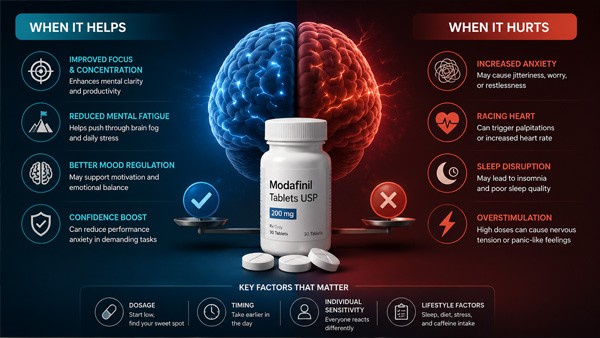
Anxiety affects approximately 5-10% of modafinil users in FDA trial data — far less common than headache or insomnia, but significant when it occurs. The presentation varies widely: some users describe a mild jittery edge similar to too much coffee, others experience genuine panic-like episodes with chest tightness, racing thoughts, and a sense of impending doom. The difference between these presentations is not random — it tracks predictably with dose, with caffeine stacking, with personal anxiety history, with concurrent stress, and with specific drug interactions. Most modafinil-related anxiety is preventable and manageable; a smaller subset indicates that modafinil is not the right drug for that user's physiology.
This guide takes the same practical troubleshooting approach used in the headache and insomnia companion articles, applied to the more nuanced symptom of anxiety. We cover the underlying neurochemistry of why modafinil generates anxiety in susceptible users, the specific risk factors that identify who is most likely to experience it, a weighted risk-scoring framework to assess your own profile honestly, the dose-anxiety relationship that explains why dose reduction works for most cases, the substances that compound modafinil's anxiety effect when stacked, immediate relief strategies including a structured grounding protocol for acute episodes, four phenotype classifications that match anxiety presentation to targeted intervention, and the clear criteria for when discontinuation and professional help are the right answer rather than continued symptom management.
Answer YES/NO to each. Each yes = 1 risk point. Total at bottom.
Question 1: Do you have a personal history of anxiety disorder, panic disorder, or generalized anxiety? Y / N
Question 2: Have stimulants (caffeine, energy drinks, Adderall, Ritalin) given you noticeable anxiety in the past? Y / N
Question 3: Do you drink more than 2 cups of coffee per day on modafinil days? Y / N
Question 4: Are you currently taking your modafinil at 300 mg or higher daily? Y / N
Question 5: Are you currently in a period of unusually high life stress (work crisis, relationship problems, recent loss)? Y / N
Scoring:
0-1 yes: Low risk — modafinil-related anxiety is unlikely for you. If it occurs, simple measures (hydration, caffeine reduction) usually resolve it.
2-3 yes: Moderate risk — proactive prevention strategies recommended. Read the prevention sections carefully before continued use.
4-5 yes: High risk — work through this article systematically. Consider lower starting dose, eliminate caffeine entirely, and have an exit strategy if anxiety becomes prominent. Discuss with physician before continued use.
🧠 Why Modafinil Can Cause Anxiety
Modafinil's anxiety mechanism is multifactorial — like its headache mechanism, several contributing pathways combine in different ways for different users. Understanding the mechanism is what allows targeted intervention rather than guesswork.
Adrenergic activation. Modafinil engages noradrenergic arousal pathways as part of its wake-promoting mechanism. Norepinephrine is the central neurotransmitter of the body's "alertness and threat" response — elevated norepinephrine tone produces the physical signature of anxiety (increased heart rate, elevated blood pressure, hyperventilation tendency, muscle tension) even in the absence of any cognitive anxiety trigger. For users with baseline-elevated anxiety, the additional noradrenergic load can tip the system from "alert" to "anxious."
Dopaminergic engagement. Modafinil's weak dopamine reuptake inhibition increases dopaminergic tone in reward and motivation circuits. Increased dopamine generally feels positive but in anxiety-prone individuals can manifest as restlessness, racing thoughts, and the kind of internal pressure to "do something" that some users experience as functional motivation and others experience as anxiety. The line between productive motivation and uncomfortable agitation is partly individual.
Histaminergic arousal. The histamine arousal pathway modafinil engages overlaps with stress-response physiology. Histamine release contributes to alertness and threat-detection sensitivity. In anxious users this amplifies background environmental scanning and heightens reactivity to neutral stimuli.
Cardiovascular sympathetic tone. Modafinil produces mild heart rate increase (+1-3 bpm) and blood pressure increase (+1-3 mmHg) in typical users — much less than classical stimulants but real. For some individuals, particularly those who attend to bodily sensations, the perception of an elevated heart rate triggers a feedback loop: noticing the racing heart produces anxious thought, which further elevates heart rate. This is the classic "panic feedback loop" and it can be initiated by modafinil even when the original cardiovascular activation is modest.
HPA axis modulation. Modafinil mildly increases cortisol secretion through hypothalamic-pituitary-adrenal axis engagement. Cortisol is the body's primary stress hormone; elevated cortisol contributes to anxious mood and physical arousal. This effect is modest in most users but contributes to the anxiety pattern in susceptible individuals.
Reduced thirst plus dehydration. As described in the companion Modafinil Headaches article, modafinil's diuretic effect plus reduced thirst sensation produces mild dehydration. Dehydration independently increases anxiety physiology — heart rate rises, cortisol increases, and subjective tension elevates. Many anxiety episodes on modafinil have a dehydration component that resolves with fluid replacement.
🎯 Risk Factor Profile
Not all modafinil users have the same likelihood of experiencing significant anxiety. The risk factors fall into stable individual characteristics (your baseline biology), behavioral factors (what you do alongside modafinil), and situational factors (your current life context). Understanding your profile helps both prevention and post-event analysis.
The risk scoring table below uses weighted points across the major factors. Higher total scores indicate higher probability of experiencing meaningful modafinil-related anxiety. This is a clinical heuristic, not a precise predictor — but it captures the major variables that drive risk differences across users.
| Risk factor | Points if YES | Why it matters |
|---|---|---|
| Personal history of panic disorder | 3 | Modafinil's adrenergic load triggers panic in vulnerable users |
| Personal history of generalized anxiety | 2 | Baseline elevated anxiety tone amplified by modafinil |
| Family history of anxiety disorders | 1 | Hereditary anxiety vulnerability |
| Prior anxiety with stimulants (caffeine, Adderall, Ritalin) | 2 | Sensitivity to stimulant-class arousal |
| Heavy caffeine intake (3+ cups daily) | 2 | Additive adrenergic load |
| Modafinil dose ≥300 mg | 2 | Dose-dependent risk increase |
| Current SSRI or SNRI use | 1 | Some interaction risk; usually safe but additive serotonergic/adrenergic load |
| Current high life stress | 1 | Reduced anxiety buffer |
| Poor sleep (<6 hours/night) | 1 | Sleep deprivation amplifies anxiety physiology |
| Pre-existing thyroid hyperactivity | 2 | Already-elevated adrenergic tone |
| Cardiac arrhythmia history | 2 | Heart palpitations trigger panic feedback loop |
| Female (pre-menstrual phase) | 1 | Hormonal modulation of anxiety |
| Age <25 | 1 | Younger users somewhat more anxiety-prone on modafinil |
Score interpretation:
- 0-2 points: Low risk profile. Modafinil-related anxiety unlikely. Standard precautions (hydration, moderate caffeine, standard 100-200 mg dose) sufficient.
- 3-5 points: Moderate risk profile. Start at 100 mg (half-tablet) and assess response over 1-2 weeks before considering 200 mg. Eliminate or minimize caffeine. Build sleep buffer before introducing modafinil.
- 6-9 points: High risk profile. Strongly consider whether modafinil is the right choice for you. If proceeding, start at 50 mg (quarter-tablet) with full caffeine elimination and physician input. Have a specific exit plan if anxiety becomes prominent.
- 10+ points: Very high risk profile. Modafinil is probably not the best choice. Discuss alternative wakefulness or cognitive enhancement strategies with your physician — caffeine moderation, sleep optimization, or alternative pharmacology may serve you better than modafinil.
📊 Dose-Anxiety Relationship
The dose-anxiety relationship is one of the cleanest dose-effect curves in modafinil pharmacology. Anxiety frequency and intensity both rise meaningfully with dose, and the relationship is more pronounced than the parallel dose-headache curve. This is good news for practical management — dose reduction is one of the highest-yield interventions available.
Empirical pattern from clinical use:
| Modafinil dose | Anxiety frequency | Anxiety intensity | Notes |
|---|---|---|---|
| 50 mg (quarter) | Rare (<3%) | Minimal if present | Useful for sensitive users |
| 100 mg (half) | Lower than 200 mg | Mild | Often adequate alertness without anxiety |
| 150 mg | Intermediate | Mild-moderate | Middle-ground compromise |
| 200 mg (standard) | ~5-10% (FDA trial data) | Mild-moderate | Standard dose; first reduction target |
| 300 mg | ~12-15% | Moderate | Above standard; rising risk |
| 400 mg (high) | ~20-25% | Moderate-severe | Diminishing benefit; high anxiety cost |
The dose-reduction protocol for users experiencing anxiety on standard dose:
- Days 1-7: Reduce to 100 mg morning. Eliminate caffeine simultaneously. Track anxiety daily on a 1-10 scale.
- Days 8-14: Reassess. If anxiety resolved at 100 mg, hold the dose. The functional question is whether 100 mg alertness is adequate — for many users it is.
- Days 15-21: If 100 mg is adequate, attempt cautious caffeine reintroduction (single cup, before 09:00) and see whether anxiety remains controlled. Some users tolerate moderate caffeine fine at lower modafinil dose.
- Day 22+: Settle on the final dose-and-caffeine combination. For most anxiety-prone users, this lands at 100 mg modafinil plus 0-1 cup of morning coffee.
- If 100 mg still produces anxiety: Try 50 mg for 5 days. If still anxious at 50 mg, modafinil is probably not the right drug — discuss alternatives with your physician.
⚠️ Stacking Substances That Worsen Anxiety
The substances most likely to amplify modafinil-related anxiety are predictable and largely modifiable. Eliminating or moderating these is often the difference between manageable mild jitters and a serious anxiety problem.
- Caffeine — the biggest amplifier. Heavy caffeine intake (3+ cups of coffee, energy drinks, pre-workout supplements with stimulant blends) on modafinil days reliably amplifies anxiety physiology. The combination produces additive adrenergic load that exceeds the sum of parts. First intervention for any modafinil-anxiety user: reduce caffeine to 0-1 cups daily during the troubleshooting period.
- Nicotine. Nicotine is itself anxiogenic in many users; combined with modafinil produces compound activation. Smokers experiencing modafinil-related anxiety often find that smoking reduction or temporary nicotine abstinence resolves the problem more cleanly than dose reduction would.
- Pseudoephedrine and decongestants. Cold and allergy medications containing pseudoephedrine are sympathomimetic — they engage the same adrenergic system modafinil affects. Combined use during a cold reliably produces anxiety in many otherwise stable modafinil users. Switch to non-stimulant decongestants (saline nasal spray, antihistamines without decongestant) during illness on modafinil days.
- Pre-workout supplements. These commonly contain caffeine 200-400 mg, beta-alanine, theanine, and various herbal stimulants. Stacked with modafinil they produce the cardiovascular and psychiatric load most anxious users want to avoid. Take pre-workout on non-modafinil days only, or substantially reduce dose.
- Alcohol. Counter-intuitively, alcohol use can worsen anxiety on modafinil. The alcohol itself produces mild sedation in the acute window but creates rebound anxiety as it clears (typically 4-8 hours later). On modafinil days the rebound anxiety stacks with residual drug effect producing notable evening anxiety. Reduce or eliminate alcohol while troubleshooting modafinil anxiety.
- Cannabis. Some users find cannabis calming with modafinil; others find that THC's effects on anxiety are highly individual and can either help or dramatically worsen the modafinil arousal pattern. Not predictable; not recommended for general use as anxiety mitigation.
- Yohimbine. Sometimes found in fat-burning supplements; strongly alpha-2 adrenergic antagonist — substantially amplifies adrenergic tone. Combined with modafinil produces strong anxiety in most users. Avoid.
- Phenylpiracetam and other racetams. The combination is poorly characterized but adds adrenergic and dopaminergic load. If anxious on modafinil, do not stack racetams. (See Modafinil vs Phenylpiracetam.)
- Other stimulants (Adderall, Ritalin, Vyvanse). Combining modafinil with classical stimulants produces compound activation that almost always produces meaningful anxiety. Combinations are occasionally prescribed for specific scenarios but require specialist oversight. Patient self-management with combinations is not safe practice for anxiety-prone users.
💆 Relief Strategies
For acute anxiety episodes during a modafinil window, the following intervention sequence works for most users. Stack interventions rather than relying on any single one:
- Paced breathing (immediate): 4-second inhale, 4-second hold, 6-second exhale. 2 minutes. Activates parasympathetic nervous system.
- 5-4-3-2-1 grounding (within 2-5 minutes): The sensory exercise above. Breaks rumination.
- Hydration (within 5 minutes): 400-500 ml water. Mild dehydration amplifies anxiety; rehydration removes one factor.
- Cool the body (within 10 minutes): Cool water on face and wrists, or step outside in cool air. The vagal response from facial cooling is immediate and measurable.
- Move the body (within 15-30 minutes): Light walk for 10-15 minutes. Physical movement metabolizes excess adrenaline and disrupts the cognitive anxiety pattern. Not vigorous exercise — that would amplify.
- Reduce stimulation (immediate and ongoing): Turn off news, social media, and other intense input. Quiet environment supports the parasympathetic shift.
- Magnesium glycinate (during episode, 200-300 mg): Mild GABA modulation. Not fast-acting but takes the edge off over 30-60 minutes.
- L-theanine (during episode, 200 mg): Mild calming. Available OTC. Reasonable acute relief option.
- Avoid the temptation of caffeine to "push through": Adding caffeine to anxiety on modafinil reliably worsens it. Counter-intuitive but consistent.
- Avoid alcohol "to calm down": Produces rebound anxiety as it clears. Worse than no intervention.
Long-term anxiety prevention strategies (apply before next dosing day, not during acute episode):
- Sleep adequacy: Sleep deprivation amplifies anxiety physiology dramatically. Prioritize 7+ hours nightly. See the companion Modafinil Insomnia article.
- Caffeine reduction: Sustain reduced caffeine even on non-modafinil days for full anxiety physiology reset.
- Regular aerobic exercise: 150 minutes weekly improves baseline anxiety regulation. Schedule exercise on non-modafinil days to avoid stacking arousal.
- Mindfulness or meditation practice: 10 minutes daily over 6-8 weeks measurably reduces baseline anxiety tone. Apps like Calm, Headspace, or Insight Timer are reasonable starting points.
- Therapy for underlying anxiety: If anxiety is a recurring theme regardless of modafinil, cognitive-behavioral therapy is the most evidence-supported non-pharmacological intervention for anxiety disorders. Modafinil is not creating anxiety from nothing — it is amplifying an existing baseline.
- Avoid stacking high-anxiety days with modafinil: If you know tomorrow is a high-stress day, consider skipping modafinil and relying on caffeine alone — lower total arousal load, more graceful coping.
🧾 Anxiety Phenotype Classification
Modafinil-related anxiety is not a single uniform symptom — different users experience meaningfully different anxiety patterns that respond to different interventions. Four phenotypes cover most cases:
Phenotype 1 — "Pure jitters." Physical activation pattern: mild heart rate increase, restless energy, slight hand trembling, mild muscle tension. No prominent cognitive anxiety, no rumination, no fear element. This is the most common phenotype — affects about 60% of modafinil-anxiety cases. Primary intervention: caffeine reduction and dose reduction. Usually resolves completely with these two changes. Often disappears with 2-4 weeks of tolerance even without dose change.
Phenotype 2 — "Cognitive worry amplification." Existing worries become more prominent and intrusive. Pre-existing anxieties about work, relationships, health become harder to set aside. Not new anxieties — amplified existing ones. The drug's arousal effect makes background worry harder to ignore. Primary intervention: combination of dose reduction plus cognitive strategies (mindfulness, externalizing thoughts via journaling, scheduled "worry time" outside modafinil window). Often improves over weeks of treatment as users develop coping habits.
Phenotype 3 — "Panic episode." Acute sudden anxiety with somatic component — racing heart, chest tightness, sense of doom, fear of dying or losing control, hyperventilation. Typically occurs 2-4 hours after dose during peak window. May be misdiagnosed as cardiac event. Primary intervention: STOP modafinil for current and following day; resume only at half dose or quarter dose; consult physician. Users with this phenotype should rule out underlying panic disorder that modafinil is unmasking.
Phenotype 4 — "Slow-burn evening anxiety." Calm during morning peak; anxiety builds through afternoon and evening as drug levels fluctuate. Often misattributed to "stress of the day" but actually pharmacological. Primary intervention: dose reduction, earlier morning dosing to push the difficult window earlier, and consideration of half-dose split (50 mg morning + 50 mg early afternoon rather than 100 mg single morning) to smooth the curve.
| Phenotype | Character | Timing | Primary intervention |
|---|---|---|---|
| 1 (Pure jitters) | Physical activation, no cognitive component | Peak window 2-5 hr | Caffeine + dose reduction |
| 2 (Cognitive worry) | Amplified existing worries | Throughout drug window | Dose reduction + cognitive strategies |
| 3 (Panic episode) | Acute sudden severe with somatic features | Often 2-4 hr peak | Stop modafinil; physician consult |
| 4 (Slow-burn evening) | Anxiety builds afternoon to evening | 4-10 hr post-dose | Earlier dose + split dose option |
🧰 5-4-3-2-1 Acute Grounding Protocol
For acute anxiety episodes during a modafinil window, the structured intervention below is more effective than ad-hoc coping. Run through the sequence even if you don't feel like it — the structure is part of why it works.
- 0-1 minute — Acknowledge and label. Say to yourself either silently or aloud: "I am having anxiety. This is a side effect of modafinil. It will pass. I am safe." Labeling activates the prefrontal cortex's regulatory effect on the amygdala.
- 1-3 minutes — Paced breathing. 4-second inhale through nose, 4-second hold, 6-second exhale through pursed lips. Repeat for 2 minutes. The extended exhale specifically activates parasympathetic response.
- 3-5 minutes — Sensory grounding. Look around your environment. Identify and silently name: 5 things you can see (be specific — not "wall" but "the cream-colored wall to my left with a small mark near the corner"), 4 things you can touch (the texture of your chair, the temperature of your phone, the feel of your feet inside shoes, the fabric of your shirt), 3 things you can hear (be specific — not "sound" but "the hum of the air conditioner", "footsteps in the hallway", "my own breath"), 2 things you can smell, 1 thing you can taste.
- 5-7 minutes — Hydration and cooling. Drink 300-500 ml of water. Cool water on wrists or face if accessible. The combined hydration plus vagal cooling response measurably reduces anxiety physiology.
- 7-15 minutes — Light movement. Walk slowly for 5-10 minutes if possible. Light stretching if walking is not possible. Movement metabolizes excess adrenaline and gives the cognitive system a different focus.
- 15-30 minutes — Reduce stimulation. Quiet environment. Dim lights. Avoid news, social media, intense conversations. Allow the parasympathetic response to consolidate.
- 30-60 minutes — Reassess. Most acute modafinil-related anxiety responds substantially to the above protocol within 30-60 minutes. If anxiety persists past 90 minutes despite the full protocol, consider that today may be a day to stop and rest rather than push through.
- End of day — Document. Briefly note what happened, what dose was taken, what time, what caffeine intake, what other stressors. Pattern recognition over days reveals your triggers more accurately than memory.
🛑 When to Discontinue and Seek Help
Most modafinil-related anxiety responds to the prevention and management strategies above. A specific set of patterns indicates that modafinil is not the right drug or that anxiety has crossed into territory requiring professional input. Recognize these and act on them:
- Panic attacks (Phenotype 3 above) occurring on multiple modafinil days. Two or more panic episodes within a month is reason to stop modafinil and discuss with physician. Modafinil may be unmasking underlying panic disorder that needs separate treatment, or it may simply not be the right drug for your physiology.
- Anxiety persisting after 4 weeks despite full intervention package. If you have reduced dose to 100 mg, eliminated caffeine, optimized sleep, used grounding techniques, and anxiety still meaningfully affects your day-to-day function, discontinuation is the appropriate next step.
- Anxiety affecting non-modafinil days. Anxiety that persists or grows on days when modafinil is not taken indicates either pre-existing anxiety disorder being unmasked or developing dependence pattern. Both warrant physician consultation.
- Avoidance behavior developing. If you find yourself avoiding situations, people, or activities because of anxiety on modafinil days, this is functional impairment that requires intervention beyond dose management.
- Sleep degradation from anxiety. If anxiety is preventing sleep onset even with proper modafinil timing, the anxiety is the primary issue and needs targeted treatment.
- Suicidal thoughts or self-harm urges. Stop modafinil immediately. Contact your physician same-day. Modafinil's FDA label includes warnings about serious psychiatric symptoms in vulnerable patients.
- Symptoms of mania or hypomania. Racing thoughts, decreased need for sleep, grandiose feelings, impulsive behavior, or pressured speech are NOT typical modafinil anxiety — they are signs of possible mood episode that requires immediate physician evaluation. Stop modafinil and seek care.
- Chest pain, irregular heartbeat, or syncope. Cardiovascular symptoms that mimic anxiety but may indicate genuine cardiac event. Emergency evaluation needed; do not assume "it's just anxiety."
✨ Bottom Line
Modafinil-related anxiety affects approximately 5-10% of users — significant when it occurs but a minority experience. Most cases are preventable through the risk-aware approach outlined here: self-screen using the 5-question questionnaire and weighted risk score, start at lower doses for higher-risk profiles, eliminate or minimize caffeine and other stacking substances, prioritize sleep adequacy, and have a clear intervention plan for acute episodes through paced breathing and 5-4-3-2-1 grounding. The 4 anxiety phenotypes — pure jitters, cognitive worry amplification, panic episodes, slow-burn evening — each respond to different targeted interventions.
For acute anxiety during a modafinil window, the structured grounding protocol above (label, breathe, sense, hydrate, move, reduce stimulation) resolves the majority of episodes within 30-60 minutes. For chronic mild jitters, dose reduction to 100 mg plus caffeine elimination handles most cases. For users with high risk profiles or those experiencing panic episodes, the right answer is sometimes discontinuation and discussion with physician about alternative wakefulness or cognitive enhancement strategies rather than continued symptom management.
For pharmaceutical-grade modafinil with split-scored tablets allowing easy dose reduction to 100 mg or 50 mg during anxiety troubleshooting, Modalert 200 mg from Sun Pharma is the most widely used generic. For users where modafinil's anxiety profile is unmanageable, alternatives in the broader category (armodafinil sometimes has a different profile despite related mechanism — see Modafinil vs Armodafinil) may be more tolerable.
❓ Frequently Asked Questions
How common is anxiety on modafinil?
Approximately 5-10% of users in FDA trial data report meaningful anxiety as a side effect. The frequency varies with dose (higher doses produce more anxiety), with caffeine stacking (heavy caffeine users have notably more anxiety), and with individual susceptibility (users with prior anxiety history or stimulant sensitivity are most affected). For comparison, headache affects ~34% of users and insomnia ~5-15% — anxiety is less common but more disruptive when it does occur.
Will modafinil anxiety go away with tolerance?
For many users, mild jitters (Phenotype 1) diminish substantially over 2-4 weeks of consistent use as the body adapts. Cognitive worry amplification (Phenotype 2) and panic episodes (Phenotype 3) do not reliably improve with tolerance and may indicate that modafinil is unmasking underlying anxiety vulnerability. Give it 4 weeks with proper management (lower dose, no caffeine, good sleep) before judging whether modafinil's anxiety profile is sustainable. If anxiety remains prominent after 4 weeks with full management in place, the drug may not be right for you.
Can I take anti-anxiety medication with modafinil?
Some combinations are reasonable; others are problematic. SSRIs and SNRIs are generally safe with modafinil and often co-prescribed for patients with both ADHD/narcolepsy and anxiety. Benzodiazepines (Xanax, Ativan) are pharmacologically opposite — modafinil promoting wakefulness, benzodiazepines promoting sedation; combining them is poor strategy and creates dependence risk on the benzodiazepine. Buspirone is a moderate option without strong interaction. Beta-blockers (propranolol) for somatic anxiety symptoms can pair well with modafinil. Any combination should be physician-supervised — do not self-medicate anxiety on top of modafinil.
Why does modafinil cause anxiety in me but not in other people?
Individual sensitivity varies meaningfully. The major factors: pre-existing anxiety vulnerability (personal or family history doubles risk), baseline adrenergic tone (some people have higher resting sympathetic activity), caffeine sensitivity (parallels modafinil sensitivity), HPA axis reactivity, and partly unmeasured biological factors. The risk scoring table above captures most of the explainable variance. Some users seem to tolerate modafinil's adrenergic and dopaminergic effects as "alertness" while genetically similar users experience the same effects as "anxiety." The boundary is partly biological and partly cognitive.
Should I take modafinil if I have generalized anxiety disorder?
Cautiously, under physician supervision, at low starting dose. Generalized anxiety disorder is not an absolute contraindication for modafinil — many GAD patients use modafinil successfully for narcolepsy or ADHD comorbidities. The keys are: start at 50-100 mg rather than 200 mg, eliminate caffeine entirely during initiation, have an exit plan if anxiety worsens, and discuss with your psychiatrist before starting. Patients with panic disorder rather than GAD should be more cautious — modafinil is more likely to trigger panic episodes than generalized anxiety amplification.
Does modafinil interact with SSRIs to cause anxiety?
The interaction is generally well-tolerated but adds modest serotonergic and adrenergic load that can amplify anxiety in susceptible patients. Most SSRI-modafinil combinations work fine in practice — they are routinely prescribed together. If anxiety appears or worsens after starting modafinil on an established SSRI regimen, the most likely fix is reducing modafinil dose rather than adjusting the SSRI. Serotonin syndrome from this combination is theoretically possible but vanishingly rare in clinical practice.
What's the difference between modafinil anxiety and a panic attack?
Mild modafinil anxiety (Phenotype 1) is a slow-building physical activation — racing heart, restlessness, hand trembling — without prominent cognitive fear. A panic attack (Phenotype 3) is acute onset (often within minutes), includes intense cognitive fear (sense of impending doom, fear of dying or losing control), and typically includes prominent somatic features (chest tightness, hyperventilation, dizziness). Panic attacks can occur on modafinil in vulnerable users and should be treated as serious — stop modafinil for today, use the grounding protocol, and discuss with your physician before resuming.
Can lowering caffeine alone fix modafinil anxiety?
For about 40-50% of users with mild-moderate modafinil anxiety, yes — eliminating or substantially reducing caffeine alone resolves the problem. Caffeine and modafinil produce additive adrenergic load; removing one variable from the stack frequently brings the anxiety below the threshold of bother. Try caffeine elimination as the first intervention for 1-2 weeks before assuming dose reduction is needed. Many users discover that their "modafinil anxiety" was actually "modafinil-plus-three-coffees anxiety."
Will switching to armodafinil reduce my anxiety?
Sometimes. Armodafinil is the R-enantiomer of modafinil — same mechanism family, similar pharmacology, but with smoother plasma curve (no S-enantiomer differential elimination). Some users experiencing prominent modafinil anxiety report better tolerability on armodafinil, particularly the slow-burn evening anxiety phenotype that improves with smoother concentration profile. Other users find armodafinil produces identical anxiety because the underlying adrenergic mechanism is the same. Worth trying as a switch if standard anxiety management fails on modafinil. See Modafinil vs Armodafinil for full comparison.
How do I know when modafinil anxiety means I should stop the drug?
Stop if any of these apply: two or more panic attacks in a month, anxiety persisting after 4 weeks of full management (dose reduction, caffeine elimination, sleep optimization, grounding techniques), anxiety affecting your non-modafinil days, functional impairment (avoiding activities or people because of anxiety), suicidal thoughts, signs of mania or hypomania, or cardiovascular symptoms that mimic anxiety. These patterns indicate that modafinil is not the right drug for your physiology or that the anxiety has crossed into territory needing professional treatment beyond modafinil management. Continued use through these symptoms is harmful — alternatives exist.
📚 References & Further Reading
- FDA prescribing information for Provigil (modafinil) — adverse psychiatric effect profile including anxiety prevalence and serious psychiatric warnings.
- FDA prescribing information for Nuvigil (armodafinil) — comparative adverse effect data.
- American Psychiatric Association — diagnostic criteria for anxiety disorders (DSM-5) relevant to phenotype classification.
- National Institute of Mental Health — patient education materials on anxiety disorders.
- Cochrane reviews on cognitive-behavioral therapy for anxiety disorders.
- American Academy of Sleep Medicine — practice parameters for modafinil's FDA-approved indications.
- Hossain et al., Sleep — adverse effect characterization in modafinil long-term use studies.
- Roth et al., Sleep Medicine — anxiety incidence in modafinil clinical trials.
- Modafinil Headaches — companion side-effect management article.
- Modafinil Insomnia: How to Sleep After Taking It — companion sleep management article.
- Modafinil vs Armodafinil — alternative for users with persistent anxiety.
- Modafinil vs Caffeine — analysis of caffeine stacking relevant to the elimination protocol.
- Modafinil vs Ritalin — comparison of stimulant-class anxiety profiles.
- Best Time to Take Modafinil — timing rules affecting anxiety window.
- Modalert 200 mg, Modvigil 200 mg, Waklert 150 mg — primary product pages on the RXshop antinarcoleptic catalogue.
- RXshop Editorial Team — content reviewed by licensed pharmacist; for adult patient education, not a substitute for individual medical consultation.
Medical Disclaimer: The information in this article is for educational and informational purposes only and is not a substitute for professional medical advice, diagnosis, or treatment. Always seek guidance from a qualified healthcare provider with any questions you may have regarding a medical condition, and before starting, stopping or changing any medication.