Modafinil vs Caffeine: What Each One Is Actually For

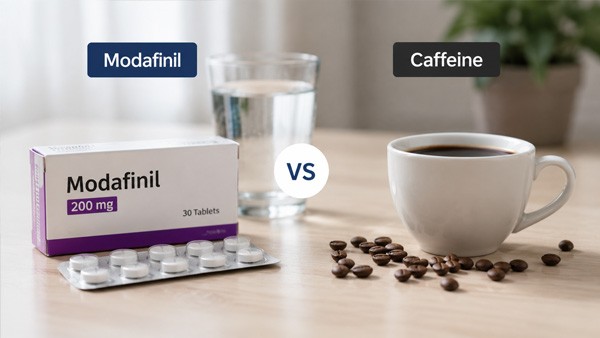
Almost nobody asks this question from a standing start. It gets asked by someone who has been drinking four coffees a day for years, has noticed they no longer do anything, and is wondering whether there is something stronger.
That framing contains the answer to most of it. The two substances are not competing versions of the same thing, and for a large share of the people comparing them, the useful move is not switching to the prescription drug but understanding why the coffee stopped working.
💡 The mechanism explains nearly everything. Caffeine does not give you energy. It blocks the receptor for adenosine, the chemical that accumulates through the waking day and produces the feeling of sleepiness. The adenosine keeps accumulating behind the blockade, so when the caffeine clears, all of it lands at once — which is the crash. Block the receptor often enough and the brain builds more receptors, which is the tolerance. Modafinil works on entirely different systems and does neither of those things, which is its main practical advantage and also the reason it is prescription-only.
⚗️ Two different mechanisms
Caffeine is an adenosine receptor antagonist. Adenosine builds up in the brain throughout every waking hour as a by-product of cellular energy use, and its accumulation is one of the main signals telling you that you are tired. Sleep clears it. Caffeine occupies the receptors adenosine would bind to, so the signal is not received.
The crucial detail is that the adenosine is still there. Caffeine hides the message rather than deleting it. This single fact explains the crash when the caffeine wears off, why caffeine cannot substitute for sleep, and why a heavily sleep-deprived person on caffeine remains impaired even while feeling adequate.
Modafinil acts on different systems entirely. Its best-established action is weak inhibition of dopamine reuptake, alongside effects on the orexin system that maintains wakefulness, on histamine signalling, and on noradrenaline and glutamate. It does not block adenosine, does not permit adenosine to accumulate unopposed in the same way, and consequently does not produce a comparable crash.
That difference in mechanism is why the two behave so differently over weeks rather than hours.
☕ Why your coffee stopped working
This is the most useful section for most readers.
Faced with regular receptor blockade, the brain adapts by producing more adenosine receptors. Within days to a couple of weeks, the same dose of caffeine produces noticeably less alerting effect, because there are now more receptors than the caffeine can occupy.
What follows from that is uncomfortable and well documented. In a habitual consumer, a substantial part of what the morning coffee delivers is the reversal of overnight withdrawal rather than a genuine boost above baseline. Overnight the caffeine clears, the surplus receptors sit exposed to accumulated adenosine, and the person wakes feeling foggy and headachy. The coffee returns them to normal. It feels like a lift because the starting point has dropped.
Caffeine withdrawal is a defined syndrome with headache as its most reliable feature, along with fatigue, low mood, irritability and poor concentration. It typically begins twelve to twenty-four hours after the last dose, peaks over the following day or so, and settles across several days.
⚠️ The test that settles it. Anyone who genuinely wants to know how much caffeine is doing for them can find out: taper over one to two weeks — tapering rather than stopping, to avoid several days of headache — then stay off it for a fortnight, then reintroduce a single 100 mg dose. The effect of that dose on a cleared system is generally striking, and considerably larger than what four cups were delivering before. This is the cheapest intervention available in this entire comparison, and it works for most people who feel their caffeine has stopped working.
📊 Side by side
| Caffeine | Modafinil | |
|---|---|---|
| Acts on | Adenosine receptors | Dopamine transport, orexin, histamine and others |
| Onset | 20 to 45 minutes | 1 to 2 hours |
| Half-life | Around 5 hours, ranging from 2 to 10 | 12 to 15 hours |
| Effective dose | 100 to 200 mg per dose | 100 to 200 mg once daily |
| Tolerance | Rapid, within days | Slow and limited |
| Withdrawal | Reliable and unpleasant — headache, fatigue, low mood | Mild if any |
| Crash | Common, from accumulated adenosine | Uncommon — a gradual fade instead |
| Availability | Everywhere, unregulated | Prescription and a controlled substance |
| Cost per day | Pennies | Around two dollars |
| Dose control | Poor — a brewed coffee ranges roughly 70 to 200 mg | Exact |
| Drug interactions | Few of consequence | Several of consequence, including hormonal contraception |
| Effect on subsequent sleep | Substantial and often unnoticed | Substantial if taken late |
Two rows in that table contradict the conventional framing and both are worth stating plainly.
Dose control. Caffeine is the one people believe they understand and it is the one nobody doses accurately. The caffeine in a brewed coffee varies by a factor of three or more depending on the bean, the roast, the grind and the method, and a large takeaway cup can exceed 300 mg on its own. Someone who reports drinking three coffees has told you almost nothing about their intake.
Interactions. The old assumption that the prescription drug is the more complicated one is backwards here. Modafinil induces the liver enzyme CYP3A4, which reduces the effectiveness of hormonal contraception, and inhibits CYP2C19, which raises levels of several other medicines. Caffeine has fewer interactions of real consequence, the notable exceptions being certain antidepressants and antibiotics that slow its clearance dramatically.
🧬 Why caffeine affects people so differently
The variation in how people respond to caffeine is genuinely large and it is not psychological.
Clearance speed varies by a factor of five. Caffeine is broken down almost entirely by a single liver enzyme, and inherited differences in that enzyme mean some people clear it in two hours and others take ten. A fast metaboliser can have an espresso after dinner and sleep; a slow metaboliser who does the same is still carrying half the dose at bedtime.
Several things shift that speed. Smoking roughly doubles the rate of clearance, which is why people who stop smoking often find their usual coffee suddenly feels like too much. Hormonal contraception slows it substantially. Pregnancy slows it dramatically, particularly in the later months, which is part of why intake limits in pregnancy are set low.
Receptor differences affect the experience. Inherited variation in the adenosine receptor itself influences whether caffeine feels pleasantly alerting or produces anxiety and a racing heart. People who describe caffeine as making them jittery at doses others find unremarkable are usually describing something real about their biology rather than a low tolerance.
😴 What caffeine does to sleep when you cannot feel it
This is the most consequential and least appreciated point about caffeine, and it produces a self-sustaining problem.
In controlled work, a substantial dose of caffeine taken six hours before bedtime measurably reduced total sleep time by about an hour. What made the finding notable was that participants largely did not notice — their own assessment of their sleep did not reflect the objectively measured loss.
The loop that creates is straightforward. Caffeine in the afternoon degrades that night’s sleep. Poorer sleep produces a worse morning. The worse morning justifies more caffeine, and often earlier. The additional caffeine reaches further into the evening. Each round makes the next one worse, and because the sleep loss is not perceived, the person attributes their tiredness to anything except the coffee.
Caffeine also alters the composition of sleep beyond its duration, reducing deep slow-wave sleep specifically — the stage most associated with feeling physically restored. Someone can sleep a full eight hours after an evening coffee and wake up unrefreshed, without any obvious reason to connect the two.
The practical rule that follows: nothing caffeinated within eight hours of bed, and longer for slow metabolisers. For most people that means a cutoff around midday to early afternoon, which is considerably earlier than people expect and is the single highest-value change available.
🎯 Using caffeine well
Most people use caffeine badly, and used well it is a genuinely effective substance.
| Practice | Rationale |
|---|---|
| Keep the daily total moderate | The alerting benefit largely plateaus around 200 mg per dose. Beyond roughly 400 mg daily, side effects rise while benefit does not |
| Set a hard afternoon cutoff | Eight hours before bed, longer if you clear it slowly. The most valuable single change |
| Use it for something specific | Timed before work that needs concentration, rather than continuously across the day |
| Take deliberate breaks | A fortnight off every few months restores sensitivity. Taper into it to avoid the headache |
| Try the coffee nap | Caffeine takes twenty to thirty minutes to act; a twenty-minute nap in that window clears adenosine while the caffeine arrives. The combination outperforms either alone |
| Consider L-theanine alongside it | Modest evidence that it reduces the jittery edge without reducing alertness |
| Drink water | Much of what gets blamed on caffeine, particularly headache, is dehydration |
| Know what is in the cup | Brewed coffee varies enormously; tablets and energy drinks are labelled, which is an underrated advantage |
💊 What modafinil is actually for
Modafinil is licensed for excessive sleepiness arising from three specific conditions: narcolepsy, obstructive sleep apnoea where sleepiness persists despite proper treatment of the apnoea, and shift work sleep disorder.
That is a narrow list and the narrowness is the point. These are conditions in which the mechanism producing wakefulness is itself impaired, and no amount of coffee compensates for that. A person with narcolepsy is not someone who is under-caffeinated.
Where it is genuinely indicated, its advantages over caffeine are substantial: a single daily dose covering a full working day, precise and consistent dosing, no crash, minimal tolerance over months, and a much smoother effect without the peaks and troughs.
Where it is not indicated, the case is weaker than commonly assumed. The evidence for cognitive enhancement in healthy well-rested people is modest and inconsistent, with the clearest benefits appearing on tasks requiring sustained attention over long periods rather than on intelligence, creativity or complex reasoning. In the sleep-deprived, both substances restore performance substantially, with modafinil holding for longer.
🔴 The risks that belong to the prescription drug and not to coffee. Modafinil induces the liver enzyme handling hormonal contraception, so the pill, patch, ring and implant become unreliable during treatment and for a month afterwards — a genuine and regularly missed cause of unintended pregnancy. It carries a rare but serious risk of severe skin reactions, meaning any rash requires stopping and prompt assessment. It can raise blood pressure and heart rate, can provoke anxiety and mood change, and it is a controlled substance in most countries. None of that argues against using it where it is indicated. All of it argues against treating it as a stronger coffee.
🥊 Which one for which situation
| Situation | Reasonable answer |
|---|---|
| Ordinary tiredness, an early start, a dull afternoon | Caffeine, used deliberately rather than continuously |
| Coffee no longer seems to work | A tolerance break, before anything else |
| Diagnosed narcolepsy | Modafinil or armodafinil. Caffeine is not adequate treatment |
| Sleepiness persisting despite treated sleep apnoea | Modafinil, as an addition to apnoea treatment and never instead of it |
| Rotating night shifts | Either, and light exposure and sleep timing matter more than both |
| An occasional long drive or deadline | Caffeine, with a nap where possible |
| Persistent unexplained tiredness | Neither, yet. This needs investigating rather than masking |
| Anxiety, palpitations or reflux on caffeine | Less caffeine — and note that modafinil can also raise anxiety |
🔄 Taking both together
Many people prescribed modafinil continue drinking coffee out of habit, and this is worth thinking about rather than defaulting to.
The combination amplifies the unwanted effects more reliably than the wanted ones — jitteriness, a racing heart, anxiety and a wrecked night are the common results. Most people on modafinil find they want considerably less caffeine than before, and reducing it usually improves how the modafinil itself feels.
Since both are long-acting, combining them also extends the effect much further into the evening, which reintroduces the sleep problem the treatment was meant to address.
A reasonable approach is to cut caffeine substantially when starting modafinil and reintroduce a small amount only if genuinely missed.
🔍 The question behind the question
Someone asking whether they need something stronger than coffee is usually reporting a symptom, and the symptom deserves attention before either substance does.
Insufficient sleep is the commonest cause by a wide margin, and no substance corrects it. Both mask it. Masked sleep debt still accumulates and still impairs judgement, mood, immune function and metabolic health.
Untreated sleep apnoea is extremely common and substantially underdiagnosed. Loud snoring, witnessed pauses in breathing, waking unrefreshed and morning headache are the pointers, and using a stimulant to cover it leaves the cardiovascular consequences entirely untouched.
Iron deficiency, thyroid disease, diabetes and depression all present as fatigue and all are straightforward to test for.
Alcohol reliably fragments the second half of the night, and is one of the commonest reasons for waking unrefreshed after adequate hours in bed.
The caffeine itself closes the loop, through the afternoon-dose-into-poor-sleep cycle described above.
The article on persistent fatigue covers what is worth testing, and the article on excessive sleepiness covers when sleepiness rather than tiredness is the problem and what assessment involves.
📋 A sensible order of operations
Fix sleep first. Regular timing, adequate duration, and an honest look at alcohol. Everything else is compensation for this.
Set the caffeine cutoff. Eight hours before bed. Two weeks is enough to notice the difference.
Take a tolerance break if caffeine has stopped working, tapering over a week or two.
Reintroduce caffeine deliberately — a defined dose, timed for when it is needed, rather than continuously.
Get investigated if sleepiness persists despite adequate sleep, or if there is snoring with pauses.
Consider prescribed treatment where a sleep disorder is diagnosed, which is where modafinil does something caffeine cannot.
Prescription options are stocked in the anti-narcoleptic category, including Modalert (modafinil 200 mg) and the armodafinil products Artvigil and Waklert. The comparison of the two molecules covers the choice between them.
❓ Frequently asked questions
Is modafinil just a stronger version of caffeine?
No, they work on different systems. Caffeine blocks adenosine receptors so the sleepiness signal is not received, while the adenosine itself keeps accumulating behind the blockade. Modafinil acts mainly through dopamine transport, the orexin system and histamine signalling, and does not create that accumulating debt. That is why caffeine crashes and builds tolerance quickly while modafinil largely does neither.
Why has my coffee stopped working?
Because the brain responds to repeated receptor blockade by producing more adenosine receptors, within days to a couple of weeks. In a habitual drinker much of what the morning coffee delivers is reversal of overnight withdrawal rather than a genuine lift above baseline. Tapering off over one to two weeks, staying off for a fortnight, then taking a single 100 mg dose usually demonstrates this convincingly.
What causes the caffeine crash?
Caffeine hides the sleepiness signal rather than removing it. Adenosine continues to build up throughout the time the receptors are blocked, so when the caffeine clears, all of it becomes available at once and the sleepiness arrives concentrated. That is also why caffeine cannot substitute for sleep and why a sleep-deprived person on caffeine remains impaired while feeling adequate.
How late can I have coffee?
Earlier than most people assume. A substantial dose taken six hours before bedtime measurably reduced total sleep by about an hour in controlled study, and participants did not notice the loss. A practical rule is nothing caffeinated within eight hours of bed, which for most people means a cutoff around midday to early afternoon, and longer for anyone who clears caffeine slowly.
Why does caffeine affect my friend so differently?
Clearance speed varies roughly fivefold between people because of inherited differences in the single liver enzyme that breaks caffeine down — some clear it in two hours, others take ten. Smoking roughly doubles the rate, hormonal contraception slows it substantially, and pregnancy slows it dramatically. Separate inherited variation in the adenosine receptor itself determines whether caffeine feels pleasant or produces anxiety.
What is a coffee nap?
Taking caffeine immediately before a twenty-minute nap. Caffeine needs twenty to thirty minutes to take effect, and a short nap in that window clears some accumulated adenosine, so the caffeine arrives to find fewer receptors competing for it. The combination outperforms either the nap or the caffeine alone. Keep the nap short, since longer risks waking from deep sleep feeling worse.
Which has more drug interactions?
Modafinil, which reverses the usual assumption. It induces the enzyme handling hormonal contraception, making the pill, patch, ring and implant unreliable during treatment and for a month after, and it inhibits another enzyme, raising levels of several medicines. Caffeine has fewer interactions of real consequence, the notable exceptions being certain antidepressants and antibiotics that slow its clearance dramatically.
Does modafinil make healthy people smarter?
The evidence is modest and inconsistent. The clearest findings involve sustained attention over long periods rather than intelligence, creativity or complex reasoning, and effects in well-rested people are considerably smaller than the reputation suggests. In sleep-deprived people both substances restore performance substantially, with modafinil holding for longer. Neither replaces sleep.
Can I take both?
You can, and the combination amplifies the unwanted effects more reliably than the wanted ones — jitteriness, a racing heart, anxiety and a ruined night. Since both are long-acting, together they extend well into the evening and reintroduce the sleep problem the treatment was meant to solve. Most people on modafinil find they want considerably less caffeine, and cutting it improves how the modafinil feels.
How much caffeine is too much?
The alerting benefit largely plateaus around 200 mg per dose, and above roughly 400 mg daily side effects rise while benefit does not. The bigger problem is that nobody doses it accurately — brewed coffee varies by a factor of three or more depending on bean, roast, grind and method, and a large takeaway cup can exceed 300 mg alone. Saying you drink three coffees conveys almost nothing.
I quit smoking and coffee suddenly feels too strong. Why?
Smoking speeds up the liver enzyme that clears caffeine, roughly doubling the rate, so smokers process their intake far faster than non-smokers. When you stop, that acceleration disappears within days while the caffeine habit stays the same, so the effective dose rises sharply. Reducing intake by around half at the point of quitting prevents a good deal of the jitteriness and insomnia often blamed on withdrawal.
I sleep eight hours and still wake up tired. What is going on?
Hours in bed and quality of sleep are different things. Afternoon caffeine reduces deep slow-wave sleep specifically, the stage most associated with feeling restored, without necessarily shortening total sleep. Alcohol fragments the second half of the night. Untreated sleep apnoea does both and is substantially underdiagnosed. Iron deficiency, thyroid disease and depression all present this way and are simple to test for.
📑 Sources and editorial
- Research on adenosine receptor antagonism, upregulation and caffeine tolerance
- Controlled study of caffeine taken at zero, three and six hours before bedtime and its effect on sleep
- Diagnostic literature on caffeine withdrawal syndrome and its time course
- Pharmacogenetic studies of CYP1A2 variation and adenosine receptor polymorphisms
- Reviews of modafinil pharmacology and its actions on dopamine transport, orexin and histamine
- Systematic reviews of modafinil for cognitive enhancement in healthy individuals
- Military and occupational research comparing caffeine and modafinil during sustained wakefulness
- FDA prescribing information for modafinil, including CYP3A4 induction and dermatologic warnings
- Regulatory guidance on daily caffeine intake in adults and in pregnancy
- Related reading: armodafinil versus modafinil, persistent fatigue, how to take Modalert
- Related products: anti-narcoleptic category
- RXshop Editorial Team — reviewed by James Carter, MD, Neurologist and Sleep Medicine Specialist
Medical Disclaimer: The information in this article is for educational and informational purposes only and is not a substitute for professional medical advice, diagnosis, or treatment. Always seek guidance from a qualified healthcare provider with any questions you may have regarding a medical condition, and before starting, stopping or changing any medication.