Ephedrine vs Modafinil: Not an Even Comparison

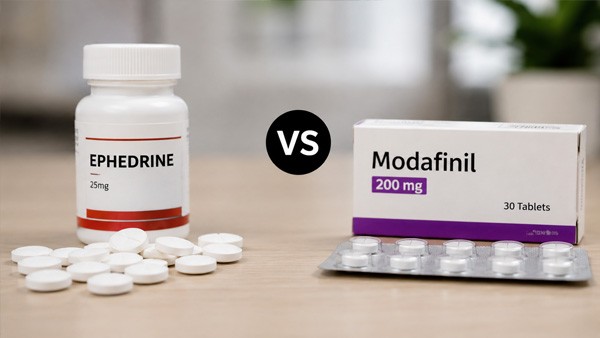

These two are compared because both make people feel more awake, and that is roughly where the similarity ends. One is a wakefulness-promoting medicine licensed for specific sleep disorders. The other is a cardiovascular stimulant that was removed from dietary supplements after a run of serious adverse events, is legally restricted in most countries, and has a pharmacological property that makes it structurally unsuitable for daily use.
Setting them side by side is still worth doing, because a great many people encounter ephedrine as an energy or fat-burning product without ever being told what it is or what it does over time.
💡 The property that settles it. Ephedrine works partly by squeezing stored noradrenaline out of nerve endings. Those stores are finite and refill slowly, so the effect diminishes within days of regular use — not through the gradual receptor adaptation seen with caffeine, but because the supply being released is running out. This is called tachyphylaxis and it is a built-in property rather than a side effect. Anyone taking ephedrine daily for alertness is chasing an effect that is fading by design, and the usual response — taking more — loads the cardiovascular system without restoring the benefit.
⚗️ What each one does
Ephedrine is a mixed-acting sympathomimetic, meaning it acts on the sympathetic nervous system through two routes at once. Directly, it stimulates alpha and beta adrenergic receptors. Indirectly, it displaces stored noradrenaline from nerve terminals so that it floods the synapse.
The effects are consequently those of an amplified fight-or-flight response throughout the body: raised heart rate, raised blood pressure, constricted blood vessels, widened airways, and central stimulation as a secondary consequence. Alertness is a by-product of a whole-body sympathetic response rather than a targeted effect on the systems governing wakefulness.
Modafinil acts on the systems that specifically regulate wakefulness — weak inhibition of dopamine reuptake, effects on the orexin system, histamine signalling and noradrenaline within the brain. It does not produce a generalised sympathetic surge, which is why its cardiovascular effect is modest by comparison rather than central to how it works.
That difference in target explains the difference in side-effect profile. Ephedrine affects the heart and vessels because that is where much of its action lies. Modafinil affects them mildly and incidentally.
⬇️ Why ephedrine stops working
The indirect mechanism has a consequence that is often not explained to people using it.
Each dose empties some of the stored noradrenaline from nerve terminals. Those stores replenish over time, but not fast enough to keep pace with repeated dosing. Within a few days of regular use, each dose has less to release, and the effect falls off sharply.
This is a different phenomenon from ordinary tolerance. Caffeine tolerance develops because the brain grows more receptors; the substance is still arriving in full quantity. Ephedrine tachyphylaxis develops because the thing being released has run low. It happens faster, it is more complete, and increasing the dose does not overcome it — there is nothing left to squeeze out.
What increasing the dose does do is intensify the direct receptor stimulation, which is the part responsible for the effects on the heart and blood pressure. So as the alerting benefit fades, the cardiovascular load rises. That combination is the mechanism behind a good share of the harm associated with the substance.
❤️ The record on harm
Ephedrine and the herbal preparations containing it were widely sold as energy and weight-loss supplements through the 1990s and early 2000s. That period generated a substantial body of adverse event reports — heart attacks, strokes, dangerous rhythm disturbances, seizures and deaths, including in young people with no known heart disease.
An independent review commissioned to assess the evidence found an association between these products and cardiac, psychiatric and gastrointestinal events, alongside a weight-loss effect that was real but modest. Regulators concluded the balance was unfavourable, and dietary supplements containing ephedrine alkaloids were banned in the United States in 2004.
Two aspects of that record are worth keeping in view. Serious events occurred in people who were young and apparently healthy, not only in those with known heart disease. And they were frequently associated with the combinations these products were sold in — ephedrine together with high-dose caffeine, which amplifies the cardiovascular effect considerably.
🔴 Ephedrine is dangerous in specific, identifiable situations. It should not be taken by anyone with high blood pressure, coronary artery disease, a heart rhythm disorder, an overactive thyroid, or a history of stroke. Combined with a monoamine oxidase inhibitor antidepressant it can cause a hypertensive crisis, which is an absolute contraindication rather than a caution. It can precipitate urinary retention in men with an enlarged prostate, and at higher doses it causes anxiety, insomnia and, occasionally, psychosis. Chest pain, severe headache, palpitations, breathlessness, weakness on one side or disturbed vision after taking it require emergency assessment.
📊 Side by side
| Ephedrine | Modafinil | |
|---|---|---|
| Class | Sympathomimetic | Wakefulness-promoting agent |
| Main site of action | Whole-body sympathetic nervous system | Brain systems regulating wakefulness |
| Licensed for wakefulness | No | Yes, in three specific sleep disorders |
| Duration | 3 to 6 hours | 12 to 15 hours |
| Loss of effect | Within days, through depletion | Slow and limited over months |
| Blood pressure and heart rate | Raised substantially — part of how it works | Raised modestly, and monitoring is advised |
| Cardiovascular event record | Documented, including in healthy young people | Not comparable |
| Legal status | Restricted as a precursor chemical; banned in supplements in several countries | Prescription and controlled |
| Sport | Prohibited in competition above a urinary threshold | Prohibited |
| Dose control | Poor in supplement form; herbal content varies widely | Exact |
⚖️ The legal position
Ephedrine occupies an unusual regulatory space that catches people out.
It is a precursor chemical for methamphetamine, which is why its sale is controlled well beyond what its medical risk alone would require. In the United States, products containing it are kept behind the pharmacy counter with quantity limits, identification requirements and purchase logging. In many other countries it is prescription-only or unavailable. Carrying it across borders can create genuine problems even where it was bought legally.
Separately, its use as a dietary supplement ingredient is banned in a number of jurisdictions following the safety review described above.
And it is prohibited in competitive sport above a urinary concentration threshold. Because it is present in some over-the-counter cold and decongestant preparations, athletes have failed tests through ordinary cold remedies rather than deliberate use. Anyone subject to testing should check every decongestant they take.
💉 What ephedrine is legitimately used for
None of the above means the substance has no place. It has a small number of genuine medical uses, and they share a feature: they are short-term.
Raising blood pressure during anaesthesia. Spinal and general anaesthesia commonly drop blood pressure, and intravenous ephedrine given by an anaesthetist corrects it quickly. This is its most frequent legitimate use in hospitals worldwide, and it works well precisely because it is a single dose in a monitored setting where tachyphylaxis never becomes relevant.
Nasal decongestion. Its vasoconstricting effect shrinks swollen nasal lining, and it appears in some cold preparations. Short courses only, since prolonged use of decongestants causes rebound congestion.
Airway narrowing, historically, before inhaled treatments that act locally and selectively made systemic bronchodilators obsolete for asthma.
What it is not used for, anywhere, in any guideline, is the routine daily management of sleepiness. Its brief appearance in older texts as an option for narcolepsy long predates the drugs that replaced it, and it has no current place there.
🏋️ The weight-loss angle
Most people who encounter ephedrine meet it as a fat-burning product rather than a wakefulness one, usually as part of a combination with caffeine and sometimes aspirin.
The honest summary is that the combination does produce weight loss in trials, of a modest size, and that the cardiovascular risk it carries is the reason it was withdrawn rather than adopted. It raises metabolic rate slightly and suppresses appetite, and it also raises heart rate and blood pressure in a population that frequently has raised blood pressure already.
The subgroup most likely to buy it — people carrying significant excess weight, often with hypertension, sometimes with undiagnosed heart disease, frequently combining it with additional caffeine — is precisely the group in whom the risk is highest. The article on safe weight loss covers approaches with a better balance, and the weight-loss category lists what is available.
📏 Correcting the claim about blood pressure
Modafinil is often described, including in older versions of this comparison, as having no effect on blood pressure and being safe in people with hypertension. That is not accurate and the correction matters.
Modafinil can produce modest increases in blood pressure and heart rate. Prescribing information advises monitoring, and greater caution in people with existing hypertension, and it is not recommended in those with certain heart conditions including some valve abnormalities and a history of significant arrhythmia. Some people on it require adjustment of their blood pressure medication.
The comparison with ephedrine still favours modafinil substantially — a modest, monitorable rise is a different matter from a sympathomimetic surge that is central to the drug’s action. But describing it as having no cardiovascular effect at all is wrong, and it is the sort of reassurance that leads people to skip checks they should have.
⚠️ Modafinil is not risk-free either
For balance, the prescription drug carries its own set of issues that have nothing to do with the heart.
It induces the liver enzyme handling hormonal contraception, so the pill, patch, ring and implant become unreliable during treatment and for a month afterwards. This is a real and frequently missed cause of unintended pregnancy.
It carries a rare but serious risk of severe skin reactions, so any rash means stopping and getting assessed promptly rather than waiting to see.
It inhibits another liver enzyme, raising the levels of several other medicines. It can cause anxiety, agitation and mood change. It is a controlled substance. And, in common with everything discussed here, it masks sleepiness rather than replacing sleep.
🎯 Which, for what
| Situation | Answer |
|---|---|
| Diagnosed narcolepsy | Modafinil or armodafinil. Ephedrine has no role |
| Sleepiness with treated sleep apnoea | Modafinil, alongside apnoea treatment, never instead of it |
| Shift work sleep disorder | Modafinil or armodafinil, with attention to light and sleep timing |
| Blocked nose from a cold | Ephedrine or another decongestant, for a few days only |
| Low blood pressure under anaesthesia | Ephedrine, given intravenously by an anaesthetist |
| Wanting more energy day to day | Neither. Sleep, and an honest look at caffeine use |
| Wanting to lose weight | Not ephedrine. The risk falls hardest on exactly this group |
| Persistent unexplained tiredness | Investigation first. Both substances only hide it |
🚫 Not together
Combining the two is a poor idea and worth stating explicitly because people do it.
Both raise heart rate and blood pressure, from different directions, and the effects add. Both extend well beyond the working day, so the combination reliably ruins the night. Both can provoke anxiety, and together they do so more.
The same reasoning applies to ephedrine with high-dose caffeine, which is how it was sold in supplement form and which accounts for a substantial share of the adverse events that led to those products being withdrawn.
📋 The practical position
If the problem is a diagnosed sleep disorder, modafinil or armodafinil is the appropriate treatment and ephedrine is not an alternative to it.
If the problem is ordinary tiredness, neither is the answer. Sleep quantity and timing, and a realistic look at caffeine intake, do more than either — the comparison with caffeine sets out why.
If sleepiness persists despite adequate sleep, that warrants investigation rather than a stimulant. The fatigue workup article covers what is worth testing.
If ephedrine is already being taken daily for energy, it is worth knowing that the effect has almost certainly faded already while the cardiovascular load has not, and that stopping is straightforward.
Prescription options are stocked in the anti-narcoleptic category, including Modalert (modafinil 200 mg), Artvigil and Waklert.
❓ Frequently asked questions
Why does ephedrine stop working so quickly?
Because part of its action is squeezing stored noradrenaline out of nerve endings, and those stores are finite and refill slowly. Within a few days of regular use each dose has less left to release. This is tachyphylaxis, and it differs from ordinary tolerance in that raising the dose does not overcome it — there is nothing further to release. Raising the dose only intensifies the effects on the heart and blood pressure.
Is ephedrine used for narcolepsy?
Not in current practice anywhere. Its appearance in older texts as an option predates the wakefulness-promoting agents that replaced it, and no current guideline includes it. Its alerting effect is a by-product of a whole-body sympathetic response rather than a targeted action on the systems governing wakefulness, and the effect fades within days of daily use.
Why were ephedra supplements banned?
Because of a substantial body of adverse event reports through the 1990s and early 2000s — heart attacks, strokes, dangerous rhythm disturbances, seizures and deaths, including in young people with no known heart disease. An independent review found an association with cardiac, psychiatric and gastrointestinal events against a weight-loss effect that was real but modest, and regulators judged the balance unfavourable.
Who should definitely avoid ephedrine?
Anyone with high blood pressure, coronary artery disease, a heart rhythm disorder, an overactive thyroid or a history of stroke. Combined with a monoamine oxidase inhibitor antidepressant it can cause a hypertensive crisis, which is an absolute contraindication rather than a caution. It can also precipitate urinary retention in men with an enlarged prostate, and at higher doses causes anxiety, insomnia and occasionally psychosis.
Why is ephedrine so hard to buy?
Because it is a precursor chemical for methamphetamine, so its sale is controlled well beyond what its medical risk alone would require. In the United States it sits behind the pharmacy counter with quantity limits, identification and purchase logging; in many countries it is prescription-only or unavailable. Carrying it across borders can create genuine difficulties even where it was purchased legally.
Can ephedrine make me fail a drug test?
In competitive sport, yes. It is prohibited in competition above a urinary concentration threshold, and because it appears in some over-the-counter cold and decongestant preparations, athletes have failed tests through ordinary cold remedies rather than deliberate use. Anyone subject to testing should check the ingredients of every decongestant they take rather than assuming an over-the-counter product is safe.
Does modafinil raise blood pressure?
Modestly, yes — the claim that it has no cardiovascular effect is inaccurate. Prescribing information advises monitoring blood pressure and heart rate, greater caution in existing hypertension, and avoidance in certain heart conditions including some valve abnormalities and significant arrhythmia. Some people need their blood pressure medication adjusted. It remains far milder than ephedrine, where the sympathetic surge is central to the action.
Does ephedrine help with weight loss?
It produces modest weight loss in trials, usually combined with caffeine, by slightly raising metabolic rate and suppressing appetite. The cardiovascular risk is why it was withdrawn rather than adopted. The group most likely to buy it — people carrying significant excess weight, often with raised blood pressure, sometimes with undiagnosed heart disease, frequently adding more caffeine — is exactly the group in whom that risk is highest.
Can I take them together?
It is a poor idea. Both raise heart rate and blood pressure from different directions and the effects add, both last long enough to reliably ruin the night, and both can provoke anxiety. The same applies to ephedrine with high-dose caffeine, which is how it was sold in supplement form and which accounts for a large share of the adverse events that led to those products being withdrawn.
What is ephedrine actually used for in medicine?
Chiefly for raising blood pressure during anaesthesia, given intravenously by an anaesthetist when spinal or general anaesthesia drops it. That works well precisely because it is a single dose in a monitored setting, where the fading of repeated doses never arises. It also appears in some short-course nasal decongestants, and it was historically used for asthma before inhaled treatments made systemic bronchodilators obsolete.
I have been taking ephedrine daily. How do I stop?
Stopping is straightforward, and the effect you are stopping has very likely faded already while the load on your heart and blood pressure has not. Expect some tiredness and low mood for a few days. If you have been taking large amounts, or have any heart condition, raised blood pressure or chest symptoms, raise it with a prescriber rather than managing it alone.
If neither is right for me, what is?
Sleep quantity and timing do more than either substance, and an honest look at caffeine intake usually finds a self-sustaining loop where afternoon coffee degrades that night and justifies more the next day. If sleepiness persists despite adequate sleep, that needs investigating — untreated sleep apnoea, iron deficiency, thyroid disease and depression all present this way and are straightforward to test for.
📑 Sources and editorial
- FDA final rule prohibiting dietary supplements containing ephedrine alkaloids
- Independent evidence review of the efficacy and safety of ephedra and ephedrine for weight loss and athletic performance
- Pharmacology literature on mixed-acting sympathomimetics and tachyphylaxis through noradrenaline depletion
- Combat Methamphetamine Epidemic Act provisions on precursor sales, and equivalent restrictions elsewhere
- WADA prohibited list entries and urinary thresholds for ephedrine
- Anaesthetic literature on intravenous ephedrine for hypotension during spinal and general anaesthesia
- FDA prescribing information for modafinil, including cardiovascular monitoring, CYP3A4 induction and dermatologic warnings
- AASM guidance on the treatment of excessive sleepiness in narcolepsy, sleep apnoea and shift work disorder
- Related reading: modafinil versus caffeine, wakefulness agents versus stimulants, safe weight loss
- Related products: anti-narcoleptic category
- RXshop Editorial Team — reviewed by James Carter, MD, Neurologist and Sleep Medicine Specialist
Medical Disclaimer: The information in this article is for educational and informational purposes only and is not a substitute for professional medical advice, diagnosis, or treatment. Always seek guidance from a qualified healthcare provider with any questions you may have regarding a medical condition, and before starting, stopping or changing any medication.